Showing posts with label Geology. Show all posts

Wednesday, May 24, 2023

Astride Two Worlds

(Chronicle photo)
In the Chronicle's words California wineries are "obsessed" with 32-year-old geologist Brenna Quigley:
Over the last few years, her reputation has soared within the wine industry, to the point where it’s a point of pride — and a marketing boon — to be able to say that Brenna Quigley did your vineyard’s geologic analysis. The 32-year-old is inarguably the state’s premiere wine geologist.

Then again, she might be the only person in California who identifies as a wine geologist. Her success is a testament to the fact that she has single-handedly established a demand for a service that five years ago many wineries likely never considered...

That ability to bridge geology and wine is what distinguishes Quigley from other vineyard consultants. “I saw that people were speaking two different languages,” Quigley says.

Wine people had one lexicon, while geologists had another. And among her fellow geologists, she perceived “a slight disrespect for the wine tasting aspect of it,” Quigley says. Concepts held sacrosanct by winemakers, like terroir — the idea that wines are capable of expressing a sense of place — were dismissed by scientists as woo-woo.

Quigley grew up in the Midwest in a family of geologists: Her father and brothers run a business that explores sites for heavy-metal mining. Quigley left for UC Santa Barbara, initially intending to become a marine biologist. Eventually she relented and switched to the family trade.

After getting her master’s, Quigley abandoned plans to pursue a PhD. Instead, she worked at wine shops and bartended. She got a job at the Kunin Wines tasting room in downtown Santa Barbara and began to befriend local winemakers. “I called my parents and said, ‘You’re not going to believe it, but these wine people also decorate their houses with rocks,’” she says.

She soon discovered that many winemakers were eager for basic geology lessons, so that they could communicate about their own vineyards more effectively. “There was this thing people wanted to talk about so badly, but they didn’t have the words to do it,” she says. Wineries started hiring her to help them write blurbs on their websites...

Quigley elucidated details that even longtime vineyard owners hadn’t been aware of, and she produced the first-ever detailed geologic maps of the county’s wine regions.
Brenna Quigley bestrides the worlds of geology and oenology, and her time is now.

Unlike the thousands of young adults who will do almost anything to garner attention on social media, the attention came to her because of her unique talent stack.

In this build-her-up-and-tear-her-down age, I hope the following doesn't happen:

1) politically-oriented groups will hold her up as a shining example of a successful STEM woman and ask her to speak out on any number of topics that she has not thought deeply about, thereby provoking a reaction from other politicized groups;

2) geologists with PhDs, jealous of her popularity, will sniff at the depth of her knowledge ("among her fellow geologists, she perceived 'a slight disrespect for the wine tasting aspect of it.'"). If they're so smart, why aren't they doing it?

Her Midwest and family roots should see her through. I hope Brenna Quigley continues her success.

Saturday, August 10, 2019

Pretty But Dangerous

A possible Yellowstone supervolcano eruption gets all the apocalyptic speculation, but for West Coast residents the more likely dangers lie closer to home. [bold added]
(Photo from AGT, a Mt. Shasta CPA firm)
There is a serious volcanic threat in the contiguous U.S., but it isn’t in Wyoming. It lurks hundreds of miles to the west, inside the snow-capped, picture-postcard peaks of Mount Rainier, Mount Shasta, Mount Hood and others. They might look like ordinary mountains, but in fact they are volcanoes—and potentially dangerous ones....

Hawaii’s Kilauea volcano, which erupted last year, ranked as the [USGS'] No. 1 “very high threat.” Hawaii’s Mauna Loa volcano and five Alaskan volcanoes were also in that category. Of the 18 U.S. volcanoes designated as “very high threat,” the other 11 are situated in California, Oregon and Washington. Washington’s Mount Rainier, near Seattle, which has erupted dozens of times in the past 10,000 years, ranked No. 3; California’s Mount Shasta, which last erupted about two centuries ago, ranked No. 5; Oregon’s Mount Hood ranked No. 6. Yellowstone, by contrast, was ranked No. 21, and didn’t make it into the “very high threat” category.
A Tufts paper states that models based on the Mount St. Helens (1980) and Mt. Pinatubo (1991) volcanic events predict that a Mt. Shasta eruption would "destroy" the nearby towns of Dunsmuir, Weed, Mt. Shasta, and McCloud, which have a combined population of under 10,000 people. The nearest city, Redding, has a population of 92,000 and is likely to be placed on high alert.

Mt. Shasta is 300 miles from the SF Peninsula, so Foster City residents don't have to fear the direct effects of an eruption. Now I can go back to the usual worrying about earthquakes and flooding.....say, did you hear that the Yellowstone super-volcano would bury the country in ash?

Tuesday, November 22, 2016

Head for the Hills

(Geology.com graphic)
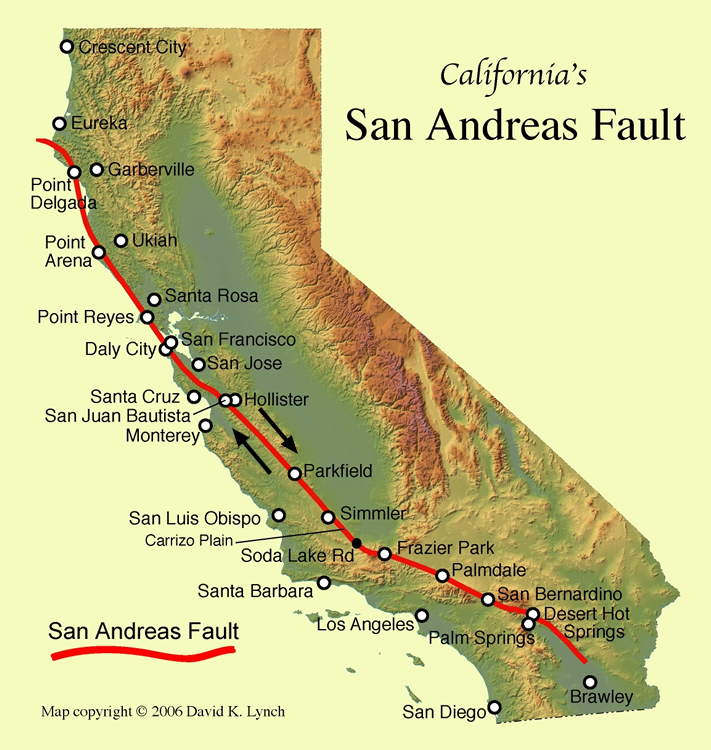
Seismophobics who live in Northern California have taken ever-so-slight comfort in predictions that the next big one will hit Southern California first, after which Northerners can start worrying in earnest.

Now scientists say that the entire San Andreas fault could rupture, wreaking devastation on North and South alike: [bold added]
As many as 3.5 million homes could be damaged in an 8.3-magnitude quake along a roughly 500-mile portion of the fault—compared with 1.6 million homes damaged if only the northern part of the fault were to break, or 2.3 million if the southern piece ruptured.

The damage to homes alone could total $289 billion, compared with a previous range of $137 billion on the southern portion of the fault and $161 billion in the north, according to the CoreLogic analysis.

Researchers say a statewide quake above 8.0 would likely hit the Golden State once at least every 2,500 years. “We are talking about very rare earthquakes here,” said Maiclaire Bolton, a seismologist and senior product manager for CoreLogic.
I admit to being math-challenged in that bimillennial and centennial events cause me about the same amount of concern. The young 'uns are worried about getting their toes wet from seas rising, while I fear my house coming down around my ears. In either case the solution is the same. Head for the hills.

Wednesday, August 31, 2016

The Science is Rocky

The last time I gave a thought to geologic time measurements (eons, eras, epochs, etc.) was in college. It was my senior year, when I took a popular geology "gut" (easy) course whose only requirement was to pass a multiple-choice open book final. Unlike most of my classmates, I did attend the weekly lectures. After all, annual tuition at the East Coast private university was an astronomical $3,400, and I had to get my money's worth.

But back to geologic time. Starting from the largest unit, we are living in the Phanerozoic eon, Cenozoic era, Quaternary period, and Holocene epoch. An influential body of geologists has decided that [bold added]
Humanity’s influence on the Earth is so great, an entirely new geological epoch called the Anthropocene should be declared.
Geologic time periods are distinguished by strata, i.e., they have different chemical compositions, fossils, etc.
The Anthropocene epoch should begin in about 1950, as man-made developments ended the geological time defined by the current epoch, the Holocene, the scientists said. The Holocene encompasses the 12,000 years since the last ice age.

Mid-20th century phenomena, such as carbon dioxide emissions, rising sea levels, the global mass extinction of species and deforestation, have ended the Holocene epoch, the scientists said. The Anthropocene would be defined geologically by the effects of nuclear bomb tests, plastic pollution, concrete and more, according to scientists.
Two comments:

1) Again, humankind has lived through an important historical event (1950, the start of the Anthropocene epoch) without knowing it;

2) Plastic pollution, mass extinction, deforestation--any time scientists tell you that they keep their language value-neutral, tell them they're full of it, which is not a value-neutral statement. For example, they could have said that the Anthropocene stratum is distinguished by "a marked increase in polyethylene molecules" instead of describing the phenomenon as "plastic pollution" but hey, what do I know, I just took Rocks for Jocks 40 years ago.

Thursday, October 30, 2014

Like a Tsunami, But Much Slower

(Photo from Reuters via Time)
Growing up in the Islands, schoolchildren learn the basics about Hawaiian volcanoes, like how they aren't explosive like Vesuvius because Hawaiian lava has low viscosity, and how to distinguish between aa and pahoehoe rocks.

Lava flows are slow-moving, but they are one of the unstoppable forces of nature. Older generations (ahem) worried about Mauna Loa, which destroyed Ho`okena-mauka village in 1950. Recently it has been Kilauea's turn. Lava from Kilauea crater buried much of Kalapana in 1986 and now threatens Pahoa.

The Big Island is one of our favorite Neighbor Islands, but we're not tempted to retire there because of respiratory problems from the vog. As the residents of Pahoa are discovering, active volcanoes are fascinating to visit, but it's unwise to live next to them. © 2014 Stephen Yuen