Showing posts with label Google. Show all posts

Thursday, May 16, 2024

Nvidia and Apple: Matters of the Heart

Nvidia's Santa Clara HQ (NY Post)
Homegrown $2.3 trillion-dollar tech giant Nvidia gives a much needed shot in the arm to the Bay Area economy.

Headline: Nvidia widens South Bay property holdings with $350 million-plus deal
Nvidia has bought several office and research buildings in Santa Clara in a deal that tops $350 million and greatly broadens the fast-expanding tech company’s holdings in Silicon Valley...

The sites Nvidia bought are adjacent to and near the tech company’s modern and futuristic-looking headquarters complex at 2788 San Tomas Expressway. The just-bought properties could be redeveloped with new office and research buildings, potentially totaling up to 2 million square feet, according to Santa Clara city planning records.
Unlike big-name companies (Tesla, Oracle, HP) that have moved their headquarters from California, Alphabet (Google) and Meta (Facebook) have indicated that they are staying put by continuing to add people and real estate in the Bay Area, recent layoffs notwithstanding.

But Apple and Nvidia are special cases. When Apple built its $5 billion spaceship headquarters in Cupertino, it was an announcement to the world that it would always be based in Cupertino. Similarly, Nvidia bought, not rented, additional real estate, a signal that it, too, would not only be staying but expanding in Silicon Valley.

Cost-benefit analysis always produces the same result: expand anywhere outside of California because of California's high-cost housing, high taxes, and onerous regulation. Sometimes, after succeeding with a far-flung workforce, these companies move their headquarters away.

But Nvidia and Apple won't be moving away for the foreseeable future. Nvidia and Apple's founders got their start in the Bay Area, have a great deal of affection for their home towns, and most importantly controlled their companies. And who knows...the heart sometimes sees the future better than the head.

Tuesday, August 29, 2023

Cheaper for a Reason

School Chromebooks awaiting repair in NYC (WSJ)
In 2020 I bought an Acer Chromebook for web-surfing at public WiFi spots. In 2022 I found that there was a good reason the 2½-year-old $175 Chromebook had been so cheap: updates were free only for five years from the date of manufacture:
Why did I get only 2½ years of software updates? Because when I bought it from Amazon in 2020 it had been sitting in inventory since 2018, according to the sticker on the back.
Now schools are learning my sad lesson on a much larger scale:
Low-price, easy-to-use Chromebooks were once a boon to cost-conscious schools. Educators say the simple laptops are no longer a good deal.

Models have shot up in price in the past four years. Constant repairs add to the cost. Google imposes expiration dates, even if the hardware still works. This year, Google ceases support for 13 models. Next year, 51 models will expire...

Chromebooks have no second life. When they expire, they become e-waste. By contrast, Macs and PCs can run apps even after their native software is no longer supported. They can even be repurposed into Chromebook-like devices.
Apple still provides free updates to my 2014 MacBook Air. Though it cost $1,000 at the time, the MacBook was a much better value.

Friday, January 20, 2023

Nary a Tweet

Monday, November 14, 2022

Blandishments of the Bear

The four most valuable companies on the U.S. exchanges--Apple, Microsoft, Alphabet (Google), and Amazon--all enjoyed at least a 6% bump in price last Thursday, when a 7.7% increase in the Consumer Price Index showed that inflation was abating, perhaps moderating future Federal Reserve rate increases.

What gave investors hope was that stock prices continued their rise on Friday, a sign that the bounce may have legs. But your humble blogger has seen--and fallen victim to--"bear traps" before.
A number of investors say they question how long the comeback can last. In previous years, like after the dot-com bubble burst in March 2000, selloffs took many painful months to play out, and the downturn was marked by big swings up and down. That is a cautionary tale for investors hoping that the worst has passed after last week’s stock rally.

“This is typical of a big bear market rally,” said Julien Stouff, founder of hedge-fund firm Stouff Capital. “It is not over.”
My stock portfolio is looking better after one week, but it's still down for the year. I'm not selling, but I'm going to resist the blandishments of the bear by not buying either.

Well, it could have been worse. In my younger, risk-taking days I would have put a sizeable chunk into cryptocurrency. Last week's bankruptcy and hack of a crypto exchange cast such a pall over the industry that it will take a long time to recover, if at all. Over the long haul one can become a successful investor just by preventing disastrous mistakes (mistakes are a given).

Added: The Crypto-Ignorant Person’s Guide To What’s Going On With FTX And Founder Sam Bankman-Fried

Saturday, September 03, 2022

Brand Loyalty

Apple's computer dashboards are fine, but if this is its real
auto dashboard it still needs work (Mercury News photo)
Apple's brand loyalty is such that new-car buyers would immediately consider buying an Apple Car, although Apple has never confirmed that it is even looking into producing one. [bold added]
Strategic Vision just released the results of an annual study that this year reached 200,000 new-vehicle owners. For the first time, the consulting firm included Apple among the more than 45 brands it surveyed consumers about. The findings: 26% said they would “definitely consider” buying a set of wheels from the iPhone maker, behind only Toyota and Honda. And 24% ticked the top box (“I love it”) when asked their impression of the quality of the brand, beating all others by a wide margin...

Bloomberg’s Mark Gurman has reported Apple is shooting for a fully autonomous electric car and aims to have one ready around 2025...or the time being, at least, Apple lacks an industrial partner. But one of the companies it knows best — iPhone assembler Foxconn — recently acquired a former General Motors assembly plant in Ohio from struggling startup Lordstown Motors. That factory is big enough to easily make 400,000 vehicles a year.
One rendering of an Apple Car (vanarama)
Unlike other product announcements, Apple couldn't possibly keep an Apple Car secret. It will need to be tested on public roads for years. (Google's autonomous car trials have reportedly been conducted over 12 years and 20 million miles.)

Once seen, a real car can never live up to what people imagine it to be. Will there be enough Apple loyalists to make the Apple car a success? Maybe, but they should probably buy the extended warranty.

Monday, March 07, 2022

Different, and Not in a Good Way

2020: Acer Chromebook
Two years ago we bought an Acer Chromebook 14 to web-surf and email in public places. For $175 it appeared to be a good deal.

I didn't know that it had less than a 3-year effective life span. Chromebook software expires:
Once a Chrome OS device expires, the device might continue to function as expected, a Google spokesman said, but over time “there could be incompatibilities with some websites, applications or management policies with no ability to fix them.”

Earlier devices receive updates from Google for five years. Devices released in 2020 and later will be supported for up to 8½ years, depending on the model.
Why did I get only 2½ years of software updates? Because when I bought it from Amazon in 2020 it had been sitting in inventory since 2018, according to the sticker on the back.
The problem is that many Chromebooks stay on the market for years, so the lifespan can be much shorter when the buyer takes off the plastic wrap.
Rueful comments: 1) there was a reason the Chromebook was cheap; 2) having gotten used to Apple's free updates for the 8-year-old MacBook Air, and Microsoft's support of Windows XP for 12 years, I thought long-term support for tech products was a given.

This is another example of how Google is different, and not in a good way.

Monday, January 10, 2022

The Blue-Green Divide

I forwarded this WSJ article to
a thread with only iPhone users.
The political extremes live in red and blue echo-chambers, but to the under-30 crowd the more meaningful divide is blue vs green and has nothing to do with politics.
Apple got creative in its protection of iMessage’s exclusivity. It didn’t ban the exchange of traditional text messages with Android users but instead branded those messages with a different color; when an Android user is part of a group chat, the iPhone users see green bubbles rather than blue. It also withheld certain features.

There is no dot-dot-dot icon to demonstrate that a non-iPhone user is typing, for example, and an iMessage heart or thumbs-up annotation has long conveyed to Android users as text instead of images.

This pic of a Thanksgiving turkey went
to a mixed Android/iPhone group.
Apple later took other steps that enhanced the popularity of its messaging service with teens. It added popular features such as animated cartoon-like faces that create mirrors of a user’s face, to compete with messaging services from social media companies... customers were particularly fond of replacing words with emojis and screen effects such as animated balloons and confetti.

Avid teen users said in interviews with The Wall Street Journal that they also liked how they could create group chats with other Apple users that add and subtract participants without having to start a new chain.
Since your humble blogger very rarely uses emojis and never plays iMessage games, the blue-green divide seems like a contretemps in a teapot. The great MLK said something like you should never judge a man by the color of his bubble but by its content, and if not, he should have said it.

Friday, December 31, 2021

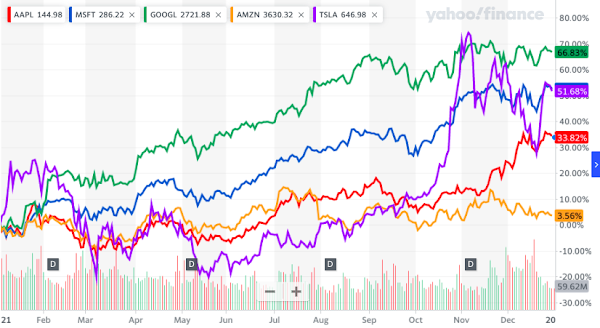
The Big Got Bigger

Except for Amazon, the "tera" cap stocks beat the indices
It was a very good year for stock market investors: [bold added]
the rollout of Covid-19 vaccines and low interest rates...helped the S&P 500 to close at a record 70 times this year, more than one-quarter of all trading days, according to Dow Jones Market Data, and pushed the index up 27% in 2021. The Dow and Nasdaq did well over the past 12 months too, rising 19% and 21%, respectively, handing all three benchmarks their best three-year performance since 1999.

Much of the broader market rally was also driven by a small group of massive stocks, such as Apple, Tesla and Microsoft. Microsoft and Tesla shares have each risen around 50% this year, while Apple has gained more than 30%.
Our stock holdings are weighted toward the so-called "megacap" tech stocks, so the portfolio has done well for the past decade. The 2021 performance of about 30% was way above expectations, since we did not expect the biggest of the big to go up that much. If we're up 10% in 2022, we'll be happy.

If you keep your expectations low, you aren't likely to be disappointed.

Wednesday, October 27, 2021

Emily and Amy Didn't Write About This

As a follow-on to yesterday's post about punctuation in the modern age, the WSJ publishes a guide to digital etiquette.  (Your humble blogger's comments are in green.)
Faux pas: pasting URL link
Don’t: Paste a long URL link into an email
Do: Hyperlink the text instead

Nothing uglies up an email exchange or reveals that you’re behind the times quite like a 10-line URL link with more symbols than letters (See our poor dinosaur’s faux pas). In most email servers, however, you can hide a hideous URL by hyperlinking it to related text in the body of your note. I prefer pasting "hideous" URL's, then converting the link to text; some servers consider links to be spam.

Not appetizing to me
Don’t: Ask for a menu
Do: Learn to scan QR Codes

People’s unwillingness to touch potentially germy surfaces and devices during the pandemic has greatly accelerated the adoption of unique QR codes. At most restaurants, only the out-of-it still ask for the opportunity to squint at a sticky menu; instead use your smartphone’s camera to scan the QR code (typically found on a placard at your table) to easily access the eatery’s offerings online. I like looking at printed menus; some restaurants spend a lot of time designing them. As for online menus, seen one, seen 'em all.

Don’t: Squirrel away your microwave manual
Do: Watch how-to videos on YouTube

You can finally clear out that drawer of old appliance manuals you keep “just in case.” The tech-savvy know that, should they need to troubleshoot a device, jump-start a car, learn how to hyperlink a URL (see above), or even change a setting on a Gmail inbox, they can simply type a query into YouTube’s search bar and watch the video with the most views. When I can't find the manual, I do watch YouTube videos, which have too many ads before, during, and inside the videos. Yes, I'm too cheap to pay Google for an ad-free subscription.

Don’t: Listen to music on Pandora
Do: Download Spotify

Beyond unearthing new artists, the best reason to download a music app is to share your taste with friends (and romantic partners). While more than 10 million people have hopped off Pandora since it was bought two years ago, according to Music Business Worldwide, dropping its active user base to around 55 million, Spotify—with its impressive algorithm for discovering new music—now boasts more than 165 million users.  Apple Music, which is part of an Apple One subscription, is good enough for me.

Don’t: Get cash from an ATM to reimburse a friend
Do: Use Venmo

Dragging a cohort along to an ATM so you can hand her a bundle of sticky bills is like insisting on communicating with her by snail mail. Venmo and CashApp help you automatically find friends in your contacts list or, if you’re sitting together, you can scan each other’s unique QR codes. Plus: No line ups.   I'll put up with mild convenience so as not to let another company into my financial affairs.

Don’t: Write down all your passwords
Do: Utilize a password manager

If you still keep passwords stored in an email draft in hopes of eluding hackers, assume your passwords have already been compromised and come up with new ones. Better yet, download a password manager like LastPass, Keeper or Dashlane. Each can securely create and store unique codes for every platform you visit, allowing you to keep dodgy types from accessing all your personal emails and information. I've got an admittedly inefficient paper system that is, as far as I know, unhackable and won't be until mind-reading devices come along, and even then, why would they bother with me?

Don’t: Store files on a thumb drive
Do: Use the Cloud or Dropbox

New computer models are quickly phasing out USB ports, so if you have all your most secret and important files stashed on a USB thumb drive, you are a bit of a dinosaur and you need to move fast. Your best option is to use a secure cloud server like Apple iCloud, Dropbox or Google Drive, which provides anyone with a gmail account 15 gigabytes of free and safe storage. "Secure cloud servers"?  If they can hack Microsoft cloud, I'm gonna keep my thumb drives for sensitive files that I can't afford to lose.

Saturday, August 21, 2021

A Real-Life Tragedy That is Destined for Hollywood

Ellen Chung, Oski, Jon Gerrish, and Miju (Chron)
It's an enigma wrapped inside a tragedy.

The mysterious death of a young couple, their daughter, and their dog on a day-hiking trail on Tuesday has puzzled investigators:
“This is a very unusual, unique situation,” said Kristie Mitchell, a spokesperson for the Mariposa County Sheriff’s Office. “There were no signs of trauma, no obvious cause of death. There was no suicide note. They were out in the middle of a national forest on a day hike.”
Ellen Chung and Jonathan Gerrish walked away from their successful professional lives in the City and moved to Mariposa "for this quieter life, focusing on their daughter.”
Gerrish for years had been an engineer for Google, [family friend Steve] Jeffe said, and had only recently begun working at Snapchat after his paternity leave had ended. Chung was a certified yoga instructor and a graduate student studying counseling psychology.

Until recently the couple were mainstays in San Francisco’s social scene, with both Gerrish and Chung known to DJ from time to time, Jeffe said. The pair also mixed with the “burner” crowd, people who visit the famous arts and culture festival known as Burning Man in a Nevada desert.

Gerrish had done well for himself and was extremely generous, Jeffe said, always sharing his good fortune with friends. While the couple took a trip abroad a few years ago, they let Jeffe stay in their San Francisco loft.

While still maintaining a residence in San Francisco, the pair mostly uprooted their life in March of last year, when the pandemic was beginning to take hold. While Chung was still pregnant, the couple relocated to Mariposa, hoping to integrate their daughter to a life in the outdoors.
180 miles east of SF, 50 miles west of Yosemite
The Gerrish family owned multiple properties in California and was independently wealthy. We, who have been reading mysteries since childhood, could not suppress suspicious thoughts. Yet, there are absolutely no signs of foul play.
“You come on scene and everyone is deceased. There’s no bullet holes, no bottle of medicine, not one clue,” Mariposa County Sheriff Jeremy Briese said from his office in town on Friday. “It’s a big mystery.”
The cause of death was likely accidental poisoning, yet there are problems with current theories of toxic gas from old gold mines (they would have had to go deep into a mine with a baby), exposure to toxic algae blooms (all would have to go into the water), and dehydration (they still had water in the container).

On top of everything else the area has a "dark" history:
Three years ago when the Ferguson Fire swept through the valley, burning more than 96,000 acres, a firefighter rolled his dozer down a ravine along the Hites Cove Road stretch of the trail and died. The north side of the trail empties out onto Highway 140 and the Yosemite Cedar Lodge, a notorious landmark.

In 1999, serial killer Cary Stayner was working as a handyman at the motel when he murdered 42-year-old Carole Sund; her daughter, 15-year-old Juli Sund; Juli's friend, 16-year-old Argentine exchange student Silvina Pelosso; and Yosemite Institute employee Joie Ruth Armstrong. Sund and the teens had been staying at the motel.
Let's hope the mystery will be solved soon by the toxicology reports. We can then focus on where the story belongs: the sorrow over the tragic death of a young family who had all the makings of a happy, fulfilling life ahead of them.

Thursday, April 01, 2021

Fake and Funny

Today is April Fool's Day, and the web is rife with hoaxes that are variations of fake pictures, videos, words, in fact any information that can be digitized. (Google's April Fool's "MentalPlex" antic is from the year 2000.)

Personally, I most admire practical jokes that were concocted before the Internet era, such as the famous Caltech pranks that included assembling a running Model T Ford in a dorm room, or the one where a student's door was plastered over so his room "disappeared."

The following isn't really an April Fool's joke because it originated a month ago and (almost) everyone knew it was fake from the beginning. WSJ: Stressed Over Getting Into College? Just Invent Your Own School
In the Reddit chatroom the women come and go
Talking of Michelangelo.
Southern Rhode Island Institute of the Arts is the most exclusive college you’ve never heard of. Why? It’s not real.

It is, however, perfectly suited to this high-anxiety moment for high-school students around the country waiting to find out if they have been accepted to college. The fake school’s founders channeled their college admissions stress into inventing a university of their own.
High school seniors from different parts of the country were commiserating over the stress of college admissions, and SRIIOTA was born. The website material grew spontaneously as more participants added to the joke.

Boomers shouldn't worry: the country is in good hands.

Friday, December 18, 2020

Dying is Easy, Keeping Track of Passwords is Hard

Facebook image: they can track you everywhere
Death is getting more complicated. Not only do we have to make arrangements for our physical and financial assets; now we have to worry about the remnants of our digital lives.

WSJ tech editor Joanna Stern takes us through the steps of organizing our electronic estate:
1. Take inventory of your digital assets
2. Add a digital executor to your will
3. Add digital heirs to your accounts
4. Plan to pass on your passwords
5. Record your stories
After step 2, adding a "digital executor" (can be the same as the regular executor), the will should contain instructions to the executor to distribute the accounts to the digital heirs.
Some of the big tech companies provide specific tools. On Facebook, assign and add a legacy contact. When you die, Facebook will allow this person to take some actions on your account, including downloading a copy of what you’ve shared on Facebook, memorializing your profile so others know you’ve passed or, if you prefer, removing your account. On Google, assign an Inactive Account Manager, who can similarly download the data, including any pictures you may have on Google Photos.

Unfortunately, other tech giants don’t offer such features. Make sure your digital executor will receive access to your passwords and also has a way to get to your phone to receive those number and letter codes that some companies send when you log in. Without that, a company could require the executor to gain a court order. Here are links to the specific policies for companies you might have digital accounts with:

Apple
Microsoft
Twitter
Instagram
Dropbox
Yahoo
LinkedIn
•Amazon (U.K. customers; U.S. link not working)

What to Do Before You Die: A Tech Checklist is humbling because I've done nothing except print out a list of all my accounts and passwords. Meanwhile the hard-core are making sure that their avatars are not interred with their bones: [bold added]
James Vlahos, co-founder of HereAfter.AI.... creates voicebots so loved ones can, via an Amazon Echo or Alexa phone app, actually talk to friends or family members after they die.

The company records interviews with people, then turns the audio into an interactive experience. Loved ones can ask the bot questions about your childhood, and it will play relevant chapters of the recording.

To me, the best part of this service—which starts at $95 for an hour of interviews—is that customers get, in addition to the voicebot, the original high-quality audio files. Of course, you and your family can record some yourselves with a good microphone and computer. The key for any interview is asking the right questions to capture the best stories.

Use targeted questions that guide your loved ones to share the most specific, visceral and emotional things they can remember,” Mr. Vlahos said. “Don’t ask, ‘Tell me about your marriage.’ Ask, ‘Describe the very first time you saw the woman who would become your wife.’”
In the Superman movies Kal-el speaks to a ghostly image of his long-dead father Jor-el. The image responds intelligently to Kal'el's questions and often gives useful advice.

Here's a 21st century question: does anyone want to listen to posthumous advice from someone who presumed that his descendants wanted to take his advice seriously after he was gone?

Thursday, October 08, 2020

Puppets on a Screen

(Image from South Asia Times)
The documentaries that I find most fascinating are the ones that tell me something new on topics that (I thought) I was familiar with. Netflix' "/the social dilemma" is such a movie.

It describes how the Internet companies--Google and Facebook, primarily, but also Twitter, pinterest, Tiktok, LinkedIn, Snapchat, et. al.--watch everything that we read, write, upload, download, or view. They know the identities of our friends, families, and business associates and where we are at all times.

The companies use that data to show us ads that are likely to trigger a sale, but marketing efficiency is only a small part of the algorithms' power. The programs predict what we'll do next; a search that begins Climate change is.. will fill in "a hoax" if one is a conservative or "a threat to humanity" if one is a liberal.

The user is steered toward sites and news--even fake news and conspiracy theories--that the algorithm believes will keep the eyeballs fixated. By making it so easy to view materials that one agrees with leads to today's political polarization; it is the rare user who actively seeks alternative points of view.

The movie dives into the ways in which social media hooks the users--for example, continuous notifications about friends and celebrities, or beeping when someone likes their selfie--but is weak when it comes to suggestions about what to do about its pervasive influence. Some speakers call for much greater government regulation--just after a section on the danger of letting tech tools fall into the hands of governments. Parents wage a lonely battle trying to keep their children unplugged when all the other kids stay connected.

Your humble blogger doesn't have any solutions either. I'm just grateful that I grew up when high schools and colleges actively introduced students to different points of view. My education and career beginnings occurred long before the Internet but after the Civil Rights Act of 1964, which, grossly simplified, said we must judge individuals for what they can do and not who they are. (Obviously there existed a large gap between the law and reality, but everyone knew what the aspiration was.)

15 minutes from the end, the movie runs a clip from Senator Jon Tester (D-Montana) at a 2019 Senate Commerce Committee hearing:
I am 62 years old, getting older every minute the more this conversation goes on, but I will tell you that I'm probably gonna be dead and gone, and I'll probably be thankful for it, when all this s*** comes to fruition. Because I think that this scares me to death.
I identify with Senator Tester more than anyone else in the documentary...and I'm sure that Facebook, Google, et. al. already knew that!

Below is the testimony from Tristan Harris, whose ideas are featured prominently in /the social dilemma, at the same hearing.

Thursday, October 01, 2020

Biting the Hand That Supports Them Dept.

(Image from Adweek)
This is an unexpected move by Democrats with only a month to go before the November elections:

House Democrats to Call for Big Tech Breakups [bold added]
Democratic lawmakers are expected to call on Congress to blunt the power of big technology companies, possibly through forced separation of online platforms, as a House panel concludes its Big Tech probe.

The House Antitrust Subcommittee is nearing completion of a report wrapping up its 15-month investigation of Alphabet Inc.’s Google, Apple Inc., Amazon.com Inc., and Facebook Inc. The report follows the committee’s collection of more than one million documents from the companies and competitors, as well as a July hearing with CEOs of the four tech giants.

Rep. David Cicilline (D., R.I.), who chairs the subcommittee, has indicated the panel is poised to recommend significant measures targeting Big Tech’s power, including requiring owners of huge technology platforms to separate those platforms from other businesses.
The largest tech companies (Amazon, Facebook, Google, Microsoft) distribute their funds to Democrats and Republicans fairly evenly (Apple doesn't have a PAC). However, their employees contribute heavily--over 90%--to Democrats.

(BTW, you can bet your bottom dollar that, because donor data is public information, there's some workplace coercion--"Hey, Joe, how come you didn't donate to Biden? Are you a racist?" If you don't toe the line in Silicon Valley, you could be blacklisted for wrongthink like James Damore or Brendan Eich.)

There is a bona fide discussion to be held over the power Big Tech holds over our lives, but it's not at all clear that consumers are worse off, say, because Amazon gives us more selection and lower prices than brick-and-mortar stores, or that Facebook shows us ads that are likely to interest us as opposed to burying us in dreck like traditional TV.

IMHO, the Democrats have judged that Big Tech will support them no matter what and are throwing a bone to Progressives that believe: 1) Tech has made too many people extraordinarily wealthy--exacerbating inequality is bad, despite making every individual better off; and 2) concentrations of power other than government cannot be allowed.

“Everything within the state, nothing outside the state, nothing against the state.” - Anne Applebaum, on totalitarianism in 20th century Eastern Europe.

Saturday, July 25, 2020

The Golden Apple is Out of Reach

EU antitrust enforcer Margrethe Vestager (Forbes)
The large-cap tech companies (Apple, Amazon, Google, Microsoft, and Facebook) all have attracted fierce scrutiny, but nowhere more so than in Europe. [Disclosure: a good chunk of my retirement portfolio is invested in these companies both directly and indirectly through funds and ETFs.] The authorities object to these companies creating legal structures that minimize taxes.

It has long become clear to this writer that the European Union tries to extract huge tax awards by getting courts to apply tax "principles" retroactively to these successful companies, despite their following the letter of the law. That is why it was gratifying to see Apple win a $14.8 billion tax case last week in European court: [bold added]
The case stems from a 2016 decision by the European Commission, the bloc’s top antitrust enforcer, which said that Ireland must recoup €13 billion in allegedly unpaid taxes between 2003 and 2014, money the commission said constituted an illegal subsidy under the bloc’s strict state-aid rules.

The General Court swept aside that reasoning, saying it annulled the decision because the commission had failed to meet the legal standards in showing that Apple was illegally given special treatment.

The 2016 decision against Apple was one of Ms. Vestager’s first big broadsides against tech companies in her role running the EU’s competition enforcement, earning her the nickname “tax lady” from President Trump. She later issued Google three fines totaling $9.4 billion, and launched formal antitrust probes into Amazon and Apple. She is now also responsible for tech regulation and is considering imposing a digital tax on tech giants...

A central issue in the Apple case was whether two Irish tax rulings granted to Apple in 1991 and 2007 gave a form of special treatment to the company, or whether they just reiterated an interpretation of Irish tax law as it was applied more generally.

Those rulings allowed two Irish-registered Apple units to attribute only a small sliver of some $130 billion in profit to Ireland in an 11-year period. The commission said all that revenue should be attributed to Ireland, but the Irish government and Apple say they split the profit reasonably, given that almost all of Apple’s intellectual property is developed in the U.S., not Ireland.

In Wednesday’s ruling, the General Court said that, despite the gaps in the contested tax rulings, the commission hadn’t proven the Irish government granted a special advantage to Apple that was unavailable to other companies in Ireland.
The European Union will now have to do the hard work of crafting new laws that will achieve their goals and not trying to re-interpret the past to try to solve present needs.

Saturday, July 04, 2020

Too Useful to Get Rid Of

My Amazon shopping cart normally has 1-5 items.
Abandoned shopping carts are a burden to supermarkets that have to retrieve them. Abandoned carts are also a nuisance in the on-line world because they distort merchants' data on what products attract customers.

They also cause an administrative burden by triggering e-mail reminders to "customers"; if the messages bounce back, eventually the merchant has to intervene and delete the cart.

Which brings us to the mysterious shopper John Smith who has been abandoning carts across the Internet.
John Smith started shopping early on a recent Wednesday and didn’t stop for days.

(Image from iaffiliatemanagement)
He visited an auto-supply site where he loaded his cart with a replacement turn-signal lever, emergency strobe light and two dozen other items. He hopped over to a home-goods merchant for another 10 items including wood picture frames, address plaques, a towel rack and mailbox. He ordered one of every kind of baby bundle, ranging from about $80 to nearly $500, from a site that sells infant sleeping boxes popular in places such as Finland.

When the roughly 48-hour spree was over, John Smith did what he always does. He walked away without buying anything.

For more than a year, online merchants selling items ranging from kayaks to keychains have puzzled over the mystery shopper with the generic name behind thousands of abandoned carts.
In a triumph of investigative journalism the Wall Street Journal tracked down the serial looker. Merchants noted that John Smith always had a gmail address. Repeated telephone calls to Google unearthed the truth:
The mystery shopper is a bot of its own creation. The purpose: making sure the all-in price for the product, including tax and shipping, matches the listing on its Google Shopping platform or in advertisements. It wasn’t to cause angst to merchants due to thousands of abandoned carts.
Internet platforms and news sites have been flooded by bots that dispense fake news, sell products, and degrade debates. So why aren't they eliminated completely? Because the platforms find them useful, too.

Friday, March 27, 2020

Resentment Resurfaces

Now that I'm semi-retired I haven't needed to upgrade Microsoft's Office suite (Excel, Word, Powerpoint) for 12 years.

The 2008 features were sufficient for any tasks that I might undertake; besides, the data flow, logic, and organization of a project are far more important to its success than technical bells and whistles.

Earlier this month I upgraded MacOS, and old Excel wouldn't run some self-developed tax spreadsheets. Now was the time to unwrap the box of Office 365 that I got for Christmas several years ago and thought I never needed. (There are alternatives to Microsoft, by the way; Google and Apple both have competing free products that can work with Office documents.)

Memories of the Microsoft/Intel software/hardware treadmill resurfaced (the new version of the software won't work on the old chip and vice versa). In a year's time Microsoft will bill me $69.99 to renew Office, and I'll pay them because it's not worth the hassle to switch.

They know my weaknesses so well, and I resent them for it.

Thursday, February 27, 2020

Preventive Purchase

2009: Lenovo IdeaPad
I bought a "Netbook" computer 11 years ago. The operating system was Windows, it had no hard disk and hence no file storage (at the time few consumers used the cloud). I used it primarily for web-surfing at public WiFi locations.

The Lenovo IdeaPad S10 Netbook cost $350. It was a pleasure to use--netbooks were much lighter compared to laptops with hard drives--but not durable. It broke after two years.

2020: Acer Chromebook
After an 11-year hiatus I bought my second websurfing-only computer, an Acer Chromebook 14. It's superior to the old IdeaPad--for example as the name implies, it has a 14" HD display--,but the functionality is basically the same. The operating system is Google's Chrome, not Microsoft's Windows. The price was right--$175 before tax--demonstrating the workings of Moore's Law.

I have other devices that can be used to websurf, but the main reason for the purchase was indeed different from 2009: there's been a rash of thefts of laptops while people are using them. I can't afford to lose one with (backed-up) sensitive information, but if thieves need a Chromebook that badly they can have it with no resistance.

In most ways the world is better, but in a few it's become worse.

Friday, August 31, 2018

Update to That Cultural Manifestation

Email hierarchy from TheOatmeal.com
For security reasons it's a good idea to change your e-mail address. Spammers and phishers will take months or longer to react, and your regular contacts should adapt in less than a minute. There's also another reason: both your old name ("PartyAnimal678") and your old provider (I'm looking at you, America Online) could be detrimental to your career:
Not everyone sheds their adolescent email addresses when they enter adulthood, instead maintaining allegiance to digital monikers based on the music, videogames and contraband they once held dear.
Five rules for setting up a new address:
Keep It Simple
Use a simple combination of your name—first and last, or initials if necessary.
Don’t Try to Be Funny

It’s Not a Numbers Game
add a few digits. But don’t go crazy... your email could look like a randomly generated spam account and be quickly dismissed.
Stay Off Drugs
the most common issue is inappropriate drug references—plenty of 420s [marijuana reference].
Move On From AOL
It might be ironic to send missives from @aol.com, but it doesn’t suggest an exceedingly tech-savvy candidate. Actually, “It weirds me out,” said [recruiter Mackenzie] Moore. “Why are you still using AOL? Gmail is definitely the winner.”
Other sites besides Google, Yahoo, and AOL offer
email, but I don't use them
For the record your humble blogger has AOL, Yahoo, and Google (Gmail) accounts, as well as accounts on three business servers.

I still use my AOL account for personal correspondence. Just last week I received a legit message from a former colleague whom I had not heard from for 20 years; I was the only person in our old business circle who retained the email address from that period. (Yes, I have to tolerate nearly a hundred corporate marketing messages a day, but they're easy enough to delete.)

I use Yahoo for business-related personal matters (for example, corresponding with my stockbroker) and Gmail for when I want to appear respectable (for example, charitable activities). If I were applying for a job, I would use Gmail.

We all have different masks we wear for different occasions, and email is simply an update to that cultural manifestation.

Thursday, July 26, 2018

We've Heard This Before

American capitalism is going through one if its periodic episodes of gargantuan infatuation. The analysis is familiar: "XYZ Corp is so big and so dominant that no one can possibly compete with it for the foreseeable future. It has the most money, it attracts the brightest people and ploughs $billions into R&D. Legions of lawyers and lobbyists protect its interests. Customers flock to it for its reputation of being the biggest and best, etc. etc."

(Graphic From Management Study Guide)
In the mid-1970's your humble blogger was introduced to the Boston Consulting Group matrix.

According to BCG businesses can be classified according to four types: stars, cash cows, question marks, and dogs.
Stars- Stars represent business units having large market share in a fast growing industry. They may generate cash but because of fast growing market, stars require huge investments to maintain their lead. Net cash flow is usually modest. SBU’s [Strategic Business Units] located in this cell are attractive as they are located in a robust industry and these business units are highly competitive in the industry. If successful, a star will become a cash cow when the industry matures.

Cash Cows- Cash Cows represents business units having a large market share in a mature, slow growing industry. Cash cows require little investment and generate cash that can be utilized for investment in other business units. These SBU’s are the corporation’s key source of cash, and are specifically the core business. They are the base of an organization. These businesses usually follow stability strategies. When cash cows loose their appeal and move towards deterioration, then a retrenchment policy may be pursued.

Question Marks- Question marks represent business units having low relative market share and located in a high growth industry. They require huge amount of cash to maintain or gain market share. They require attention to determine if the venture can be viable. Question marks are generally new goods and services which have a good commercial prospective. There is no specific strategy which can be adopted. If the firm thinks it has dominant market share, then it can adopt expansion strategy, else retrenchment strategy can be adopted. Most businesses start as question marks as the company tries to enter a high growth market in which there is already a market-share. If ignored, then question marks may become dogs, while if huge investment is made, then they have potential of becoming stars.

Dogs- Dogs represent businesses having weak market shares in low-growth markets. They neither generate cash nor require huge amount of cash. Due to low market share, these business units face cost disadvantages. Generally retrenchment strategies are adopted because these firms can gain market share only at the expense of competitor’s/rival firms. These business firms have weak market share because of high costs, poor quality, ineffective marketing, etc. Unless a dog has some other strategic aim, it should be liquidated if there is fewer prospects for it to gain market share. Number of dogs should be avoided and minimized in an organization.
High-market-share companies, whether they are cash cows or stars, are very difficult to dislodge because, in general, their costs are lower than smaller competitors' and they have more reinvestable cash flow to maintain their dominance.

Today the evidence seems to suggest that the biggest companies are pulling away from, not regressing back to, the field: [bold added]
The biggest companies in every field are pulling away from their peers faster than ever, sucking up the lion’s share of revenue, profits and productivity gains...But new data suggests that the secret of the success of the Amazons, Googles and Facebook s of the world—not to mention the Walmart s, CVSes and UPSes before them—is how much they invest in their own technology.

IT spending that goes into hiring developers and creating software owned and used exclusively by a firm is the key competitive advantage. It’s different from our standard understanding of R&D in that this software is used solely by the company, and isn’t part of products developed for its customers.
Just like the "old" IBM, AT&T, Microsoft, GM and GE, the tech giants Amazon, Google, and Facebook appear to have unassailable positions in their respective sectors. Everyone else is at best a "question mark" and has to invest $billions just to be an also-ran. Everyone else may as well give up.