Showing posts with label Tariffs. Show all posts

Wednesday, April 23, 2025

California: Not Entirely Hopeless

Gov. Newsom and Pres. Trump on 1/24/25 (Politico)
California is still doing some things right.

SF Chronicle: California is now 4th largest economy in world, surpassing Japan
The International Monetary Fund’s World Economic Outlook data for 2024 found that California had a nominal gross domestic product of $4.1 trillion, behind only the United States, China and Germany when compared with nations worldwide...

[Gov. Gavin] Newsom said, while announcing the lawsuit [against Trump tariffs], that more than 36,000 manufacturing companies in California employ more than 1.1 million people and are “disproportionately going to be hurt by this.”

The recent data also found that California had an economic growth rate of 6%, higher than the 5.3% rate for the United States, 2.6% rate for China or 2.9% rate for Germany.

India, which currently has a gross domestic product of $3.9 trillion, is projected to overtake California’s standing as fourth by 2026, according to preliminary data, Newsom’s office said.
We've posted how large companies like Oracle, Hewlett Packard, Tesla, and most recently Chevron have fled because California's taxes, regulations, and housing costs are inimical to the welfare of businesses and their employees.

For the time being the growth in businesses that have remained. e.g., Apple, Google, Facebook, Nvidia, Netflix, plus the formation of startups, have offset the losses. But once it goes negative--like the downtowns of San Francisco and Los Angeles--the turnaround will be extremely difficult.

Wednesday, April 09, 2025

Relief Rally

Happy trader, at least for 1 day (McDermid/Reuters/CNBC)
The stock market bounced back today in one of "its biggest rallies in history".
The stock market mounted one of its biggest rallies in history after President Donald Trump announced a pause in some of his “reciprocal” tariffs on the globe, causing a market that has been under extreme pressure for the past week to explode higher.

The S&P 500 skyrocketed 9.52% to settle at 5,456.90 for its biggest one-day gain since 2008. For the broad market index, it was the third-biggest gain in post-WWII history. The Dow Jones Industrial Average advanced 2,962.86 points, or 7.87%, to close at 40,608.45 for its biggest percentage advance since March 2020. The Nasdaq Composite jumped 12.16% to end at 17,124.97, notching its largest one-day jump since January 2001 and second-best day ever.

About 30 billion shares traded hands, making it the heaviest volume day on Wall Street in history, according to records that go back 18 years.

“I have authorized a 90 day PAUSE, and a substantially lowered Reciprocal Tariff during this period, of 10%, also effective immediately,” Trump posted on his Truth Social. Trump, in the same post, said he was raising the tariff on China higher again to 125%.

Treasury Secretary Scott Bessent later clarified that all countries except China would return to the 10% baseline tariff rate, down from the higher rates that previously shocked the markets, as negotiations take place. The pause would not apply to sector tariffs, Bessent said.

Stocks that were heavily pressured by the trade war tensions led the comeback Wednesday afternoon. Apple and Nvidia soared more than 15% and nearly 19%, respectively. Walmart shares rallied 9.6%. Tesla shares climbed more than 22% on the back of the pause announcement.
The precipitous fall in the stock market since last Wednesday made it ripe for a bounce back upon any piece of good news. In this case the news was very hopeful--President Trump's 90-day pause in tariffs excluding China--and was a sign that tariffs were more a bargaining chip than a permanent fixture. However, the economic landscape before last Wednesday was not especially rosy, so the odds are against the one-day relief rally to continue much longer.

Saturday, April 05, 2025

No Fine-Tuning This

iPhone: it's all tariff-able.
Last September I was certain I was going to buy a new iPhone. However, two developments have upended that Apple cart: 1) the delay in rolling out Apple Intelligence; 2) the newly-announced tariff on goods from China, where most iPhones are made.

The WSJ shows how the 54% tariff on Chinese imports raises the cost of the materials that go into the iPhone by 54% (from $549.73 to $846.59). If Apple wants to maintain the same profit margin of 50% on materials, the price of the 256GB iPhone 16 would have to rise by 54% (from $1,100 to $1,694). Such an increase in price will cause some customers to choose the iPhone's competitors who are not experiencing similar price hikes, or at least hold off purchasing a new smartphone. Apple sales will suffer, perhaps a lot, which explains why the stock has fallen 28% from its all-time high.

I am firmly ensconced in the Apple ecosystem and will buy a new iPhone when the creaky 2018 iPhone XS Max gives up its ghost, but not sooner. The WSJ:
This tariff matter is far from settled. Our advice is to hold off on stockpiling last year’s iPhones, and make that one in your hand last as long as it can.

Wednesday, April 02, 2025

Tariffs: He Really Meant It

(photo Schiefelbein/AP/American Prospect)
The big news this afternoon was the new tariffs imposed on the rest of the world:
President Trump’s sweeping new tariff plan reverberated through global markets, with U.S. stock futures slumping and the dollar tumbling to its lowest level of the year. Popular stocks such as Apple, Amazon and Nike were among the largest retreaters in offhours trading and oil prices slid.

Here’s what to know:

All U.S. imports will be subject to a 10% tariff, effective April 5.

Trump will impose even higher rates on some nations that the White House considers bad actors on trade. For example, Japan faces a 24% duty and the European Union faces a 20% levy, effective April 9.

China will be hit with a new 34% tariff, adding to previous duties, like the 20% tariff Trump imposed over fentanyl. That means the base tariff rate on Chinese imports will be 54%, before adding pre-existing levies.

The tariffs are pegged to amounts Trump says other countries impose on the U.S. Here’s the math behind the levies.

Some global leaders are vowing to retaliate, while others are hopeful there is still time to strike a deal with the U.S.

Canada and Mexico are excluded from the reciprocal tariff regime. They are still subject to plans to impose 25% tariffs on most imports to the U.S., though the administration has given an exemption for autos and many other goods. Here’s a list of the products and countries exempted from the tariffs.

Trump’s 25% tariffs on foreign-made autos and parts took effect at 12:01 a.m. ET
Four years ago we reflected on the stagflation of the Seventies and how it took years for Ronald Reagan and Paul Volcker to wring inflation out of the system and restore economic growth.

The short-term pain hurt the Republican Party politically in the Eighties and may well hurt it this time as President Trump tries to reset 80 years of globalization and no-import-tariffs "free trade" practiced by the United States and no one else. It was clear to your humble blogger that President Trump did not talk about the pain of his policies in order to get elected, but it is better that he get it out of the way now while his party controls both the House and Senate.

Tuesday, February 18, 2020

Reversal of Fortune

The Chinese century? Not so fast.
“Since Xi came to power, problem after problem have occurred on his watch that he seems unable to effectively manage,” says Jude Blanchette, a China analyst at the Washington-based Center for Strategic and International Studies. These include popular unrest in semiautonomous Hong Kong, a disruptive trade war with the U.S. and now an unfolding health crisis.
It took only a few months for the Hong Kong protests and the mishandling of the coronavirus outbreak to damage the perception of Chinese invincibility. Also, the trade war that would supposedly have no winners has so far caused more harm to China's economy than the U.S.'

Recent setbacks may well be temporary, and the Chinese are famous for playing the long game. But the century is not theirs yet.

Friday, October 25, 2019

Steve Job's Wisest Decision

Unlike other Silicon Valley tycoons opposed to Donald Trump--a redundant description now that the President's only major SV supporter moved to LA--Tim Cook has kept the lines of communications open:
(WSJ photo)
Mr. Cook is one of the few executives in a hyperpolarized political era who has managed to both support and challenge the president’s agenda in a way that has kept him in Mr. Trump’s good graces while avoiding any public backlash from either employees or customers.
The laudatory Journal article, IMHO, understates the business and political skill of Tim Cook. He can express disagreement with the President and his own virulently anti-Trump work force without being vilified by either. And he is able to maintain cordial relations with China though Apple is one of the most prominent symbols of America and a visible target for China's displeasure.

This month the Apple CEO was named the chairman of the advisory board for Tsinghua University's economics and management school, aka the "Harvard Business School" of China. The appointment was lambasted by some American hard-liners, but declining the position would not only have hurt Apple but also the U.S.-China trade negotiations. The result is that Tim Cook has the ear of everyone and is respected by everyone.

Most of us didn't see it clearly in 2011, but naming Tim Cook his successor was Steve Jobs' wisest decision.

AAPL has outperformed the FANG (Facebook, Amazon, Neflix, Google) stocks in 2019.

Tuesday, August 06, 2019

FOMO

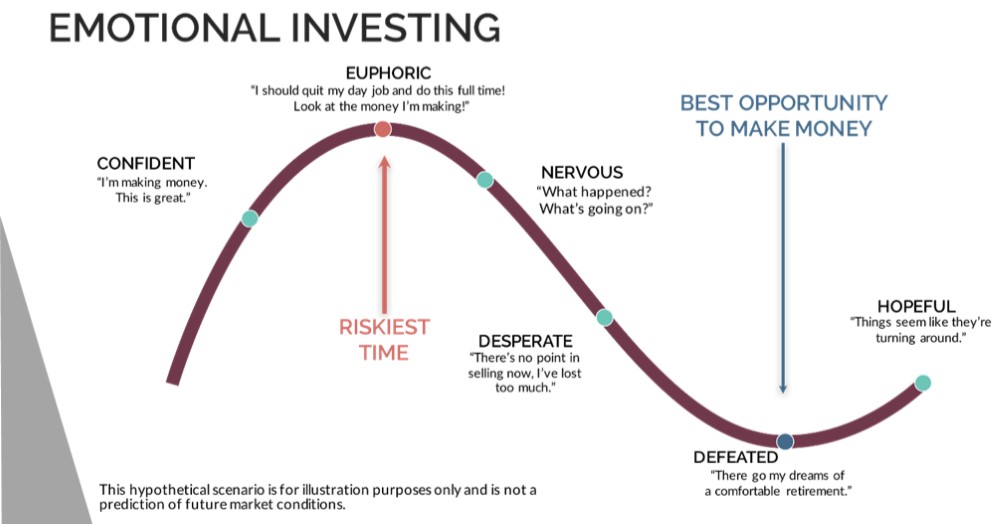
(Graphic from searcyfinancial)
After yesterday's 2.9%-3.5% (depends on which index you look at) sell-off, I dipped in my toe and shifted 1% of my portfolio from cash into equities and equity derivatives. The volatility from the tariff battles is not even close to being resolved, but at these price levels I couldn't bear if I missed another buying opportunity. In other words I am driven by the Fear of Missing Out.

Irrationality loves company. Your humble blogger takes comfort that professional money managers are also subject to emotional investing. [bold added]
Several new studies show that the so-called smart money is prone to many of the same errors as amateurs...Professional investors hold stocks too long. They react erratically to stock splits. They may even buy one stock when they intended to purchase a different one—almost as often as supposedly clueless individual investors make the same kind of blunder.
Sometimes a sector is so hot that just by including a keyword in its name a company's stock could take off--witness the near-panic buying that greeted "cloud" and "blockchain" offerings. In the near future one can expect space mining, life extension, and artificial intelligence businesses to experience similar booms and eventual busts.

Look at it this way, if your life span will indeed be extended past 100 years, you can afford to be patient. But that would be rational, and frankly, not as much fun.

Monday, May 20, 2019

Protectionism Doesn't Stink for Everyone

Experts caution that trade wars have no winners, but don't tell that to this local company:
Ken Christopher gets emotional about tariffs
Christopher Ranch, the nation’s largest commercial garlic grower,....stands to gain from a 25% tariff the Trump administration imposed on Chinese garlic and other goods this month. [snip]

Before the 10% tariff enacted in September, Chinese garlic cost $15 to $20 per box, while California garlic was about $50 to $60 per box, according to [CEO Ken] Christopher. Now, with the 25% tariff Chinese garlic will be $40 to $45 per box, he said.
Despite its higher price, your humble blogger always buys Gilroy garlic. "Made in China" means low prices and acceptable, sometimes above-average quality, but I'll admit to being biased against imported Chinese food. From 2015:
"Food from China is frequently found to contain alarming levels of heavy metals (arsenic, cadmium, lead, mercury) and other contaminants." That's why some of my new neighbors left their homeland---who wants to raise kids in that environment?
Saving a couple of bucks on a package of garlic isn't worth one's health.

Also from 2015: note how this Asian-market's display advertises the non-Chinese sourcing of its meat.

Friday, April 06, 2018

Tariffs: Never say Never

Conventional wisdom: tariffs hurt those imposing them.
What if someone violates a written agreement? The dispute-resolution process is a matter of common sense. First, the parties should talk to each other. Perhaps one wasn't aware that it had breached the agreement, or the other mistook a permissible act for a violation. If talks fail, the lawyers get involved, with a mixture of threats and offers to renegotiate. Finally, the courts decide.

But what if there are no courts (with the authority to impose their decision)? Then the parties must come up with a solution that has a reasonable chance of being adhered to voluntarily.

Such is the situation that the United States is facing vis-à-vis China. It's very clear that China has materially violated the WTO agreement it signed 17 years ago.
What is needed is a change in Chinese behavior to conform to the rules Beijing accepted when it joined the World Trade Organization in 2001.

The most important issue is the demand that U.S. companies transfer their technology to Chinese counterparts as a condition of doing business in China. American businesses that want to produce or sell in China are often required to enter into a joint venture with a Chinese firm that then has access to U.S. technology....

The Chinese government acknowledges that WTO rules forbid making the transfer of technology a condition for access to a nation’s economy. But it argues that the practice is “voluntary” because American firms aren’t forced to do business in China—their other option is to stay out of the country. American companies and officials say it’s a form of extortion because U.S. firms should have access to the Chinese market, as they do to markets in Europe and elsewhere, without losing their intellectual property....

Other trade issues should be easy to resolve. The U.S. would like China to reduce its excess capacity in steel and other industries and to stop selling the resulting products on the global market at below cost, in violation of WTO rules. Mr. Trump’s tariffs on steel are a way of putting extra pressure on China to accelerate its reduction of excess capacity.
President Trump's imposition of tariffs and China's retaliatory response have raised the specter of a trade war that has spooked financial markets.

In high-school American history we had it drummed into our skulls that the Smoot-Hawley Tariff Act of 1930 brought on the Great Depression. Free-trade-good-tariffs-bad is more widely accepted than motherhood and apple pie.

Questions:
1) How come the Chinese don't buy into the free-trade mantra, i.e., they are so stupid that they impose tariffs and other tariff-like barriers to imports? Don't the Chinese see that's why they [sarc!] have been so unsuccessful?
2) Assuming talks have failed to change Chinese behavior, what are steps, preferable to tariffs, that the U.S. could take?

By the way I still am hopeful that the skirmish over tariffs is part of the overall strategy to denuclearize North Korea.

Wednesday, March 21, 2018

Less Steak, More Spam

Whether he planned it or not, recent economic developments have helped Donald Trump in his battle with coastal elites.
  • One source of wealth, high-end real estate, will stop increasing and may even fall. The Tax Cut and Jobs Act reduces the deductions for state and local taxes and for mortgage interest. The elimination of these tax subsidies may well cool off the overheated real estate market in New York and California.
  • The drop in the stock market, whether due to the threat of a trade war, Facebook's woes, higher interest rates, political uncertainty, or all of the above, hammers the other major source of wealth for the coastal elites.
  • It's ironic that these developments will reduce the stark economic wealth inequality of the coasts versus middle America much more than occurred under President Obama, yet Donald Trump will never get a smidgeon of credit from progressives.

    Related: it's time for Costco's semi-annual sale on Spam, so I picked up a package. Less steak, more spam--time to watch my pennies.