Showing posts with label Bill Gates. Show all posts

Wednesday, July 06, 2016

The Last Event in Human History?

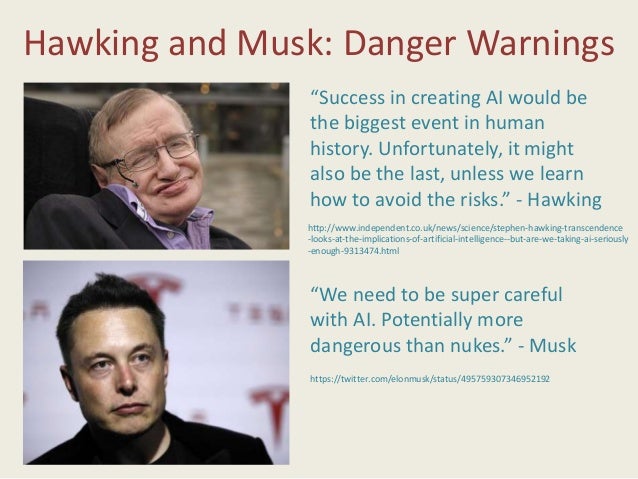
(Via slideshare.net)
Famous, very smart people have recently been sounding the alarm about artificial intelligence (AI).
Stephen Hawking: "The development of full artificial intelligence could spell the end of the human race."

Elon Musk: "With artificial intelligence, we are summoning the demon."

Bill Gates: "I agree with Elon Musk and some others on this and don’t understand why some people are not concerned.”
The concerns about AI appear to be twofold [bold added]:
many fear that machines will make millions of workers redundant, causing inequality and unrest. Martin Ford, the author of two bestselling books on the dangers of automation, worries that middle-class jobs will vanish, economic mobility will cease and a wealthy plutocracy could “shut itself away in gated communities or in elite cities, perhaps guarded by autonomous military robots and drones”. Others fear that AI poses an existential threat to humanity, because superintelligent computers might not share mankind’s goals and could turn on their creators.
Futurists' dreams---or nightmares---of artificial intelligence are close to being realized because of the convergence of three phenomena: the availability of data, the speed of computer processing, and an algorithm ("deep learning") that enables programs to teach themselves.

IMHO, the benefits of artificial intelligence exceed the risks---though the most extreme risk, i.e., human extinction, is fairly negative(!)--but I have faith that we'll come up with answers, just as we have to other concentrations of power like private monopolies (regulated capitalism) and tyranny (democracy, law, and separation of powers).

The most creative solutions will probably have the machines regulate themselves--as private actors do in free markets--though your humble blogger is certainly not smart enough to imagine what these solutions are. The same genius(es) that invented bitcoin, a currency not dependent on central or private banks, can surely come up with a self-regulating structure for artificial intelligence.

If that doesn't work, there's always the "off" button....

Saturday, January 18, 2014

Second Life

(Guardian photo)
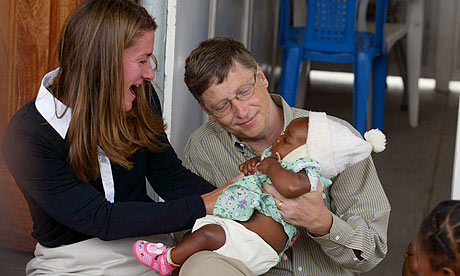
Bill and Melinda Gates predict that by 2035 "there will be almost no poor countries left in the world." [bold added]
a few unhappy countries will be held back by war, political realities (such as North Korea) or geography (such as landlocked states in central Africa). But every country in South America, Asia and Central America (except perhaps Haiti) and most in coastal Africa will have become middle-income nations. More than 70% of countries will have a higher per-person income than China does today.
If prosperity does become universal within a couple of decades, the 21st century will mark perhaps the greatest turning point in human history. And if his charitable works in no small part help to bring about that result, Bill Gates may well be known to future historians as a philanthropist who used to run a computer business. © 2014 Stephen Yuen

Friday, August 09, 2013

Whose Books Does Bill Gates Read?

Vaclav Smil has unconventional observations [bold added]:
If you ask “what has been the most important invention of the past 100, 150 years?” it’s been the synthesis of ammonia. If we could not synthesize ammonia by taking nitrogen from the air, hydrogen from natural gas and pressing them together in the Haber-Bosch cycle… if we could not do this to make nitrogen fertilizers, we could not grow enough food for about 40% of people. So you are talking about something like three billion people. In existential terms, that is the most important invention. [snip]

People think that we are getting better because we are dematerializing. Look at your iPhone. A perfect example of dematerialization. Before that you would need, what? An alarm clock. A telephone. A camera. A compass and a map. Now you don’t need any of these things — you just need one cellphone. So instead of having the mass of all these things like before, you dematerialize....

Many things are dematerializing, but they are dematerializing per unit. Yet we are selling many more units, so in total terms, global consumption is vastly increasing. This is like efficient energy consumption. We increase the efficiency of energy consumption, but have three televisions instead of one. Per refrigerator, per television, per car, the consumption is down. But overall, the consumption is up. [snip]

What would be the reason to rush into renewables? Global warming. But, China will burn every bit of coal it can lay its hands on. So whatever you do in the US or Germany, it’s irrelevant because China will wipe it out in a matter of weeks or months.
The example of Vaclav Smil shows that Bill Gates doesn't restrict his reading only to books that confirm his biases and predilections. That's why he's Bill Gates, and we aren't. © 2013 Stephen Yuen

Tuesday, February 07, 2012

Great Moments in Intellectual Property

What they said at the 1983 meeting between Steve Jobs and Bill Gates, when Microsoft announced plans for the graphical interface "Windows":
Jobs: "You're ripping us off! I trusted you, and now you're stealing from us!"

Gates: "Well, Steve, I think there's more than one way of looking at it. I think it's more like we both had this rich neighbor named Xerox and I broke into his house to steal the TV set and found out that you had already stolen it."

--From Steve Jobs, by Walter Isaacson