Showing posts with label Community. Show all posts

Sunday, April 07, 2024

A Progressive Sees the Social Benefits of Religion

(Atlantic image)
A self-proclaimed Progressive agnostic now laments the emptying of pews across America:
As an agnostic, I have spent most of my life thinking about the decline of faith in America in mostly positive terms. Organized religion seemed, to me, beset by scandal and entangled in noxious politics. So, I thought, what is there really to mourn? Only in the past few years have I come around to a different view. Maybe religion, for all of its faults, works a bit like a retaining wall to hold back the destabilizing pressure of American hyper-individualism, which threatens to swell and spill over in its absence...

Suddenly, in the 1990s, the ranks of nonbelievers surged. An estimated 40 million people—one in eight Americans—stopped going to church in the past 25 years, making it the “largest concentrated change in church attendance in American history,” according to the religion writer Jake Meador. In 2021, membership in houses of worship fell below a majority for the first time on record...

That relationship with organized religion provided many things at once: not only a connection to the divine, but also a historical narrative of identity, a set of rituals to organize the week and year, and a community of families. PRRI found that the most important feature of religion for the dwindling number of Americans who still attend services a few times a year included “experiencing religion in a community” and “instilling values in their children.”..

“Places that used to anchor community life, like libraries and school gyms and union halls, have become less accessible or shuttered altogether.” Many people, having lost the scaffolding of organized religion, seem to have found no alternative method to build a sense of community...

I’m not advocating that every atheist and agnostic in America immediately choose a world religion and commit themselves to weekly church (or synagogue, or mosque) attendance. But I wonder if, in forgoing organized religion, an isolated country has discarded an old and proven source of ritual at a time when we most need it. Making friends as an adult can be hard; it’s especially hard without a scheduled weekly reunion of congregants. Finding meaning in the world is hard too; it’s especially difficult if the oldest systems of meaning-making hold less and less appeal. It took decades for Americans to lose religion. It might take decades to understand the entirety of what we lost.
I appreciate what he's trying to do, but writer Derek Thompson's reconsideration of the value of religion is along utilitarian lines; just as Marxists trash religion because it causes more people to be anti-abortion or pro-military or less inclined to overthrow capitalism, religion is beneficial because it encourages face-to-face interactions, makes people put down their smartphones, gets them off the couch on Sunday mornings, etc.

"Go to church, young man, it's good for you," is not an inspiring motivator. Is the religion true, does it help explain what's going on with you and the world?--those are the reasons you should go.

Sunday, September 16, 2018

Doing It Right

One of the organizations we've long supported is Episcopal Relief and Development, which "provides relief in times of disaster and promotes sustainable development by identifying and addressing the root causes of suffering." In other words ERD "gives a man a fish" for disaster relief but "teaches a man to fish" to make a permanent difference.

CEO Robert Radtke
We spent the weekend at the Vallombrosa Center in Menlo Park, where we were brought up to date with Episcopal Relief's mission and operations. Last year's expenditures were $23.3 million (programs $19.6, administration $1.1, fundraising $2.6). 90% of donated dollars go directly to programs because administration and fundraising are partially funded by investment income and service-subsidies from the Episcopal Church. That's the principal reason I like ERD--the dollars go where they're supposed to go. (Charity Navigator gives the organization a four-star rating.)

Other takeaways:

1) Episcopal Relief has focused its sustained-development efforts on Women, Children, and Climate. While the latter is fraught with politics in the U.S. (because, IMHO, the climate-change movement tries to scold/strong-arm people into changing their behavior based on "science" that does not explain contradictory phenomena), ERD
focuses on how families and communities can work together to adapt to the effects of rapidly changing weather patterns. This work includes preparing for and recovering from climate-influenced events such as floods, hurricanes and other disasters.
No scolding, no politics, just preparation and recovery.

2) Episcopal Relief has embraced asset-based community development, which involves analyzing a community's existing assets (e.g., individuals, businesses, non-profit organizations, government) and their relationships. By marshaling these assets and relationships it's possible to effect positive change. In the United States "community organizing" has a negative connotation because of its association with wealth redistribution and identity politics, but in the so-called Third World the political element is much less emphasized. There is no rich uncle that can be tapped to save the community, it must save itself.

3) Episcopal Relief works alongside Anglican organizations who are "close to the ground" in order to make sure funds are spent judiciously. It declines to work in stricken areas where there is no Anglican presence. Such temperance is a point in its favor, IMHO.

4) Nearly half of donations are specified for aid for specific disasters (e.g., Haiti earthquake, Hurricane Sandy). Because funds are received fairly immediately, but disaster aid is spent--it's easy to waste--over a period of years, the accounting and ethical administration of these funds is not simple. I was impressed with the ERD leadership, which has clearly thought about this issue.

I have been critical about several aspects of the Episcopal Church. Episcopal Relief and Development is an example of the Church doing it right.

Sunday, February 14, 2016

A,B,C,D

When the local church announced that it would be hosting sessions on Asset Based Community Development (ABCD) during Lent, I had an instinctive negative reaction. The short description of ABCD contained terms like "sustainable development", "community", and "environment", all favorites of the Marxism progressivism to which our bishop and many of our clergy adhere. (Just to be clear, your humble blogger supports to varying degrees these activities on an individual basis; when featured prominently together, however, they signal common cause with a political group that is not mine. See dog-whistle politics.)

But there was a pleasant surprise: the first session did not bash capitalism and did not advocate an expanded central government to correct society's wrongs. According to Episcopal Relief and Development [bold added]
Asset-Based Community Development (ABCD) is an approach that catalyzes change and development based on utilizing the existing gifts and capacities of people and their communities. The ABCD model discourages development brought in from an outside source, but rather energizes change and development from within.
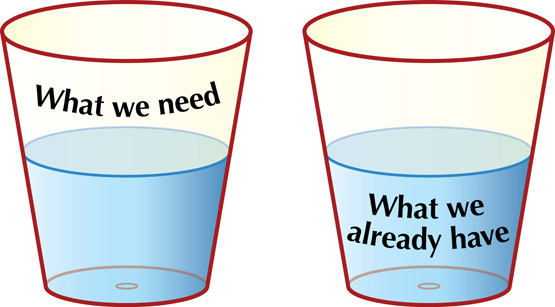
(Image from communitypartnering.info)
ABCD seeks to make changes to the community based on existing individuals, associations, institutions, physical assets, and connections. The traditional model of starting with wants (for example, affordable housing) seeks outside help, which becomes permanent and creates dependency.

In other words ABCD says, let's start with our assets to see what we can do, not list our wants to see what we can get. I'll attend the next session to see where this goes.