Today's Google Doodle depicts the 1965 march from Selma to Montgomery in honor of Martin Luther King, Jr. As a pre-teen, I read about Selma in the two Honolulu newspapers, but it had little resonance.
In Hawaii everyone was race-conscious, but there seemed to be very little overt racism. My eighth-grade (haole) teacher had a theory that racial resentment in Hawaii was defused because each race could point to its own wealthy, powerful representatives (Chinese real estate moguls, Caucasian businessmen, Japanese politicians, etc.). Also, there were very few African-Americans in the islands; most of the ones I saw were in the military, and they certainly appeared "normal", not like the activists who were in the news.
The passions that triggered the civil rights movement and the Watts riots became real when I went to the Mainland for college. Many of my fellow students were obsessed with racial identity; they told me that I should feel angry about the way Asian-Americans were treated, and that white Americans resented all Asians because of Vietnam.
For guidance I turned to the writings and speeches of Martin Luther King, Jr. They were consistent with traditional American ideals and were a call to action to ensure that all Americans had the rights to which they were entitled under the Constitution. To spur a recalcitrant society towards that goal he fleshed out the theory and practice of non-violent civil disobedience. I came to understand, less than a decade after his death, why he is so revered.
Today Martin Luther King, Jr. would have turned 95. The assassin's bullet cut short his life at the age of 39, much too soon.
Showing posts with label civil rights. Show all posts
Monday, January 15, 2024
Monday, January 16, 2023
MLK Day, 2023
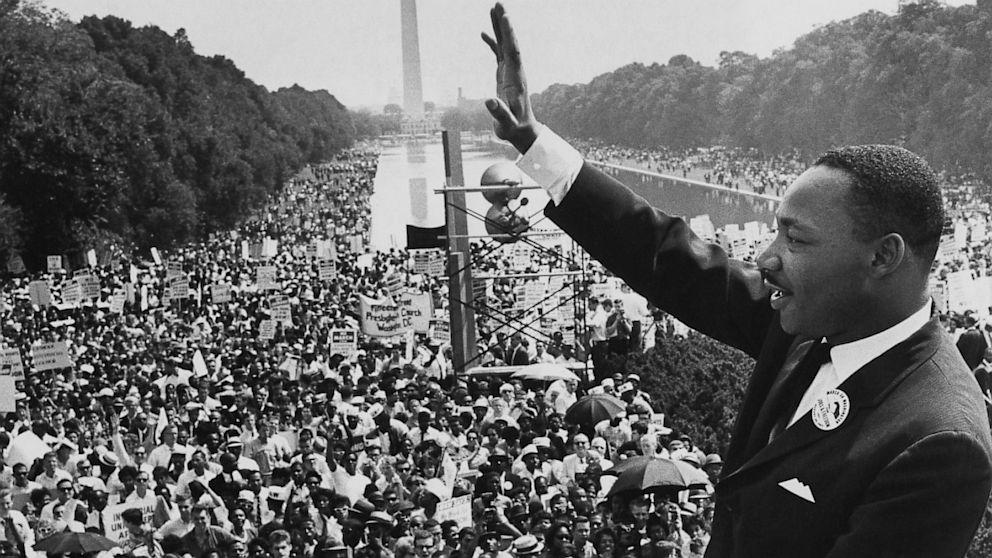
Note: August 28, 2023 will be the 60th anniversary of Martin Luther King, Jr.'s "I Have a Dream" speech.
After re-reading my previous posts on Martin Luther King Day, the great man seems more relevant than ever to this boomer blogger. Unfortunately, his doctrine of non-violent civil disobedience seems increasingly quaint. Today speakers will honor him, all the while willfully ignoring what he called them to do. We must not allow our creative protest to degenerate into physical violence.
From 2010:
Martin Luther King, Jr. was an American original whose stature has only grown since his assassination in 1968. His I Have a Dream speech and Letter from Birmingham Jail are masterpieces of the rhetorical art, replete with religious themes, historical references, and poetic flourishes. Dr. King pushed, pulled, and forced a preoccupied postwar superpower to confront the difference between its glossy self-image and ugly racist reality.
He did this by conveying a vision of an America that was full of hope and was consistent with its founding ideals. He delivered that vision in soaring preacherly cadences that called, if not compelled, his audiences to act. On the holiday of his remembrance Dr. King's wisdom has not dulled with time's passage:
On non-violence:
From 2010:
Martin Luther King, Jr. was an American original whose stature has only grown since his assassination in 1968. His I Have a Dream speech and Letter from Birmingham Jail are masterpieces of the rhetorical art, replete with religious themes, historical references, and poetic flourishes. Dr. King pushed, pulled, and forced a preoccupied postwar superpower to confront the difference between its glossy self-image and ugly racist reality.
He did this by conveying a vision of an America that was full of hope and was consistent with its founding ideals. He delivered that vision in soaring preacherly cadences that called, if not compelled, his audiences to act. On the holiday of his remembrance Dr. King's wisdom has not dulled with time's passage:
On non-violence:
In the process of gaining our rightful place we must not be guilty of wrongful deeds. Let us not seek to satisfy our thirst for freedom by drinking from the cup of bitterness and hatred. We must forever conduct our struggle on the high plane of dignity and discipline. We must not allow our creative protest to degenerate into physical violence.On the difference between just and unjust laws:
An unjust law is a code that a numerical or power majority group compels a minority group to obey but does not make binding on itself. This is difference made legal. By the same token, a just law is a code that a majority compels a minority to follow and that it is willing to follow itself. This is sameness made legal.On civil disobedience:
In no sense do I advocate evading or defying the law, as would the rabid segregationist. That would lead to anarchy. One who breaks an unjust law must do so openly, lovingly, and with a willingness to accept the penalty. I submit that an individual who breaks a law that conscience tells him is unjust and who willingly accepts the penalty of imprisonment in order to arouse the conscience of the community over its injustice, is in reality expressing the highest respect for law.How to effect peaceful change:
In any nonviolent campaign there are four basic steps: collection of the facts to determine whether injustices exist; negotiation; self-purification; and direct action.Dr. King asked his followers to “purify” themselves, that is, lead blameless lives in accordance with the very principles that they would demand others follow. Walking the talk remains as difficult as it is noble, and it is as relevant to leadership today as it was 60--and 2,000--years ago. © 2023 Stephen Yuen
Friday, August 05, 2022
California: More Lenient Laws For Government Than Everyone Else
![]() |
| Small businesses are plagued by lawsuits filed under the American with Disabilities Act. |
California businesses that discriminate against a customer can be sued for penalties of at least $4,000 and damages of as much as three times the harm they inflicted. But the same penalties do not apply to public schools that violate their students’ rights, the state Supreme Court ruled Thursday in the case of a disabled student from Contra Costa County.In this case the double standard doesn't lie with the state Supreme Court which is just interpreting the laws as written, but with the legislature. This is yet another example of the government applying more lenient rules to itself than it does to everyone else.
The 1959 California law, the Unruh Act, applies to civil rights violations by “business establishments.” And “public schools, as governmental entities engaged in the provision of a free and public education, are not ‘business establishments’ within the meaning of the act,” Justice Joshua Groban wrote in the 7-0 decision.
I often wish that the Progressives who want the government to run everything would look at the consequence of them getting their wish. Government exempts itself from penalties or remedies or shortages, there is no appeal, and we are all immiserated.
Monday, January 17, 2022
MLK Day, 2022
No changes are necessary to last year's post on one of the great men of the 20th century:
After re-reading my previous posts on Martin Luther King Day, the great man seems more relevant than ever to this boomer blogger. Unfortunately, his doctrine of non-violent civil disobedience seems increasingly quaint. Today speakers will honor him, all the while willfully ignoring what he called them to do. We must not allow our creative protest to degenerate into physical violence.
From 2010:
Martin Luther King, Jr. was an American original whose stature has only grown since his assassination in 1968. His I Have a Dream speech and Letter from Birmingham Jail are masterpieces of the rhetorical art, replete with religious themes, historical references, and poetic flourishes. Dr. King pushed, pulled, and forced a preoccupied postwar superpower to confront the difference between its glossy self-image and ugly racist reality.
He did this by conveying a vision of an America that was full of hope and was consistent with its founding ideals. He delivered that vision in soaring preacherly cadences that called, if not compelled, his audiences to act. On the holiday of his remembrance Dr. King's wisdom has not dulled with time's passage:
On non-violence:
From 2010:
Martin Luther King, Jr. was an American original whose stature has only grown since his assassination in 1968. His I Have a Dream speech and Letter from Birmingham Jail are masterpieces of the rhetorical art, replete with religious themes, historical references, and poetic flourishes. Dr. King pushed, pulled, and forced a preoccupied postwar superpower to confront the difference between its glossy self-image and ugly racist reality.
He did this by conveying a vision of an America that was full of hope and was consistent with its founding ideals. He delivered that vision in soaring preacherly cadences that called, if not compelled, his audiences to act. On the holiday of his remembrance Dr. King's wisdom has not dulled with time's passage:
On non-violence:
In the process of gaining our rightful place we must not be guilty of wrongful deeds. Let us not seek to satisfy our thirst for freedom by drinking from the cup of bitterness and hatred. We must forever conduct our struggle on the high plane of dignity and discipline. We must not allow our creative protest to degenerate into physical violence.On the difference between just and unjust laws:
An unjust law is a code that a numerical or power majority group compels a minority group to obey but does not make binding on itself. This is difference made legal. By the same token, a just law is a code that a majority compels a minority to follow and that it is willing to follow itself. This is sameness made legal.On civil disobedience:
In no sense do I advocate evading or defying the law, as would the rabid segregationist. That would lead to anarchy. One who breaks an unjust law must do so openly, lovingly, and with a willingness to accept the penalty. I submit that an individual who breaks a law that conscience tells him is unjust and who willingly accepts the penalty of imprisonment in order to arouse the conscience of the community over its injustice, is in reality expressing the highest respect for law.How to effect peaceful change:
In any nonviolent campaign there are four basic steps: collection of the facts to determine whether injustices exist; negotiation; self-purification; and direct action.Dr. King asked his followers to “purify” themselves, that is, lead blameless lives in accordance with the very principles that they would demand others follow. Walking the talk remains as difficult as it is noble, and it is as relevant to leadership today as it was 59--and 2,000--years ago. © 2022 Stephen Yuen
Saturday, September 11, 2021
20 Years Later
On the 10th anniversary of the 9/11 attacks, I posted the following, now updated with minor edits, using strikethroughs and italics:
============================================================
I saw it on TV, like almost everyone else. I shuffled to the kitchen table with my cup of coffee and pushed the remote. The TV was set to Channel 11, NBC. It was 5:45 a.m. The Today Show was on; strange, normally it doesn't start till 7 a.m. on the West Coast.
The camera was fixed on the World Trade Center. Black smoke was pouring out of one of the towers. There were no jump cuts or commercials to distract the unblinking eye. Katie Couric's voice seemed dispassionate as she described how an airplane had crashed into the building. Surely it was a small plane and a horrible accident.
Then the second jet hit, another struck the Pentagon, and the towers fell. Other images are seared into our memories--the Pennsylvania field that became hallowed ground, the throngs who lustily cheered the deaths of thousands, flames and smoke everywhere, the weeping, the exhausted searching and the death of hope.
The fear gripped us for a long time. Not knowing has that effect. Who did it and why, how powerful were they, what's next, what should we do, what can I do?
Everyone--even those who were in charge of our government--can list major mistakes in the pastten twenty years. All the criticisms have at least some plausibility: we waged war against the wrong people, maybe we shouldn't have gone to war at all, we mistreated prisoners, we had intelligence that was grossly wrong, we sacrificed too many of our civil liberties, we didn't pay the cost of the wars, and we are no farther only a little further along in being energy independent or securing the safety of Israel.
But if we are honest with ourselves, we will remember the worst of our fears:
1) we would be hit again and perhaps lose a major city; this event coupled with our response, could forever change the character of America;
2) if the attack were biological, we could lose much more than one city;
3) oil supplies would be disrupted, maybe cut off for a long time, and usher in a new Dark Ages;
4) Israel, surrounded by powerful enemies, could be destroyed.
5) A state of war would exist between the West and the Islamic world, which has over a billion people.
Ten Twenty years and trillions of dollars later none of these fears has been realized, yet victory, which we can't even define, seems as distant as it was in 2001.
I'll take it. © 2011 Stephen Yuen
============================================================
![]() |
| (Reuters photo) |
The camera was fixed on the World Trade Center. Black smoke was pouring out of one of the towers. There were no jump cuts or commercials to distract the unblinking eye. Katie Couric's voice seemed dispassionate as she described how an airplane had crashed into the building. Surely it was a small plane and a horrible accident.
Then the second jet hit, another struck the Pentagon, and the towers fell. Other images are seared into our memories--the Pennsylvania field that became hallowed ground, the throngs who lustily cheered the deaths of thousands, flames and smoke everywhere, the weeping, the exhausted searching and the death of hope.
The fear gripped us for a long time. Not knowing has that effect. Who did it and why, how powerful were they, what's next, what should we do, what can I do?
Everyone--even those who were in charge of our government--can list major mistakes in the past
But if we are honest with ourselves, we will remember the worst of our fears:
1) we would be hit again and perhaps lose a major city; this event coupled with our response, could forever change the character of America;
2) if the attack were biological, we could lose much more than one city;
3) oil supplies would be disrupted, maybe cut off for a long time, and usher in a new Dark Ages;
4) Israel, surrounded by powerful enemies, could be destroyed.
5) A state of war would exist between the West and the Islamic world, which has over a billion people.
I'll take it. © 2011 Stephen Yuen
Monday, January 18, 2021
MLK Day, 2021
From 2010:
Martin Luther King, Jr. was an American original whose stature has only grown since his assassination in 1968. His I Have a Dream speech and Letter from Birmingham Jail are masterpieces of the rhetorical art, replete with religious themes, historical references, and poetic flourishes. Dr. King pushed, pulled, and forced a preoccupied postwar superpower to confront the difference between its glossy self-image and ugly racist reality.
He did this by conveying a vision of an America that was full of hope and was consistent with its founding ideals. He delivered that vision in soaring preacherly cadences that called, if not compelled, his audiences to act. On the holiday of his remembrance Dr. King's wisdom has not dulled with time's passage:
On non-violence:
In the process of gaining our rightful place we must not be guilty of wrongful deeds. Let us not seek to satisfy our thirst for freedom by drinking from the cup of bitterness and hatred. We must forever conduct our struggle on the high plane of dignity and discipline. We must not allow our creative protest to degenerate into physical violence.On the difference between just and unjust laws:
An unjust law is a code that a numerical or power majority group compels a minority group to obey but does not make binding on itself. This is difference made legal. By the same token, a just law is a code that a majority compels a minority to follow and that it is willing to follow itself. This is sameness made legal.On civil disobedience:
In no sense do I advocate evading or defying the law, as would the rabid segregationist. That would lead to anarchy. One who breaks an unjust law must do so openly, lovingly, and with a willingness to accept the penalty. I submit that an individual who breaks a law that conscience tells him is unjust and who willingly accepts the penalty of imprisonment in order to arouse the conscience of the community over its injustice, is in reality expressing the highest respect for law.How to effect peaceful change:
In any nonviolent campaign there are four basic steps: collection of the facts to determine whether injustices exist; negotiation; self-purification; and direct action.Dr. King asked his followers to “purify” themselves, that is, lead blameless lives in accordance with the very principles that they would demand others follow. Walking the talk remains as difficult as it is noble, and it is as relevant to leadership today as it was 58--and 2,000--years ago. © 2021 Stephen Yuen
Tuesday, September 08, 2020
Lies, Damned Lies, and Headlines
![]() |
| Peaceful protest, no photos of violence in Time. |
Headline: 93% of Black Lives Matter Protests Have Been Peaceful, New Report Finds
The use of percentages is a dead giveaway that the writer is trying to downplay the violence, rioting, and destruction in some BLM demonstrations. Here's the text: [bold added]
The Armed Conflict Location & Event Data Project (ACLED) analyzed more than 7,750 Black Lives Matter demonstrations in all 50 states and Washington D.C. that took place in the wake of George Floyd’s death between May 26 and August 22.The meaning would be quite different if, using the same facts, the headline were
Their report states that more than 2,400 locations reported peaceful protests, while fewer than 220 reported “violent demonstrations.” The authors define violent demonstrations as including “acts targeting other individuals, property, businesses, other rioting groups or armed actors.” Their definition includes anything from “fighting back against police” to vandalism, property destruction looting, road-blocking using barricades, burning tires or other materials. In cities where protests did turn violent—these demonstrations are “largely confined to specific blocks,” the report says.
"220 U.S. Locations Report Violent Demonstrations in 3 Months".
![]() |
| Source: NY Times 9/7/2020 |
Reporters who wanted to downplay the virus' magnitude could say only 1.9% of the U.S. population (328.2 million) have contracted the disease, and if someone is unlucky enough to have been infected, he has a 97% chance of survival. To really minimize the virus' importance one could say that an American has a less than 0.1% chance of dying from it this year.
None of the above is an opinion about BLM violence or COVID-19's severity. It just illuminates what the media would like you to think--BLM violence occurs rarely, while COVID-19 is spreading out of control. Read and believe what you want, dear reader, but do read critically.
Monday, January 21, 2019
Now, More Than Ever
From a speech by a great American in 1963:
Push ahead determinedly but always peaceably, and dream of an America where "my four little children will one day live in a nation where they will not be judged by the color of their skin but by the content of their character." I miss that guy.In the process of gaining our rightful place we must not be guilty of wrongful deeds. Let us not seek to satisfy our thirst for freedom by drinking from the cup of bitterness and hatred. We must forever conduct our struggle on the high plane of dignity and discipline. We must not allow our creative protests to degenerate into physical violence. Again and again we must rise to the majestic heights of meeting physical force with soul force.
(Washington Post photo)
Monday, January 15, 2018
MLK Day, 2018
From the Letter from Birmingham Jail:
![]() |
| (Washington Post photo) |
In no sense do I advocate evading or defying the law, as would the rabid segregationist. That would lead to anarchy. One who breaks an unjust law must do so openly, lovingly, and with a willingness to accept the penalty. I submit that an individual who breaks a law that conscience tells him is unjust and who willingly accepts the penalty of imprisonment in order to arouse the conscience of the community over its injustice, is in reality expressing the highest respect for law.Martin Luther King, Jr.'s actions, words, and the thought behind them made him remarkable in a century filled with great men (Churchill, Gandhi, Roosevelt(s), Einstein, Picasso, Hemingway, Pope John XXIII, to name a few).
Monday, January 16, 2017
MLK Day, 2017
Last year's post, with an addendum:
The death of Martin Luther King, Jr., occurred when I was a teenager. I admired his speeches but knew little else about him. He was part of the societal eruptions occurring on the Mainland, and wasn’t the FBI investigating him, and weren’t there rumors that he was a communist?
Race riots, the civil rights movement, Vietnam war protests, drugs, the Russo-Chinese axis, and finally the granddaddy of worries—nuclear war—all made for an unsettled Sixties. The murder of Martin Luther King in 1968, one of the most eventful years of the 20th century, was another sign of a very unstable world.
The world, of course, did survive the tumult, and with distance comes reflection and perspective. For me Dr. King is one of those rare individuals whose greatness has increased with the passage of time. His “I Have a Dream” speech is as compelling—and relevant—as ever, and his “Letter from a Birmingham Jail” is a soul-searching treatise on civil disobedience. Only recently have I begun to appreciate its wisdom.
Dr. King's words, like the Bible, have been used by people to support opposing sides of various issues. Usually at least one side engages in cherry-picking; an honest reading in context will likely make it clear where he would have stood.
For example, gay rights may be analogized to the battle against segregation.
Addendum: the Letter from a Birmingham Jail has something to say about the debate over a voter identification law (one side says it would prevent fraud, the other says it would cause intimidation). Would such a law be unjust? Your humble blogger would cheerfully show his ID to vote, as would the presumed majority who would support its enactment. In other words the majority would make the law binding on itself, making voter ID a just law by Martin Luther King's definition.
![]() |
| At the 1963 March on Washington (ABC news) |
Race riots, the civil rights movement, Vietnam war protests, drugs, the Russo-Chinese axis, and finally the granddaddy of worries—nuclear war—all made for an unsettled Sixties. The murder of Martin Luther King in 1968, one of the most eventful years of the 20th century, was another sign of a very unstable world.
The world, of course, did survive the tumult, and with distance comes reflection and perspective. For me Dr. King is one of those rare individuals whose greatness has increased with the passage of time. His “I Have a Dream” speech is as compelling—and relevant—as ever, and his “Letter from a Birmingham Jail” is a soul-searching treatise on civil disobedience. Only recently have I begun to appreciate its wisdom.
Dr. King's words, like the Bible, have been used by people to support opposing sides of various issues. Usually at least one side engages in cherry-picking; an honest reading in context will likely make it clear where he would have stood.
For example, gay rights may be analogized to the battle against segregation.
An unjust law is a human law that is not rooted in eternal law and natural law. Any law that uplifts human personality is just. Any law that degrades human personality is unjust. All segregation statutes are unjust because segregation distorts the soul and damages the personality. It gives the segregator a false sense of superiority and the segregated a false sense of inferiority.Another example: the hypocrisy of climate change celebrities and billionaires who use private jets and own multiple estates.
An unjust law is a code that a numerical or power majority group compels a minority group to obey but does not make binding on itself. This is difference made legal. By the same token, a just law is a code that a majority compels a minority to follow and that it is willing to follow itself. This is sameness made legal.Martin Luther King, Jr.: something to like---and not like---for everyone.
Addendum: the Letter from a Birmingham Jail has something to say about the debate over a voter identification law (one side says it would prevent fraud, the other says it would cause intimidation). Would such a law be unjust? Your humble blogger would cheerfully show his ID to vote, as would the presumed majority who would support its enactment. In other words the majority would make the law binding on itself, making voter ID a just law by Martin Luther King's definition.
Saturday, March 12, 2016
Where Backwardness is Sought
Affirmative action, a term that originated in the Kennedy Administration, had begun with the best of intentions: a method of redressing discrimination that had persisted in spite of civil rights laws and constitutional guarantees.
More than 50 years later, this humble blogger is of the opinion that affirmative action has outlived its usefulness. Too many resources are now devoted to claiming membership in "disadvantaged" groups that ironically are granted advantages through force of law. Affirmative action causes individuals to emphasize their differences; it exacerbates, not reduces, conflict. The above statements about human behavior and motivations are disputed in the United States; they are not so in India. [bold added]
![]() |
| Jats protest in Haryana (Hindustan Times) |
Haryana’s Jats are angry. [Blogger's note: the state of Haryana has roughly 25 million people, of which 25%--6 to 7 million--are Jats.] Jealous that weaker, lower-caste groups get government aid, they want to be classified as equally deserving. Protests that started peacefully soon turned violent as rioters looted, pillaged and raped and blocked roads, railways and, most alarmingly, also a canal that supplies about half of Delhi’s water.Corrective programs do address needs, but they often not only continue but expand with their original purpose transformed, long after the original problems have subsided.
Since India’s independence, the government has made provisions to uplift the most downtrodden members of the caste system, known as Dalits, most often by means of state favours known as “reservations”: jobs and slots at universities set aside for the people who had been least likely to enjoy their benefits. None of the riots have been started by Dalits, who were traditionally known as “untouchables”. It is relatively clear who counts as a Dalit: about a quarter of the country’s population qualifies, including remote tribal groups. But since 1990 the national government has allowed other, somewhat less disadvantaged groups to claim similar benefits, if they can establish that they belong to the “Other Backward Classes” (OBCs). There are 11 formal criteria for admission into the ranks of the OBCs, but these are open to interpretation. Dalits and OBCs together may claim as many as 50% of a given state’s reservations. The Jats of Haryana, like the Patidars of Gujarat or the Kapus of Andhra Pradesh, all want to be counted among the OBCs to gain a slice of the social-welfare pie to which lowlier castes are entitled.
Monday, January 18, 2016
Growing in Greatness
![]() |
| At the 1963 March on Washington (ABC news) |
Race riots, the civil rights movement, Vietnam war protests, drugs, the Russo-Chinese axis, and finally the granddaddy of worries—nuclear war—all made for an unsettled Sixties. The murder of Martin Luther King in 1968, one of the most eventful years of the 20th century, was another sign of a very unstable world.
The world, of course, did survive the tumult, and with distance comes reflection and perspective. For me Dr. King is one of those rare individuals whose greatness has increased with the passage of time. His “I Have a Dream” speech is as compelling—and relevant—as ever, and his “Letter from a Birmingham Jail” is a soul-searching treatise on civil disobedience. Only recently have I begun to appreciate its wisdom.
Dr. King's words, like the Bible, have been used by people to support opposing sides of various issues. Usually at least one side engages in cherry-picking; an honest reading in context will likely make it clear where he would have stood.
For example, gay rights may be analogized to the battle against segregation.
An unjust law is a human law that is not rooted in eternal law and natural law. Any law that uplifts human personality is just. Any law that degrades human personality is unjust. All segregation statutes are unjust because segregation distorts the soul and damages the personality. It gives the segregator a false sense of superiority and the segregated a false sense of inferiority.Another example: the hypocrisy of climate change celebrities and billionaires who use private jets and own multiple estates.
An unjust law is a code that a numerical or power majority group compels a minority group to obey but does not make binding on itself. This is difference made legal. By the same token, a just law is a code that a majority compels a minority to follow and that it is willing to follow itself. This is sameness made legal.Martin Luther King, Jr.: something to like---and not like---for everyone.
Thursday, August 29, 2013
The Greatest American Speech
It has been called the greatest American speech of the 20th century. Yesterday marked its 50th anniversary.
I first saw the newsfilm of "I Have a Dream" in its entirety in 1969, the year after Martin Luther King, Jr., was assassinated. In truth I wasn't ready to appreciate it in 1963 when I was a pre-teen.
Growing up in Hawaii my friends and I were all far removed from the civil rights movement, Mississippi and Alabama. Our class had one African-American student, a friendly guy and a terrific athlete (!). It didn't seem comprehensible that some people could hate our classmate because of the color of his skin. In retrospect, although he seemed to fit in with the multiracial student body, I have absolutely no idea what he really thought or felt. (It turned out that another black kid in our elementary school at that time did feel out of place.)
The greatest American speech surprised me with its power and, yes, beauty. Sure, I had read its text, but watching Dr. King and hearing his preacherly cadences calling forth the best in each listener filled this then-teenager with emotion. He and John F. Kennedy two years earlier had asked us to look to the mountaintop. Their dreams seemed impossible, but with these men leading us perhaps we had a chance to get there. In the wink of an eye they were both gone.
I first saw the newsfilm of "I Have a Dream" in its entirety in 1969, the year after Martin Luther King, Jr., was assassinated. In truth I wasn't ready to appreciate it in 1963 when I was a pre-teen.
Growing up in Hawaii my friends and I were all far removed from the civil rights movement, Mississippi and Alabama. Our class had one African-American student, a friendly guy and a terrific athlete (!). It didn't seem comprehensible that some people could hate our classmate because of the color of his skin. In retrospect, although he seemed to fit in with the multiracial student body, I have absolutely no idea what he really thought or felt. (It turned out that another black kid in our elementary school at that time did feel out of place.)
The greatest American speech surprised me with its power and, yes, beauty. Sure, I had read its text, but watching Dr. King and hearing his preacherly cadences calling forth the best in each listener filled this then-teenager with emotion. He and John F. Kennedy two years earlier had asked us to look to the mountaintop. Their dreams seemed impossible, but with these men leading us perhaps we had a chance to get there. In the wink of an eye they were both gone.
Saturday, March 03, 2012
Two Points of View
...about when the battle is won.
Attorney General Eric Holder on affirmative action:
Holder expressed support for affirmative action, saying that he “can’t actually imagine a time in which the need for more diversity would ever cease.”The Rev. Martin Luther King, Jr. on civil rights:
“Affirmative action has been an issue since segregation practices,” Holder said. “The question is not when does it end, but when does it begin ... When do people of color truly get the benefits to which they are entitled?”
There are those who are asking the devotees of civil rights, "When will you be satisfied?" We can never be satisfied as long as the Negro is the victim of the unspeakable horrors of police brutality. We can never be satisfied as long as our bodies, heavy with the fatigue of travel, cannot gain lodging in the motels of the highways and the hotels of the cities. We cannot be satisfied as long as the negro's basic mobility is from a smaller ghetto to a larger one. We can never be satisfied as long as our children are stripped of their self-hood and robbed of their dignity by signs stating: "For Whites Only." We cannot be satisfied as long as a Negro in Mississippi cannot vote and a Negro in New York believes he has nothing for which to vote. No, no, we are not satisfied, and we will not be satisfied until "justice rolls down like waters, and righteousness like a mighty stream."
Monday, January 18, 2010
Martin Luther King, Jr.
He did this by conveying a vision of an America that was full of hope and was consistent with its founding ideals. He delivered that vision in soaring preacherly cadences that called, if not compelled, his audiences to act. On the holiday of his remembrance Dr. King's wisdom has not dulled with time's passage:
On non-violence:
In the process of gaining our rightful place we must not be guilty of wrongful deeds. Let us not seek to satisfy our thirst for freedom by drinking from the cup of bitterness and hatred. We must forever conduct our struggle on the high plane of dignity and discipline. We must not allow our creative protest to degenerate into physical violence.On the difference between just and unjust laws:
An unjust law is a code that a numerical or power majority group compels a minority group to obey but does not make binding on itself. This is difference made legal. By the same token, a just law is a code that a majority compels a minority to follow and that it is willing to follow itself. This is sameness made legal.On civil disobedience:
In no sense do I advocate evading or defying the law, as would the rabid segregationist. That would lead to anarchy. One who breaks an unjust law must do so openly, lovingly, and with a willingness to accept the penalty. I submit that an individual who breaks a law that conscience tells him is unjust and who willingly accepts the penalty of imprisonment in order to arouse the conscience of the community over its injustice, is in reality expressing the highest respect for law.How to effect peaceful change:
In any nonviolent campaign there are four basic steps: collection of the facts to determine whether injustices exist; negotiation; self-purification; and direct action.Dr. King asked his followers to “purify” themselves, that is, lead blameless lives in accordance with the very principles that they would demand others follow. Walking the talk remains as difficult as it is noble, and it is as relevant to leadership today as it was 47--and 2,000--years ago. © 2010 Stephen Yuen
Subscribe to:
Posts (Atom)