Showing posts with label Florence. Show all posts

Saturday, April 01, 2006

Grace Under Pressure

Despite overwhelming international opposition, the American leadership bulls ahead. Entreaties to go slow fall on deaf ears. Novel ideas are adopted as policy, and understandings that have developed over the centuries are cast aside like so much excess baggage. The mechanisms of international communication and cooperative action are in tatters and may never be repaired. We are speaking, of course, of the ordination of declared, non-celibate homosexuals to the rank of Bishop of the Episcopal Church. Nearly three years ago Gene Robinson was elevated to Bishop of the Diocese of New Hampshire. And now the sexual orientation of three of the seven candidates to replace retiring California Bishop William Swing raises the possibility that a second non-celibate gay bishop will be elected. The worldwide Anglican Communion faces schism.


Grace Cathedral: Gay Fray Mobs Nob Job

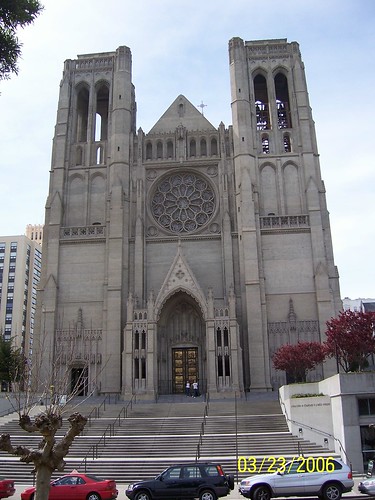
Last week the rain abated, so I walked up Nob Hill, past the diocesan offices, to Grace Cathedral. When one enters the sanctuary, one should put aside all thoughts of controversy and conflict.

A man and a woman, not together, were walking the labyrinth. The man was charging along the path as if he wanted to get it over with quickly. He ignored or was not aware of the labyrinth’s purpose: to assist the traveler in his meditations by imparting a sense of the Divine. Perhaps the man was a tourist and was rushing through the path just to say he did it, a microcosm of how most of us appear to be leading our lives. The woman was lost in thought as she traced the carpeted lines with her bare feet. At least she appeared to get the point.
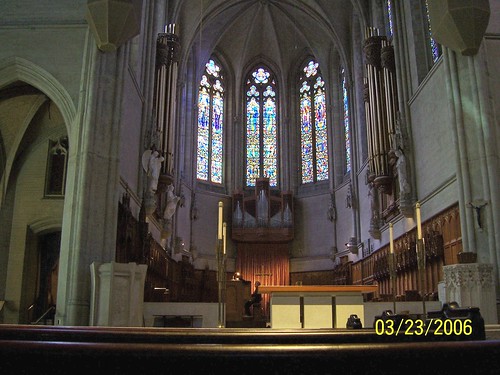
The organist was practicing for next Sunday and had let out the stops. Strains from the pipe organ reverberated through the cavernous room, and sunlight from the stained glass played across the altar. I felt awe and humility, unfamiliar emotions in an intimate age that converses with a personal deity. Beneath the high arches one’s daily preoccupations are revealed for the trivial distractions that they are.

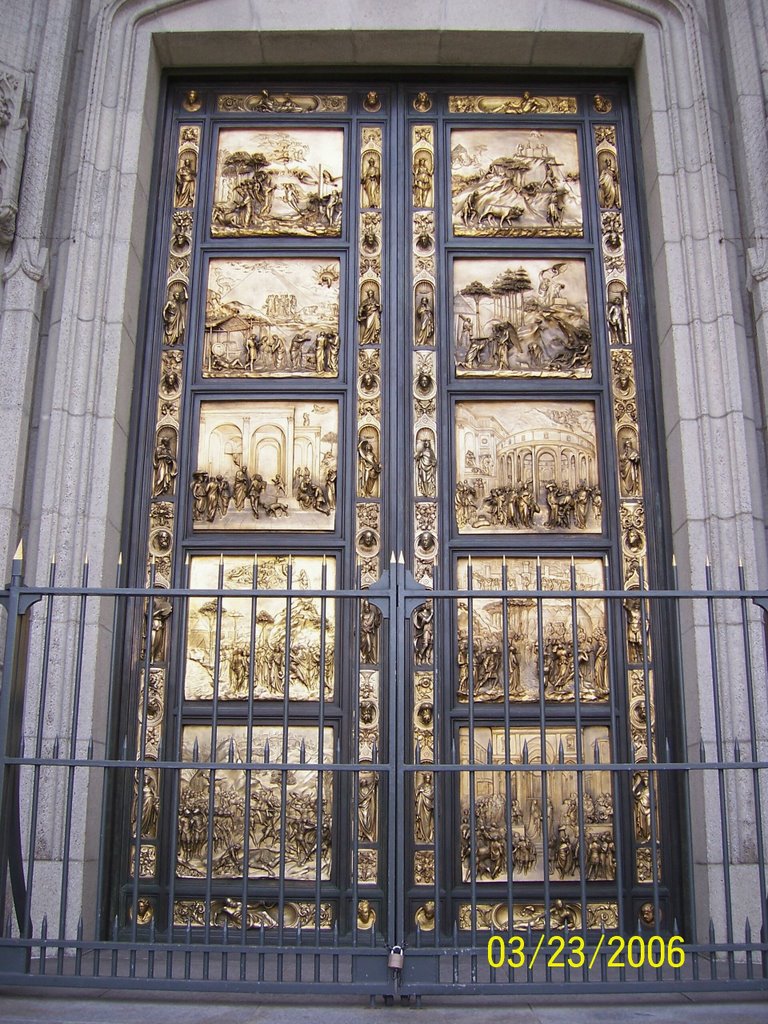
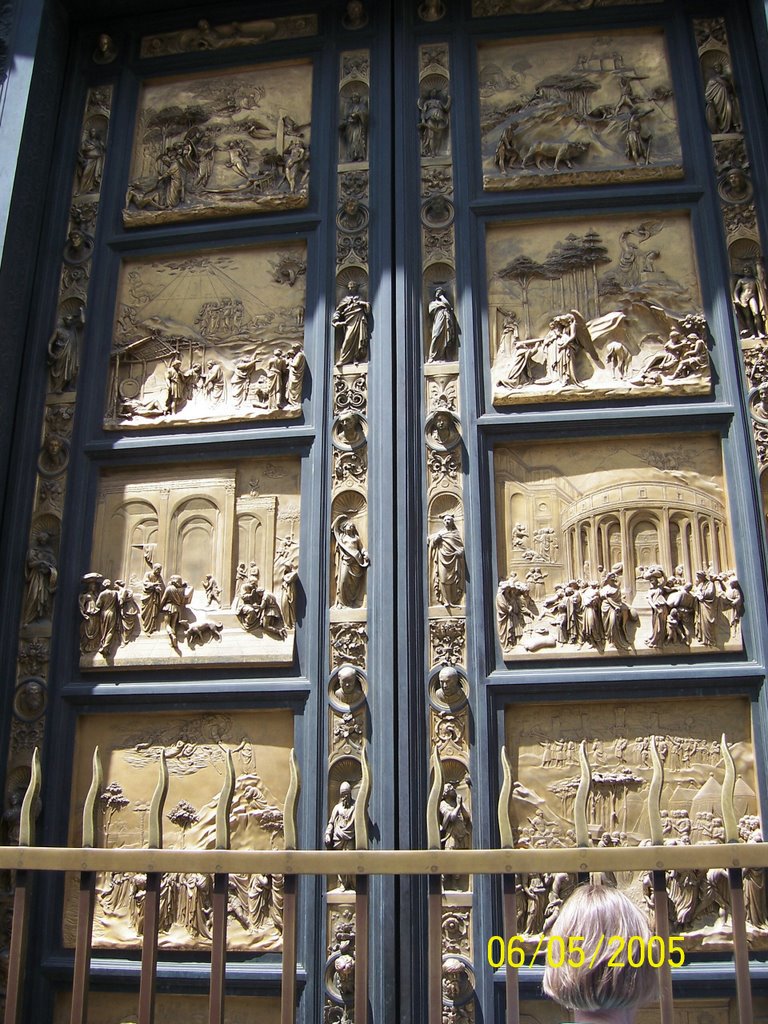
Exiting into the sunshine, my concerns having been put in perspective,I paused at Ghiberti’s Doors of Paradise. Grace Cathedral’s replica (left) of the Renaissance masterpiece, another gem in this city of under-appreciated jewels, was in better shape than its Florentine counterpart (right)--replicas themselves, the originals having been moved indoors to a museum. [Note: other pictures from my Florence trip last year may be found here.] © 2006 Stephen Yuen
Saturday, June 18, 2005

Small Talk

Rooftop of Westin Marriott, Florence

Data, the android in Star Trek: the Next Generation, had great difficulty mastering the subtleties of human behavior. In one episode he attended a cocktail party and attempted to practice the art of “small talk”. His feeble attempts to engage in dialogue paled before the pontificating politician who could expound at length on the weather and other trivialities. Watching the diplomat babble—and Data’s quizzical expression—was a great comic moment in the series.

I’ve always admired the conversationalist who can come up with interesting things to say about any topic. But the key to small talk proficiency is not the possession of erudition or brilliance but simply the ability to respond as if one had been listening closely to what the other party has been saying. People warm to flattery, and there is nothing more flattering than someone paying attention to what we’re saying.

Sure, one has to perfect a few icebreaking lines, but at a business conference 1) how long have you worked for Acme Corp., 2) did you have a nice flight, or 3) have you always lived in London / New York / Tokyo are usually enough to get the ball rolling.

I was doing well on this trip until I made the mistake of asking a woman about her family (in my defense, in every conversation that I had had during the past few days people talked about their kids), and she, with a pained expression, asked to change the subject. I beat a hasty retreat by turning the conversation to the magnificent city in which we were having our conference. In Florence it’s easy to put aside one’s problems and be swept away by history. &copy 2005 Stephen Yuen

Monday, June 13, 2005

David


Five hundred years later, the David’s nudity still startles. No fig leafs for Michelangelo, who not only would sculpt an anatomically correct man---the man would be perfect, and he would be 16 feet tall.

In the world of the 15th century the human physique was not yet widely celebrated. Doctors could not even examine the bodies of their living patients, and artists such as Michelangelo and Leonardo were forced to visit morgues in the dead of night to study the human form.

Michelangelo’s David is not the slender stripling of Biblical legend but a handsome youth of princely mien. He gazes intently at his opponent---close-ups of his face show a hint of fear, but you can see a mind feverishly at work. The left hand, holding the sling, is raised to his shoulder, while the right, holding the stone, rests on his thigh. As if to emphasize the unity between head and hand, Michelangelo raised a vein that extends down the neck, past the right arm, to the hand; no such vein, of course, exists in reality.

The greatness of the David is more pronounced when one considers the limitations of working with marble. The weight of the material normally forces the sculptor to design a wide base that tapers toward the top.

Here the weight is borne by two relatively slender legs, so Michelangelo added support by the innocuous placement of a branch by the right calf. If the arms extended out from the body, they may have broken off long ago, but the placement of the hands on the shoulder and the thigh stabilize the structure while fulfilling the artistic vision.

If art provokes a reaction, the David is great art because of the after-shocks it produced not only in Florence but throughout 16th century Europe. It became the symbol of the Florentine republic and civil liberty. And today it still has the power to provoke…..and to humble.
&copy 2005 Stephen Yuen
Note the broad base on Giambologna's
Rape of the Sabine Women, Florence