Showing posts with label San Francisco. Show all posts

Thursday, October 30, 2025

Robert Louis Stevenson Monument

Robert Louis Stevenson monument
Portsmouth Square Park in San Francisco predates the 1848 Gold Rush, and its monument to poet and author Robert Louis Stevenson is 128 years old. Portsmouth Square is undergoing a $71 million renovation, and Chinese-American organizations want the monument to be removed, apparently because "Stevenson 'had nothing to do with Chinatown.'” Writer Ron Lee, whose grandfather was a friend of Stevenson's, says removal would be a mistake.
Before marrying and leaving San Francisco in 1880, Stevenson lived in Chinatown. While in the city, he made daily jaunts to Portsmouth Square, where he sat for hours on end, watching the comings and goings of residents.

He also became friends with a loquacious Chinese teenager named Chow Chong, who later in his life became my grandfather. Chong’s family lived in a building facing the square on what is now Walter U Lum Place, and he took Stevenson on tours of Chinatown.

My grandfather belonged to a family of seafarers who routinely sailed their ocean-going junk on trade expeditions back and forth to Kwong Hoy, China. They were in the funeral trade and members of the clan in their home village manufactured teakwood coffins to be sold in San Francisco. They also embarked on monthly trips to Monterey Bay, and Stevenson described his newly found Chinese friends as “vagabonds of the seas.”

R L Stevenson (Brittanica)
Stevenson was invited on two occasions to join my grandfather’s family on a voyage to the Chinese fishing village at Point Alones in Monterey Bay. Along the way, they anchored at China Beach on the northern tip of San Francisco, and Stevenson watched while Chong and his uncles climbed a hill and started digging up boxes. Stevenson, who would go on to write the classic novel “Treasure Island,” imagined his new friends must be uncovering their own hidden riches. Instead, he learned that boxes contained human remains of Chinese nationals that had been earmarked for repatriation to villages across the Pacific.

The practice known in Cantonese as “jub gwut,” meaning “pick up bones,” was a sacred tradition to Chinese “sojourners” who had come to “Gum San” (Gold Mountain) with hopes of earning a fortune and then returning home. If one should unfortunately perish along the way, their remains were considered by their descendants to be more valuable than gold, and a burial back in an ancestral village was a sacred vow.

The voyages, plus Chong’s tales of avoiding pirates and British gunboats in the seas around China, deeply influenced Stevenson. In 1880, he published stories in a magazine called Frasier’s that were similar to those that had been told to him by my grandfather’s family, only with a treasure-hunting theme. It’s speculated that those stories eventually led him to write “Treasure Island,” and I often wonder whether the novel’s protagonist, Jim Hawkins, was partly inspired by a Chinese teenager.

Stevenson also wrote disapprovingly of rabble rousers such as Denis Kearney, whose racist rants went a long way in the eventual passage of the Chinese Exclusion Act of 1882, which barred most immigration from China.
Despite the fact that Robert Louis Stevenson was not Chinese, or that his monument may have been funded by a man who was an anti-Chinese racist, it seems like a good idea to retain the cenotaph in the renovated square. Stevenson did nothing objectionable and had a historical connection to Chinatown. Besides, haven't we had enough attempts to erase history? I hope this is one monument that won't be torn down.

Tuesday, October 28, 2025

Sam Wo Lives (Again)

The late, great Edsel Ford Fung (left), the "world's
rudest waiter," in a gallery photo from the website
.
When we first posted on Sam Wo Restaurant 22 years ago, the signs of its demise were unmistakable: the menu was dated, the dishes didn't provide good value, and the decor was on the verge of going to seed. ("If Sam Wo is here 20 years from now, I'll be very surprised.")

Since then Sam Wo went out of business twice--the second time was this January--and its chapter in San Francisco's history appeared closed. To my pleasant surprise, Sam Wo is back:
The century-old establishment, almost certainly the most famous restaurant in Chinatown, reopened its doors in early September under new ownership. There are updates to the menu — more dim sum, including sections for steamed and fried “tapas.” Also, instead of potent Hong Kong-style lemon tea and milk tea, there’s a list of oolongs and pu-erhs from Vital Tea Leaf, available by the pot. Not to fear, the barbecue pork rice noodle roll ($) is still on the menu.
I'll be sure to pick up a T-shirt the next time I go.

Saturday, October 25, 2025

Bay Area Stand Down

Demonstrators at Coast Guard Island, Alameda (Wittpenn/Chron)
President Trump said on Thursday that he would not order the National Guard into San Francisco. Yesterday Federal officials confirmed that immigration enforcement actions, including sending the National Guard, were suspended in the entire Bay Area.
The Rev. Deborah Lee, co-executive director of the Interfaith Movement for Human Integrity, a coalition of 300 faith groups across California, was happy to hear the “welcome news” of the Bay Area-wide stand-down, but also wanted to “to make sure that there’s not a false sense of security. … We also want to make sure people don’t let their guard down too much because we’re still in an overall difficult reality.”

In front of Coast Guard Island Bridge shortly after noon Friday, protesters were cautiously optimistic after Lee’s announcement.

“It’s not over yet, but that they’re out of Oakland for now is a huge win for us,” said protester JP Hayes.

“I’ll believe it when I see it,” said protester Ryan Hasty. “Trump could change his mind tomorrow. We need to let them know that even into the future, we don’t want to see it.”
The anti-ICE protestors should take the win and be happy, but your humble blogger senses a tinge of disappointment in some of them that there won't be a confrontation. Eh, it's probably just my imagination.

Thursday, October 23, 2025

Trump Backs Off

Donald Trump and Jensen Huang in April (Chron)
President Trump threatened to send National Guard troops into San Francisco, but today he called off the move.
Under pressure from two of Silicon Valley’s most prominent executives, President Donald Trump on Thursday abruptly abandoned plans to deploy federal agents to “clean up” San Francisco — an idea the administration had floated since Salesforce CEO Marc Benioff suggested ahead of the Dreamforce conference earlier this month that the National Guard might be needed to address the city’s safety problems.

Now, after weeks of criticism from residents, colleagues and civic leaders, Benioff — alongside Nvidia CEO Jensen Huang — may have helped spare San Francisco from a federal invasion.

“Great people like Jensen Huang, Marc Benioff, and others have called saying that the future of San Francisco is great,” Trump wrote on Truth Social. “They want to give it a ‘shot.’ Therefore, we will not surge San Francisco on Saturday. Stay tuned!”

Mayor Daniel Lurie, in a statement Thursday, confirmed the president “told me clearly that he was calling off any plans for a federal deployment in San Francisco.”

“Friends of mine who live in the area called last night to ask me not to go forward with the surge in that the Mayor, Daniel Lurie, was making substantial progress,” Trump wrote.

The mayor said he touted the city’s momentum during the call.

“San Francisco is on the rise,” he said. “Visitors are coming back, buildings are getting leased and purchased, and workers are coming back to the office” — and warned that “having the military and militarized immigration enforcement in our city will hinder our recovery.”
It always helps to have the CEO's of some of the nation's most prominent companies ask President Trump to do or not do something. They can be very persuasive. Pity poor Portland, which lacks anyone with such clout.

Saturday, October 18, 2025

No Kings: Now That's Mostly Peaceful

No Kings march on Market Street (Orbegozo/Chronicle)
Hundreds of thousands of people joined "No Kings" rallies across the country to protest what they view as authoritarian behavior of the Trump Administration. The Bay Area, one of the centers of liberal politics, was no exception.
Protest organizers in San Francisco, Oakland, Marin County and other Bay Area communities said turnout surpassed their initial projections, in many cases exceeding the participation in the first No Kings protest. That event was held on June 14 to coincide with Trump’s 79th birthday and a parade he orchestrated for the U.S. Army’s 250th anniversary.
Although your humble blogger doesn't see the President as a would be or actual monarch, it would be foolish to dismiss rally-goers as leftist extremists, i.e., Hamas members, gender reassignment advocates, and Socialists. The marchers seemed sincere, and demonstrations were peaceful. No Kings was a time for feelings to be let out, not lengthy policy discussions.

Republicans would be wise to respect the passions that were on display. Mocking or silencing the Tea Party movement arguably gave rise to Trumpism and the resurgence of modern conservatism. Conservatives shouldn't do the same to No Kings and give leftist opposition the oxygen that it needs.

Saturday, October 11, 2025

The Way Things Were, but Not Too Long Ago

The Blue Angels won't be here for Fleet Week due to the government shutdown. To the right is a 2003 picture of the Angels near Alcatraz. It was taken by my Canon point-and-shoot camera from my old Embarcadero Center office, four years before the first iPhone was released.

Speaking of the way things used to be, Young People Are Falling in Love With Old Technology.
Driven by a desire to escape screens and reclaim a sense of control, [teens and twenty-somethings] are resurrecting digital cameras, flip phones and CDs. It’s not unusual to see them roaming the aisles of a record store or doing sidewalk photo shoots with digital cameras, as if they had traveled back to the early 2000s.

The Luddite Club, a nonprofit group that supports taking smartphone breaks, has 26 chapters, nearly all of them at high schools or colleges.
You know you're really old when stuff you once marvelled as new (digital cameras, CD players, AOL dial-up e-mail) is now thought of as ancient history.

Wednesday, October 01, 2025

Dog City

In the City dogs eat better than a lot of people (Wilson/WSJ)
The Bay Area is a dog-friendly place, but San Francisco appears to have crossed the line.
Virginia may be for lovers, but San Francisco is for dog lovers. It has sprawling green spaces, treats behind every shop counter and beaches where canines can run and splash in the surf. But dog lovers, dog haters and the dog-neutral are finding themselves in an uncomfortable alliance against a contingent they say is exploiting the city’s tolerance.

Paws are up on the counters of coffee shops and no one flinches. Croissants are being stolen out of the hands of hungry diners by hungrier black labs. The aisles of Target and Trader Joe’s are full of “service animals” that can’t seem to recall much, if any, of their training.
Dog owners ignore posted leash laws, bring their dogs into restaurants and stores, and chuckle when their animals steal food from diners. For a City that prides itself on its civic-mindedness many of its residents don't display the community values that supposedly make it superior to those who live between the coasts.

Friday, September 26, 2025

When the World was Orange

Five years ago we awoke to an orange sky::
distant wildfire smoke, cool fog, and still air combined to turn the sky orange. It was so dark that the automatic street lights were on at 10 a.m.
Chronicle photographer Jessica Christian captured the "otherworldly" mood that morning in the above view of the Bay Bridge from the Embarcadero.
I was thinking about what iconic locations I could visit that would give a sense of place while also showing this bizarre orange sky and how people were reacting to it.

I photographed my drive across the Bay Bridge, I got off at the first San Francisco exit and photographed the iconic view of the bridge from looking east on Harrison, then decided to head towards the Embarcadero. Remember, we were in the middle of a pandemic that kept us at least six feet apart at all times. The city had been eerily quiet for at least six months, so I remember the first thought I had wasn’t of the sky, but it was the surprise of being surrounded by so many strangers for the first time in a very long time. It felt like everybody came out of their offices or their houses to experience the strange sky, to ask each other what was going on. In a moment of some real fear, there was also community and I think we were all craving that. No one was looking at their phones, they were looking up.

I took this photo at 9:48 a.m. It took a little while for us to get answers as to why this was happening, but … this phenomenon was the result of multiple wildfires burning across California and (the Pacific Northwest) sending smoke hovering above a low-lying marine layer of fog where the sun cut through both, illuminating the sky orange. It only lasted a few hours, the orange glow illuminated only because of the low angle of the morning sun. It was something that had rarely happened before and would maybe never happen again.

The person in this photo is named Eli Harik. After I took the photo I asked for his name and we kind of just talked about how crazy this all was. When I first spotted him, I wasn’t sure if his mask was being used to protect him from the heavy wildfire smoke in the air or to protect him from COVID, which is just a wild thing to think about five years later. Later on, as the picture got more popular online, Eli had friends and family, reaching out to him after recognizing him. To this day, we follow each other on Instagram. The seagull in this photo is also notable. I wonder what was going through its head while it shared this moment looking at the sky with Eli.
Some environmental enthusiasts (alarmists is too strong a word) believed that this orange sky would be the first of many. We have not seen its like again.

Monday, September 15, 2025

The San Francisco Garter Snake

These baby San Francisco garters will be one foot long in
a year, when they will be released in SM County. (Chron)
With an estimated population of over one million, garter snakes are a common sight throughout the continental United States. However, one of the thirteen (13) subspecies--the San Francisco garter--is classified as endangered.
The San Francisco garter snake, with its brilliant hues of deep red and turquoise, is widely considered one of the most beautiful snakes in North America. It’s also one of the rarest, with maybe 2,000 living in the wild today, all in San Mateo County.

In a bid to ensure a future for the endangered snake, Bay Area scientists are teaming up on a first-ever effort to rear a captive colony of the colorful crawlers, with plans to start releasing the newborns and rebuilding their populations at local ponds and hillsides.

“If we don’t have more snakes out there, they could disappear in our lifetime,” said Rochelle Stiles, director of field conservation for the San Francisco Zoo and Gardens, where the captive group is being raised. “The snakes serve a very important role in the ecosystem.”

...The snakes have historically lived in wetlands and grasslands only in San Mateo County and northern Santa Cruz County. (They’ve never resided in their namesake city.) Much of their limited habitat has been developed for housing and farming while invasive predators, such as bullfrogs, have proliferated, all squeezing out the native reptile.

Also, the striking appearance of the snakes once made them a premium target of the illegal pet trade. The snakes are characterized by a wide, bluish dorsal stripe that stands in contrast to jet-black and reddish-orange stripes and a blue-greenish underbelly.

Their vivid coloring, unusual for North American snakes, is likely a defense mechanism, signaling to predators — falsely — that they’re venomous or poisonous. The San Francisco garter snake, like the many other types of garter snakes, is not a danger to people or pets.

The snake was listed as a federally endangered species in 1967, setting the stage for protections that have fallen short of securing its recovery.
Although the "San Francisco garter" only lives in San Mateo County, leave it to the City to hog the glory, as it often does, for goings-on in other parts of the Bay Area.

Monday, September 08, 2025

Unsurprising Development

The water has been shut off over a year (SFGate)
In August we commented on the City's decision to remove the Vaillancourt Fountain as part of a 5-acre development plan. As is true of every highly visible construction project in Northern California, legal methods have been employed to halt the fountain's removal.
Armand Vaillancourt, the 96-year-old artist behind the brutalist fountain in Embarcadero Plaza, tapped a lawyer to write the letter, asking the city on August 29 to “immediately cease and desist from taking any steps whatsoever that may endanger or damage the Vaillancourt Fountain.”

...If the city ignores Vaillancourt’s warning and request for the city to hand over all documents related to the fountain’s future and keep the artist in the loop on ongoing conversations, Vaillancourt and six “long-standing” architectural and cultural organizations are prepared to take legal action, according to the letter.
We have seen this play before: opposition to the removal of an old building or public work of art has not furnished a plan to pay for the repair and upkeep of the object being eliminated. In Vaillancourt's case the repair is estimated to cost $29 million. One easily foreseeable result is that nothing happens while the property deteriorates. If San Francisco avoids this outcome, it will be a good sign that it's back.

Saturday, August 23, 2025

Low Hanging Fruit

Bret Harte elementary principal Hilinski (Mejia/Chronicle)
At the cost of $500 per student per year, a San Francisco elementary school has seen "jaw dropping" improvement in literacy skills: [bold added]
[San Francisco principal Jeremy Hilinski's] school-based assessments showed that 80% of the kindergarten and first-grade students participating in the tutoring were mastering foundational literacy skills by the end of the year, which was a “gigantic” improvement, he said.

Chapter One is a private tutoring company providing trained, paid tutors who are based in specific classrooms each day, working individually with students for five to 15 minutes at a time on letter recognition, letter sounds and other foundational reading skills. The students who were tutored saw their grade-level literacy rates jump to 54% from 24% in the limited period, according to initial progress reports.

“There’s no shortage of programs going into San Francisco schools for literacy,” he said. “This one actually worked.”

And it only costs $500 per student per academic year, with the donations-based San Francisco Education Fund covering the cost for just over 1,000 mostly K-2 students for the final five months of the past school year...

The Ed Fund not only paid for the tutors, but also covered the cost and staffing required to manage the program — work that included scheduling the tutors and coordinating with teachers as well as all the other bureaucratic and logistical issues that administrators and educators don’t have time for.
Individual instruction of "five or 10 minutes each day" was enough to show results; it may explain why parents who spend time reading to their kids can make such a difference. It may also explain why home schooling, for all its drawbacks, produces kids who are on average superior academically to those who graduate from public school.

According to a Census bureau 2024 report San Francisco spent $23,654 per student in FY2022. Where all the money went remains a mystery, but it's clear that "administrators and educators don’t have time for" a $500 proven program that helps children read.

Wednesday, August 20, 2025

No Fountain in its Future

Armand Vaillancourt, 95, stands in the midst
of his water sculpture (Suzuki/Chronicle)
Last month all signs pointed to its demise. This week San Francisco filed the paperwork that will lead to the removal of the Vaillancourt Fountain. [bold added]
San Francisco parks officials this week requested the removal of the massive Vaillancourt Fountain from Embarcadero Plaza, the first written acknowledgement that they do not intend to include the controversial 710-ton sculpture in the plaza’s planned redesign...

The letter, a copy of which was provided to the Chronicle by park department officials, notes that it would cost an estimated $29 million to restore the broken-down fountain to working order. That sum almost equals the entire $32.5 million budget for the ambitious park makeover to combine the area formerly known as Justin Herman Plaza with Sue Bierman Park, creating a seamless 5-acre multiuse destination across from the Ferry Building.

The concrete Brutalist fountain, which has been a lightning rod for public opinion since its debut a half-century ago, sits in the middle of the planned multiuse area. A park department report estimates that it would cost $2.5 million to remove it.
Your humble blogger does like the fountain but he does not love it. I have no way of judging whether it's worth $29 million to the City to restore it, plus committing $millions to maintain it annually. I do hope its replacement--the "seamless 5-acre multiuse destination"--does not turn out to be an overhyped, underpriced monstrosity like most of the City's other projects, thereby making everyone regret that they were stampeded into destroying a unique work of art.

Saturday, August 16, 2025

Reading in the Room

Library tote bags (Chron photo)
Marketers have struggled to figure out how to appeal to older members of Gen Z, aka twenty-somethings, but this trend comes as a surprise. Emily Hoeven writes: [bold added]
It’s no secret that young people in San Francisco don’t frequent bars and nightclubs the way they once did.

This has left many perplexed. If the city’s dwindling population of 20-somethings isn’t drinking and dancing, what are they doing?

This 20-something has spent much of her time this summer at the San Francisco Public Library. And based on my observations, plenty of other young adults have, too.

No, we aren’t geeks. The library is cool.

To start, it’s a free third space — a perk that cannot be overstated in this ridiculously expensive city.

I recently visited the Chinatown library shortly before it closed at 8 p.m. There was barely an empty seat in the house. And it was impossible not to notice the sizable number of young adults.

Is it any surprise we’d forgo a moody bar when a glass of wine can set you back $20 these days?
Thousands have earned the library tote bags that are given to those who complete 20 hours of reading (books) over the summer. Given enough time, everything passé, even reading books, will become cool again.

Monday, August 11, 2025

The Pace is Still Glacial

$700 leases you a top or bottom pod
Ten (10) months ago we wrote about a creative solution to San Francisco's cost of housing:
The reported rent of $700 per month is a fraction of the cost of a studio apartment. Even if one can afford to pay much more for housing, being a pod person may appeal to finance or engineering types who work long hours in the office and just need a place to crash and wash up.
James Stallworth and his company, Brownstone Shared Housing, were unable to achieve profitability, and the landlord is trying to evict him for unpaid rent.
Last week, Brownstone’s landlord — the Prime Co., a Kansas-based real estate developer — filed an eviction lawsuit accusing the startup of owing more than $150,000 in rent payments. The alleged debt is equal to about a year’s worth of unpaid rent, according to court records...

The eviction lawsuit comes months after Stallworth and his landlord switched to a new lease contract that pivoted away from requiring the startup to make monthly rental payments, switching instead to a “revenue sharing” model.

Per the contract, which was viewed by the Chronicle, the landlord would receive 80% of all profits generated from the sleeping pods.
The common area
While Mr. Stallworth is primarily responsible for the likely failure of his pod-rental business, the City's labyrinthine regulations must share the blame: (bold added)
San Francisco Planning greenlighted the building’s residential conversion in October, only to rescind the approval a month later, after ruling that the project didn’t meet the city’s affordable housing requirements and accusing Stallworth of misrepresenting certain details of the project.

At that point, Stallworth faced over $300,000 in affordable housing fees, payment of which the city required from all housing developers with projects of 10 or more units.

Stallworth was offered a lifeline when legislation by former Mayor London Breed exempted downtown residential conversion projects like 12 Mint Plaza from paying the onerous fees. Brownstone’s sleeping pods were approved to operate again, pending final permits from the department of building inspection.

But those permits were never pulled, public records show. Dan Sider, the planning department’s chief of staff, said the lack of permits has caused Brownstone to accrue $69,000 in penalty charges with the department to date.
With only 13 (out of 30) pods approved for rental, Brownstone Shared Housing's gross income of $9,100 per month has no way of paying San Francisco's unpaid penalties and fees in addition to the cost of operations. Even if all 30 units were approved and leased, monthly rents of $21,000 minus an 80% profit-share going to the landlord makes the business proposition very iffy. There are operating expenses, plus the cost of the original conversion, that Brownstone has to recover.

Mayor Daniel Lurie has said he is trying to make government more efficient, but the pace is still glacial.

Wednesday, July 09, 2025

Vaillancourt Vigil

The fountain is fenced off and "closed"
per the green sign (Chron photo)
The future is bleak for San Francisco's 54-year-old Vaillancourt Fountain.
a San Francisco city official said publicly for the first time that the controversial concrete sculpture is not part of the renovation plan for Embarcadero Plaza.

“We did look into keeping the fountain on-site,” Recreation and Park Department Project Manager Eoanna Harrison Goodwin told a decidedly pro-fountain audience, “but once we got the cost estimate, it is beyond our project budget.”

The revelation, while not the final word on the 710-ton sculpture, was perhaps the most discouraging sign yet for its ardent supporters that its days on Embarcadero Plaza may be numbered.
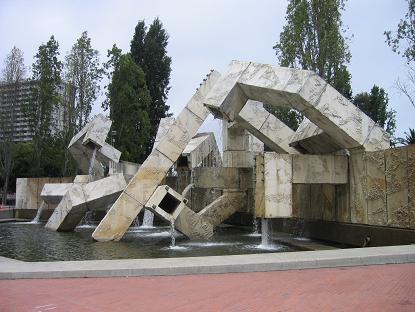
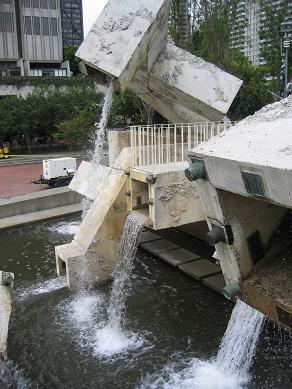
Your humble blogger will be sad to see it go. Although Vaillancourt Fountain is not classically beautiful, watching it when the water is flowing is a unique experience. From 2004:
The Vaillancourt fountain in Justin Herman Plaza is hard to love. After the 1989 earthquake destroyed the freeway off-ramp, the fountain’s complementary big brother, some said it lost its raison d’etre.

Because it was expensive to power the pumps, the water had been turned off since 2000. Vaillancourt fountain became a silent, concrete jumble in the midst of a waterfront that is growing greener and softer.

Depending on the way one is facing, the harsh angles overwhelm the view of the renovated Ferry Building, the nearby park, or the beauteous Bay beyond. The fountain became a grimy sculpture, a favorite resting spot for the ubiquitous pigeons, who further despoiled its surface and walkways. It became such an eyesore that some called for its demolition.

Last month the pumps were turned on, and the area was transformed. The sight and sounds of the rushing water bring life to a dead corner of Justin Herman plaza. Children skip along the walkway beneath the waterfalls, the tourists take their pictures, and the pale tower denizens leave their cubicles to munch on their sandwiches in the sun.

Thursday, June 26, 2025

Chicken of Choice

(Chronicle photo)
When Boston Chicken (later Boston Market) introduced rotisserie chicken to the masses in the late 1980's, we were frequent patrons of its restaurants. In 1994 Costco began selling a whole rotisserie chicken for $4.99 (a price which hasn't changed for 30 years), and we visited Boston Market much less often. The Costco chicken was juicy, well-seasoned, and cheap; it was a much better value proposition than Boston Market or any other restaurant.

The Chronicle conducted a blind taste test of rotisserie chicken prepared by 17 different Bay Area vendors. How well did the Costco product measure up?
We took note of saltiness, appraised aromatics and analyzed distinguishing seasonings. We loved schmaltzy, crisp skin and abhorred the rubbery ones. We wanted meat rich in moisture and dreaded when a piece was dry...We rated each on flavor, juiciness and skin. A good chicken excels in all of those categories, which influence the judge’s overall score, on a 10-point scale. The findings show that restaurants typically make better chickens than markets and butchers; they often use higher quality birds...

[Costco's] chicken was by far the juiciest, practically dripping with moisture, and stayed warm longest. The value also must be noted: The price disparity between Costco and every other place was cavernous, nearly five to 20 times cheaper than the rest at $1.16 per pound. However, there is one big caveat: The oversized fowl is only available to those with a Costco membership, which starts at $65 per year.
Without considering the cost, Costco's chicken finished second to Rooster’s Peruvian Rotisserie, a restaurant in San Francisco's Mission district. If we happen to be in that area, we'll check out Rooster's. Meanwhile, Costco's second-best offering will do just fine.

Friday, June 20, 2025

Rewards are High but Intangible

Starburst, a pit bull/husky mix with
lopsided ears and one blue and one
brown eye, was adopted when she
was 6 months old
For people who love animals this headline is a tragedy:

San Francisco is euthanizing more stray dogs [bold added]
These shelter records are full of heartbreak — stories of people abandoning their dogs because they couldn’t afford veterinary care or housing. Last year, such cases propelled Animal Care and Control, the city’s public shelter, to the highest rate of euthanasia since 2013, and it’s on track to worsen this year.

The problem is playing out across California. When veterinarian clinics closed during the COVID-19 outbreak, spay and neuter surgeries stopped, creating generations of surplus puppies. Huge numbers of people adopted pandemic pets, but now demand for dogs, especially large ones, has plunged.
As might be expected, dogs that are larger or older or have health or behavioral problems have a tough time being adopted. Taking responsibility for such an animal can be a heavy commitment.

Speaking from personal experience, however, I can attest to the rewards being high if one takes the plunge.

Monday, June 16, 2025

The Fentanyl Fold

(photo by Stephen Lam/The Chronicle)
That fentanyl is a modern-day plague is a well known fact--in 2024 San Francisco had 635 drug overdose deaths, of which over 70% included fentanyl--yet much remains unknown about the deadly opioid. For example, why do fentanyl users contort themselves into an unusual standing position?
Dr. Daniel Ciccarone, UCSF professor of addiction medicine, said what he calls the “nod” is a common side effect of opioid use.

“It’s not much different than the experience of being in a boring lecture and falling asleep,” Ciccarone said. “It’s a version of losing consciousness. But not to the point of losing consciousness –– they’re still conscious.”

These nods have always happened to varying degrees with other opioids, particularly heroin. The nods with fentanyl, however, seem to be more extreme, Ciccarone noted. And it’s often a sign that a person has taken too strong a dose, he said.

“What you’re witnessing is the balance point between passing out –– when you lose all muscular control and are on the floor –– versus some small remnant of consciousness that is keeping the person upright,” he said.

Fentanyl, which can be up to 50 times more potent than heroin, can induce this “low point of consciousness,” which is believed to be euphoric, Ciccarone said.

“As opioids get stronger, the nod gets deeper,” he said. “The dials are just being turned down. Consciousness, breathing, muscular control are going down … and this is just one of the visible signs of it.”
Repeated positioning in the fold can itself cause severe health problems:
UCSF orthopedic surgeon Dr. Alexos Theologis, who specializes in the spine, said some people probably slump because of muscular issues. But going into the fentanyl fold position too much over a long period of time can cause severe damage to the spine, neck and back muscles, he added.

Theologis said there’s nothing in the use of fentanyl itself that will cause people spinal problems, but such prolonged folding can lead to chronic issues.

“The postures I see … are very, very disabling,” Theologis said. “We have studies that demonstrate these postural changes (are) … among the most disabling medical conditions anybody can experience. It’s similar to cancer treatment and pain associated with cancer.”
Whatever one may think of President Trump, his stated goal to eliminate fentanyl from the streets of big cities will help the most wretched who live among us.

Tuesday, May 20, 2025

Its Hair Was on Fire

The SF apartment fire in March, 2024 (Mercury News)
Removing ticks from a dog set a five-story apartment building on fire.
Giancarlo was just trying to help. But he set the dog on fire, the dog set the couch on fire, the couch set the curtains on fire, and before long, residents of a five-story, 114-unit apartment building in San Francisco were fleeing for their lives down a fire escape amid a blaze that sent two people to the hospital.

That’s according to a fire department report filed as an exhibit in a wrongful-eviction lawsuit against the building’s owners.

“He tried to remove the ticks using a lighter, which accidentally lit the puppy on fire,” the report said.

The lawsuit was filed May 14 in San Francisco Superior Court by a couple who claim the building’s owners delayed work to repair their apartment after the fire, forcing them to live in a home-made trailer on streets around the Bay Area. It seeks unspecified damages.

A second-floor tenant told fire investigators she had adopted a puppy in Modesto, and after she brought it home, noticed it had a tick. The woman, whose name is redacted from the fire department’s report, said her friend Giancarlo decided to use a lighter to remove the blood-sucking parasite. It was just before midnight on March 12 last year.

Giancarlo — who is not identified by a last name in the report — told investigators he found many ticks on the dog’s stomach, and that he had experience using heat to get rid of ticks.

The dog, which Giancarlo said combusted as if something flammable had been applied to it, ran over to the couch, where the tenant tried to grab it, the report said. Her clothing and the sofa both caught fire, and the sofa set the curtains ablaze, the report said.
If you are a San Francisco landlord, not only can your tenants set the building on fire but you can be sued for "wrongful eviction" if you don't make repairs fast enough. Another reason to get out of San Francisco with all deliberate speed.

Monday, May 05, 2025

Prisoner of Trump's World

Alcatraz, 2006
Its prison closed in 1963, and Alcatraz has since become one of the most popular tourist attractions in the Bay Area.
Visitors can wander through the Gardens of Alcatraz, peruse the Big Lockup Exhibit, or take a night tour where one can “enjoy the beauty of a sunset silhouetting the Golden Gate Bridge” as well as “experience a cell door demonstration.” Over the years, Boy Scouts have clamored to hold overnight campouts in the infamous isolation cells of D Block. Athletes compete in prison-themed events, including a canoe race circling the island and the Escape from Alcatraz triathlon.
Donald Trump demonstrated the power of the Presidency's "bully pulpit" when he called for the Alcatraz prison to be rebuilt and re-opened.
Calling the prison a “symbol of law and order,” Trump on Sunday said he is directing the Bureau of Prisons and other federal agencies to rebuild Alcatraz to house “America’s most ruthless and violent offenders.”
However, the reasons for its original closure haven't gone away.
It operated as a maximum-security facility for nearly three decades, closing in 1963 because of millions of dollars in needed repairs and the expense of hauling all supplies, including fresh water, to the facility by boat. Alcatraz was tiny by the standards of most federal facilities, never housing more than around 275 prisoners.
President Trump is too much of a cost-benefit realist to take his own proposal seriously. IMHO, he did it to provoke Democrats and direct their attention from his other policies. [bold added]
Democratic state Sen. Scott Wiener of San Francisco...call[ed] the president’s idea “unhinged and terrifying.” Trump wants to turn Alcatraz “into a domestic gulag in the middle of San Francisco Bay,” Wiener wrote on social media.
Some Democratic strategists recognize the President's maneuver as a distraction. [bold added]
But Trump’s Sunday evening social media post about the idea follows a well-honed strategy that the president has been deploying for years. He makes outlandish claims and goads the media into writing stories debunking or criticizing them, which focuses the national conversation around his preferred topics.

Centering the news cycle around the idea that he wants to crack down on crime could keep Americans’ focus on an issue that’s politically advantageous to him, experts say.

“He picks outlandish topics that he thinks will be popular with the general public, but unpopular with Democrats and maybe the educated Democratic elites, in the hopes that they criticize it,” said Gabriel Lenz, a political science professor at UC Berkeley. “That keeps an idea, an issue, a topic where he thinks he has an advantage in the news.”...

Longtime Trump adviser Steve Bannon calls this strategy “flood the zone.” It’s how Trump grows his popularity among everyday Americans, Bannon says.
"Flooding the zone" is a term that originated in sports. For example, if a team sends enough pass receivers to an area, it becomes impossible for the other team to cover each one.

Calls by wiser heads to ignore the Alcatraz distraction fall on deaf ears, because as Scott Wiener has demonstrated, some Democrats can't help themselves.