Showing posts with label Maui. Show all posts

Thursday, March 06, 2025

Paia and Its Cemeteries

Paia Hongwanji Cemetery (Forrest and Kim Starr)
SFGate travel writer Eric Brooks stumbles upon abandoned graveyards. On the pathway to Baldwin Beach Park near Paia, Maui
There, just beyond some overgrown grass, was what looked like a group of headstones. Next to that, another 5 to 10 feet away, were more headstones. I rounded the corner to see an entire graveyard surrounded by sand and unmaintained brush. I estimated maybe 100 headstones in all...

Baldwin Beach Park and much of the surrounding land used to be owned by Maui’s Hawaiian Commercial & Sugar Company, or HC&S, a titan of the top industry in Hawaii for many years, according to Lucienne de Naie, author and docent at Hale Hoikeike at the Bailey House, a local history and art museum located in nearby Wailuku.

“The big boom in sugar cane came in the 1880s and 1890s,” de Naie told SFGATE.

That’s when plantation owners, keen to take advantage of the growing sugar cane business, began to import contract workers from countries like Japan, China, the Philippines and Portugal. “There were little camps of Japanese workers; the plantations tended to segregate their workers,” said de Naie, a resident of Maui since the 1970s who knows Paia very well. “The Chinese workers would live in another, the Philippine workers would live in another and so on. The camps had communal activities.”

...Citing a book called “Island of Maui Cemetery (Map & History) Directory,” de Naie was able to pinpoint the original name of the cemetery as the “Paia Hongwanji Cemetery.” It was associated with a Buddhist group called the Makawao Hongwanji, she added, which opened a temple in the area in 1908. The group moved not too far northeast to Upper Paia in 1917, later relocating about 7 miles southeast to Makawao in 1968, according to their website...

“Paia is the cemetery capital of Maui,” de Naie added. “For a small town, it probably has nine to 10 recognized cemeteries. It’s amazing how many cemeteries are there. Catholic, Protestant, Chinese and Mormon cemeteries. It’s a very easy place to dig, with the sand dunes. You put them where you can easily dig.”
Paia boy Fred, my father-in-law
My father-in-law (1922-2001) and his seven siblings were born in Paia. On a trip 35 years ago he showed us his old two-story house, now a tourist shop, and the old Maui High school buildings in a defunct sugar cane field. He regaled us with stories about the best fishing spots, the mischief he and his brothers got into, and life in old Paia town with Japanese, Chinese, Portuguese and Filipino children. (I won't use the names they actually called each other because they would offend modern sensibilities.)

Later we drove along the narrow cliffside rode to the Hotel Hana, where my inlaws honeymooned. Then we visited his half brother George in Kahului, and we flew back to Honolulu. Little did I know that it would be the last time I would visit central Maui.

Carpe diem.

Monday, October 28, 2024

Haleakala Ride

Looking down at the clouds from the summit (Volcano tours)
Another activity that I enjoyed in my younger days may be outlawed.
A popular Hawaii tourist activity, Maui downhill bicycle tours offer visitors an opportunity to see stunning landscapes on a ride down the winding roads of Haleakala with little physical exertion.

The activity, however, comes with some risk, as bicyclists share the road with vehicles, whose drivers sometimes get impatient, and downhill speeds may cause a rider to lose control.

Throughout its history, accidents have happened. Some have died. Earlier this month, Jeffrey Hins, a 68-year-old visitor from Arizona, was killed while biking down Haleakala as part of a group. The Maui Police Department said Hins crossed the yellow double-solid lane into the oncoming lane and crashed into a vehicle.

A new law addressing the safety of commercial guided and unguided bike tours, Ordinance 5439, just went into effect last year to alleviate concerns about safety and disruption to local traffic.,,“There’s been some in the community who want an outright ban on this type of industry operating on the road,” Mike Molina told KHON-TV. Molina, a former Maui County councilmember, championed the new law...

Haleakala downhill bicycle tours started in 1983. Over the next 20 years, the industry flourished, as it was a way for visitors to see Haleakala National Park at sunrise, then do a fun experiential activity. By 2007, about 90,000 visitors participated in bike tours annually, and revenues were estimated at $11 million...

Last year was the first time in 15 years that a new law was enacted to regulate the industry. Ordinance 5439 limits commercial tours to 10 riders, requires a minimum age of 15 and restricts guided and unguided tours to between Mile Marker 3 and Mile Marker 9.5 on Haleakala Crater Road.

Only a handful of companies continue to operate the downhill bike tours today and have altered their itineraries to accommodate the changes.

Depending on the operator, guided tours begin with a van ride up Haleakala Volcano to 10,000 feet to watch the sunrise inside Haleakala National Park. Then, the van brings the group down to around 6,500 feet, where cyclists launch after a safety briefing. Bicyclists then descend on a winding road of 29 switchbacks, while the van follows behind.

Ordinance 5439 cut some mileage from the tours by prohibiting specific areas of road and excluding the town of Kula. Operators have improvised by adding a second bike loop of the switchbacks, a van ride through Kula or lunch stop in Makawao, before continuing on the bikes to ride down to Haiku or Paia, where the tour ends.
I've done the summit downhill a number of times, the most recent occasion being a corporate retreat in the mid-1990's. We watched the sun rise over the crater, then cruised to Paia without stopping. It was early morning, traffic was light, and this weekend bicyclist used the brakes often. However, it is easy to see how increased auto traffic, combined with unskilled bicycle tourists, made serious accidents inevitable. Like many things in life, I'm glad I got to do the Haleakala ride before it got regulated away.

Saturday, July 20, 2024

Oahu No Ka Oi

Oahu is the cheapest, hands down (Merc)
The answer has long been obvious, even if the visitor doesn't have a free "hotel" and car like your humble blogger:

What’s the cheapest Hawaiian island to visit? [bold added]
Of the four main Hawaiian islands for tourism — Oahu, Maui, Kauai and the Big Island — Oahu is the cheapest Hawaiian island to visit by multiple metrics. Oahu has the lowest daily average hotel room rate of the islands and the lowest average daily spending per tourist, according to May 2024 data from the Hawai‘i Tourism Authority.

Though the average room rate in May 2024 across all of Hawaii was $342, Oahu hotel rooms average about 21% less, coming in at $272. That translates to about $70 per night less than the average...

One reason for Oahu’s lowest average room rate? The island also has the biggest supply. In fact, Oahu had more than double the number of hotel room nights than Maui, the next closest contender...

So why is spending on Oahu lower than on other islands? Not only are there more hotels, but also more restaurants and other types of businesses. According to the latest U.S. Census Bureau data, Honolulu County in Oahu had more than 21,000 businesses in 2020, while Maui County in Maui had fewer than 5,000. The increased competition lowers prices for consumers.

There’s also just a lot of free and cheap stuff to do on Oahu. Many of the top activities — including visiting the Pearl Harbor National Memorial, lounging on Waikiki Beach and hiking the Makapuʻu Point Lighthouse Trail — are free. It costs just $5 per person to enter Diamond Head State Monument (though it’s an additional $10 for parking).

And because of Honolulu’s robust bus network and walkability, it’s easy to get around Honolulu without a rental car. For places more difficult to get to, it’s possible to rent a car for just a day or rely on rideshare services like Uber or Lyft.
I use my parents' house and Nissan Altima when I go to Oahu, so I'm able to keep the trip cost to under $1,000 including plane fare. Even so, I typically only use the car to visit Mom in assisted living and like to spend my free time hoofing it around Waikiki and Ala Moana, where there are many quality, inexpensive restaurants.

Some of my friends, whom I like despite their snootiness, only go to the Neighbor Islands. I'm not ashamed to say that this middle-class kid prefers Oahu.

Saturday, August 19, 2023

When You Want Everything, You End Up with Nothing

(Images of class action lawsuits against HE)
After its 2019 bankruptcy resulting from wildfire liabilities, PG&E enacted procedures to cut off electricity preemptively when fire danger is high.

Now similar class-action lawsuits have been filed against Hawaiian Electric for not shutting down Maui's power lines.

Utilities may not be as legally responsible in Hawaii as they are in California. [bold added]
The company noted that there is no precedent in Hawaii, as there is in California, for property owners to receive compensation for damages caused by a private party such as an investor-owned utility, or from a government entity.
Hawaiian Electric also cited the dangers of shutting down electricity in the midst of a fire:
“Preemptive, short-notice power shut-offs have to be coordinated with first responders, and in Lahaina, electricity powers some of the pumps that provide the water needed for firefighting,” the company wrote. “A power shut-off can jeopardize the health and safety of the elderly, the disabled and those most in need.”
Hawaiian Electric management no doubt bears some responsibility, but IMHO government is at least equally culpable. Government regulates utilities because utility monopolies are free to set prices without being restrained by competition. The WSJ says that Hawaiian Electric and PG&E are simply following their State governments' orders:
If Hawaiian Electric’s lines did ignite the fires, it would echo the problems of PG&E, the California utility that filed for Chapter 11 bankruptcy in 2019 after getting sued for tens of billions of dollars for damages from fires caused by its equipment. The 2018 Camp Fire killed 84 people and razed the town of Paradise.

What both utilities have in common is that they prioritized growing renewable power to meet government mandates over hardening their systems and reducing fire risk. In 2015 Hawaii lawmakers required that 100% of the state’s electricity come from renewable sources by 2045. California and some other states followed with similar mandates.
Hawaii and California share another characteristic: the Democratic Party has held all state-wide offices and controlled the state legislature for over a decade. This means that the priorities of regulated businesses are the priorities of the Party: eliminating fossil fuels, promoting DEI (diversification, equity, and inclusion) and corporate ESG (environment, social, and governance) all supersede such mundane activities as hardening infrastructure and operating profitably.

The voters of Hawaii and California are getting what they wanted, and the victims of Paradise, CA, and Lahaina, HI paid the tragic price.

Wednesday, August 16, 2023

Winning by Losing

After the acquisition fell apart in 2016, NEE and HE's stock prices diverged, even before the Lahaina fires.
(This post is related to yesterday's about the collapse of Hawaiian Electric Industries' stock price.)

Seven years ago Florida-based NextEra Energy (NEE) failed in its attempted acquisition of Hawaiian Electric for $2.63 billion. The deal was rejected by Hawaiian regulators.

The ostensible reason was that NextEra did not provide enough details about whether its green-energy plans were sufficiently compliant with Hawaii's own goals. In truth there was a local element that would have resisted any takeover of HE, a Hawaiian institution that was more than 120 years old.

NEE, with a current market cap of about $137 billion, must be thanking its lucky stars that the deal fell apart. With a wealthy Mainland parent company who would be convenient to blame, the Maui victims and lawyers would try to extract $billions in damages from HE's parent.

In NextEra's case the failure to make a deal was the best deal.

Tuesday, August 15, 2023

Hawaiian Electric on the Brink

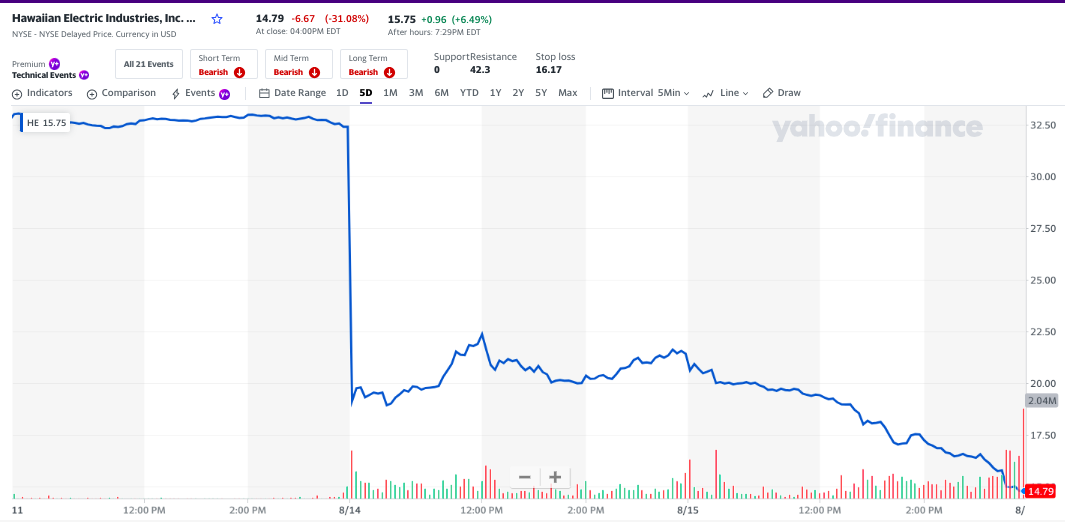
The Lahaina fires began on Tuesday, Aug. 8.; HE stock took over a 50% hit this Monday and Tuesday.
Whether justified or not, Hawaiian Electric Industries is now accused of bearing major responsibility for the Lahaina fire:
The selloff continues in shares of troubled utility Hawaiian Electric Industries.

The stock fell another 24% on Tuesday after Monday’s plunge, on fears the utility could be held liable for the wildfires that have devastated Maui.

The stock recently traded around $16.

Wells Fargo analysts cut their price target to $25 per share on Monday. “While it remains unclear if any of HE’s equipment directly caused any of the wildfires, we believe it prudent to account for the risk,” they wrote.

All told, the stock has dropped about 50% so far this week, according to FactSet; that’s the stock's worst two-day selloff on record dating back to 1983, according to Dow Jones Market Data.
Honolulu: as power needs grow, the tangles get worse.
In 2017, as California wildfire liabilities drove PG&E into bankruptcy, I wrote:
Telephone poles and overhead power lines have been a ubiquitous part of the Honolulu landscape ever since I can remember. They're still in every neighborhood a half-century later despite the danger and poor esthetics. The cost of burying infrastructure (electricity, trains) is enormously expensive, so little has been done.

In Napa and Sonoma counties Pacific Gas and Electric faces similar costs to Hawaiian Electric and did not bury most of its power lines.
At today's close, HE had a $1.6 billion market cap, and there's not much flesh to scavenge from its bones. Any substantial recompense will have to come from Hawaii ratepayers.

Saturday, August 12, 2023

Everyone Was Affected

The Chronicle published before and after pictures of the fire.
It's not an exaggeration to say that everyone who's lived in Hawaii for at least a few years is affected by the destruction of old Lahaina. I've visited Maui often (though not this century) and know people who were born there and live there.

To them Lahaina is special, much like San Francisco is special to its region. Lahaina and San Francisco each have roughly 10% of the population of Maui and the Bay Area, respectively, but punch way above their weight in cultural and economic influence.

Sarah's diary, circa 1917
My maternal grandmother moved from Honolulu to Lahaina to stay with her older sister Ruth before Ruth went off to Boston to study nursing.

According to her diary Sarah, then an 8th grader, was "the pianist, the office helper, and the sewing assistan[t] to the pupils" at King Kamehameha III elementary school, which did not survive the fires this week.

Benjamin O. Wist (1889-1951), then principal of the school, helped my grandmother transfer to McKinley High in Honolulu. He later became the President of the University of Hawaii and wrote "A Century of Public Education in Hawaii, 1840-1940." Wist Hall on the UH campus is named after him.

Thursday, August 10, 2023

Lahaina No Ka Oi, Hopefully Again


As of this writing (4 p.m. HST) there are 53 confirmed dead in the Maui wildfires that started on Tuesday. 1,000 people are unaccounted for, historic Lahaina town is completely destroyed, and basic communications and infrastructure are heavily damaged. Flames are 80% contained.

The videos are similar to those that Californians saw during the 2018 Camp Fire that leveled the City of Paradise. In Maui too we watch residents given only seconds to flee, trees burning on both sides of the road, and winds spreading flames faster than people can run. In California people jumped into rivers and lakes, in Maui they leaped into Lahaina Harbor.

Before the Camp Fire Paradise was a city of 14,000 homes and 27,000 residents. 4½ years later Paradise is less than half what it once was: "more than 1,400 homes have been rebuilt and now nearly 10,000 people call Paradise home again."

Because of the importance of Lahaina to the State of Hawaii, your humble blogger hopes that Lahaina's restoration will be faster and more complete than California's rebuilding of Paradise. And, selfishly, it will raise the probability that I can visit Lahaina one more time before age and infirmity prevent me from doing so.

Friday, March 09, 2012

Retiring in Hawaii

When we moved to the San Francisco Bay Area in 1975, our plan was to live on the Mainland for "about five years" then return to the Aloha State, where we would raise children, buy a house, and live the rest of our lives surrounded by family and friends. As John Lennon sang,
Life is what happens to you
While you're busy making other plans.
37 years later, now that we are approaching the age when we're eligible for Social Security and Medicare, it's time to get serious about that long-ago objective.

Smart Money advises transplanted Mainlanders to abandon dreams of living in the popular Hawaiian tourist destinations unless they are quite wealthy.
...forget about the ultimate in a Hawaiian retirement paradise, the lovely beaches of Kaanapali on Maui. With a cost of living that's 163% higher than the national average and median home prices that are over $1 million, Kaanapali makes even ultra-pricey mainland favorites like Nantucket and Kennebunkport look affordable.
Smart Money's more affordable Hawaiian locales:
  • Hilo, Big Island - Hawaii's second largest city, Hilo has the accoutrements of urban living at lower prices than Honolulu. Hilo is on the water, but living by Hilo Bay isn't necessarily a plus. Kamaainas still talk about the 1946 and 1960 tsunamis that killed 160 and 61 people, respectively. Currenty we are not considering retiring to the Big Island because it's an hour's flight from Honolulu.
  • Kailua-Kona, Big Island - is probably where we would settle if we did live on the Island of Hawaii. My maternal grandfather hailed from Kohala, an hour's drive north of Kailua-Kona. He moved to Honolulu after the Great War. The area is the site of our family reunions.
  • Paia, Maui - is an old agricultural town whose economy is now dependent on the tourist trade, like the rest of Hawaii. Paia is close to the beaches of central Maui and the Kahului airport. Nearly an hour's drive (33 miles) from Kaanapali, Paia is not completely "haolified", i.e., it still retains the rhythms and culture of pre-jet age Hawaii. There's also a family connection: my father-in-law and his siblings grew up in Paia.
  • Kaneohe, Oahu - To an island kid Kaneohe seemed quite distant from Honolulu because one had to drive there through the Wilson or Pali Tunnels that had been drilled through the Koolau mountains. To a Californian the half-hour distance from downtown is like walking across the street. With a median home price of $563,200 Kaneohe isn't cheap, but on a relative basis it's still less than central Honolulu.

    With Hawaii's high housing prices we'll be lucky to break even on transferring from Northern California. Well, there's one financial inducement to make the move sweeter: Hawaii doesn't tax pension distributions, and, knock on wood, we'll have some of those.
  • Friday, June 11, 2010

    Getting My Vitamin D

    I've been in Hawaii this past week to reunite with high school classmates and to visit relatives.

    A few days ago we drove around Oahu and marveled at all the changes. I got lost frequently. iPhone GPS and Google Maps were not wholly reliable, or maybe I just don't know how to use them properly. One area that hasn't changed much is the beach along the far North Shore where the road ends, away from crowded Haleiwa. White sand, fierce sun, and lapping waves. Maui's over-rated. Oahu no ka oi!

    Gotta get me one of those new iPhones. 2MP resolution doesn't cut it.