Ancient history: Angela Lansbury's Jessica Fletcher, Tom Bosley's Sheriff Amos Tupper, and a pay telephone.
Last month I began watching Murder, She Wrote reruns on the Hallmark Mysteries Channel. The popular series ran from 1984 to 1996, and I managed to catch many of the episodes the first time around because it followed the Sunday NFL game on CBS.
I have always been a fan of the whodunit. Angela Lansbury's Jessica Fletcher was squarely in the tradition of the amateur sleuth--Sherlock Holmes, Hercule Poirot, Miss Marple--who through keen observation, deductive reasoning, and photographic memory bested the professionals.
When Murder, She Wrote began, Jessica Fletcher was conceived as an unassuming Miss Marple who was ignored by police and criminals alike. As the series progressed, Jessica grew in fictional stature by writing numerous mystery best sellers and solving cases in cities toured by the increasingly famous author.
It's not an exaggeration to say that Jessica Fletcher helped to implant in the consciousness of late 20th-century America the idea that an older woman with character and smarts could be successful without being rich or beautiful or riding on her husband's coattails.
Though Jessica was initially conceived as a somewhat flighty character, Lansbury said she fought to portray her as a strong, successful single woman.
“In the first place, she was shown as a rather kooky character,” she told Australia’s Studio 10 in 2018. “That’s all right up to a certain point, but I thought, ‘No, let’s make her a smart woman.’ And by the time we were finished she got back her sense of purpose as a woman, she was attractive, she had boyfriends, she had a nice wardrobe. She became much more of an everywoman rather than a kook.”
After the turn of the century characters like Jessica Fletcher became passé. Detective shows spent more time on forensic science, violent action, and soap-opera-ish season-long character arcs. Those series are entertaining and stored on the videorecorder, too, but lately Murder, She Wrote has been at the top of your humble blogger's list.
Angela Lansbury, who died this Tuesday at the age of 96, had Tony and Grammy Awards, as well as three Academy Award nominations, but she will be most remembered for her portrayal of a schoolteacher-turned-writer from Cabot Cove, Maine. R.I.P.
Netflix (NFLX) fell 35% today and is down 62% since January 1st
Competitive stresses had been building for Netflix, which once had the market for streaming video all to itself. The dam broke last night, when Netflix announced that it had lost subscribers, and the stock fell precipitously:
The shares shed more than a third of their value, finishing down $122.42 to $226.19. The stock was the S&P 500’s worst performer of the day. Investors had expected that the company would add new users in the quarter. Instead, Netflix said it ended the first three months of the year with 200,000 fewer subscribers than it had in the fourth quarter and said it expected to lose two million global subscribers in the current quarter...
The fall in Netflix’s shares represented its biggest single-day percentage drop since Oct. 15, 2004, when it fell 41% after saying it would cut subscription fees and postpone planned international expansion. It slashed $54.3 billion from the company’s market capitalization, its largest one-day market cap loss on record...
“Nobody was expecting Netflix to announce they lost subscribers. They were expecting a slowdown in subscriptions, but seeing Netflix losing subscribers is a big deal,” said Ipek Ozkardeskaya, senior analyst at Swissquote Bank, an online broker.
Your humble investor/blogger turned a modest profit on Netflix eleven years ago. At the time I was spooked by Amazon's entry into streaming video and thought that the much-larger company would eat Netflix' lunch.
Though I sold Netflix ten years too soon, there are only small regrets. I would probably have held on too long and watched a large Netflix holding fall by 35% in one day. Irrational, to be sure, but that's why you shouldn't listen to a blogger who gives free advice.
TikTok is one of the fastest growing social-media networks in history. Developers post 15-second videos on any subject, and TikTok deduces the types of videos that the users prefer and steers them onto the next. TikTok has close to one billion users and is enormously influential among young people.
The Wall Street Journal determined how TikTok's algorithm works by creating artificial users ("bots") that did not reveal their interests, e.g., yoga, sadness, forestry, to TikTok. To be clear, TikTok did not ask for user data, spy on text messages, etc. The algorithm found out users' preference from just one thing:
How long you linger over a piece of content. Every second you hesitate or rewatch, the app is tracking you...
Tiktok fully learned many of our accounts' interests in less than two hours. Some it figured out in less than 40 minutes.
Your humble blogger enjoyed TikTok last year until President Trump accused the company of spying for China and tried to force its sale to a U.S. entity. I immediately deleted the app because the benefit of laughing at 15-second vignettes wasn't worth the possible risks. The sale fell through, no proof of perfidy emerged, and President Biden reversed the Trump restrictions. TikTok hasn't been cleared, however, and is still under investigation by various U.S. government agencies.
Now I only watch TikTok videos about once a month when someone sends a link. The vast majority of videos that I have seen are mildly enjoyable and some are astonishingly creative. However, they are not necessary to life and happiness.
Below is one of the most popular (2 billion views...really?) TikTok videos:
Videoconferencing has been used in business since the 1990's, but widespread consumer adaptation had been waiting for a catalyst. In March, 2020 it arrived with a vengeance.
Home WiFi + easy-to-use software + multiple devices + low cost/free + coronavirus = the Zoom explosion.
The WSJ asks if consumer videoconferencing will permanently alter our methods of interacting.
You’d be hard-pressed to name another technology that’s been so quickly and blindly adopted as Zoom. Television took years. Social media grew in fits and starts (some of you will remember Friendster). But in the past few weeks, I’ve been invited to Zoom work meetings, happy hours, poker games and Easter brunches. I have weekly Saturday-morning coffees with my buddy Joe who’s isolating a few blocks from me in Brooklyn. Friends have attended Zoom weddings and seders, court proceedings and dance parties. “SNL” even recorded its latest episode on the now-ubiquitous platform, with host Tom Hanks performing the monologue from his (surprisingly unglamorous) kitchen.
This pandemic too shall pass, but the professionally prescient are already debating what parts of this novel lifestyle will continue when it does. “We’re developing new habits and new comfort and new solace in these behaviors,” said Matt Klein, director of strategy for Sparks & Honey, a consultancy that studies trends. “But when we’re increasing the repetition of these things, over time, they’re going to become more normalized.”
Those of us who pressed the flesh for decades will go back to in-person meetings with eagerness. But the post-COVID19 generation probably won't. An historical example is e-mail, which didn't eliminate letter-writing for those who grew up writing letters. Four decades later, the texting-with-emojis cohort can barely compose an email, much less a real printed letter.
I have to put in an admiring word about Isaac Asimov (1920-1992), whose science fiction I read avidly in my youth. Sentient robots with vast powers are no longer thought to be impossible, and his three laws of robotics (1942) now are the starting point for discussion of intelligent-machine ethics. What Isaac Asimov wrestled with nearly 80 years ago is relevant today.
Another of the writer's creations, albeit minor, was the planet of Solaria (The Naked Sun - 1957), which was one of many Earth colonies that had lost touch with the home world in the Asimovian future history of the galaxy. Solaria is relevant today because it was a world of extreme social distancing. From a 2011 research paper: [bold added]
Solaria was a planet inhabited by Spacer descendants. The 50th and last Spacer world settled, it had perhaps the most eccentric culture of all of them. Originally, there were about 20,000 people living alone in vast estates. Solarians’ lives were marked by technology: citizens never had to meet, save for sexual contact for reproductive purposes. All other contact was accomplished by sophisticated holographic viewing systems, with most Solarians exhibiting a strong phobia towards actual contact, or even being in the same room as another human. All work was done by robots: there were indeed thousands of robots for every Solarian. As centuries went by, Solaria became even more rigidly and obsessively isolationist...
Solaria is a fictional planet in Isaac Asimov’s Foundation and Robot series. The author draws on this metaphor to warn against the risks of dehumanization that may be brought about by an excessive and indiscriminate technical progress. In the 1950s, Asimov’s novel well embodied the common fear according to which technology would have progressively destroyed social interaction. Today, at the beginning of the twenty-first century, our lives are marked by technology almost as those of Solarians. The widespread diffusion of the broadband, the internet revolution, and the true explosion of online networks like Facebook, Flickr and Twitter is worrying social scientists, who fear the risk of growing relational poverty.
Isaac Asimov had it right. In the name of health and safety authorities are justifying all sorts of actions that would have seemed extreme a few months ago. Let's hope that lifting the "temporary" rules will be as quick and easy as imposing them.
But it's not all Zoom and gloom. We can enjoy the creative ways in which Zoom is being used to stimulate and entertain us in our bunkers.
One of the latest tempests-in-a-Washington-teapot is about whether President Trump retweeted a doctored video of Nancy Pelosi slurring her words. Complicating the matter is that there are several Pelosi videos circulating the web, some "more fake" than others. Also, there is little consensus about where the line is crossed, for example, whether it includes editing out context or slowing the speed.
IMHO, this Trump-Pelosi contretemps is tiresome and will blow over soon.
Deepfakes first entered the public eye late 2017, when an anonymous Redditor under the name “deepfakes” began uploading videos of celebrities like Scarlett Johansson stitched onto the bodies of pornographic actors...
Celebrities are the easiest targets, with ample public imagery that can be used to train deepfake algorithms; it’s relatively easy to make a high-fidelity video of Donald Trump, for example, who appears on TV day and night and at all angles....
The concern is that a cleverly crafted deepfake of a public figure, perhaps imitating a grainy cell phone video so that it’s imperfections are overlooked, and timed for the right moment, could shape a lot of opinions.
You and I, dear reader, may take comfort in that we are not public figures; there are relatively few pictures and videos of us that can be used for nefarious purposes. But are we deluding ourselves?
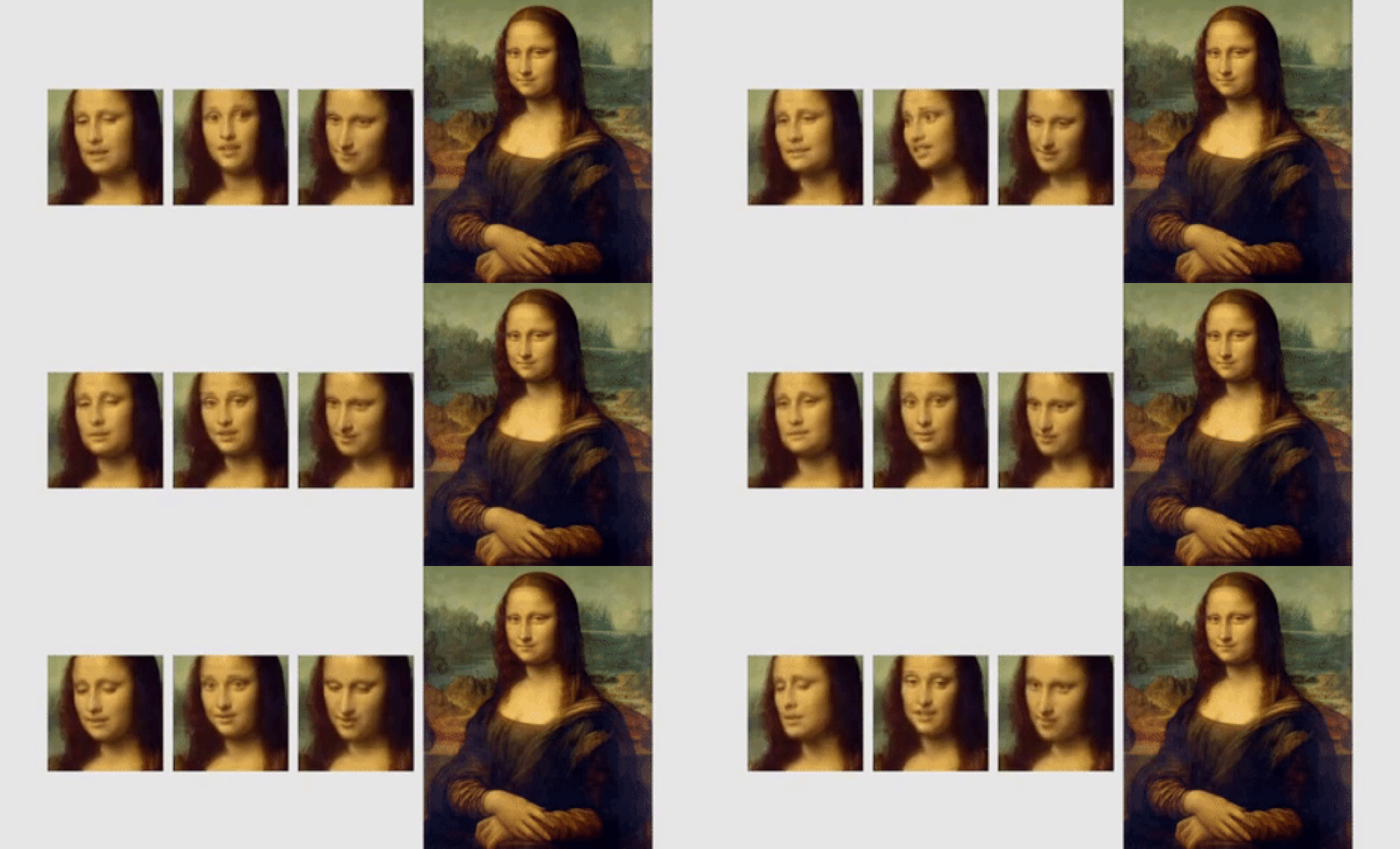
Samsung's "deep fake" algorithms can create a video talking head from a single photograph. Below is a demonstration using a well-known portrait.
One silver lining is that the subjects of embarrassing revelations can plausibly claim that the "evidence" is made up. If some of it is untrustworthy--and we don't know which part--then all of it is. And maybe, just maybe, this will lead the viewing public to do more thinking for themselves.