Showing posts with label Chinatown. Show all posts

Thursday, October 30, 2025

Robert Louis Stevenson Monument

Robert Louis Stevenson monument
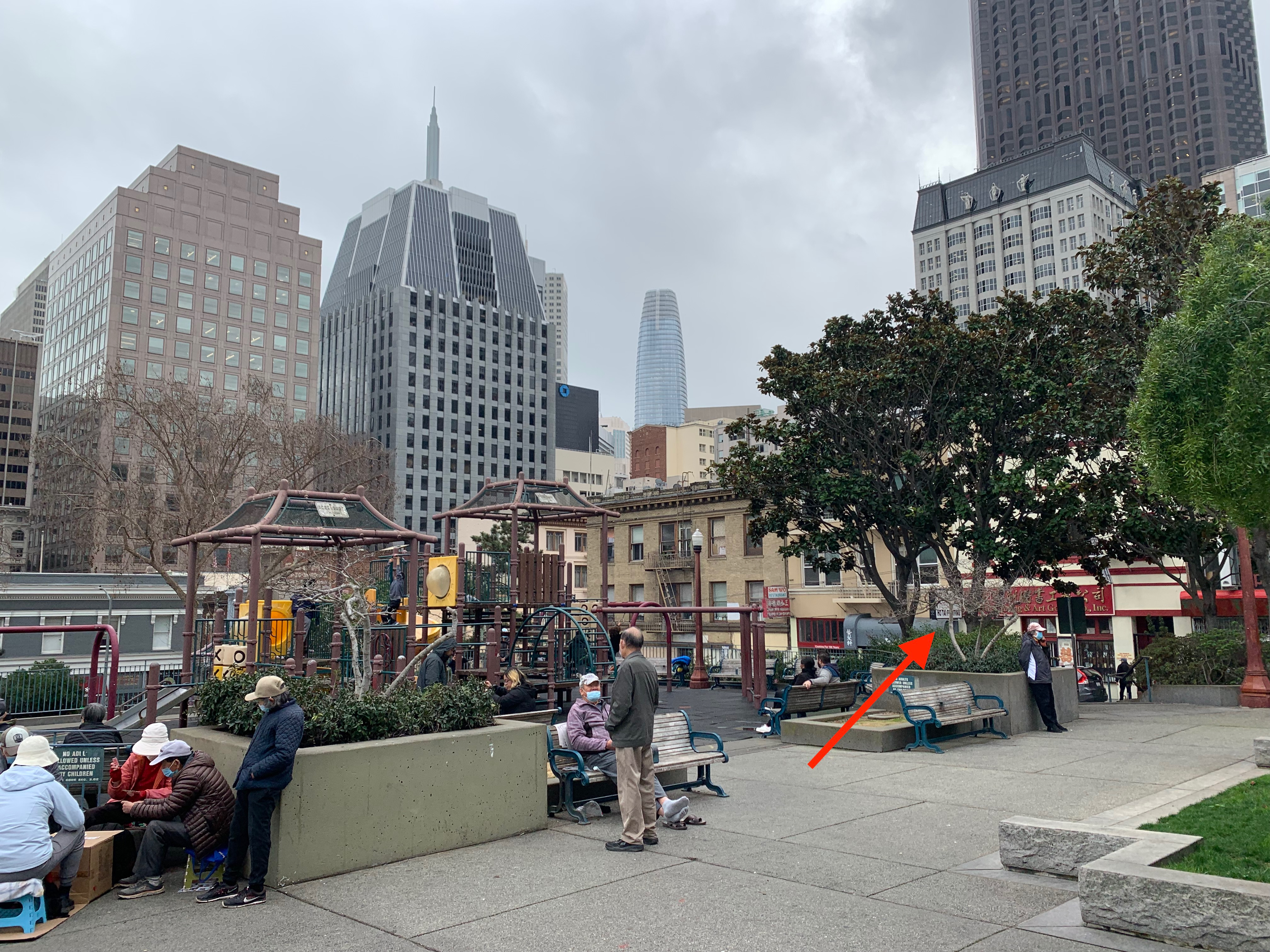
Portsmouth Square Park in San Francisco predates the 1848 Gold Rush, and its monument to poet and author Robert Louis Stevenson is 128 years old. Portsmouth Square is undergoing a $71 million renovation, and Chinese-American organizations want the monument to be removed, apparently because "Stevenson 'had nothing to do with Chinatown.'” Writer Ron Lee, whose grandfather was a friend of Stevenson's, says removal would be a mistake.
Before marrying and leaving San Francisco in 1880, Stevenson lived in Chinatown. While in the city, he made daily jaunts to Portsmouth Square, where he sat for hours on end, watching the comings and goings of residents.

He also became friends with a loquacious Chinese teenager named Chow Chong, who later in his life became my grandfather. Chong’s family lived in a building facing the square on what is now Walter U Lum Place, and he took Stevenson on tours of Chinatown.

My grandfather belonged to a family of seafarers who routinely sailed their ocean-going junk on trade expeditions back and forth to Kwong Hoy, China. They were in the funeral trade and members of the clan in their home village manufactured teakwood coffins to be sold in San Francisco. They also embarked on monthly trips to Monterey Bay, and Stevenson described his newly found Chinese friends as “vagabonds of the seas.”

R L Stevenson (Brittanica)
Stevenson was invited on two occasions to join my grandfather’s family on a voyage to the Chinese fishing village at Point Alones in Monterey Bay. Along the way, they anchored at China Beach on the northern tip of San Francisco, and Stevenson watched while Chong and his uncles climbed a hill and started digging up boxes. Stevenson, who would go on to write the classic novel “Treasure Island,” imagined his new friends must be uncovering their own hidden riches. Instead, he learned that boxes contained human remains of Chinese nationals that had been earmarked for repatriation to villages across the Pacific.

The practice known in Cantonese as “jub gwut,” meaning “pick up bones,” was a sacred tradition to Chinese “sojourners” who had come to “Gum San” (Gold Mountain) with hopes of earning a fortune and then returning home. If one should unfortunately perish along the way, their remains were considered by their descendants to be more valuable than gold, and a burial back in an ancestral village was a sacred vow.

The voyages, plus Chong’s tales of avoiding pirates and British gunboats in the seas around China, deeply influenced Stevenson. In 1880, he published stories in a magazine called Frasier’s that were similar to those that had been told to him by my grandfather’s family, only with a treasure-hunting theme. It’s speculated that those stories eventually led him to write “Treasure Island,” and I often wonder whether the novel’s protagonist, Jim Hawkins, was partly inspired by a Chinese teenager.

Stevenson also wrote disapprovingly of rabble rousers such as Denis Kearney, whose racist rants went a long way in the eventual passage of the Chinese Exclusion Act of 1882, which barred most immigration from China.
Despite the fact that Robert Louis Stevenson was not Chinese, or that his monument may have been funded by a man who was an anti-Chinese racist, it seems like a good idea to retain the cenotaph in the renovated square. Stevenson did nothing objectionable and had a historical connection to Chinatown. Besides, haven't we had enough attempts to erase history? I hope this is one monument that won't be torn down.

Tuesday, January 10, 2023

Successful Excursion

Ho Tai Printing (723 Clay) is across the
street from Portsmouth Square
Red envelopes are widely available for Chinese New Year (January 22, 2023)--Amazon has new year lai si--but a relative from Hawaii wanted some with her family surname.

Ho Tai Printing has red envelopes pre-printed with dozens of common family names, and so it was that we headed to San Francisco's Chinatown to browse its wares.

Traffic on 101 North was moderate to light in the early afternoon, not yet equal to pre-pandemic levels.

It had been three years since we had been to Chinatown. Parking at the Portsmouth Square garage, we used to find it difficult to snag a space, but today there were plenty on the lowest level.

The print shop had an ample supply of envelopes with the name we were looking for. (We didn't see any of ours--the clerk said they had run out.)

In previous years we might have done some shopping. However, with many boarded-up storefronts San Francisco had lost its appeal.

It had already been a successful excursion, and unfortunate things usually happen when we press our luck for more.

Don't go for a home run and be satisfied with a single---sounds like a good motto for 2023.

Monday, March 02, 2020

Seize (Cease?) the Reservation

Starting a restaurant is always uncertain, but in this fear-filled environment, the risks may be overwhelming:
Easy to get a table at pricey Mr. Jiu's
in SF Chinatown (Chron photo)
.
San Francisco Chinatown restaurants have seen the neighborhood’s streets empty out because of misplaced concerns and suspected xenophobia. Other restaurant owners aren’t sure exactly why business has dipped, but mounting fears around the coronavirus as cases emerge in Northern California could be the answer...

Christopher Kostow, executive chef at the three-Michelin-starred Restaurant at Meadowood in Napa Valley...said some cancellations stemmed from international tourists who opted out of their vacation plans, while others were domestic visitors newly nervous about coming to the Bay Area after San Francisco Mayor London Breed declared a state of emergency.
We walked into a popular Japanese restaurant last Friday and were seated immediately.

We had our pick of tables. Service was prompt, the sashimi was fresh, and the presentation was attractive (right).

As the Good Book says, let us eat and drink, for tomorrow...

Wednesday, November 13, 2019

A Caracas in our Future?

Two juxtaposed stories in today's fishwrap illustrate why the City is circling the drain.

Violent beating of three seniors in San Francisco’s Chinatown sparks fear, outrage
The violent beating of three older men captured on video in San Francisco’s Chinatown over the weekend has sparked fear and outrage among some residents in the city’s Chinese-American community, who said they feel increasingly targeted following several high-profile attacks on the neighborhood’s most vulnerable residents....

Three victims, all men ages 63, 67 and 68, were left with varying injuries, police said. Two were treated at San Francisco General Hospital and later released. A third was checked out by paramedics and released at the scene...

No one has been arrested and no suspects have been identified in the attack.
And who is the official who will lead the fight against this recent wave of attacks against seniors?

How Chesa Boudin, a public defender who never prosecuted a case, won SF D.A. race
Boudin’s story is even more movie-worthy. His parents were left-wing radicals in the Weather Underground and served as getaway drivers in an October 1981 robbery that wound up killing three people. Boudin, 14 months old at the time of the incident, was adopted by Bill Ayers and Bernardine Dohrn, also Weather Underground radicals. He graduated from Yale and Oxford University, where he was a Rhodes scholar.
Voters elected Mr. Boudin "despite never having prosecuted a case and having a controversial background that included an imprisoned father* and a stint working for Hugo Chávez, the late president of Venezuela who was criticized for trampling human rights."
*Not your run-of-the-mill imprisoned dad: "His parents were left-wing radicals in the Weather Underground and served as getaway drivers in an October 1981 robbery that wound up killing three people."
Hugo Chavez was the socialist who turned Venezuela, the wealthiest country in South America, into a hellhole where millions flee from starvation, disease, and crime. San Francisco currently has the highest per-capita income of all U.S. cities, and the progressives are in charge. Let's hope the parallel to Venezuela stops there, but the signs aren't hopeful.

Well, San Francisco voters keep electing progressives like Chesa Boudin, so there may yet be a Caracas (Wikipedia: "Caracas has one of the highest per capita murder rates in the world, with 111.19 homicides per 100,000 inhabitants") in our future.

Wednesday, July 25, 2018

On the Edge

Nuuanu Stream by the Cultural Plaza
In the '50's and '60's the border of Honolulu's Chinatown was occupied by drunks and bums. (Diffident, therapeutic language would become de rigueur decades later.)

The Chinatown Cultural Plaza, built in 1974, was supposed to be the catalyst for a new Downtown. However, it never attracted the foot traffic that the builders dreamed of, and today the Plaza stores and restaurants are barely keeping it together. (We attended a birthday party there last week.)

The area hasn't gone to seed completely--and it's still much improved from 50 years ago--but a lot of money and time will be needed to make it a tropical River Walk. Chinatown teeters on the edge of growth or decay. In 30 years we'll say the signs were obvious, but today, not so much.

Tuesday, July 24, 2018

Sun Yat-Sen

Statue of Sun Yat-sen in Chinatown
Sun Yat-sen is a pivotal figure in Chinese history. Brittanica: [bold added]
[He was] known as the father of modern China. Influential in overthrowing the Qing (Manchu) dynasty (1911/12), he served as the first provisional president of the Republic of China (1911–12) and later as de facto ruler (1923–25).
Sun Yat-sen is unique in that he is admired by both the Chinese Communists and Nationalists (Chiang Kai-shek, who would become the ruler of Nationalist China, was his protégé).

He is also revered by Hawaii's Episcopalians of Chinese ancestry. From the website of Iolani, originally the Anglican boys' school in the Kingdom of Hawaii:
He also is ‘Iolani School's most famous alumnus, known as Tai Cheong or Tai Chu when he enrolled as a 13-year-old boarding student in 1879. He graduated from ‘Iolani in 1882. When he first came to Hawaii, Tai spoke no English. His teacher Solomon Meheula asked him to first observe classes for 10 days. But Tai was a fast learner. When he graduated from 'Iolani, he won an award in grammar, which was presented to him by King David Kalakaua. After ‘Iolani, he attended Punahou School for one semester in 1883 before returning to China. His travels eventually brought him back to Hawaii five more times.
In 2016 Iolani celebrated the 150th anniversary of Sun Yat-sen's birth.

Monday, March 20, 2017

Honolulu Chinatown

The Cultural Plaza, built in the 1970's, never did spark
a much desired urban renewal in Chinatown
In the 1950's my grandmother would often take me to Chinatown. The friendly shopkeepers would give me a piece of candy or char siu (roast pork). I would stare at the live chicken that grandmother picked out, destined for slaughter in her back yard. (When I first saw a cleaned, de-feathered, and refrigerated chicken it was a wonder, as well as expensive.) The last stop was Char Hung Sut, where we would pick up noodles, rice cake, and manapua (pork buns). Chinatown was always colorful but never upscale....until now.

The lei shops on Maunakea St. are still there (WSJ photo)
Per the WSJ - Honolulu's Chinatown is "newly hip":
New owners are taking over nondescript spaces and tearing down the stained drop ceilings to create tall, airy spaces; ripping up the worn linoleum and smoothing the concrete floors underneath. They’re also expanding the area’s offerings, peddling everything from moules frites (at the bistro Grondin) to Italian linen dresses (at Echo & Atlas), as well as sophisticated Hawaiian wares.
I'll check it out on my next trip, and it looks like I'll have to save up, too.

Sunday, September 20, 2015

Too Much

Changing tastes are reflected quickly on the Sunset District's Irving Street, where shops and restaurants spring up and disappear like flowers after a rain. The bubble tea stores appear to have staying power as a hangout for Asian kids. It helps that the shops have free WiFi, in other words a Starbucks for teens.

The local clientele's sweet tooth having been confirmed, there's room for another confection. The moffle, a Japanese mochi waffle ice cream sandwich, made an appearance. In my younger days I would have tried one without a second thought. Today, well, that's too much of a mouthful.

Wednesday, May 13, 2015

One-Pot Lap Cheong

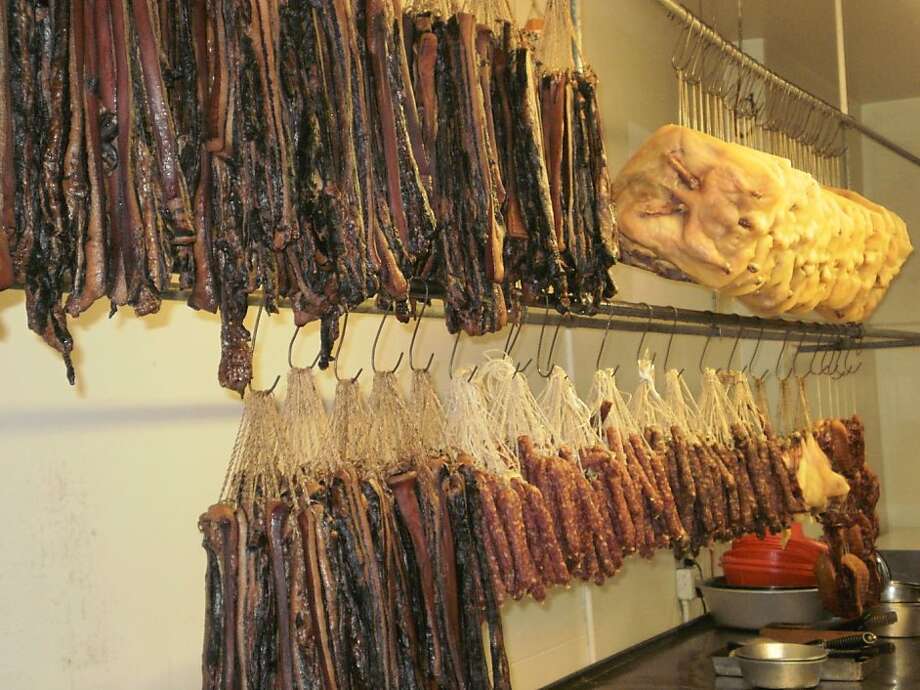
Sausages and other dried meats at the Mow Lee Shing Kee
Company, Commercial St., San Francisco (SF Gate photo)
Occasionally I hanker for lap cheong, aka Chinese sausage. Lap cheong is sweet and salty; when raw, its density and dryness are about the same as salami.

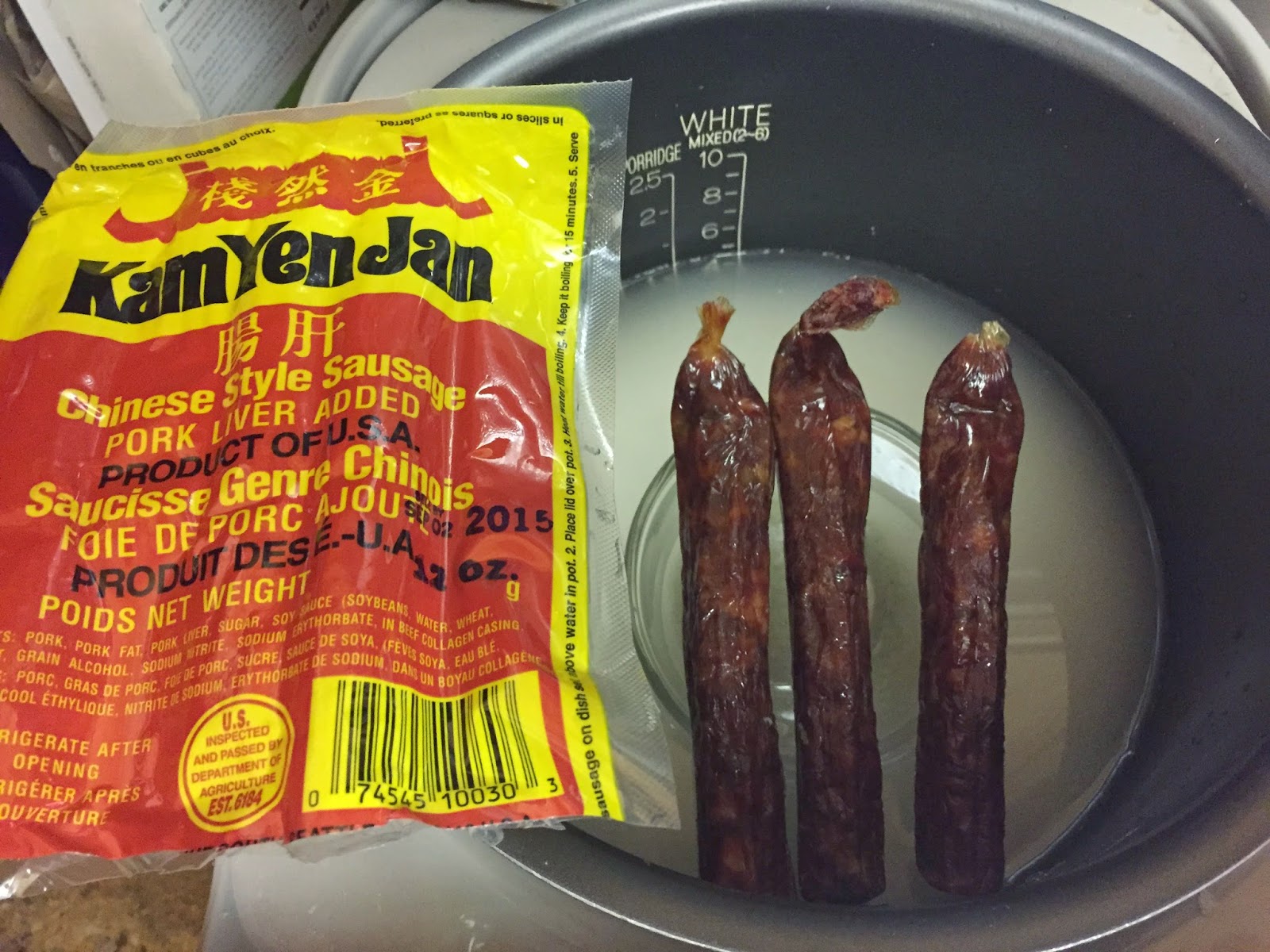
I prefer to plump the sausages via steaming in the rice cooker, an efficient one-pot method if one is preparing rice as well.

The best lap cheong is purchased fresh from SF Chinatown shops, but imported sausages from Seattle or LA can be purchased at supermarkets throughout the Bay Area.

I've found the packaged imports to be too oily for my taste, however, and so place a small dish in the cooker to catch the liquids. (Locally made, less greasy lap cheong can be laid directly on top of the rice.)

Today I sliced the sausages for inclusion in another dish, but sausage and rice by themselves make for a hearty meal. Enjoy!

Sunday, May 25, 2014

Immortality

Thirty years after his passing--and two years after the Sam Wo Restaurant was closed ignominiously by the San Francisco Health Department--the legend of "the world's rudest waiter," Edsel Ford Fong lives on at AT&T Park.

The food at the eponymous restaurant is overpriced and nothing special: orange chicken, broccoli beef, fried rice, etc. But it does comply with the health code, an improvement over Edsel's former employer.

"This no good! Go to Derby Diner!" I imagined Edsel shouting, and so I did. © 2014 Stephen Yuen

Saturday, December 28, 2013

Horse Sense

The horse ambled west on Irving at a very slow pace, perhaps 3 mph. No one dared pass and risk scaring the horse, and it was a policeman riding it after all.

Horses are classified as a slow-moving vehicle in the California Drivers' Handbook:
Animal-Drawn Vehicles: Horse-drawn vehicles and riders of horses or other animals are entitled to share the road with motor vehicles. It is a traffic offense to scare horses or stampede livestock. Slow down or stop, if necessary, or when requested to do so by the riders or herders.
The common-sense course of slowing down and accepting one's circumstance, despite the temptation to speed around the horse, turned out to be written into law.

After he had gone two blocks, the policeman stopped and waved the traffic around. Both he and the drivers behaved sensibly, a sign of hope for civic life.

Thursday, June 13, 2013

Afternoon Amble

Grant Ave. had very light traffic.
After several meetings in the Financial District, it was a perfect afternoon for a walk up to Chinatown.

Tourists chattered away in their native tongues; Asians were nattily dressed, while Europeans and Americans tended to be attired more comfortably in shorts and T-shirts.

Everyone was taking pictures with their phones; they fearlessly snapped away standing in the middle of streets, which, except for Broadway, were largely free of cars.  A word to the wise visitor: tour San Francisco during the weekday.

(Only have one day? Try this San Francisco Quickie Tour.)