Showing posts with label Cupertino. Show all posts

Monday, November 18, 2024

Cupertino Contretemps

(Illustration from them.us)
Just when I thought the Chronicle was a decent newspaper that kept its news and opinion sections separate, it produces this headline:

A Silicon Valley teacher used pronouns in a TK class. Parents demanded they go back ‘in the closet

The slant from the headline? Pronouns are relatively harmless, "back in the closet" harks back to the historic suppression of homosexuality, and "parents demand" hints that they're intolerant uneducated rubes, probably religious. However, digging into the article reveals that non-binary pronouns are being taught to four-year-olds in Transitional Kindergarten.
The individual at the center of the battle teaches 4-year-olds in transitional kindergarten at Dilworth Elementary School and was placed on leave in August after parents complained that they were discussing content they did not believe was appropriate for young children. Supporters of the teacher, including many experts in early childhood development and instruction, said the criticism appears to be leveled against the teacher’s gender identity, not what they’re teaching.
The reporter's bias is evident. She accuses the parents of transphobia ("against the teacher’s gender identity, not what they’re teaching") by using the "many experts...said" ploy. She also adopts trans pronoun language ("what they're teaching" not "what she's teaching").

I agree with the parents that non-standard pronouns are wholly confusing for kids who are learning the alphabet and basic arithmetic. Teach four year olds the fundamentals, then branch out to nuances and exceptions when they're years older. Parents' protests, IMHO, have nothing to do with animus toward the teacher's personal characteristics, just the content of his or her instruction.

Get the woke ideology out of elementary schools, and the kids will have a much better chance of getting into a good college (if that's what they want).

Saturday, February 11, 2023

Apple Visitors Center

The $5 billion mothership: close but out of reach.
The last occasion to visit Apple's headquarters was during a shareholders' meeting ten years ago.

The office buildings on Infinite Loop were well-appointed low-rises, but not noticeably different from other Silicon Valley companies.

The $5 billion circular headquarters building has been open for five years, and, since we were in Cupertino, it was time to check out the Apple Park Visitor Center.

It took less than 15 minutes to stroll through the main sections.

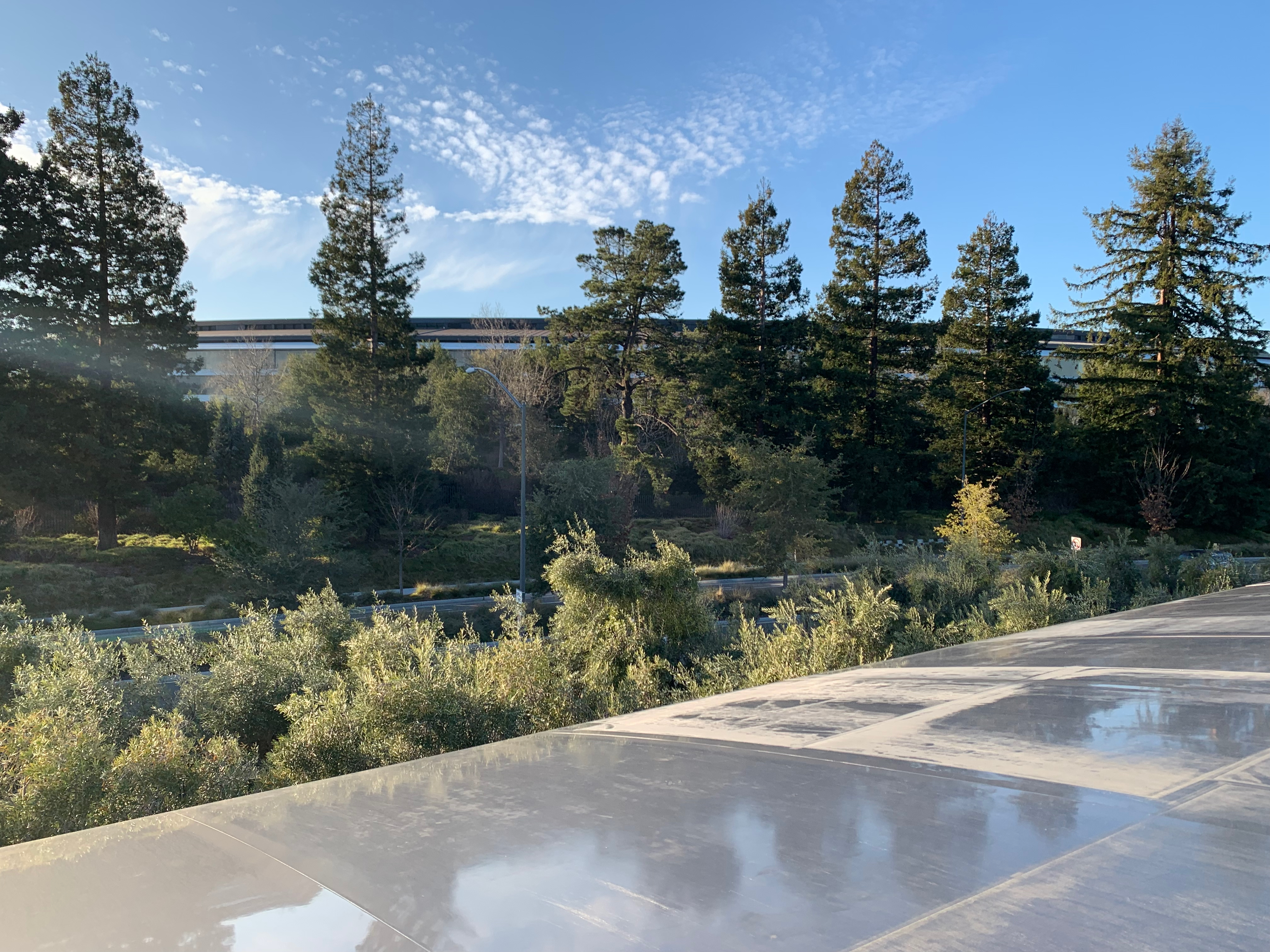
The rooftop terrace provided a view of the mothership. Movie images (Men in Black, ET, Independence Day, the Day the Earth Stood Still, etc.) of flying saucers are familiar, but being in the presence of something large, tangible, and circular does stimulate an emotion akin to awe. Millions of iPhone sales went into the headquarters construction.

Having just picnicked, we didn't spend much time in the café. Nor did we linger in the exhibit room, which had a scale model of the headquarters, visitor center, and the rest of Apple Park. The exhibit was distinguished by virtual reality technology; pointing an iPad at any section of the model called up an audio-visual presentation. It's quite an advancement over the cassette players that we used to rent for museum tours.

What I found most impressive were the lavatories, which were pristine and high-tech throughout. There was minimal touching of the fixtures. Even the corridors (pictured) had a futuristic-but-sterile feel. The $80 million (per Wikipedia) for the Visitor Center had to be spent somewhere.

At the Apple Store we bought T-shirts and an iPhone 14 Pro with specifications that we couldn't find at the Apple Store near our house. After basking in the ambience of Apple Park we were indeed privileged to spend money (using Apple Pay, of course) at the Apple Visitor Center.

Thursday, July 11, 2019

What Worries Me Most About Apple Stock

(Justin Sullivan photo via the Chronicle)
While Apple stock has nearly quadrupled since Steve Jobs' death in 2011, its rise has been choppy, to say the least. Periodically the bears drown out the bulls re the company's purported lack of innovation, legal and regulatory troubles, priciness versus the competition, and lately the vulnerability to a trade war with China.

None of these bother me as much as C. Northcote Parkinson's warning, published over 60 years ago, as applied to Apple's new headquarters: [bold added]
"During a period of exciting discovery or progress there is no time to plan the perfect headquarters," he wrote. "The time for that comes later, when all the important work has been done. Perfection, we know, is finality; and finality is death."
The cost of Apple's "spaceship" HQ is approximately $5 billion, including contents. While the company had more than enough cash to pay for it, the diversion of management time had to be significant yet was available because, as Parkinson said, "all the important work has been done."

By the way, in financial terms it's been a loser. [bold added]
New figures released this week show the tech giant’s circular headquarters in Cupertino was assessed at $3.6 billion by Santa Clara County for property tax purposes. The valuation doesn’t perfectly coincide with its market value — how much it would sell for — but is based off a detailed appraisal of the building, which opened in 2017.

If you include computers, furniture and even farm equipment to take care of the property’s trees, the figure rises to $4.17 billion for the fiscal year that ended in June, the assessor’s office said.
The paint has barely dried, and the property is worth 18-28% less than what Apple paid for it. You or I might see a similar drop when we drive a new car off the lot, but, frankly, I expect better from a trillion-dollar tech leader.

Saturday, July 08, 2017

The New Company Town

The American company town reached its heyday between Reconstruction and the 1920's. The lack of basic services across the nation's empty expanses necessitated that businesses create schools, stores, and churches for their workers; the number of company towns reached an estimated peak of 2,500 about a century ago, after which the automobile and rising affluence reduced the importance of living close to one's employer.

Here in the Bay Area the original raison d'être---providing basic services---for company towns had vanished long ago; nevertheless, company towns are being carved out in existing, highly developed cities.

Google's planned 1.2 million sq. ft. campus (Verge)
Google dominates Mountain View (pop. 80,000):
At a January 22nd, 2013 meeting, Google's VP of real estate David Radcliffe gave the city council something of an ultimatum. "We can either grow up, taking the buildings we have now and making them bigger and denser, or we can sprawl out in a continued march through neighboring business parks and communities."

The company has bought or leased a total of nearly 2 million square feet since that meeting, including giant parcels west, south, and east of the company's traditional North Bayshore haunts.
Facebook's Anton Menlo apartments
Facebook is building a $120 million complex in Menlo Park (pop. 33,000):
The social network said this week it is working with a local developer to build a $120 million, 394-unit housing community within walking distance of its offices. Called Anton Menlo, the 630,000 square-foot rental property will include everything from a sports bar to a doggy day care.

One of Facebook's corporate goals is to take care of as many aspects of its employees lives as possible. They don't have to worry about transportation—there's a bus for that. Laundry and dry cleaning? Check. Hairstylists, woodworking classes, bike maintenance. Check.
And then there's Apple's "spaceship" headquarters in Cupertino (pop. 61,000):
Steve Jobs' vision (Wired photo)
Everything in this building is the best. The toroid glass of the roof curves scientifically to shed rainwater....Of course, it only has 9,000 parking spaces, but that’s supposed to encourage people to take an Apple shuttle to work. And once they arrive, they’re not going to want to leave. The fitness center has a climbing wall with pre-distressed stone. The concrete edges of the parking lot walls are rounded. The fire suppression systems come from yachts. Craftspeople harvested the wood paneling at the exact time of year the late Steve Jobs demanded—mid-winter—so the sap content wouldn’t be ruinously high.
Apple and Google (Alphabet) are the two most valuable companies in the world; Facebook is #7 and rising. For the sake of the 21st-century company towns that they are building, here's hoping that these companies stay valuable for a long, long time. (Term for the kiddies to look up: white elephant).

Tuesday, March 22, 2016

Ancien Régime 2.0

Apple's HQ (Rendering from the Economist 1843 Magazine)
Like some nouveau riche who distance themselves from their humble backgrounds, “Silicon Valley is having its Versailles moment”: [bold added]
The scale of the project rivals the ancient Egyptians’ monuments. Every piece of glass on the four-story exterior is curved, requiring special panes to be made in Germany – the largest pieces of curved glass ever manufactured. With a price tag of around $5 billion, [Apple's] may be the most expensive corporate headquarters in history. [snip]

Last year Facebook opened a new, 430,000-square-foot building in Menlo Park designed to embody the company’s informal culture. Resembling a giant warehouse, it is reputedly the largest open-plan office in the world. Meanwhile, Google is working on a zany idea for a new headquarters to replace its Googleplex, which involves constructing movable glass buildings. Other technology companies, including Nvidia, Samsung and Uber, will, collectively, spend well over $1 billion on new buildings that broadcast their success.
With world-changing innovations ever harder to invent, our latter-day Masters of the Universe are spending precious energy and enormous resources on building monuments to their grandeur. Let's hope that, like Versailles, 200 years after the monuments were built that tourists aren't the only beings on the grounds.
The truth is that individuals and institutions usually turn to architecture at moments of decline. This curious fact was pointed out years ago by Cyril Northcote Parkinson in his 1968 best seller, Parkinson's Law....Parkinson considered buildings as an important barometer of corporate health, but as a negative barometer. "During a period of exciting discovery or progress there is no time to plan the perfect headquarters," he wrote. "The time for that comes later, when all the important work has been done. Perfection, we know, is finality; and finality is death."