Showing posts with label Apple Shareholders Meeting. Show all posts

Saturday, February 11, 2023

Apple Visitors Center

The $5 billion mothership: close but out of reach.
The last occasion to visit Apple's headquarters was during a shareholders' meeting ten years ago.

The office buildings on Infinite Loop were well-appointed low-rises, but not noticeably different from other Silicon Valley companies.

The $5 billion circular headquarters building has been open for five years, and, since we were in Cupertino, it was time to check out the Apple Park Visitor Center.

It took less than 15 minutes to stroll through the main sections.

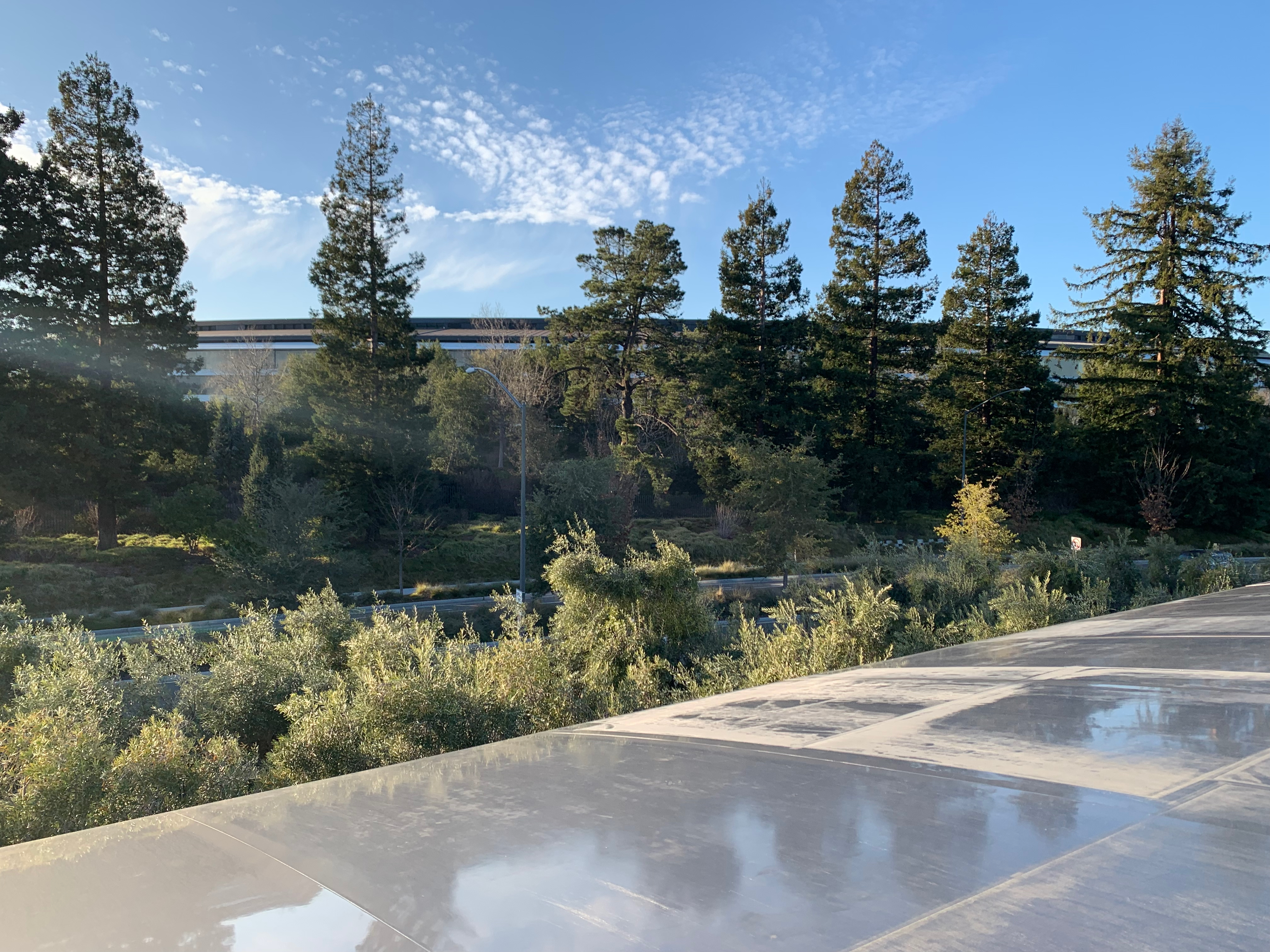
The rooftop terrace provided a view of the mothership. Movie images (Men in Black, ET, Independence Day, the Day the Earth Stood Still, etc.) of flying saucers are familiar, but being in the presence of something large, tangible, and circular does stimulate an emotion akin to awe. Millions of iPhone sales went into the headquarters construction.

Having just picnicked, we didn't spend much time in the café. Nor did we linger in the exhibit room, which had a scale model of the headquarters, visitor center, and the rest of Apple Park. The exhibit was distinguished by virtual reality technology; pointing an iPad at any section of the model called up an audio-visual presentation. It's quite an advancement over the cassette players that we used to rent for museum tours.

What I found most impressive were the lavatories, which were pristine and high-tech throughout. There was minimal touching of the fixtures. Even the corridors (pictured) had a futuristic-but-sterile feel. The $80 million (per Wikipedia) for the Visitor Center had to be spent somewhere.

At the Apple Store we bought T-shirts and an iPhone 14 Pro with specifications that we couldn't find at the Apple Store near our house. After basking in the ambience of Apple Park we were indeed privileged to spend money (using Apple Pay, of course) at the Apple Visitor Center.

Wednesday, February 27, 2013

Apple Shareholders Meeting

We arrived for the 9 AM Apple shareholders' meeting at 8:45, but already we were too late to get into the main auditorium. The young guides with Apple badges herded us over to Building 4, where two large videofeeds had been set up. Before entering, we had to check in all iPhones, iPads, Macs, and any other electronic equipment. (It took 20 minutes to retrieve our items after the meeting, so for future reference it's recommended that attendees leave their gear in the car.)

Now that Steve Jobs is gone, there's little point in attending Apple shareholders' meetings. Today there were no product, dividend, strategy, or personnel announcements. The business session went smoothly--the controversy over Proposal 2, regarding shareholder approval of new preferred stock issues--had dissipated because Apple withdrew the proposal. The rest of the Board's recommendations passed overwhelmingly (for more detail see Barron's live blog). CEO Tim Cook fielded questions for half an hour and several times repeated that Apple wants to make the best products, not necessarily the most or the biggest.

Other comments:

1) the breakfast spread was generous and well laid out; shareholders could bring food and drink into the meeting area, unlike in previous years.

2) at the beginning it was announced that the meeting would be over by 10 AM, so it was obvious that there weren't going to be any big revelations today. At least with Steve Jobs there wasn't the feeling that he couldn't wait for the meeting to end; he would field questions until the audience was reasonably satisfied.

3) Concerning Apple's glorious new "spaceship" campus that will be ready in 2016, we are reminded of the words of C. Northcote Parkinson:
"During a period of exciting discovery or progress there is no time to plan the perfect headquarters," he wrote. "The time for that comes later, when all the important work has been done. Perfection, we know, is finality; and finality is death."
© 2013 Stephen Yuen

Friday, February 24, 2012

Apple Shareholders Meeting

The line for the second overflow room
Although I arrived at 9:30 for the 10 a.m. meeting, I couldn't get into the main hall for the Apple shareholders meeting. We were bused to the second overflow room, where Tim Cook et al. appeared on the big screen. The audio and video were actually better than watching them live at a distance, which I did in 2010.

With the mail-in and online proxies already having decided the business issues by overwhelming majorities, we sped through the agenda until we got to the #1 issue in the mind of most investors: was Apple going to pay a dividend? (Interestingly, the issue was raised by the first questioner, who pleaded with Mr. Cook not to pay a dividend and focus on rationalizing the video streaming business.) There was no new news: Tim reiterated that the Board is considering the matter "deeply" and that Apple will make this and other decisions "in the best interests of the shareholders."

After reminding us that Apple has spent billions on its supply chain, Apple stores, and corporate acquisitions, he gave a very strong signal that some form of equity distribution (or buyback) will occur this year: Apple has more cash than it needs "to run the company."

There were moments of levity:

  • Concerning the change to majority-vote election of the directors, TC remarked that even that system is not perfect, as Director Al Gore knows.

  • One shareholder said that he bought a large flat-panel TV for the Super Bowl and had another month to return it. Should he do so? Everyone laughed about the allusion to the rumored iTV, but TC remained tight-lipped, saying that the shareholder should buy the $99 Apple TV add-on to enhance the viewing experience on his flat-panel.

  • The same wit said that he was tired of Greece being in the news and that Apple should use its cash hoard to "buy Greece." TC congratulated him on coming up with a use that Apple had not thought of.

    No one spoiled the party by bringing up working conditions in China.

    In response to a question about funding scholarships, TC talked about the many ways that Apple is supporting education: through matching donations (up to $10,000 per employee, who channel a large amount to educational institutions), discounts and giveaways to schools and students, summer internships, and free software. He encouraged everyone to try the new iBooks app, particularly the new iBooks Author which makes it easy to put together an electronic publication.

    The meeting was over in an hour. Next year I probably won't bother to go, especially since Apple doesn't give out free stuff like Google. But that's okay, I'd rather have a $500 billion market cap plus a good chance at a dividend.
  • Sunday, June 12, 2011

    One Week Later

    Mountain View, June 3, 2011 - Posting about an event a week after it occurs is like writing about the Peloponnesian War---it's ancient history. Nevertheless...

    I've owned the stock for several years, but I had never attended a Google shareholders' meeting. Although I drive by the Mountain View Rengstorff exit on Hwy 101 several times a week, I had never even been to Google's offices (in the tech world they're now "campuses", which is appropriate given the age and attire of the employees).

    Curiosity about the facility was one lure. Another was the free food, which despite recent cutbacks, was locally renowned for its quality and variety. And I did want to hear new CEO Larry Page handle questions from the floor. (See for yourself - he steps up to the stage 31 minutes into the meeting, speaks for 15 minutes, then fields questions.)


    Larry Page and the other executives on stage seemed sensitive to the widespread perception that Google spends a lot of resources on fanciful projects (e.g., driverless cars, alternative energy) that are far removed from its core businesses. Their response was: 1) only a few people work on these projects; 2) they apply a high "cost of capital" hurdle to such risky endeavors; and 3) the original proposals for Chrome and Android were viewed with much the same skepticism, and look how they turned out.

    When the meeting was over, I didn't have a different opinion about Google than when the meeting started: Google has some of the smartest people in the world working for it; they do have a track record of successfully monetizing some of their products but not others; I have a slight disquiet, only a feeling, really, that makes me hesitate in believing 100% that they know what they're doing. The fear is not that they'll make mistakes, it's that Google has created a high cost structure that will be damaging if revenue streams fail to materialize. Remember that Google went public in 2004, and most of its employees and managers haven't had the experience of operating during tough times.


    Well, I did enjoy the food. The salad and entrees were of a higher quality than any company cafeteria that I've been to. In looking after its shareholders'appetites, Google is eating Apple's lunch.


    In the demo area an "android" was controlled by an Android phone.

    Sunday, February 28, 2010

    Cupertino Confab

    CNET has an accurate recounting of the Apple shareholders’ meeting on Thursday. My only quibble is the writer’s emphasis on the “pointed discussion” surrounding Al Gore’s election to the Board of Directors. IMHO, there was not much controversy. Just one speaker, a white-haired gentleman whom CNET identified as Sheldon Ehrlich, spoke in a good-humored way about how the glaciers aren’t melting and how the former Vice President’s advice would hurt, not help, Apple. Polite silence greeted Mr. Ehrlich’s statement—I did hear chuckles, “that guy’s got [guts]”—but there was applause after another stockholder gave a rebuttal in support of Mr. Gore.

    There were no startling revelations in the Q&As. The biggest? 25 stores are planned for China. Apple somehow rises above limitations that bedevil other companies. Apple is notorious for maintaining tight control over its technology and markets for monetary, security, and reliability reasons. It will be interesting to watch this secretive company expand its operations in a secretive society.

    Other impressions and notes from the meeting on Thursday:

    The average age of the attendees must have been 2-3x that of the average Apple user. Despite their gray hair the crowd isn’t tech-illiterate: half of them had iPhones. The audience had the look of upper-class California-casual: Dockers, pullover sweaters, comfortable shoes—but not Nikes or Adidas. The racial make-up was overwhelmingly Caucasian. Phrases overheard from the pre-meeting chatter: Fairchild, hypercard, Los Altos Hills, Palo Alto, iPad, golf. Many attendees appeared to be retired veterans of Silicon Valley’s first generation, the millionaires next door.

    The room seats between 400 and 500 people and was filled by 9:45. I don’t know how many were in the overflow room(s). 9:55 a.m.– the Board enters and quickly fills in the front row, facing the stage. The men are wearing sports jackets, no ties. There is only one woman member, Andrea Jung, a fact which is remarked on negatively by some of the questioners later.

    Steve Jobs is skinny but not emaciated; he moves energetically and his voice is lively. He turns the meeting over to general counsel Bruce Sewell , who keeps the business session moving. Speeches are made for and against Al Gore being seated on the board, and in favor of two separate environmental sustainability measures. Board recommendations to elect the slate of directors and to reject sustainability motions are approved. Apparently, Apple has a sterling environmental reputation but like everyone else,wants to do good voluntarily and not be compelled to do so.

    One speaker in favor of sustainability stumbles over the title of Al Gore’s book, finally settling on “An Inconceivable Truth.” No one laughed.

    The business session was over at 10:25, after which the management triumvirate of COO Tim Cook, CEO Steve Jobs, and CFO Peter Oppenheimer took the stage. Most of the questions were fielded by Steve.

    On Tim Cook’s leadership while SJ was convalescing: “Tim took the helm and Apple didn’t miss a beat.” [applause]

    With a $40 billion cash hoard why doesn’t Apple help the environment by investing in electric-car maker Tesla? “We were thinking of a toga party.” [laughter]

    Why doesn’t Apple start paying a dividend? “Cash gives us security and flexibility. We want to take risks.” Apple wants to be able to “write a check for big and bold things” but if we take a leap we want to know that we can “land on the ground.”

    On Google CEO and former-Board member Eric Schmidt’s access to Apple’s secrets: “Eric conducted himself appropriately and recused himself.”

    Apple has more ideas than it can pursue. Why not license technology to others? TC: Apple is “not in the business of licensing ideas.” Apple “focuses on very few things” and puts all its efforts into those things. All of Apple’s product offerings could fit on one table.

    Back to the dividend question, Steve makes some financial assertions. “Our stock price is based on our ability to continue growing. If we dividend out all our cash the stock price will be the same. If Apple buys back the stock, the price will be the same.” [A change in dividend or stock-buyback policy will send meaningful signals about Apple’s prospects, making share price changes extremely likely. Also, to claim that Apple will have the same market capitalization of about $180 billion whether or not it dividends $40 billion is doubtful, to say the least, but if that were true there’s no question that shareholders would be better off with the dividend.]

    But Steve’s allowed to opine about finance, just as he can expound whatever he wants to about the environment. He’s made a lot of people rich, and if he wanted to say that the moon was made of green cheese everyone in the room would indulge him.

    iPhone is a great videogame platform so why doesn’t Apple produce first-party software like Nintendo, Sony, and Microsoft? “There are never enough great software engineers to go around.” With all the projects on their plate-- iPhone/iPad OS, Mac OS, iWorks, and iTunes-- 26,000 game apps shows that games are not a problem that Apple has to solve.

    Steve seemed quite animated about Apple’s environmental record. SJ and TC: Apple was the first to demand that its suppliers eliminate toxic metals and chemicals from the products. Apple has conducted environmental audits of over 100 vendors, about half of whom said that no one bothered to audit them before. Apple has reduced its packaging equivalent to many cargo planes’ worth of shipments over one year. But Apple doesn’t publish comparisons with competitors like HP and Dell; that’s for others to do. [Steve’s irritation was in evidence. Apple is a leading corporation on environmental matters, but it’s never enough for the single-issue folks.]

    Steve confirmed that Apple’s corporate facilities are no longer open to user groups. [Yes, there’s a price to becoming a big-time corporation.]

    What is Apple afraid of, what keeps Steve Jobs up at night? “Shareholder meetings.” [laughter] Seriously, it was “stability in the world” and “things that are not in our control.”

    After nearly an hour of Q&A, the meeting was over.

    iPhone's strength is not its camera!