Showing posts with label iPhone. Show all posts

Friday, October 31, 2025

Apple: Keep the Faith

NASDAQ is up 23% year-to-date, while AAPL has gained 8%. Still, it's 101 points higher than April.
As an Apple investor and fan of its products, I've been rushed (panicked?) into doing things too soon. Last April, worried about tariffs and a trade war with China, I mothballed my 6½-year-old XS Max and bought an iPhone 16 Pro Max. (Halfway through the product year I would have normally waited to order the new iPhone models in September.) Two months ago, pleased that the stock had recovered from the April tariff scare when it had hit a low of $169.21, I sold some AAPL at $241.50.

Tim Cook (Morris/Bloomberg/WSJ)
I should have had faith that the new iPhone 17 would be a hit, the problems with China would lessen, the stock would rise even more, and that CEO Tim Cook knew what he was doing.
It took two quarters for Tim Cook to save Apple from what was almost a disastrous year.

President Trump’s on-again, off-again tariffs risked massively increasing the company’s costs. A pending court ruling imperiled Apple’s lucrative Google contract. Plus, the company was seen as lagging on artificial intelligence.

Facing so much uncertainty, Apple tumbled to a market capitalization of $2.6 trillion in April and lost its title as the world’s most valuable company.

Six months later, Cook pushed Apple’s market value above $4 trillion for the first time. That’s more than 10 times what the company was worth when Cook took over as chief executive from Steve Jobs 14 years ago.
I am pleased with the iPhone 16 purchase and that I took some profits in the stock. However, if I had not let emotions cloud my judgment, it would have been even better.

Saturday, October 11, 2025

The Way Things Were, but Not Too Long Ago

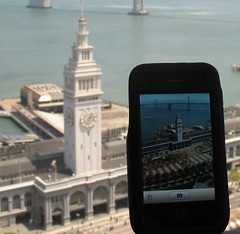
The Blue Angels won't be here for Fleet Week due to the government shutdown. To the right is a 2003 picture of the Angels near Alcatraz. It was taken by my Canon point-and-shoot camera from my old Embarcadero Center office, four years before the first iPhone was released.

Speaking of the way things used to be, Young People Are Falling in Love With Old Technology.
Driven by a desire to escape screens and reclaim a sense of control, [teens and twenty-somethings] are resurrecting digital cameras, flip phones and CDs. It’s not unusual to see them roaming the aisles of a record store or doing sidewalk photo shoots with digital cameras, as if they had traveled back to the early 2000s.

The Luddite Club, a nonprofit group that supports taking smartphone breaks, has 26 chapters, nearly all of them at high schools or colleges.
You know you're really old when stuff you once marvelled as new (digital cameras, CD players, AOL dial-up e-mail) is now thought of as ancient history.

Tuesday, July 29, 2025

Monkey Business

Having collected its ransom, a macaque leaves
the prescription sunglasses behind.
Criminals have been identified, the evidence against them is irrefutable, but they're immune from prosecution.
At a cliff-side temple on the tropical island of Bali, an unexpected group of criminals is running one of the world’s most sophisticated scam operations.

Every week, they steal dozens of phones, wallets and other valuables from tourists in broad daylight and exchange them for handsome rewards. It’s been going on for decades and nobody’s been able to stop it.

The culprits? Long-tailed macaques....

On the southern tip of the Indonesian vacation hot spot known for its beaches, tourists flock to Uluwatu Temple for traditional fire dance shows and panoramic views at sunset with the Indian Ocean crashing below. The Balinese Hindu site dates back to at least the 11th century and the roughly 600 monkeys that inhabit it are considered by locals to be sacred guardians of the temple.

Primate researchers have found that the macaques steal belongings to use as currency to trade with humans for food. Some monkeys can distinguish between objects we highly value (smartphones, prescription glasses, wallets) and those we don’t (hats, flip flops, hair clips)—and will barter accordingly, according to a University of Lethbridge team that spent years filming the macaques and analyzing hundreds of hours of footage.
Monkey handlers ("pawang") help negotiate the return of the stolen property.
They offer fruits such as bananas, mangos, rambutan and mangosteen in exchange for the stolen items. In rare cases, they use raw chicken eggs, highly coveted by the monkeys.
If your humble blogger were ever to visit Bali, he would flaunt packages of snacks (though the authorities disapprove) to divert the monkeys' attentions from more valuable items. To the simian mind a potato chip is prized over the silicon kind, and on Bali it's hard to disagree.

Saturday, May 17, 2025

Artificial Education

As a boomer, I am glad most of my life was spent before smartphones (the iPhone was introduced in 2007) or even the Internet. I learned how to write, solve problems without looking up the answer, and focus on tasks for hours without being distracted. Speaking of writing, here's another reason to be grateful that I received my education when I did, and yes, I would have been tempted to use artificial intelligence (AI) had it existed. [bold added]

(Illustration from Kent State U.)
There’s a Good Chance Your Kid Uses AI to Cheat
A high-school senior from New Jersey doesn’t want the world to know that she cheated her way through English, math and history classes last year.

Yet her experience, which the 17-year-old told The Wall Street Journal with her parent’s permission, shows how generative AI has rooted in America’s education system, allowing a generation of students to outsource their schoolwork to software with access to the world’s knowledge.

Educators see benefits to using artificial intelligence in the classroom. Yet teachers and parents are left on their own to figure out how to stop students from using the technology to short-circuit learning. Companies providing AI tools offer little help.

The New Jersey student told the Journal why she used AI for dozens of assignments last year: Work was boring or difficult. She wanted a better grade. A few times, she procrastinated and ran out of time to complete assignments.

The student turned to OpenAI’s ChatGPT and Google’s Gemini, to help spawn ideas and review concepts, which many teachers allow. More often, though, AI completed her work. Gemini solved math homework problems, she said, and aced a take-home test. ChatGPT did calculations for a science lab. It produced a tricky section of a history term paper, which she rewrote to avoid detection.

The student was caught only once.
We are now in the second stage of the AI arms race in education. Teachers are using software to detect the use of AI, and students are using AI to "humanize" their writing.
Students don’t want to be accused of cheating, so they’re using artificial intelligence to make sure their school essays sound human.

Teachers use AI-detection software to identify AI-generated work. Students, in turn, are pre-emptively running their original writing through the same tools, to see if anything might be flagged for sounding too robotic.
In the workplace of the near future, using artificial intelligence will be a necessary skill. It will also be important to have human workers who can think for themselves. I am very happy to be retired and will be neither a worker or supervisor in that environment.

Saturday, April 12, 2025

iPhone 16 Pro Max

One week ago I decided to hold off buying a new iPhone 16 because Apple Intelligence had been delayed and steep price hikes were coming.

Family members encouraged me to go ahead and make the purchase; what if Apple runs out of inventory? (It wasn't a hard push.) On Friday afternoon I went to the Apple Store and charged an iPhone 16 Pro Max to the Apple card.

It may be cognitive dissonance justifying the purchase, but the new phone is much faster than the 6½-year-old XS Max, the battery life is nearly double (after the entire day the charge was still above 50%), and the camera is a vast improvement in low light.

Later Friday afternoon the Administration announced that it was exempting smartphones and other electronics from the new tariffs. The supply of iPhones seems to be assured, but I am glad I made the purchase anyway.

Saturday, April 05, 2025

No Fine-Tuning This

iPhone: it's all tariff-able.
Last September I was certain I was going to buy a new iPhone. However, two developments have upended that Apple cart: 1) the delay in rolling out Apple Intelligence; 2) the newly-announced tariff on goods from China, where most iPhones are made.

The WSJ shows how the 54% tariff on Chinese imports raises the cost of the materials that go into the iPhone by 54% (from $549.73 to $846.59). If Apple wants to maintain the same profit margin of 50% on materials, the price of the 256GB iPhone 16 would have to rise by 54% (from $1,100 to $1,694). Such an increase in price will cause some customers to choose the iPhone's competitors who are not experiencing similar price hikes, or at least hold off purchasing a new smartphone. Apple sales will suffer, perhaps a lot, which explains why the stock has fallen 28% from its all-time high.

I am firmly ensconced in the Apple ecosystem and will buy a new iPhone when the creaky 2018 iPhone XS Max gives up its ghost, but not sooner. The WSJ:
This tariff matter is far from settled. Our advice is to hold off on stockpiling last year’s iPhones, and make that one in your hand last as long as it can.

Wednesday, January 15, 2025

Lockdown Mode

After reading about it, I gave Lockdown Mode a try:
Lockdown Mode disables or restricts such commonly used tools and activities as photo sharing, payment applications and use of unsecured local networks—all features that attackers often exploit to install spyware through phishing attempts and malicious downloads.

Unsolicited FaceTime calls and messages from unknown contacts are blocked. Standard features of modern messaging, like preview links and automatic media downloads, also are disabled. Links to images or files appear as plain text URLs without previews or direct opening options. Popular features like Apple Pay become limited, too. When someone sends money through Apple Cash, recipients see only a generic notification rather than specific payment details. Payment integrations also become more limited in third-party apps.

Users can still approve access to trusted websites and applications for more flexibility. But in return for beefed up security, Lockdown Mode essentially transforms iPhones, iPads and Macs into stripped-down versions of themselves.
Accessing the feature on the iPhone is easy. Go to Settings>Privacy and Security>Lockdown Mode, then press a series of buttons to restart the phone.

The only drawbacks seem to be that there now are constant reminders to set Lockdown mode on my other Apple devices (iPad, Mac) and that the phone works more slowly.

Trading speed for more security is worthwhile for this non-power user, and I will be using Lockdown Mode when I go out of town.

Thursday, December 05, 2024

Tsunami Warning Cancelled

At 10:44 this morning three iPhones in our house blared an emergency warning. A 7.0 earthquake had occurred in the waters off Humboldt County, over 260 miles north of San Francisco. The earthquake was just close enough--and Foster City just close enough to the Bay--that we could not disregard the dangers of a tsunami.

And so it was that our eyes were glued to the TV on the off chance that an evacuation would be announced. To our relief the tsunami warning was canceled within the hour:
Temblor CEO and Stanford Geophysics lecturer Ross Stein gave ABC7 News an explanation for the change. He said the earthquake initially appeared to be a 6.0-magnitude shallow earthquake, the kind that involves “a lot of vertical motion of the seafloor, which tends to produce more tsunamis.”

It didn’t take long, however, for scientists to realize it was a much larger 7.0-magnitude earthquake and a different type of earthquake that is unlikely to produce a large tsunami, he said.

It was “a very typical, garden-variety event on this northern extension of the San Andreas Fault, which we call the Mendocino Fault Zone. In that respect it doesn’t move the sea floor up and down very much,” said Stein.
Of course, we were relieved that there was no tsunami. It would have drastically inconvenienced our Christmas shopping activities!

But seriously...this was another demonstration of the inadequacy of our evacuation plans. We did have "go" bags at the ready, every car had at least half a tank, and we did have an idea where to seek temporary shelter. However, what to take and what to leave behind had not been finalized, I had not digitized and stored key documents in the cloud, nor had we updated our wills since 2002 (we do have draft revisions that have not been executed).

At least we know what our top New Year resolutions will be.

Tuesday, November 12, 2024

Notes: the Modern Private Diary

I began using the Notes app when I got my first iPhone 16 years ago. It was the repositor of random musings, then shopping and to-do lists, passwords, progress on YMCA exercise machines, drafts of emails not sent (but too good to trash), and sundry items. There are now 53 Notes in total; one could almost say Notes has become an extension of my brain.
For lots of people, the Notes app has become an extension of their brains. Its popularity has spurred Apple to introduce richer features like document scanning and checklists with check boxes. But users and tech-industry analysts alike say its simplicity is what has made Notes a cultural touchstone since its 2007 debut. Taylor Swift, Ariana Grande and other celebrities use it to express their feelings in a relatable way—so do the keepers of world-famous pygmy hippos.

Apple doesn’t say how many people use Notes, though it’s preinstalled on most of the 2.2 billion Apple devices active globally. Goodnotes, Notion and other similar services with more features—and broader compatibility with Android and Windows—have each been downloaded around 50 million times from 2021 to October 2024, according to market-intelligence firm Sensor Tower.

...TikTok has become a repository where people share what they deem their most “unhinged” Notes app entries.

The hashtag #notesapp has more than 90,000 posts, with users sharing revenge speeches, breakup rationales, love-song lyrics and cry logs. (Yes, people use Notes to record the days when they cry.) One popular trend, which even singer Chappell Roan jumped on, was “never go through a girl’s notes app.”
Apple's iPhone data is encrypted and therefore gives users a (false?) sense of privacy. It's a place to vent, save inappropriate jokes, and store our true impressions of people. Just be careful which icon you tap: Notes are very easy to send to or share with other people.

Monday, September 09, 2024

iPhone 16: I've Deferred Gratification Long Enough

It's been six years since I bought my iPhone XS Max. The XS Max has performed well, and I've been patiently watching as successor iPhones have improved the camera, speed, and battery life.

This year I'm going to pull the trigger on a new iPhone 16. The hyped AI (Apple Intelligence) features are just an added bonus, since the XS Max battery health had declined to 81% (80% is Apple's recommended minimum) and I was going to get a new iPhone regardless.

Here's the WSJ's first look at the new iPhone 16 announced today.

Saturday, May 04, 2024

AAPL Bounces

Despite its recent difficulties, AAPL has outperformed
MSFT over the past five years. (WSJ)
Unlike its other mega-cap peers, Apple stock had barely moved in the past twelve months. It had not outlined an artificial-intelligence strategy, its iPhone sales had fallen in China, and the Justice Department had launched a broad antitrust action against Apple. Expectations had been set very low for Apple's quarter ended March 31, 2024.

Apple's report on May 2nd provided a pleasant surprise:
Apple stock rallied in afternoon trading, after results narrowly beat estimates and the company touted a new $110 billion buyback program.

Apple also signaled sales are likely to grow this quarter, when it reported earnings late Thursday.

Shares in Apple stood more than 6% higher in recent trading, mirroring a late-Thursday rally. The stock hasn't risen more than 5% in a single session since late 2022, FactSet data shows.

Here is how the results stacked up against analysts' consensus expectations from FactSet:

Revenue of $90.8 billion vs. expected $90.4 billion

Net income of $23.6 billion vs. expected $23.3 billion

GAAP earnings of $1.53 per share vs. expected $1.51 per share

Apple approved an additional $110 billion in share repurchases, and raised its quarterly dividend by a penny to 25 cents.
Apple may have already hit its bottom this year. I'm holding on.

Tuesday, September 12, 2023

Half a Brain is All I Need

(Part of) our brain is in the Cloud
In 2018 I tried to buy the maximum memory of 512GB for a new iPhone XS Max but had to settle for the 256GB model in inventory.

Five years later the XS Max is only 40% filled. I didn't create as many files or download as many apps as I thought I would, but the main reason the extra storage is unnecessary is that I've transferred most of the files to Apple's iCloud. (Our subscription costs $9.99 per month for 2TB, which can be shared among the family.)

The larger iPhone capacity was unnecessary because some of the tasks could be offloaded to Apple's network.

It turns out that there's a biological parallel: the human brain has shrunk over the past 5,000 years. [bold added]
But a growing body of evidence suggests our brains recently changed in an unexpected way: They diminished in size sometime following the end of the last Ice Age.

“Most people think of brain evolution happening in this linear way. It grows, plateaus and stops,” said Jeremy DeSilva, a professor of paleoanthropology at Dartmouth College. “But we’ve lost brain tissue equal to the volume of a lime—it isn’t a tiny little sliver we’re talking about.”

The precise timing of that post-Ice Age brain shrink has remained a mystery until now. A group of researchers led by DeSilva used a mixture of fossil and modern specimen data to pinpoint that this loss of gray matter happened between 3,000 to 5,000 years ago, according to research published in June in the journal Frontiers in Ecology and Evolution.

Many anthropologists had initially posited the changes coincided with the advent of agricultural practices around 10,000 years ago, and a global shift away from hunting and gathering.

The more-recent dates from DeSilva’s group point to booming eras for ancient civilizations in North Africa, the Middle East and South America—complex societies that they think may have played a role in the shrinkage.

They hypothesized that human societies got so cooperatively organized in the past 3,000 years that we began relying on what researchers call collective intelligence.

“It is the idea that a group of people is smarter than the smartest person in the group,” said James Traniello, a biology professor at Boston University and one of DeSilva’s co-authors. “So basically, if you live in a group, you solve problems more rapidly, more efficiently and more accurately than what’s possible for any individual.”

Traniello said the inspiration for applying this idea to why human brains may have shrunk came from “ultrasocial” insects such as ants. Ants form highly cooperative societies in which division of labor has favored smaller-brained individuals due to an advanced level of social organization.

The researchers suggested that perhaps our need to maintain a large brain—to keep track of information about food, social relationships, predators and our environment—has also relaxed in the past few millennia because we could store information externally in other members of our social circles, towns and groups.
We don't have to hunt to survive, so it's logical that our senses--and the related parts of the brain--don't have to be as acute as they once were. Nor do we have to store as much knowledge in our head when we can rely on other people, books, and the World Wide Web. The extra brain cells are not needed.

However, I'm still going to try to get the 1TB version of the iPhone 15 Pro Max.

Thursday, May 25, 2023

Nvidia: at the Center of A.I.'s iPhone Moment

Two-year price chart of NVDA
Over ten years ago an engineering friend recommended Nvidia stock (he wasn't an insider, just a contract programmer who was impressed by the company when he worked for them between jobs). I passed.

At the time NVDA seemed to be over-priced; it made the fastest gaming boards, but it had a very high price-earnings ratio. It dominated the gaming market, but it was a niche business. Its upside was capped.

In 2011 Bitcoin began to seep into the public consciousness. Over the next decade Bitcoin and other crypto-currencies went through boom-and-bust cycles, but always with higher highs. Crypto-currency coins could be created through an increasingly costly process called "mining", and the race went to those who used fast Nvidia cards. The price of Nvidia stock reached an all-time high in November, 2021, the same month that Bitcoin reached its high of $67,567 (chart above).

In 2022 crypto prices crashed for a variety of reasons, which included a trading ban in China, the bankruptcy of crypto funds and exchanges, and U.S. interest rate hikes that had a highly negative effect on speculative assets. From peak to trough in the ensuing twelve months Nvidia stock lost more than half its value.

Ignoring the Wall Street adage, "never try to catch a falling knife," your humble blogger-speculator was driven by the fear of missing out and made a small investment in NVDA at $211 and later at $142. Then the artificial intelligence "chatbot" known as ChatGPT was released to the general public on November 30, 2022, and the stocks of companies that had been involved in artificial intelligence took off. Nvidia makes the chips that everyone in A.I. must use, and its stock rocketed past its previous all-time high today. A year ago I had been regretting my purchase. Now I wish I had bought more.

Jensen Huang, the CEO of Nvidia, said "This is the iPhone moment of artificial intelligence." Millions of consumers, investors, and producers agree with him.

Monday, April 10, 2023

A Price I Have to Pay

Your smartphone can't do everything. Its map programs can still point users to the wrong location. Service in the mountains can be non-existent, as hikers in extremis have found to their detriment.

Left: Phone ID No.   Right: Physical ID Yes. (Chron photo)
And smartphones with photo IDs won't get young adults into nightclubs. [bold added]
Bars across the Bay Area are reporting an uptick in these attempted entries during the last three years, and it’s left their owners scratching their heads in disbelief. “It’s a ridiculous concept,” said Michael Valladares, co-owner of the Hotsy Totsy Club in Albany.

People attempting to show a photo of their ID, he said, might as well “just draw a picture of your face and write your name next to it.”

Valladares’ theory is that the early-pandemic practice of showing vaccination cards on phones instilled bad habits in bargoers — especially younger people who may have turned 21 during the pandemic and never knew differently. It has “definitely been happening more, and quite honestly it’s really annoying,” said Alicia Walton, co-owner of the Sea Star in Dogpatch.
We're not at the point where the cellphone can completely eliminate the need for identification documents, cash, and old-fashioned credit cards.

This boomer still treats the smartphone as a device that enhances but is not essential to the ability to perform tasks. The too-thick wallet that I always carry in the pants pocket ruins my sleek silhouette, but that is a price I have to pay.

Saturday, February 11, 2023

Apple Visitors Center

The $5 billion mothership: close but out of reach.
The last occasion to visit Apple's headquarters was during a shareholders' meeting ten years ago.

The office buildings on Infinite Loop were well-appointed low-rises, but not noticeably different from other Silicon Valley companies.

The $5 billion circular headquarters building has been open for five years, and, since we were in Cupertino, it was time to check out the Apple Park Visitor Center.

It took less than 15 minutes to stroll through the main sections.

The rooftop terrace provided a view of the mothership. Movie images (Men in Black, ET, Independence Day, the Day the Earth Stood Still, etc.) of flying saucers are familiar, but being in the presence of something large, tangible, and circular does stimulate an emotion akin to awe. Millions of iPhone sales went into the headquarters construction.

Having just picnicked, we didn't spend much time in the café. Nor did we linger in the exhibit room, which had a scale model of the headquarters, visitor center, and the rest of Apple Park. The exhibit was distinguished by virtual reality technology; pointing an iPad at any section of the model called up an audio-visual presentation. It's quite an advancement over the cassette players that we used to rent for museum tours.

What I found most impressive were the lavatories, which were pristine and high-tech throughout. There was minimal touching of the fixtures. Even the corridors (pictured) had a futuristic-but-sterile feel. The $80 million (per Wikipedia) for the Visitor Center had to be spent somewhere.

At the Apple Store we bought T-shirts and an iPhone 14 Pro with specifications that we couldn't find at the Apple Store near our house. After basking in the ambience of Apple Park we were indeed privileged to spend money (using Apple Pay, of course) at the Apple Visitor Center.

Tuesday, January 24, 2023

It's the Content That Keeps Us Wide-Eyed

(Cleveland Clinic photo)
The blue light on our smartphone is a minor factor in keeping us awake at night. The content is a much greater disruptor.
If we come across alarming news, a scary movie or an annoying work email right before bed or in the middle of the night, the stress hormone cortisol can rise. A spike in cortisol provides an energy boost by moving glucose from a stored state in the body to an active state. “It’s like eating a candy bar,” says Jamie Zeitzer, co-director of the Stanford Center for Sleep and Circadian Sciences. Coming down from that energy rush can be difficult.

Positive content can be just as disruptive because it can increase the amount of dopamine or norepinephrine in the brain, two neurotransmitters Dr. Zeitzer says can excite the thalamus—the brain’s information-relay center—and disrupt the brain-wave oscillations needed for sleep.
Turning off the phone completely is an obvious solution. The sleep-tracking app is also effective; it dims the iPhone and Apple Watch 15 minutes before the targeted bedtime.

But if you must surf in bed, dear reader, I've been told this blog is an excellent soporific...

Friday, June 03, 2022

Coping with Inflation

(WSJ illustration)
The WSJ publishes 15 Ways Consumers Can Deal With—and Even Benefit From—Rising Inflation. Below are my comments in italics:

What’s your inflation rate?
In the CPI-U [consumer-price index for all urban consumers], motor fuel represents approximately 5% of assumed total household spending and is up 44% from April 2021 to April 2022. Used cars and trucks represent approximately 4% of the total and are up 22.7% over the same period. So if you can hold off on buying a new car, for instance, you can feel less of a sting from those big increases.
My personal inflation rate is lower than the average because the largest expenditures (mortgage and car payments) are fixed. Variable components have a discretionary element, e.g., chicken can be substituted for beef, and we can dine out two days a week instead of three. So we're lucky--we certainly feel the inflation, but the non-inflatable part of our budget is high, and we are willing to substitute lower-priced items in most cases.

Be aware of shrinkflation
Product companies will slowly “shrink” the contents of the packages and goods you buy while charging you the same price. This means a price hike for you. The package of strawberries now has five fewer strawberries. The bag of chips has more air and less chips than usual. The roll of toilet paper went from 264 sheets to 244 sheets...

One way to deal with shrinkflation is to try to stick with generic store brands because those tend to be the last to shrink...It also helps to only buy fruits and vegetables that are in season.
Perhaps there's brainwashing involved, but about half the time I don't find generics to be as good or effective as branded products, so that suggestion doesn't work for me.

Instead, my problem is kind of the opposite but is an opportunity to save money: don't buy more than you're going to use before it spoils. I buy too-large packages of perishable items, for example, two loaves of bread for $7.50 instead of one for $5, then have to throw out the second because of mold. Switching to smaller-size packages raises the per-item cost, of course, but the overall expense is lower.


Delay Social Security
Every year that Social Security benefits are delayed past full retirement age, the amount of the eventual benefit increases by 8%.

Thus, an individual with a full-retirement-age benefit at 67 years of $1,000 a month could increase their benefit to as much as $1,240 by delaying to age 70—an increase of as much as 24%. And the annual CPI increase is based on this higher amount.
My health is good but not great, and there's a good chance I will make it to 90. However, there are many personal friends, relatives, and acquaintances my age for whom stuff happened, so I claimed full benefits at 66 rather than defer until 70. Deferral is a good plan if you're in good health and are financially comfortable.

Buy the car you’re leasing
New-vehicle prices rose 13.6% since March 2021, while prices for used cars/trucks were up a whopping 34.7%. If you have a vehicle lease expiring soon, you possess a valuable way to avoid those higher prices.

That’s because your vehicle’s lease-end price was set when your lease began, prior to the current inflation...

Even if you really want to get rid of it, buy it anyway. It’s now a (lightly) used vehicle whose market value has jumped about 35% in the past year. So sell it yourself, and pocket the profit on the difference before buying something else. If you simply return it to the dealer, they will do the same thing and, of course, share none of the profit with you.
We bought out our leased car three months ago. It was the right thing to do, kind of like going to the dentist.

Seek a higher return on happiness
Take a moment and think about what you’re spending money on and why. And then stop spending money on the unnecessary things that don’t bring you joy. After all, if you stop spending money on something, by definition, you are no longer impacted by inflation in that area...

take just a week (a month is even better) and commit to deliberately reflecting on every single expenditure made during that period—from the auto-payment on that streaming service to filling up your gas tank—transformational things can happen...thinking about that one expenditure allows you to rethink where you are going—literally and figuratively.
COVID-19 caused a lot of people to reflect on their lives before inflation struck. What one needs vs. what one wants is an age-old question, but it's still relevant. I want the latest iPhone but the almost-four-year-old iPhone XS Max satisfies all my needs (except for status and techno-lust), so resist temptation!

Ask for a raise
The salary increases one normally gets are likely to be below the rate of inflation, so it is important to ask for higher raises...Given the state of the labor market—this time in favor of workers—summon up courage and go ask for the raise. You need it.
I only expressed unhappiness to management about my pay a couple of times in my career. Each time I was fully prepared with comps, a list of extra things I did, and even a worst-case scenario if the discussion went south and I had to leave the company. Even if the worst-case scenario is improbable, it's good to go through in your mind (see "happiness" above) and enter negotiations with the confidence that walking away from a job isn't so bad.

Time your expected purchases
Consumers are often advised to have cash and other liquidity available for unexpected expenses, such as house or car repairs or even medical bills. But there is another use for that cash on hand: making expected purchases on sale and ahead of time. While this only works for nonperishables, there is real value to be reaped by buying goods when the price is right and in quantities that make sense.

...households tend to hold inventories of consumer goods worth about $1,100 on average. By shopping strategically and optimally managing their inventories, households can potentially earn returns well above 20% on their “household working capital.” The key is not to stockpile too much at full cost and buy only when the price is right.
Stockpile supplies when prices are low. Clothing, however, carries the risk that tastes change: you may not like the swimsuit you bought on sale last winter.

Don’t add explicit inflation protection
While there’s nothing wrong with maintaining a long-term allocation to Treasury inflation-protected securities (TIPS) for diversification, tactically adding them as a hedge may not have the intended effect. TIPS performance is driven by unexpected changes in inflation expectations. So while inflation is high today, the likelihood of inflation expectations surprising to the upside going forward seems low now that the Federal Reserve is actively tightening monetary policy.

Gold, meanwhile, has been an awful inflation hedge since gold futures began trading in 1975, in part because they tend to rise in anticipation of inflation (rightly or wrongly) rather than with inflation.

Even with the recent period of higher inflation, average inflation is less than 3% over the past five-year and 10-year periods. So rather than adding an explicit inflation hedge, you are better off reviewing the underlying assumptions of your financial plan to focus your attention on items that are within your control.

Plus, most investors already own the best asset to combat inflation: stocks. A big reason stocks beat inflation over time is that corporate earnings and dividends tend to grow faster than inflation.
I followed my own advice from one year ago, and it holds up: If we are going to reprise the 1970's, shift some investments into real estate, gold, art, or more stable foreign currencies that can keep up with dollar inflation. (I would recommend cryptocurrencies, but I don't understand them well enough.) Get out of bonds and low-growth dividend paying stocks. If you have variable-rate loans, convert them to long-term fixed-rate debt.

Control your lifestyle creep
spending inertia is very common and, oftentimes, there are some expenses that can be cut out with minimal impact. A good place to start this budgeting process is to simply pull all of one’s bank account, credit-card and debit-card statements and look for any recurring expenses for subscriptions or services that may no longer be needed.
COVID's silver lining: we bundled our shopping expeditions, doctor's visits, etc. to minimize car trips before gas spiked, cut back on recreational travel, and cooked more often. We're spending less in total than we did before COVID but I draw the line on subscriptions; we're keeping them all.

Account for shadow inflation
Do you remember when your restaurants gave you free bread and butter? When soda refills were free? Or when your hotel room was automatically cleaned, and you could count on fresh turned-down sheets before bedtime? With the cost of goods rising rapidly, along with the current labor shortage, many of the services we have grown accustomed to are no longer included without an extra fee...

Since it is likely right now that the cost of goods and services will continue to rise, build a buffer into your budget for spending on meals and other services that are affected by this cost increase.
The message seems to be that freebies are a vanishing species, hence inflation is worse than we thought, and we should "build a buffer." Very helpful! (sarc)

Buy inflation-indexed stocks
Investors should purchase stocks from established companies—such as supermarkets—whose revenues are indexed to the inflation rate. Inflation is a basket, and the best thing correlated with the change in the price of the basket is exactly the basket. Food is sold in supermarkets and, therefore, the inflation rate of food is highly correlated with the revenues of those companies. Because those companies have small margins, their earnings also are correlated with the inflation rate. Hence, buying a claim on the revenues or the earnings has to be correlated with the inflation rate.
My own preference is for real estate stocks or the hard asset itself. Though risky, real estate returns, especially with leverage, exceed inflation.

Update your résumé
I encourage individuals to update their résumés. Given the tight job market, there’s an opportunity for many employees to find new positions that will pay them more—and a higher salary is obviously a benefit in an inflationary environment. But workers may be able to find a job that is more personally satisfying as well.
The retirement nest egg is big enough so that I don't have to go back to work...yet. If inflation continues for a couple more years, then the résumé will have to be dusted off.

Watch for falling prices
One strategy for dealing with inflation is accelerating certain purchases. This might seem counterintuitive given the impact of inflation on the economy. However, in certain scenarios it is possible to selectively capitalize on the current environment. Many consumers will need to cut spending on discretionary items, so a lack of demand may cause the prices of various nonessential goods to decrease. This can present a unique buying opportunity.

If you planned to pursue new hobbies in retirement, for instance, and are fortunate enough to have ample cash flow, it’s possible to make the most of this inflationary environment by accelerating the purchase of select recreational items as their prices fall. The key is to identify where you have some financial flexibility and make the most of what is otherwise a very challenging situation.
Prices fall with products that no one else wants (duh!). Time to fill your space with hardcover books and CD's.

Invest in alternative energy
Investors may want to consider alternative-energy stocks as an inflation hedge...But the war in Ukraine has further underscored the importance of sourcing alternative energy...While traditional energy may outperform over the near-term, the drive toward clean energy seems unlikely to reverse and may present a better long-term opportunity for socially responsible investors and the planet.
Even if you don't buy alternative energy stocks, get out of fossil fuel companies like Chevron and Exxon-Mobil. Their shares have doubled in the past year, so take the profits. The long-term prognosis is bad.

Better insulate your home
One of the best investments for a return on your dollar is to better insulate your home. This is particularly important given the current higher costs of fuel. Often, you can get a free energy assessment from your power company, with a to-do list for lowering your energy costs.

The upgrade will eventually pay for itself—sometimes in as little as three to five years—and you will have lower heating and cooling bills that will outlast this inflationary period. If it takes five years in saved electrical and fuel bills to recoup the expense, you likely just got a lifetime 20% return on your insulation investment. And as the costs of fuel and electricity go up, so does your percentage saved.
Insulating the house has been recommended for decades, and we haven't done it because we're highly allergic to the dust that project will create. Besides, it's cheaper to wear a sweater during the winter and go to the air-conditioned mall, library, or theater during the summer.

A few final words of advice, applicable to non-inflationary times, too:

1) Temper your lifestyle to be less than your income (easy to say, but pride and pleasure are powerful obstacles);

2) Pay off your credit card balances every month;

3) Do all you can to make your marriage work.

Friday, April 29, 2022

Apple Rolls Along

Through yesterday's close AAPL is up 42%, vs the NASDAQ'S 12%, over the past 12 months.
It's down 2% to $160 this morning.
Despite strong revenue and earnings for the quarter ended March 31, 2022, Apple said that supply-chain shortages and strict China lockdowns will affects its performance for the rest of 2022.
Apple Inc. cautioned Thursday that the resurgence of Covid-19 in China threatens to hinder sales by as much as $8 billion in the current quarter—a setback after seeing supply-chain improvements during the first three months of the year.

The guidance from the iPhone maker came Thursday shortly after the company posted one of the best quarters in its 46-year history...

The challenges come after a blockbuster quarter. Apple’s revenue for the recent period rose 9% to $97.3 billion, far exceeding analyst expectations for $94 billion. Earnings per share rose to $1.52 from $1.40 a year earlier—beating estimates for $1.42 a share and setting a record for Apple’s fiscal second quarter.
Apple has continued to grow despite COVID-19, the ups and downs of U.S.-China relations, supply-chain issues, and the supposed limitations of being a hardware company. As we noted almost two years ago,
Apple's market capitalization when Tim Cook officially took over in October, 2011, was $344 billion. The company is valued six times [on 4/29/22 it's 7.6x] as much today. As we've observed, naming Tim Cook as his successor was Steve Job's wisest decision.
We're a holder of AAPL more for Tim Cook and his management team than for any one product, yes, even the iPhone.

Monday, March 21, 2022

There's Always a Dark Side

Get to the iPhone Control Center by
swiping down from top right corner,
then tap the QR Code scan button.
Late to the party, I discovered the iPhone's Quick-Response (QR) Code scanner (image right) a few months ago. I scanned codes indiscriminately from menus, TV programs, magazines, and websites.

But wasting time is far from the worst thing that can happen.

Beware of QR Code Scams
in December, a much darker scenario involving QR codes unfolded when malicious actors placed QR-code stickers on parking meters in major Texas cities, directing drivers to a fraudulent website where they supposedly could pay for parking.

“People were tricked into putting in their credit-card information,” says Eric Chien, security threat researcher at Symantec...

The best way to thwart would-be scams is to manually input the desired website when a QR code seems fishy or untrustworthy....

Baiting-the-hook graphic by WSJ
Use a password manager, which won’t autofill your credentials on a suspicious site; make sure your credit cards have functions to protect against theft and fraud; don’t input personally identifiable information on an unknown website.
New, exciting tech breaches our cautious nature.

In the Brave New World we can never let down our guard.

Monday, February 28, 2022

Bank of America: Not Optimal

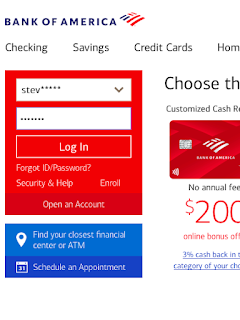
Asterisks hide passwords from users, too
It's possible to have too much security on an internet bank account.

As many websites do, Bank of America's replaces password characters with asterisks (*) shortly after the characters are typed in. Because passwords now have numbers, special characters, and both lower-case and capital letters, the probability of a mistake has increased as passwords have become lengthier. But one can't see what has been typed.

Unlike all my other financial and shopping accounts, Bank of America does not have a "show" or "eye"(👁) button that allows the user to turn off the asterisks.

After 3 password failures, Bank of America locks the account. And yes, that has happened to me, and I had to call the bank and spend an hour satisfying the person at the other end that I was not a scammer. The bank had me at its mercy, because the fee structure almost forces retail customers to cancel paper statements in favor of electronic access, which makes it impossible to check or reconcile with a locked account.

I've also gotten to the third and final login attempt several times, when my aging arthritic hands shook with trepidation (okay, some poetic license here).

Bank of America does allow FaceID to login on the iPhone, but the user can do it on only one account--I was locked out of one of the other two which required a typed password.

All the above is a protracted preface to a simulation that showed
that five was actually the optimal number—the sweet spot we were hoping to identify. When allowing five attempts, the number of lockouts were minimized, with no adverse effect on security.
Bank of America would make me a happier customer if: 1) the Password field had a "show" option; 2) the account would lock after the fifth attempt, not the third; 3) iPhone FaceID would work on every account, not just one. I would like all of those changes, but I am not expecting any.

Come to think of it, why am I staying with them?