Showing posts with label Emigration. Show all posts

Thursday, August 11, 2022

Tanforan Shopping Mall - Last Gasp

No spacing problem here.
In 2018 the decline of retail and the growing homelessness in San Bruno were warning signs for the Tanforan Mall.

The coronavirus lockdown was the death blow, and in November, 2020 the property was acquired by Alexandria Real Estate Equities for an eventual tear-down and conversion to a biotech campus / housing development.

But it would be a slow death, with designs and permits requiring years to process. Alexandria Real Estate Equities was in no hurry to buy out the leases, so tenants were running out their contracts.

In 2012 the Food Court bustled.
It was my first visit to the shopping center in four years. It was nearly empty. The once-bustling Food Court had a few diners, quietly picking at their food. Starbucks, Jollibee, and Burger King were already gone, while Chipotle, the movie theater, and Target were hanging on.

I ordered a teriyaki chicken lunch from Sarku, Japan, for old times sake. It was as good as I remembered but cost $3 more. Well, they have to make ends meet during the next year or two until construction begins.

The Tanforan Mall has been the site of a Peninsula race track, an internment camp for Japanese-Americans during World War II, and a shopping center. The recent 200-bp spike in interest rates and migration of people and business out of the Bay Area makes the biotech campus / residential housing plan by Alexandria Real Estate anything but a sure-fire moneymaker.

I wish them well.

Tuesday, January 05, 2021

Accelerating the Inevitable

(WSJ graphic)
Signs that the Bay Area had lost its luster abounded before COVID-19.

February, 2018: San Francisco Bay Area Experiences Mass Exodus Of Residents
Joint Venture Silicon Valley’s own study of the out-migration says workers are moving to Sacramento, Austin, and Portland due to a number of factors. But topping the list is the high cost of housing.
Last May, two months into the lockdown, we wrote:
The great San Francisco earthquake of 1906 destroyed real estate values. The coronavirus earthquake of 2020 will have a like effect, though few are aware that it's happening.
Yesterday the Chronicle reported on the mounting data that California has peaked. (Out-migration is a lagging indicator because circumstances--except for natural disasters--have to become bad enough to overcome the costs of moving.) [bold added]
California suffered the steepest outflow of residents via rental truck among all 50 states in 2020, with San Francisco the epicenter of the Bay Area’s pandemic exodus for DIY movers, new data shows.

California ranked last in the nation for migration growth last year, with the largest net loss of one-way U-Haul trucks crossing its border in 2020....U-Haul used data from more than 2 million transactions annually to analyze migration trends, finding that more people left densely populated areas when the pandemic hit, particularly in the Bay Area and New York City.
Hayes St., SF (October Chron photo)
Your humble Cassandra finds a silver lining in everything: now California and the Bay Area won't have to spend a penny on "affordable housing" because the fleeing people and companies have caused rents to drop precipitously. [bold added]
San Francisco’s housing rental market saw the most dramatic changes among all U.S. cities last year during the coronavirus pandemic, new data shows.

When the pandemic began in March, moving virtually halted across the country. But as job losses rose and workplaces went remote, people started leaving pricey big metro areas in favor of more affordable cities.

The country’s most expensive big city, San Francisco, was the most affected, with rental prices plummeting 26.7% since March, according to 2020 National Rent Report from rental listings website Apartment List. The current median two-bedroom rent is $2,305. [Blogger's note: it was over $3,000 a year ago.]

San Jose landed sixth on the list with a 15.2% drop since March and a median two-bedroom rent of $2,035, and Oakland was eighth on the list, declining 14.2% since March and a median two-bedroom price of $1,952. Apartment List estimates the median contract rent across new leases signed in a given market and month.

Rents in principal cities across the U.S., which are usually the largest or have the greatest economic output in the area, fell 9.3% since January, while rents in surrounding suburban cities increased 0.5% since the start of last year. The report reflected a big exception in the Bay Area: Both principal city San Francisco and its neighbor Oakland saw dramatic declines, though Oakland’s was somewhat smaller.
I talked to a few highly paid young professionals about why they're leaving. To paraphrase Rick in Casablanca:
Rick: I came to San Francisco for the night life.
Capt. Renault: Night life?! We're locked down!
Rick: I was misinformed.
San Francisco ownership and rental values are experiencing their self-inflicted, foreseeable collapse. The coronavirus, as it has in many areas of life, has accelerated the inevitable.

Friday, August 28, 2020

San Francisco Has Topped Out

This month I've been posting--and probably boring you to tears, dear reader--about the untenability of life in the Bay Area ("Cascading Catastrophes", "Thousands Flee"). Chronicle writers have devoted time to this theme:
Bad things keep piling on — when is enough enough in the Bay Area? [bold added]

Come for the fog, stay with the smoke (Chron)
The lightning-sparked fires spreading in all directions, fouling the region’s air and driving people from their homes in at least six of our nine counties, are the latest onslaught in a year that already has given us too many layers of stress. They come as we enter our sixth month of a pandemic that has no clear end, as protests continue against the racial inequities made stark by the police killing of George Floyd in Minneapolis in May...

In a poll last year by the Bay Area Council, for example, 57% of the people surveyed by the business group said that the region was on the “wrong track” — twice the number who held that view in 2015. Almost as many, 49%, classified themselves as “strongly” or “somewhat” likely to move from the region in the next few years. Asked why, nearly three-quarters identified housing costs or the cost of living as the main culprit.
Veteran writer Carl Nolte believes San Francisco will bounce back:
Forces keep battering San Francisco — and its spirit is still alive

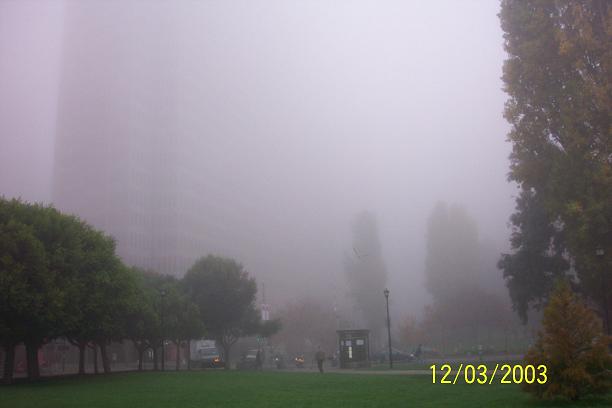
2003: now this is fog.
There are a lot of examples of how the city has lost its soul: the tent encampments, the boarded-up stores, the urban failures you see everyday, the moving vans taking people away for good.

But I see other things: the man up the street who left some honey from local bees on my doorstep earlier in the summer, the woman who left a nosegay of flowers from her garden by her gate with an invitation to passersby to take the flowers home. The sidewalk libraries with free books. A city’s soul is intangible, wispy and ephemeral like the summer fog. You miss it most when the heat’s on.
Meanwhile, home prices are booming in a resort town:
Downtown Truckee, 12 mi from N Tahoe (Chron)
Tahoe’s new Gold Rush: Bay Area residents fleeing coronavirus push up home prices

The COVID-19 pandemic has stoked a real estate boom throughout the Tahoe region, propelled by thousands of workers fleeing San Francisco and the broader Bay Area. Freed from the shackles of 9-to-5 office work, these white-collar workers are seeking mountain homes near open space and tranquility far from downtown high-rises. And they have the money to pay for it.
Young people move here for the nightlife, job opportunities, networking, and the weather. The nightlife is non-existent, jobs and networking can be done remotely, and the smokey air, not fog, is now an annual summer phenomenon.

The population inflow is slowing, the outflow is accelerating, and, sorry Carl Nolte, IMHO I don't see what will stop these trends.

Saturday, August 22, 2020

Bay Area: "Cascading Catastrophes"

SF on Wednesday: it's not the fog. (Chron)
We alluded to Northern California's perfect storm of problems--wildfires, COVID-19, homelessness, unemployment, crime, etc.--two days ago. The Chronicle describes how State and local governments are overwhelmed:
Firefighters may face increased risk of contracting the coronavirus while living and working in close quarters on the front lines. In hospitals and evacuation shelters across the region, people suffering smoke exposure may have symptoms that could be confused for COVID-19, complicating care and draining resources.

“These are all cascading catastrophes. We’re looking at the consequences of these overlapping emergencies,” said Dr. Matt Willis, the Marin County health officer. “We had been concerned there might be a fire here or there. And now we’re dealing with fires everywhere. And while we’re still seeing all this viral transmission.”

And on top of it all, everyone’s exhausted...
Adding to the constant chaos [not a hyperbolic description of the way things are, per Democratic VP Nominee Kamala Harris] is the confusion from government officials: [bold added]
In a pandemic, people are told that outdoor activities are better than inside. But with smoke choking the region, everyone’s being told to stay inside now. People evacuated from their homes often are urged to stay with friends or relatives if they can. But that’s not necessarily a wise choice now, either, when the pandemic message is to avoid others.
Don't count on the government to save us or our homes. It's paralyzed by indecision and is spewing conflicting advice in all directions. It also lacks resources; across Northern California Cal Fire is hoping the fires burn themselves out.

When the crises are over, a lot of jobs won't be coming back, and neither will the people who fled "temporarily".

Friday, February 09, 2018

Goodbye, California

The 1978 thriller is about a terrorist threat
to the San Andreas fault. The next Big
One, back to the subject,  might precipitate
an exodus from the State, just as the 1908
quake moved the population center south.
A few days ago I wrote:
The warning signs are widespread. I don't know what may trigger the fall; perhaps it will be rising interest rates, dropping tech stock prices, or fed-up tourists, but it would not be surprising to see a collapse, and an exodus of individual and business taxpayers, in San Francisco's near future.
The data now confirm what reason says should be happening.
Thursday CBS Headline: San Francisco Bay Area Experiences Mass Exodus Of Residents [bold added]
The number of people packing up and moving out of the Bay Area just hit its highest level in more than a decade...Of course people come and go from the Bay Area all the time, but for the first time in a long time, more people are leaving the Bay Area than are coming in. And the number one place in the country for out-migration is now, right here.

Topping the list is the high cost of housing.

“You can’t even contemplate getting into the housing market here,” [Joint Venture Silicon Valley's Russell] Hancock said. “And I don’t mean just service workers, I mean highly skilled professionals. The tech elite are having a hard time affording reasonable housing in Silicon Valley. So this is difficult, this makes it very difficult for employers trying to recruit.”

[Retired engineer Carole] Dabak cites crowding, crime and politics as the reasons for her own exodus...She plans to sell her home for about $1 million, buy a much larger place near Nashville for less than half that and retire closer to family and friends.
During my career I turned down transfers out of California from two different employers. Given the same circumstances today,  I would make a different decision.