Showing posts with label Interest. Show all posts

Tuesday, September 09, 2025

Breaking Up is Hard to Do

Divorced Ryan Hambry and Morgan Dickson have dinner
together with their children at their Florida house once a week
The cliché about the economics of marriage--"two can live as cheaply as one"--remains true even though the marriage is over. Some divorced couples continue to live together because their housing costs would rise substantially if they were to sell their house with a low-interest mortgage.
For divorcing couples, there is a particularly tricky version of what housing professionals call the “lock-in effect,” where homeowners stay in place because they don’t want to give up their low rates. Across the housing market, the lock-in effect prevented almost two million home sales between mid-2022 and mid-2024, according to Federal Housing Finance Agency research. The number of people moving is significantly lower than it was before the pandemic, according to Bank of America.

Some ex-spouses are choosing to “nest,” an arrangement in which the kids remain in the family home and the parents rotate in and out. The practice has been around a long time, but it has gained popularity as the costs of moving have risen, according to family-law attorneys and mediators.
There are compelling short-term financial reasons for not cutting the cord completely, but keeping the family house under joint ownership will make it difficult to find other partners, relocate to other cities, and move on with their lives.

Monday, March 03, 2025

Changing the Terms

I receive over a hundred e-mails every day, and about 20% are phishing scams (is that a redundancy)? I don't even bother to read them and can tell immediately they are fake (you have won a trip/tool set/gift card; your subscription to Netflix/Microsoft/Quicken has expired).

However, the most recent e-mail from "McAfee" piqued my curiosity because of the "espouse" in the subject line. Espouse ("to become involved with or support an activity or opinion"), although not obscure, is not a word used in regular parlance.

Looking into the text, I saw that "espouse" had replaced "expired" and "submit" was substituted for "subscription." The scammers had changed common phishing words to evade e-mail screens. They were successful in that they made me look at it...this one time.

Thursday, August 15, 2024

California Gas Prices: the Answer Always is More Regulation

The Phillips 66 refinery in Rodeo (Merc)
We've posted before about why California gasoline prices are higher than the rest of the country (gas taxes, "boutique" gas formula, banning new Internal Combustion Engine cars after 2035, etc.).

As refineries close down, the ones that remain have been accused of price gouging--any person capable of critical thought might ask herself why refiners are abandoning such a profitable business--but critical thinking about Progressive governance has been sorely lacking for decades.

The long-term supply outlook has become so dire that last week the Progressive government floated trial balloons about California seizing control of the refineries. Realizing that running refineries (and bearing responsibility for the inevitable debacles) was a step too far, Governor Newsom proposed a bill that he thinks will stabilize fuel prices. [bold added]
California Gov. Gavin Newsom on Thursday announced a first-in-the-nation plan to require petroleum refiners to maintain minimum fuel reserves to avoid supply shortages he says create higher prices at the gas pump.

The proposal would authorize the California Energy Commission to require state refiners to maintain a minimum supply, which would help prevent gas price spikes and save Californians hundreds of millions of dollars every year. Newsom said profit spikes for oil companies are overwhelmingly caused by refiners not backfilling supplies when they go down for maintenance.
The industry is likely to have to build storage facilities in order to hold the gasoline reserves. Also, the gasoline reserves themselves have a cost. As students learn in Finance 101, all assets on the balance sheet are financed through debt or equity (for analytical purposes debt is assumed). Adding storage and gas-reserve assets will increase interest expense which the companies will try to recover through higher prices.

Higher prices are what Governor Newsom was trying to avoid, but if the regulator doesn't allow the expense to be passed through to the customer, the exodus of refiners will accelerate. In the one-Party state, the answer to unforeseen consequences of regulation is always more regulation that will make the problems worse.

Wednesday, February 21, 2024

Keep Telling Yourself that Going Paperless is for Your Convenience

17 months ago I joined thousands of others who opened a Treasury Direct account. We bought I-bonds that paid 9.62% interest for the first six months. If the investor didn't withdraw his funds, the amount is reinvested at prevailing rates, currently 5.27%.

Typically savings bond interest is not reported until the bonds are cashed--this means years of deferred interest can be reported in one year--but I wasn't 100% sure that these bonds operated that way. In the old days I relied on the U.S. Postal Service to deliver all forms 1099 by mid-February, after which I could prepare our tax returns. The WSJ reminds us that times have changed, at least with regard to I-bond interest.
“A form 1099 will NOT be mailed to you,” explains an email from the government’s clunky TreasuryDirect site. For I bonds, you have to log in to the site and navigate to the page where you can download the form.

“Because it’s digital, many people forget, and many of them will end up getting IRS notices,” said Miklos Ringbauer, a certified public accountant in Los Angeles.
After making my way through the "clunky" site, I got the good news (screenshot). I had not taken the funds out; consequently there was no reportable interest for 2023. The lesson, however, is that one can't relax if a form doesn't come in the mail; one has to check each financial account to make sure. And woe is you if you can't remember every account and how to log in.

There was reportable interest on my Apple Savings account, which transmits Form 1099-INT only electronically (one can call a phone number to get a paper copy). From Apple Support:
Download a PDF of your Savings tax documents
On your iPhone, open the Wallet app and tap Apple Card.
Tap Savings account.
Tap the More More button, then tap Documents.
Tap Tax Documents. You may also have to tap the year that you want to download.
Tap the Share button to save, print, or share a copy of your tax documents.
Apple said I had $30 of interest. The rate of over 4% is good but for me not worth the administrative hassle. I'm going to close the account.

Thursday, February 01, 2024

The Lazy Explanation is Wrong

Same-sex couples are denied mortgages more frequently than different-sex couples, and, when they do get approved, are charged a higher rate. The lazy explanation is that discrimination must be the reason. This study looked deeper. [bold added]
We identify same-sex and different-sex couples according to the gender of the mortgage applicant and co-applicant. Then, controlling for a rich set of lender, borrower, and loan characteristics, some of which are important in mortgage decisions but were not available in previous research like credit scores, we find that same-sex couples are 8.8 percent more likely to be denied a home mortgage than similar opposite-sex couples and conditional on being approved, are quoted an interest rate that is 0.8 percent higher. We explore heterogeneity by regions, by acceptance of same-sex marriage, and pre- and post-COVID. Interestingly, we also find that same-sex couples default significantly more (53.9%) than similar different-sex couples, which suggests an unobserved characteristic that causes same-sex couples to default more, and could explain a part of observed disparities in mortgage approval, undermining results in previous research.
It's an undisputed principle of lending markets that higher-risk borrowers are charged higher rates and are turned down for loans more frequently. To this humble observer, the fact that same-sex couples are riskier is a more likely explanation for mortgage disparity than bias. (H/T Marginal Revolution)

Friday, October 13, 2023

Double-dipping is Never a Compliment

If you don't understand this diagram, don't do double dips.
Some leveraged companies whose low-rate loans are coming due are resorting to "double-dip" loans:
Here’s how a double-dip loan generally works: A company creates a subsidiary that issues new loans and it lends loan proceeds to its parent on a secured basis, meaning the proceeds are backed by collateral. The parent also guarantees the new loans, creating a second claim on the assets. New lenders often get collateral not pledged to existing lenders. Such a transaction is called double-dip because the loan to the parent company, along with the loan guarantee, creates separate claims on company assets.

A double-dip provides additional claims against existing collateral via an intercompany note and guarantee. Double-dips must be allowed by a company’s credit agreements, and they usually are because contractual provisions have weakened over the last several years, [AllianceBernstein director Scott] Macklin said.

Companies drawn to these transactions generally have a significant amount of leverage and few options for refinancing short-term debt. Potential new lenders often are concerned a heightened bankruptcy risk for many of these companies would prevent recovering the par value of debt they provide, so they require additional protections, Macklin said.
If you're still with me, dear reader, here are my comments.

To vet the transaction a lender needs to diagram the cash flows and understand thoroughly what happens when a deal goes south.

On a macro level when money gets tight, structures get more complex. Securitizations and collateralized debt obligations were all the rage because buyers convinced themselves that the collateral was good in case the cash flows did not materialize. We know how that turned out.

Double-dips are simpler to analyze because they only involve one company and look like a way to borrow against assets that are unpledged. Prospective lenders should ask themselves: why doesn't the parent just issue the debt without all this complexity? Instead, they've got to lend to a subsidiary that's got the collateral and a parent guarantee that's worth little when things go south.

They've got to ring-fence the sub with enough protections so they can sleep at night. Frankly, I'd try to get some upside over and above the nominal spread as compensation for the risk.

From the borrower's point of view, these loans may carry a lower coupon than other alternatives, but legal, investment banking, sales-commissions, and compliance costs make them expensive.

Yes, I used to look at complex financial arrangements and didn't particularly enjoy it. But it was a living.

Friday, July 14, 2023

Fits and Starts

July, 2023: lots of progress (viewed from Kuhio Ave.)
The fits and starts of construction since 2020 have been mirrored in this Waikiki property that I walk by on my semi-annual trips.

In 2020 tourism slowed to a trickle, unemployment in Hawaii reached 15%, and construction halted not only for economic reasons but also because it was a non-essential business during the pandemic.

In 2021 tourism picked up slowly, some Mainlanders exploited the working-from-home craze to move to Hawaii, and construction resumed.

Nov., 2022: Building on Kalakaua & Kalaimoku
In 2022 rising inflation caused the Federal Reserve to take the punch bowl away by dramatically increasing interest rates. Speculative projects were postponed, if not killed.

The opposite effect occurred on construction-in-progress. Delays were costlier, and it was urgent to finish them to make them revenue-producing. The property I've been watching is on pace to be completed by year-end.

That's good timing. Tourism is almost fully recovered, and this is the only sizable building coming on line in Waikiki.

Wednesday, June 28, 2023

"Real Estate is Local" Beats Overall Market Trends

Zillow: these Honolulu fixer-uppers are at least $1 million
The WSJ real estate section declares, Nobody Wants to Buy a Fixer-Upper Right Now [bold added]
Real-estate agents say buyers right now seem in no mood to take on the additional costs and headaches of major renovation projects... It is one reason sellers are receiving an average of three offers now, compared with around six a year ago, according to the National Association of Realtors.

The drop in demand for unrenovated homes is mostly driven by high mortgage rates, buyers and their agents said. Fixer-uppers are always a risky proposition for buyers, but now they are more costly as the rates for home loans and construction loans have both increased, on top of high property prices.

This push higher in rates has widened the gap in sale time between turnkey and non-renovated properties, say agents. For sellers, this means a home in need of repair often sits on the market longer unless they attempt to do more work before listing....

Anything that sits on the market for more than a month is usually either overpriced or in need of significant repairs or updates, said Taylor Marr, Redfin’s deputy chief economist. Homes stay on the market for a median of 27 days, up from 19 days a year ago, according to Redfin.

“Most home buyers right now simply don’t have enough money left over to invest in major repairs or remodeling,” said Marr.
We foresaw the drop in demand when we ran the numbers 12 months ago. The overwhelming majority of home buyers must use a mortgage to finance part of their purchase price, and the main factor behind the drop in home prices is the doubling in mortgage rates.

Repair costs are usually paid from the buyer's cash reserves, because the original mortgagor won't lend on a future uptick in value. If the buyer is fortunate to obtain a home improvement loan, that rate is likely higher than the mortgage rate and in any event the loan must be repaid quickly. That's why, in general, prices are dropping more on old homes in need of repair than on homes in general.

That said, we are personally aware of at least four fixer-uppers in Hawaii. All the homes require repairs to such an extent where two may be torn down. Yet demand remains strong and prices on these old homes seem to be at or above 2021 levels, when interest rates were much lower.

When deciding what to do with a specific property, be aware of what's going on nationally but it's more important to remember that all real estate is local.

Wednesday, June 07, 2023

Apple Savings: Easy to Put In, Hard to Take Out

Set up took two minutes
Six weeks ago I opened an Apple Savings account to earn the highly attractive 4.15% interest rate. The major banks now offer CD's in that range, but Apple Savings still has an advantage because the account holder can withdraw the funds instantly, or so I thought:
Some customers say it has been hard to get their money out.

Nathan Thacker, who lives outside Atlanta, had been trying to transfer $1,700 from his Apple account to JPMorgan Chase since May 15. Each time he called Goldman’s customer service department, he said, he was told to give it a few more days.

The money arrived in his Chase account Thursday morning, he said, after The Wall Street Journal contacted Goldman about his and other customers’ experiences.

Others said they also had trouble transferring money from their new Apple accounts. Customer service representatives at Goldman, which holds the deposits, sometimes gave differing responses about what to do, they said. Sometimes, their money appeared to have simply vanished, not showing up in their Apple account or in the account they were trying to move it to.
Unnerved by the Journal's June 1st article, I immediately ordered a $100 withdrawal to be sent to my bank account. The credit appeared on June 2nd, a 1-day delay that I find perfectly acceptable.

The article goes on to state that withdrawals can be delayed if there are certain "red flags": [bold added]
On brand-new accounts, like Apple’s, transfers that make up a large share of the overall balance can trigger anti–money-laundering alerts or other security concerns that require additional review, according to people in the AML field. Those delays usually last five or so days, they said.

It can also be a red flag when a customer tries to transfer a large amount of money from a newly opened savings account into an account that is different from the one where the money originally came from.
The above precautions sound reasonable, but Nathan Thacker was only trying to transfer $1,700, a small transaction in banking circles.

Although one deposit and one withdrawal went smoothly, I'm going to wait until next year before putting any more funds in Apple Savings.

Monday, April 24, 2023

Apple Savings

Despite the year-long rise in interest rates, our major-bank savings account rate has not budged from 0.03%(!) On our average balance of $10,000 we earn a handsome (sarc) $3 per year. Meanwhile, last week Apple launched its Savings Account that pays 4.15%. (Accounts under $250,000 are managed by Goldman Sachs and are insured by the FDIC.} Your humble blogger is not so wealthy that he sneezes at the difference between $3 and $415.

Establishing the Apple Savings account took a couple of minutes on the iPhone. I opened the Wallet app, tapped the Apple Card and the three dots (...) in the upper corner and selected Daily Cash. Setting up the Savings Account required entering my Social Security Number for tax reporting and checking a withholding option.

The bank account that pays the monthly Apple Card charges is the same account that is used for savings deposits and withdrawals. I immediately transferred $1,000 into Apple Savings.

I feel myself getting richer already.

Saturday, April 01, 2023

California Housing: Price Declines Were Easily Foreseen

Redfin graph confirms the price decline from 2022.
Nine months ago your humble blogger demonstrated how an increase in the mortgage rate of two percentage points, e.g., from 3% to 5%, would produce a 20% decline in the selling price of a house, e.g., from $1 million to $800,000. No advanced analytic skills were required, just the basic math taught in Finance 101.

Today's Mercury-News: Median price of single-family home in California is 18% off May 2022's high
As the pandemic throttled the nation’s economy in early 2020, the Fed did what it often does in dicey times: helped to prop up the business climate with lowered interest rates.

However, the Fed gave housing an additional nudge by doubling its ownership of mortgage bonds to $2.8 trillion – as it clearly feared another housing crash.

These actions pushed mortgage rates to a historic low of 2.6% by early 2021 – and the Fed kept rates below 3% for roughly a year. That stimulus, plus federal aid for the broad economy, was too much good stuff. Home prices, for example, jumped 53% in two years.

Meanwhile, all this stimulus ballooned to inflation rates to highs not seen in four decades. You know, back in the early 1980s when the S&Ls sunk.

This bubble’s pop came in early 2022 when the Fed’s pump ended. The central bank sharply reversed its interest rate policies hoping to chill an overheated economy. Mortgage rates swiftly doubled, icing homebuying.
We're close to the end of the Fed rate hikes, because the weakness in the banking system won't tolerate more increases.

(Image from Tax Foundation)
Does this mean that California real estate has hit bottom and prices will turn upward? IMHO, no. The exodus of people, business, and capital from California is a trend that will last for years and should put a damper on prices.

This isn't rocket science: interest rates, though powerful, aren't the only factor driving real estate. Buy properties in states experiencing population growth, and avoid those that are declining.

Friday, March 10, 2023

Silicon Valley Bank Lent Long and Borrowed Short

Police at SVB HQ in Santa Clara (Mercury News)
The failure of Silicon Valley Bank today appears ("appears" because it's still early days) to be contained to the bank itself and does not foretell other failures in the banking sector.

However, the latter possibility affected the stock market, whose major indices were down between 1 and 2%. [bold added]
SVB Financial bought tens of billions of dollars of seemingly safe assets, primarily longer-term U.S. Treasurys and government-backed mortgage securities...These securities are at virtually no risk of defaulting. But they pay fixed interest rates for many years. That isn’t necessarily a problem, unless the bank suddenly needs to sell the securities. Because market interest rates have moved so much higher, those securities are suddenly worth less on the open market than they are valued at on the bank’s books. As a result, they could only be sold at a loss.

SVB’s unrealized losses on its securities portfolio at the end of 2022—or the gap between the cost of the investments and their fair value—jumped to more than $17 billion.

At the same time, SVB’s deposit inflows turned to outflows as its clients burned cash and stopped getting new funds from public offerings or fundraisings. Attracting new deposits also became far more expensive, with the rates demanded by savers increasing along with the Fed’s hikes. Deposits fell from nearly $200 billion at the end of March 2022 to $173 billion at year-end 2022.
The failure of SVB is symbolically meaningful because it puts an exclamation mark on the decline of the tech industry in California. SVB's customers are concentrated in tech, and the steep rise in interest rates over the past year has made risky investments in those customers much less attractive.

In California financial stress has been exacerbated by high taxes and regulations, which have caused high-profile companies like HP, Oracle, and Tesla to move out of State. It is easy to imagine that the run on California's premier tech bank is related to the exodus of businesses out of the State.

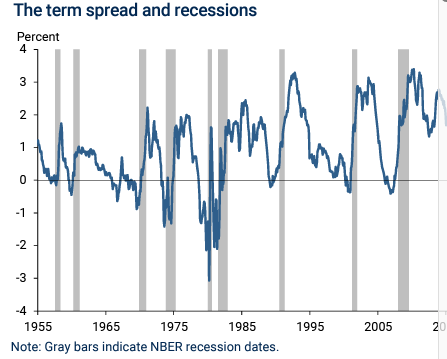
A negative number indicates the 1-year Treasury rate
is greater than the 10-year. (SF Federal Reserve)
The weekend hiatus provides time for cooler heads to prevail. According to the Journal article, SVB's problems seem to stem from lending long and borrowing short. That strategy produces regular profits, except for the infrequent occasions when the short rate exceeds the long. Duke University finance professor Campbell Harvey:
"If you lock your money up for a longer period of time, you almost always get a higher interest rate..."However, today, things are backwards - 10-year interest rates are far below short-term rates. This is known as an 'inverted yield curve.' In the past 50 years, we have seen seven inverted interest rate curves. Each one was followed by a recession."
Silicon Valley Bank bet that normal would continue. That bet proved disastrous when it kept having to refinance deposits and other short-term borrowings as rates climbed rapidly higher. Major banks are required to "stress test" for just such an eventuality; let's hope they didn't cut corners.

Friday, October 28, 2022

I-Bond Deadline

(Forbes image)
Not knowing whether I was going to invest in I-bonds, I nevertheless opened up a Treasury Direct account at the beginning of October. There were more steps to go through than when opening a normal bank account--for example, each user computer must be individually authorized--but otherwise there were no insuperable difficulties. Opening an account did not require an investment.

Last week I quit hesitating and ordered a $10,000 I-bond purchase. The Treasury debited the bank account on the next business day.

Many people are worse ditherers than I and tried to open Treasury Direct accounts and make the investment this week to beat the deadline, today, to capture the 9.62% rate.
a surge in demand for the inflation-adjusted bonds has overwhelmed the TreasuryDirect site and the Treasury Department said it cannot guarantee orders will be completed in time.

Many investors managed to beat the clock and the tech issues. As of 4 p.m. ET, nearly 69,000 accounts had been created and more than $710 million in I Bonds purchased on Friday alone, Treasury said. That brings this week’s I Bond sales to about $3.4 billion so far, Treasury said. Five thousand new accounts were created per hour Friday, Treasury said.
Procrastination is one of my life-long vices, but from sad experience I know better than to count on government systems to function under pressure. You must submit papers or electronic applications a few days before the deadline; you are asking for hours, if not days, of trouble if you don't.

Saturday, October 22, 2022

Simplification Will Have to Wait

$10,000 will earn $481 interest in 6 months. Then $10,481
will be re-invested at a projected 6.47% p.a. for the next six.
Now that we're scratching for yield on our savings accounts, I took another look at I-bonds. The 9.62% rate on a "risk-free" investment outweighed the drawbacks: a $10,000 per year limit on new investment and an interest penalty if the funds are withdrawn before five years.

The excess return over our bank savings and money market accounts was there for the taking. Though limited to several hundred dollars per year, your humble blogger couldn't pass it up. The long-term project to consolidate and simplify our financial picture would have to be delayed yet again.

Note: after the break, WSJ experts explain I-bonds.

Monday, October 03, 2022

Scratching for Yield

This happens every time interest rates rise; it's just that the increases have been so sharp that the effect is noticeable to everyone, not just Wall Street and corporate treasurers.

Interest Rates Are Rising Everywhere—Except Your Savings Account [bold added]
The interest on my $45,900 money market fund rose
from .16% to .25% between August and September.
Sheer laziness was the reason I didn't do better.
Mortgage rates doubled this year to nearly 7%, and it has become more expensive to get a car loan or carry a credit-card balance. Yet the interest on savings accounts barely budged. In March 2020, the average annual yield on a standard savings account was 0.1%, according to Bankrate.com. It fell to a pandemic low of 0.06% after Americans’ personal saving rate peaked, and is now up to a wan 0.14%.

...[banks] still paying out meager interest can count on customer inertia: We fail to take advantage of better deals, because switching banks seems like a headache.
One reason savers haven't shopped around is inertia; another is the "headache" of switching. A third reason, IMHO, is that we've gotten used to making $thousands on the stock market, and scratching around for $hundreds in interest doesn't seem to be worth the trouble.

The great reset isn't just about re-evaluating priorities; it's about recognizing how hard it is to make a buck, working hard for it, and shopping around, both to lower household expenses and to raise the interest on one's savings.

By the way, I have not yet seized the opportunity to invest in the almost too-good-to-be-true yield (9.62%) on I-bonds. There is a $10,000 limit on an I-bond account, so under the old perspective it wasn't worth the trouble. Now that I'm scratching for yield, it is.

Thursday, August 11, 2022

Tanforan Shopping Mall - Last Gasp

No spacing problem here.
In 2018 the decline of retail and the growing homelessness in San Bruno were warning signs for the Tanforan Mall.

The coronavirus lockdown was the death blow, and in November, 2020 the property was acquired by Alexandria Real Estate Equities for an eventual tear-down and conversion to a biotech campus / housing development.

But it would be a slow death, with designs and permits requiring years to process. Alexandria Real Estate Equities was in no hurry to buy out the leases, so tenants were running out their contracts.

In 2012 the Food Court bustled.
It was my first visit to the shopping center in four years. It was nearly empty. The once-bustling Food Court had a few diners, quietly picking at their food. Starbucks, Jollibee, and Burger King were already gone, while Chipotle, the movie theater, and Target were hanging on.

I ordered a teriyaki chicken lunch from Sarku, Japan, for old times sake. It was as good as I remembered but cost $3 more. Well, they have to make ends meet during the next year or two until construction begins.

The Tanforan Mall has been the site of a Peninsula race track, an internment camp for Japanese-Americans during World War II, and a shopping center. The recent 200-bp spike in interest rates and migration of people and business out of the Bay Area makes the biotech campus / residential housing plan by Alexandria Real Estate anything but a sure-fire moneymaker.

I wish them well.

Sunday, June 12, 2022

Interest Rates and Housing Prices

The unit is on the 2nd floor.
In yesterday's post I noted:
We are already seeing early signs of a recession with layoffs in tech and a cooling housing market (mortgage interest rates have risen above 5%).
Saturday's mail included a flyer for a new listing in a nearby development.

A two-bedroom, two-bath condo has been offered at $829,000 (pictures right) when one year ago similar units had sold for over $1 million.

But could a mortgage-rate change by itself explain a $200,000 drop in price? Yes.

The table below compares the monthly payment on a $1.02 million property versus one that costs $800,000. Both are financed with an 80% 30-year loan, the former at 3% and the latter at 5%.

The 20% down payment is $44,000 ($204,000-$160,000) less on the lower-priced example, but the focus of this exercise is the monthly payment.

(Of course, in real life a $44,000 down payment difference can be a huge factor.)

There's less than a $5 difference in the mortgage payments, confirming the effect that interest rates have on the size of mortgage loans and ultimately real estate prices.

The drop in house prices will be felt immediately after existing "loan-lock" commitments expire, and the ripple effects through construction, labor and the building materials supply chain should manifest before year end.

The coming slowdown in real estate is obvious, while the ultimate recessionary effect on the economy is unclear. Let's hope that the battle against inflation succeeds, else the cost will not have been worthwhile.

Note: below is a chart from the St. Louis Fed. It shows that mortgage rates have risen from 3.0% to 5.2% during the past year.

Thursday, May 05, 2022

Sinking on Cinco de Mayo

WSJ graphic: the peak was yesterday's close
As of 10 a.m. PDT the stock market has given back all yesterday's gains (which were posted about below):
“The market yesterday was a relief rally,” said Seema Shah, chief strategist at Principal Global Investors. By Thursday, she said, the realities of a more challenging environment for stocks were starting to settle in.
Using a cliché--with expletives if you desire--is warranted: what goes up must come down, the market giveth and the market taketh away, etc.

Before Chairman Powell spoke yesterday, the outlook was gloomy but IMHO not apocalyptic. We're just back to where it was.

Wednesday, May 04, 2022

Stock Market: Hold, but Buy Antacids

Gloom on 4/29, more declines on 5/2, cautious rise on 5/3, snapback on 5/4.
Gloom on Friday
The NASDAQ index closed last Friday, April 29th, with the worst showing of any month since the financial crisis year of 2008:
The broad selloff has erased trillions of dollars in market value from the tech-heavy gauge, with investors souring on shares of everything from software and semiconductor companies to social-media giants.

The Nasdaq dropped 4.2% Friday, bringing its losses for the month to more than 13%, its worst showing since October 2008. The index is down 21% in 2022, its worst start to a year on record.
The explanations were high inflation, the raising of interest rates by the Federal Reserve to cool off the economy, the COVID-19 lockdown in China, a possible expansion of the war in Ukraine, and lowered corporate outlooks.

Warren Buffett prepared to speak to Berkshire
shareholders this Saturday. (WSJ photo)
Buffett: Buying Opportunities
Though the gloom was palpable over the weekend, experienced hands began to see buying opportunities. Of course, none are more experienced and successful as Warren Buffett:
As recently as February, Warren Buffett lamented he wasn’t finding much out there that was worth buying.

That is no longer the case.

After a yearslong deal drought, Mr. Buffett’s Berkshire Hathaway Inc. BRK.B 2.45% is opening up the spending spigot again. It forged an $11.6 billion deal to buy insurer Alleghany Corp. Y -0.26% , poised to be Berkshire’s biggest acquisition in six years. It bought millions of shares of HP Inc. HPQ 3.88% and Occidental Petroleum Corp. OXY 3.93% And it dramatically ramped up its stake in Chevron Corp. CVX 3.14% , making the energy company one of Berkshire’s top four stock investments.

...While he finds speculative bets “obscene,” the pickup in volatility across the markets has had one good effect, he said: It has allowed Berkshire to find undervalued businesses to invest in again following a period of relative quiet.
Wednesday Snapback
Though the Federal Reserve raised the Federal Funds rate by 50 basis points, the market had been expecting worse. As soon as Chairman Jay Powell said that a 75-bp increase was off the table, the stock market took off:
Major indexes were at first little changed Wednesday after the Fed announced it would raise interest rates by half a percentage point and begin to shrink its $9 trillion asset portfolio next month. Investors had widely expected both decisions heading into the conclusion of the central bank’s policy meeting.

What caught some by surprise was Mr. Powell saying the Fed wasn’t “actively considering” raising interest rates by 0.75 percentage point at a future meeting. Federal-funds futures, which traders use to track interest-rate expectations, had previously shown the market pricing in a 95% chance of the Fed making such a move in June.

Stocks soared after Mr. Powell’s remarks, with the Dow Jones Industrial Average finishing up 932.27 points, or 2.8%, to 34061.06, marking its biggest one-day gain since November 2020. The S&P 500 jumped 124.69 points, or 3%, to 4300.17 for its best day since May 2020, while the Nasdaq Composite added 401.10 points, or 3.2%, to 12964.86.
There's always a possibility of negative surprises, but on balance I don't think apocalyptic scenarios are likely. I am holding on to my portfolio and am neither a buyer or a seller.

Wednesday, November 24, 2021

Just in Time

The recent upward blip in interest rates resulted in Citibank adding 8 cents, more than double the usual, to my largely inactive savings account.

It was just in time for Christmas shopping.

As the saying goes, I'll try not to spend it all in one place.