Showing posts with label Poetry. Show all posts

Monday, June 19, 2023

Juneteenth 2023

From the papers of Harlem poet Langston Hughes (1902-1967), Beinecke Library:
The night is beautiful,
So the faces of my people.

The stars are beautiful,
So the eyes of my people.

Beautiful, also, is the sun.
Beautiful, also, are the souls of my people.
Now that Juneteenth is a Federal holiday, let's all of us just celebrate it and forget about the political calculations behind it.

Monday, May 30, 2022

Memorial Day, 2022

This month marks the 107th anniversary of the widely known poem, In Flanders Fields. It was composed one year after World War I ("the Great War") began. I first heard it 58 years ago when an upperclassman quoted the opening stanza from memory.
In Flanders Fields the poppies blow
Between the crosses, row on row,
That mark our place; and in the sky
The larks, still bravely singing, fly
Scarce heard amid the guns below.

We are the Dead. Short days ago
We lived, felt dawn, saw sunset glow,
Loved and were loved, and now we lie,
In Flanders fields.

Take up our quarrel with the foe:
To you from failing hands we throw
The torch; be yours to hold it high.
If ye break faith with us who die
We shall not sleep, though poppies grow
In Flanders fields.
By 1964 the 20th century was already the bloodiest in history; the Korean War stalemate, the American buildup in Vietnam, and the threat of mutually assured destruction promised a dystopian future--if we had one at all--of continuous war and police states. All Quiet on the Western Front portrayed the recent past, and 1984 and Brave New World the future.

It is with wonder and gratitude that we are still around to reflect on the sadness and beauty of Flanders Fields.

Flanders Fields (U of Texas NROTC photo)

Sunday, August 01, 2021

The Prescient Poet

Five years later, this post about W.B. Yeats' Second Coming is still relevant....perhaps more relevant since the poem was written in the shadow of the Great War and the Spanish flu.

----------------------------------------------------------------------

W.B. Yeats (Daily Beast / Library of Congress)
W.B. Yeats' poem, The Second Coming, is experiencing a second life in these times of turmoil:
the Irish poet’s incantatory words and frightening symbolism are being deployed with unusual frequency by commentators, journalists and others seeking to add an apocalyptic tone to their work.
Confused and discouraged by events, we turn not to more words, but better ones. Phrases from the poem have entered the popular lexicon:
The widening gyre
Things fall apart; the centre cannot hold
The best lack all conviction, while the worst are full of passionate intensity
Slouches towards Bethlehem
We may think that the ground is crumbling beneath our feet, but that feeling is extraordinarily self-indulgent compared to the experiences of 100 years ago. The romantic ideals of European civilization crashed into the charnel house of the Great War, the effects of which still reverberate through arts and literature.
The Second Coming
Turning and turning in the widening gyre
The falcon cannot hear the falconer;
Things fall apart; the centre cannot hold;
Mere anarchy is loosed upon the world,
The blood-dimmed tide is loosed, and everywhere
The ceremony of innocence is drowned;
The best lack all conviction, while the worst
Are full of passionate intensity.

Surely some revelation is at hand;
Surely the Second Coming is at hand.
The Second Coming! Hardly are those words out
When a vast image out of Spiritus Mundi
Troubles my sight: somewhere in sands of the desert
A shape with lion body and the head of a man,
A gaze blank and pitiless as the sun,
Is moving its slow thighs, while all about it
Reel shadows of the indignant desert birds.
The darkness drops again; but now I know
That twenty centuries of stony sleep
Were vexed to nightmare by a rocking cradle,
And what rough beast, its hour come round at last,
Slouches towards Bethlehem to be born?

Tuesday, October 29, 2019

A Hell of Our Own Making

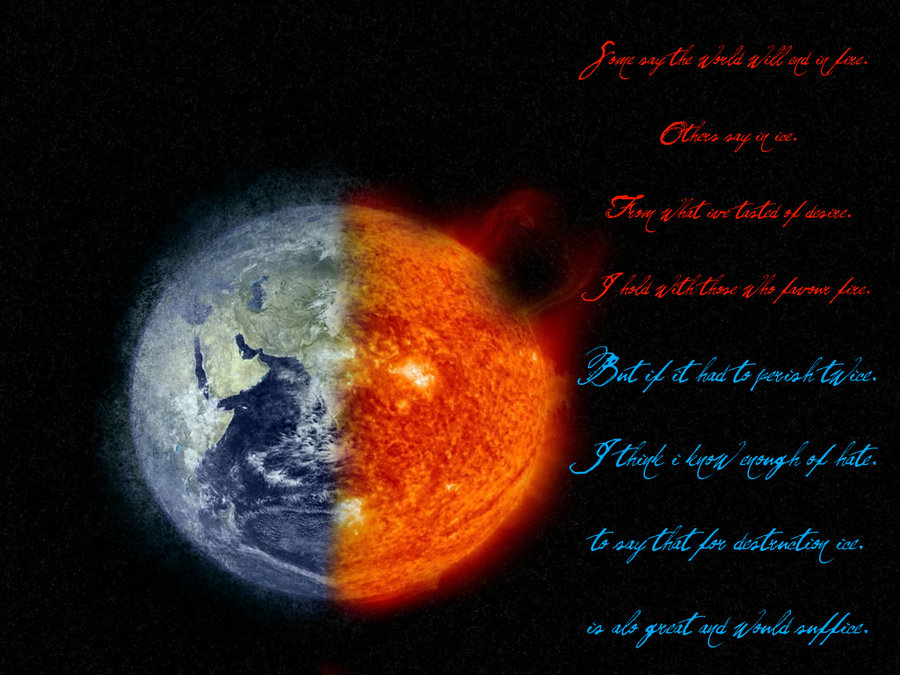
Fire and Ice by Robert Frost

(Wallpaper safari image)
Some say the world will end in fire,
Some say in ice.
From what I've tasted of desire
I hold with those who favor fire.
But if it had to perish twice,
I think I know enough of hate
To know that for destruction ice
Is also great
And would suffice.
We first pondered Robert Frost's short and superficially simple poem in grade school. By then we were familiar with scientists' predictions about the fate of our planetary home: the sun will become a red giant and envelop the earth, which, if it somehow remained intact, would spend eternity frozen in the orbit of a dead star. But our elementary minds couldn't fathom the poet's allusions to the emotions of desire and hate. Hey, we're talking science here! (Wikipedia: "John N. Serio claims that the poem is a compression of Dante's Inferno.")

As we contemplate the disasters that are unfolding in California--wildfires, high winds, evacuations, and power shut-offs--we are catching a glimpse of what the poet is referring to. With thousands displaced, the damage only beginning to be assessed, and new fires popping up, some prominent politicians are laying blame, resulting of course in counter-accusations:
The Soda Rock Winery, Healdsburg (Chronicle photo)
Gov. Gavin Newsom is trying to deflect political blame. “It’s about dog-eat-dog capitalism meeting climate change. It’s about corporate greed meeting climate change. It’s about decades of mismanagement,” Mr. Newsom declared. But Democrats for years have treated PG&E as their de facto political subsidiary. The wildfires and blackouts are the direct result of their mismanagement...

Yet PG&E received no safety fines related to its power-grid management over the last several years. The commission has instead focused on enforcing the Legislature’s climate mandates.

State law mandates that utilities obtain 33% of electric generation from renewables such as wind and solar by 2020 and 60% by 2030. Utilities must spend hundreds of millions of dollars each year to reduce the cost of green energy for low-income households. PG&E has prioritized political obeisance over safety.

In 2018 PG&E spent $509 million on electric discounts for low-income customers in addition to $125 million for no-cost weatherization and efficiency upgrades for disadvantaged communities. Utilities also receive allowances from the state’s cap-and-trade program—$7.5 billion since 2012—to pay for other “ratepayer benefits” that reduce emissions.
In a discussion with a climate-change activist over the weekend, he named PG&E as the cause of the entire disaster. I said that PG&E is a regulated monopoly and is following the directives of the Public Utilities Commission. "So it's the government's fault?" my friend asked. No. It's all our fault--we elected the politicians who gave the marching orders to PG&E.

Besides, if I blamed the government or the Democratic Party--which are synonymous in California--we'd get into a heated, purposeless argument.

One thing that we and Robert Frost can all agree upon, albeit for different reasons: we are in a hell of our own making.

Wednesday, August 14, 2019

The Meandering Muse

Publishing tycoon William Randolph Hearst died on this date in 1951. His poem, Song of the River, written in 1941 when he was 78, begins:
Inspiration: the McCloud River
The snow melts on the mountain
And the water runs down to the spring,
And the spring in a turbulent fountain,
With a song of youth to sing,
Runs down to the riotous river,
And the river flows to the sea,
And the water again
Goes back in rain
To the hills where it used to be.
And I wonder if life’s deep mystery
Isn’t much like the rain and the snow
Returning through all eternity
To the places it used to know.
I first came upon this reflective poem a few years after college. At the time the life-as-a-river imagery resonated with your humble blogger, whose arc of life no longer rose steeply.

Reading it again, I still respond positively, but less so. The verses go on and on, with too much explaining of the river metaphor. I like poems ("the best words in the best order", as my 5th grade teacher said) to be rich with multiple meanings...and shorter.

W.R. Hearst, whose life inspired Citizen Kane, had spectacular success in his youth followed by self-inflicted misfortunes. We read Song of the River today because of the importance of the poet---the Hearst newspapers reprint it annually on this date---and not so much the poem (reprinted in entirety after the break).

Sunday, August 28, 2016

Spiraling toward Doom

W.B. Yeats (Daily Beast / Library of Congress)
W.B. Yeats' poem, The Second Coming, is experiencing a second life in these times of turmoil:
the Irish poet’s incantatory words and frightening symbolism are being deployed with unusual frequency by commentators, journalists and others seeking to add an apocalyptic tone to their work.
Confused and discouraged by events, we turn not to more words, but better ones. Phrases from the poem have entered the popular lexicon:
The widening gyre
Things fall apart; the centre cannot hold
The best lack all conviction, while the worst are full of passionate intensity
Slouches towards Bethlehem
We may think that the ground is crumbling beneath our feet, but that feeling is extraordinarily self-indulgent compared to the experiences of 100 years ago. The romantic ideals of European civilization crashed into the charnel house of the Great War, the effects of which still reverberate through arts and literature.
The Second Coming
Turning and turning in the widening gyre
The falcon cannot hear the falconer;
Things fall apart; the centre cannot hold;
Mere anarchy is loosed upon the world,
The blood-dimmed tide is loosed, and everywhere
The ceremony of innocence is drowned;
The best lack all conviction, while the worst
Are full of passionate intensity.

Surely some revelation is at hand;
Surely the Second Coming is at hand.
The Second Coming! Hardly are those words out
When a vast image out of Spiritus Mundi
Troubles my sight: somewhere in sands of the desert
A shape with lion body and the head of a man,
A gaze blank and pitiless as the sun,
Is moving its slow thighs, while all about it
Reel shadows of the indignant desert birds.
The darkness drops again; but now I know
That twenty centuries of stony sleep
Were vexed to nightmare by a rocking cradle,
And what rough beast, its hour come round at last,
Slouches towards Bethlehem to be born?

Saturday, August 30, 2014

Don't Hurry Up, Wait

According to psychological research
the purchase of experiences appears to bring more happiness than the purchase of things.

"The anticipatory period tends to be more pleasant, more exciting, and less tinged with impatience for experiential purchases."
(Image from Schmoop.com)
Science confirms what the poet said 200 years ago about two lovers, frozen in time, who can never meet:
Bold Lover, never, never canst thou kiss,
Though winning near the goal—yet, do not grieve;
She cannot fade, though thou hast not thy bliss,
For ever wilt thou love, and she be fair!
From politics to sex to tech gadgets to books and movies, often it's not the experience itself but the anticipation that gives the most pleasure.

Monday, May 26, 2014

Memorial Day, 2014

In two months we will mark the 100th anniversary of the start of World War I, aka the "Great War," aka the "War to End All Wars." (The latter description is now used ironically, because the casualties and destruction of the Second World War dwarfed that of the First.) To be sure, World War I introduced its own horrors, with machine guns, trench warfare, and chemical weapons forever dispelling any romantic notions of armed conflict between nations.

This month also marks the 99th anniversary of the widely known poem, In Flanders Fields. I first heard it 50 years ago when an upperclassman quoted the opening stanza from memory.
In Flanders Fields the poppies blow
Between the crosses, row on row,
That mark our place; and in the sky
The larks, still bravely singing, fly
Scarce heard amid the guns below.
By 1964 the 20th century was already the bloodiest in history; the Korean War stalemate, the American buildup in Vietnam, and the threat of mutually assured destruction promised a dystopian future--if we had one at all--of continuous war and police states. All Quiet on the Western Front portrayed the recent past, and 1984 and Brave New World the future.

It is with wonder and gratitude that we are still around to reflect on the sadness and beauty of Flanders Fields.

Flanders Fields (U of Texas NROTC photo)

Sunday, May 03, 2009

R.L. Stevenson: A Child's Memory of Verses

Like any red-blooded American boy in the age before ubiquitous color television, I devoured action-adventure novels by Robert Louis Stevenson. His Treasure Island, Kidnapped, and Dr. Jekyll and Mr. Hyde were always checked out of the school library by me or my friends.

But my fondest memories are of a little book, the Child’s Garden of Verses, that sat on the second shelf in the back hallway of my grandmother's house. To a six-year-old boy seeking relief from the grimness of Grimm, Stevenson’s airy word-pictures captured perfectly a childhood in the Hawaiian sun:

The Swing

How do you like to go up in a swing,
Up in the air so blue?
Oh, I do think it the pleasantest thing
Ever a child can do!

Up in the air and over the wall,
Till I can see so wide,
River and trees and cattle and all
Over the countryside--

Till I look down on the garden green,
Down on the roof so brown--
Up in the air I go flying again,
Up in the air and down!


[Above right: photo of Stevenson monument in Portsmouth Square, San Francisco]