Showing posts with label Social Science. Show all posts

Thursday, March 14, 2024

Her Honesty Research Was Dishonest

Francesco Gino
You can't make this stuff up.

Harvard University has found that "prominent" researcher Francesco Gino, "known for her research into the reasons people lie and cheat", manipulated her data.
The investigative committee that produced the nearly 1,300-page document included three Harvard Business School professors tapped by HBS dean Srikant Datar to examine accusations about Gino’s work.

They concluded after a monthslong probe conducted in 2022 and 2023 that Gino “engaged in multiple instances of research misconduct” in the four papers they examined. They recommended that the university audit Gino’s other experimental work, request retractions of three of the papers (the fourth had already been retracted at the time they reviewed it), and place Gino on unpaid leave while taking steps to terminate her employment.
After this incident and the Claudine Gay fiasco, it would be nice if Harvard people became less insufferable, but don't hold your breath.

Sunday, August 02, 2020

The Meaning of Life, Continued

Whether life has meaning beyond mere existence--e.g., a couple hundred years from now, when I and any of my works have long been forgotten, did it matter that I was here?--has been debated by theologians and philosophers for millennia. Whether true or not, research has shown that the belief that life has meaning helps individuals thrive:
People who view their decisions as existentially weighty cope better with stress and tragedy. They also live longer and healthier lives. Disbelief in meaning is a major risk factor for depression, substance abuse and suicide.
The belief in "existential agency"--the extent to which people believe they are capable of finding and maintaining meaning in life--is highly correlated with a favorable view of capitalism and entrepreneurship: [bold added]
In our study, 1,269 American adults 18 to 88 completed questionnaires that assessed psychological characteristics (including existential agency), their general views on economic freedom, and the extent to which they believe capitalism can help solve large-scale challenges such as climate change, automation and poverty. They also responded to items assessing how much they believe entrepreneurship benefits society, as well as their own entrepreneurial motivation.

We found that existential agency is strongly associated with views about capitalism. The more people believe in their ability to live a meaningful life, the more they view capitalism and entrepreneurship as good for society.
To be clear, the researchers do not say that life has meaning, just that believing it to be true makes an individual's life better.

Meanwhile, I ponder the words from our priests' farewell sermon last week:
"What gives our lives meaning is purpose."
"Seeking the reign of God needs to be the purpose of our lives."
"Good is kindness, mercy, compassion, a forgiving heart, humility, and faith"
"Evil is the result of self-seeking."
"It is my hope that...we will all continue to seek God's reign in our lives so that when we have completed them we will be able to return as loving servants and children to God who loves us all."
(Poster by Anna Vital)

Thursday, May 09, 2019

Nice Little Business You Have Here

(Image from 123RF.com)
Consumers value lower prices more than they do "corporate social responsibility (CSR)" policies--for example, green initiatives or workplace safety. So why do companies sometimes voluntarily restrict their actions more than the law requires? According to a Stanford study [bold added]
Firms may exceed regulation in order to reduce support for stricter regulations among key stakeholders, thereby forestalling future implementation of these regulations.
Another finding--breadth is more important than depth:
We found that self-regulation can be an effective corporate strategy, but the breath [sic] of self-regulation (the number of companies participating) mattered more than depth (the extent of self-regulation). In some simulations we conducted, we find that in the absence of self-regulation, pro-regulatory forces dominate in 68% of cases. If companies implement broad and deep regulations, this number drops to only 4%. However, companies can get it to as low as 16% by implementing broad but shallow regulations. In contrast, deep and shallow regulations only slightly reduce the chance of pro-regulatory domination.
Poll responders are displaying common sense; for example, it's better for everyone to cut their energy use by 10% than for a few large users to switch 100% to alternative energy.

It's also clear that companies are strongly incentivized to adopt CSR policies not because of innate altruism but because of the unspoken threat of regulation, i.e., "nice little business you have here, it would be a shame if anything happened to it."

Few approve of extra-legal coercion, especially if it's done to them, but it's better than imposing strict laws that nearly always have unintended consequences.

Monday, August 13, 2018

Don't Be Typecast

Michal Kosinski
Stanford Business School professor Michal Kosinski demonstrates how it was possible that the techniques used by Cambridge Analytica influenced Facebook users in the 2016 election.

In an older study the researchers figured out a user's personality traits (for example, introversion or extroversion) based on his Facebook likes:
Kosinski and his Cambridge colleague, David Stillwell, were able to correlate “likes” with other basic personality traits: openness, conscientiousness, agreeableness, and neuroticism. Armed with only 10 “likes,” they could evaluate a person’s traits more accurately than that person’s coworkers. With 70 “likes,” they could do better than a person’s close friends.
Armed with personality information, [bold added]
Kosinski and his colleagues — including Stillwell, Sandra Matz of Columbia Business School, and Gideon Nave of Wharton School of Business — confirm[ed]the next logical step: Ads are indeed more persuasive when they are tailored to those psychological traits....

In promoting a line of cosmetics, for example, they ran dueling ads aimed at introverts and extroverts. All told, the ads reached 3 million people.

The ad for extroverts featured a woman dancing and the slogan “Dance like no one’s watching (but they totally are).” By contrast, the ad for introverts featured a woman contemplating herself in a mirror and a quiet slogan: “Beauty doesn’t have to shout.”

Sure enough, people were 50% more likely to buy the cosmetics if they saw the ad aimed at their particular type.
While these studies show how the melding of big data, artificial intelligence, and social networking can influence mass behavior, now that the public has become aware of it, IMHO, they'll be less susceptible to manipulation.

For example, when I watch the Hallmark Channel the ads for Medicare supplemental insurance and long-term care insurance come as no surprise because Hallmark and its viewers know the demographic of its audience. When it comes to Facebook and other sites, we did not know the extent to which they were targeting messages to us based upon our web behavior.

This is all the more reason to get out of our silos and look at news and opinions that we don't agree with.

Whatever your opinions or tribe, don't be typecast, and don't be manipulated.

Friday, August 03, 2018

When Not to Keep Score

Splitting the check (Hypepotemus image)
Time cites a study that shows that pettiness--"being intentionally attentive to trivial details"--makes a person less likable. (You don't need a study to tell you that!)

The useful finding is that if petty behavior objectively benefits another person, that person doesn't appreciate the benefit.
In one [experiment] a person paid back acquaintances in round amounts ($10, $35 and $20), while another person paid $9.99, $34.95 and $20.06. When asked which person they’d rather be friends with, the vast majority of study participants picked the person who paid round amounts. This suggests that being petty — in this case, by accounting for every last cent — is considered a negative quality, the authors say.
I don't think pettiness is the right word for the behavior that people find objectionable. Obsessive exactitude is a positive attribute if one is a brain surgeon, auditor, construction engineer, or rocket scientist.

But in the realm of friendship we don't like people who keep score; what is the precise repayment for someone helping you move, watching your dog, visiting you in the hospital, or throwing you a birthday party? There's an old joke--and truth--about an accountant being someone who knows the price of everything and the value of nothing. However, if that accountant can turn off his calculator and close his ledger after hours, he can be a good friend, too.

Saturday, August 13, 2016

Don't Ask, Don't Hire

An idea becomes a rule, then encounters reality [bold added]:
Forcing job applicants to declare they have a criminal record.....allows employers to filter out ex-convicts...So activists across the world have called for “ban-the-box” laws, which prohibit employers from inquiring about criminal histories prior to job interviews or offers.
What happens when information is withheld? Decision-makers are forced to use blunter instruments.
[Researchers] found that withholding criminal-record data from employers encouraged them to treat certain minority groups as if they were more likely to have criminal pasts. [They] sent 15,000 fictitious job applications to employers in New York and New Jersey. Before ban-the-box was introduced in these states, white applicants received around 7% more callbacks than similar black applicants. But when the policy took effect the gap increased to 45%.
The full cost of hiring a criminal or a drug user can be much higher than just the loss of his salary. Employers, if they can't screen for this information, will disregard entire racial groups to avoid the possible damage of a mis-hire.

The social engineers set out to "help" certain groups and ended up making things worse for the innocent majority. Keeping people in the dark is rarely a good idea.

Tuesday, June 28, 2016

Children of Acton

Research supports the notion that power corrupts.

Berkeley students [bold added]
monitored vehicle etiquette at road junctions, kept notes on models and makes. They observed who allowed pedestrians their right of way at street crossings; who pretended not to see them and roared straight past. The results couldn’t have been clearer. Mercedes drivers were a quarter as likely to stop at a crossing and four times more likely to cut in front of another car than drivers of beaten-up Ford Pintos and Dodge Colts. The more luxurious the vehicle, the more entitled its owner felt to violate the laws of the highway.

"Prisoner" and "guard" from the Stanford
Prisoner Experiment (SF Gate, 1971)
The Berkeley traffic study continues a long line of research that confirmed the results of 1971's Stanford Prison Experiment, in which "normal" middle-class males began to behave abusively if they were assigned the role of a prison guard over other subjects who were assigned the role of prisoners. Abuse of power results from the power position itself and is less a character defect of the powerful. Berkeley psychology professor Dacher Keltner:
“Here is what power does to just about every human being. It’s going to make you not pay attention to people as well as you used to pay attention to them. You may find yourself swearing at a colleague or telling them that their work is horseshit [blogger's note: this is a situation where it would be helpful to hear the speaker's tone to tell whether he's speaking with self-awareness]. You will be a little less careful in the language you use. You will be a little less thoughtful about how things look from their perspective. So just practise a little gratitude. Listen empathetically. It shouldn’t be that difficult.”
A few more thoughts:

1) Studies that show contradictory findings---that the wealthy are more charitable, for example---run against the prevailing wisdom and don't get published; similarly, hypotheses that the overwhelming left-wing political leanings of academia bias the results are ignored. In other words the social-science gatekeepers themselves are using their power to quash dissent.

2) If we accept that power corrupts, why does it necessarily follow that a larger State will reduce abuses? Encountering jerks in positions of authority is a fact of life, but it's been my experience that it's much more difficult to get rid of those who are in the public sector, who are often protected by higher-ups and even the law, rather than those who are in the private sector and ultimately vulnerable to market forces.

3) Leaders who head most charitable organizations are always asking, wheedling, cajoling, and thanking---but never telling--their volunteers and donors. (Mega-charities with large payrolls have traditional power relationships.) One also sees these non-authoritative leadership styles in organizations where the talent could easily go elsewhere (e.g., big data analytics, professional basketball, neurosurgery).

Said Publius (James Madison) in Federalist 47: "The accumulation of all powers, legislative, executive, and judiciary, in the same hands, whether of one, a few, or many, and whether hereditary, self-appointed, or elective, may justly be pronounced the very definition of tyranny."

Sunday, April 17, 2016

The Harder I Work, the Luckier I Get

Psychologist Anders Ericsson has studied expertise:
At the heart of Mr Ericsson’s thesis is that there is no such thing as natural ability. Not for Mozart, nor for Garry Kasparov. Traits favourable to a task, such as perfect musical pitch, help at the outset but confer no advantage at higher levels. Rather, after a basic ability, it all comes down to effort.
I find it hard to believe that genetics, culture, and family wealth are secondary to hard work. However, if Mr. Ericsson is right, inequality can be at least partially rectified by effort.

Government policies are heavily directed toward taking from Peter to pay Paul. Perhaps they should encourage Paul to work harder? Heaven forfend!

Sunday, January 03, 2016

An Experiment Intelligently Designed

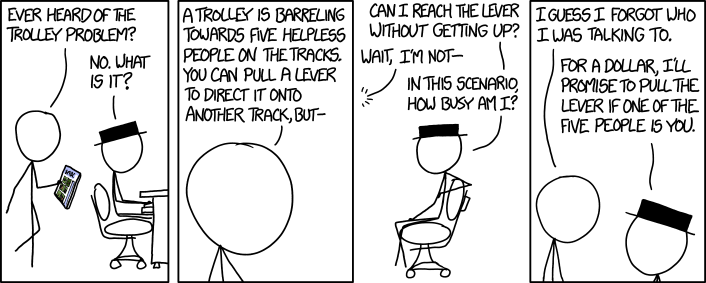
(Cartoon from explainxkcd.com)
To ruin a dinner party one just needs to ask whether religion has been more helpful or harmful in the history of mankind. There are many examples on both sides of the argument, but "trading anecdotes, though, is unlikely to convince anyone."

A recent social-science experiment produced a result that favors the pro-religion argument. Based on the runaway trolley car problem (do you sacrifice one person to stop a runaway trolley that will definitely kill five other people?) [bold added]
[New York psychologist Jeremy] Ginges gave the question—to push or not to push—a religious twist. His participants were Muslim, and most were personally religious (more than 80% reported praying regularly). He presented them with two versions of the thought experiment. In one, the endangered children were fellow Muslims. In the other, they were Jews. In both, the sacrificial victim was a Palestinian of unspecified religion. He then asked his young volunteers to consider, in each case, how one ought to act—and then how they thought God would want people to act.
Despite decades of conflict, of the 555 Palestinian teenagers
55% of respondents indicated that the religion of the threatened children would make no difference to their behaviour; 42% said they would be more likely to act to save their co-religionists than to save the Jewish children; and 3% swung the other way, saying they were more willing to save Jewish children than Muslim ones. When asked to consider how their God would prefer them to act, this pattern became even more pronounced. Then, 66% said religious affiliation would have no impact on their actions. Only 30% of respondents favoured the Muslim children.
One cannot conclude a great deal, based on familiar weaknesses in these studies. For example, what the subjects say about their future behavior often differs from how they actually behave, and in the real world the choices are multiple, not binary (how do they evaluate a teenager choosing to sacrifice himself? It does happen.)

Nevertheless, as we enter the New Year, there's a smidgeon of hope for the future.

Sunday, August 02, 2015

Teach a Man to Fish

In 2007 we visited Heifer International's demonstration
farm (now closed) near Modesto.
Heifer International is one of our favorite charities. For the expenditure of a few hundred dollars a donor can buy a farm animal such as a goat or a water buffalo for a family in the Third World. Per Heifer's website:
our approach is more than just giving them a handout....Our animals provide partners with both food and reliable income, as agricultural products such as milk, eggs and honey can be traded or sold at market.

The core of our model is Passing on the Gift. This means families share the training they receive, and pass on the first female offspring of their livestock to another family. This extends the impact of the original gift, allowing a once impoverished family to become donors and full participants in improving their communities.
One of the thorniest problems in philanthropy is finding "investments" that lift people out of poverty permanently without making them dependent on continued funding. It turns out that a modification to Heifer's approach has been supported by MIT researchers Abhijit Banerjee and Esther Duflo, who found [bold added]
an anti-poverty strategy that works consistently, based on a seven-year, six-country study of more than 10,000 poor households. The secret, the economists argue, is to hand out assets, followed by several months of cash transfers, followed by as much as two years of training and encouragement. That formula seems to have made a lasting difference to the lives of the very poorest in countries as different as Ghana, Pakistan and Peru.
The short-term cash transfers help the recipients resist the temptation to consume the farm animals they have been given.
Perhaps most important, when the researchers went back and surveyed households a year after the programme had ended, they found that people were still working, earning and eating more.
The good can be made better.