What’s different today is that there’s an alternate route for the city, born in Crown Heights, Brooklyn.Santayana's observation bears repeating: "Those who cannot remember the past are condemned to repeat it".
From the early 1900s to the mid-1960s Crown Heights was an upscale, mostly Jewish neighborhood: a mix of secular Jews and observant ones, rich and poor, American-born Dodger fans and Holocaust survivors. Then things began to change.
Migration patterns, a massive social-services infrastructure that welcomed dysfunction, and a breakdown in policing destroyed many New York neighborhoods. The newcomers were black, but race wasn’t the issue. It was the gangs, drugs, violence and a pernicious new strain of antisemitism mysteriously condoned by elites. During one three-month period in 1968, 11 Jewish institutions in New York were vandalized, set on fire or firebombed. As in other parts of the city and country, many Jews began to leave Crown Heights.
The neighborhood, however, was also home to Rabbi Menachem M. Schneerson, seventh leader of the Chabad-Lubavitch Hasidic movement. The Rebbe, as he is known, charted a new course. “A phenomenon has recently spread among the Jewish people, like a plague, God forbid, of abandoning Jewish neighborhoods,” he said at a public gathering in 1969. Panic was causing people to flee, harming those left behind, especially the poor, elderly and infirm.
The "Rebbe" (1902-1994)
“People claim there’s no solution, but that’s not true,” the Rebbe said. “To start, one must stand firm and not run away.” He argued that Jews abandoning one place automatically weakened the resolve and position of communities facing similar challenges everywhere.
“I’m very concerned about Crown Heights,” Mayor John Lindsay told the Rebbe when he visited him in 1968. “It is very key to the whole community of Brooklyn.” The Rebbe saw even more: “It is a test case, not only for New York” but for the world.
Many Jews continued to leave for the greener pastures of Westchester County and Long Island, but the Hasidim stayed and planted their roots even deeper. They organized a citizen patrol, built schools, worked to head off the sale of synagogues, and created nonprofits to buy homes and resell them to community members. The Rebbe encouraged the opening of a Hasidic art gallery and a flower shop. He asked that weddings and other joyous events be held within the community to raise morale and support local kosher establishments.
It wasn’t always easy, and not everyone appreciated the Hasidim for bucking the trend. Following the 1991 riots, Al Sharpton dubbed the Crown Heights Jewish community a “Fort Apache in the black ghetto.” But they persevered, transforming the neighborhood again into a wonderful place to live, work and raise a family. In the process, they realized the Rebbe’s vision for saving the American city.
It is ironic that many of the young transplants to New York who voted for Mr. Mamdani live in such places as Crown Heights, unaware that had it not been for increased policing, government reforms they despise, and, most important, the locals who persisted during the city’s darkest days, they wouldn’t have dared enter the neighborhoods they now colonize. They know little about what came before them—and where their ideological fantasies lead.
Showing posts with label Islam. Show all posts
Showing posts with label Islam. Show all posts
Sunday, July 06, 2025
Fight or Flight
Because of the likely election of Zohran Mamdani ("globalize the intifada") to mayor, many Jews are considering leaving New York City. Dovid Margolin, chronicler of Jewish life, points to an example from New York's history that shows that there is an alternative to flight:


Saturday, October 14, 2023
The Lines Were Quick
 |
| Khaled Meshaal (NY Post/Reuters) |
Bah! rational guys like me shouldn't let superstition rule their lives. I clicked the pay-and-submit button.
It was more than superstition that paralyzed some people with fear yesterday. Former Hamas leader Khaled Meshaal designated yesterday as the "Day of Jihad":
The former leader of Hamas called on Muslims to stage global demonstrations in support of Palestinians on Friday, and urged Arabs in neighboring countries to take up arms against Israel.In the Bay Area some schools cancelled classes:
Schools and universities across the Bay Area said they were bolstering security measures — and in some cases canceling classes — amid so-far unsubstantiated threats of pro-Hamas violence.Just in case TSA had installed extra procedures, I showed up 2½ hours before the 8:20 AM flight. The caution was unnecessary as the lines were quick, and I spent an hour nursing a coffee and croissant before boarding.
Gideon Hausner Jewish Day School in Palo Alto, Wornick Jewish Day School in Foster City and South Peninsula Hebrew Day School in Sunnyvale said they would be closed Friday amid concerns that Jewish institutions could be targeted, Jewish Weekly reported.
Stanford Law School announced it would be holding all of its classes Friday on Zoom in the wake of students’ fears around safety on the “Day of Jihad.”
We disparage law enforcement, the FBI, the CIA, and other alphabet agencies, but a point in their favor is that there has not been a major terrorist attack on American soil since 9/11. Because of that record, there is still hope that the agencies can be fixed.
And yes, the flight went well.
Sunday, July 02, 2023
Strength in Numbers
In the world of sports it sometimes happens that the son outshines the father, for example, Bobby Bonds / Barry Bonds and Del Curry / Steph Curry.
In world history former colonies are more powerful than their mother countries, for example, Great Britain / United States and Portugal / Brazil. In these cases the story is over.
In real time we can watch this ascent / descent occur in Africa: [bold added]
In world history former colonies are more powerful than their mother countries, for example, Great Britain / United States and Portugal / Brazil. In these cases the story is over.
 |
| Worshipers at an evangelical Christian service near Lagos, Nigeria, 2021 (WSJ photo) |
Owing to population growth and the intensity of their religiosity, Africans are now one of the more important constituencies of both Islam and Christianity worldwide, and sub-Saharan Africa is one of the world’s most active and contested religious markets. The region was 59% Christian and 30% Muslim in 2020, according to the World Religion Database. “There is a new scramble for Africa,” said Sheikh Ibrahim Lethome of Jamia Mosque in Nairobi, Kenya, drawing an analogy with the colonization of the continent in the late 19th century. “Christianity is growing, Islam is growing, and there is competition.”The story is about the (peaceful) competition between Christianity and Islam in Africa, but the story as it affects the West and the United States in particular, is the Africanization of Christianity:
On a continent where indigenous religions dominated just a century ago, Christian missionary efforts, associated with European colonization, have borne fruit in massive conversions. By 2020, there were 643 million Christians in sub-Saharan Africa, a quarter of the world total, up from 7.4 million in 1900. By 2050, it is projected that there will be 1.3 billion Christians in the region, or 38% of all the Christians in the world.In the worldwide Anglican communion the numbers in Africa (43 million in 2008) are overwhelming the influence of the (United States) Episcopal Church:
leaders of African churches that are among the largest and fastest-growing....refuse to join progressives, led by the U.S. Episcopal Church, who support marriage or blessings for same-sex unions and the ordination of openly gay clergy...The Episcopal Church numbers two million members. It has shrunk to a husk of its former self. The African converts embraced what the Episcopal missionaries told them half a century ago, that Pride is a sin, that homosexuality is a sin, and redemption can be found by accepting God the Father, Son, and Holy Ghost. A 180-degree turnabout from supposedly fundamental doctrines seems desperate and frankly crazy to African eyes. Kenyan Archbishop Jackson Ole Sapit:
“We make a humble request to these churches: Wake up! Strengthen what little remains, for even what is left is almost dead.”
Sunday, March 06, 2022
A Strong Religious Element to the Russian Invasion of Ukraine
 |
| Vladimir Putin is a practicing Russian Orthodox Christian |
Frederick Kagan, former professor of military history at West Point, delves into this motivation when interviewed by Jordan Peterson on February 27, 2022: [bold added]
Putin has carried on the tradition of the czars of subordinating the Moscow patriarchate to himself. The Moscow patriarchate is fundamentally an arm of the Russian government, and so he controls it de facto.The Eastern Orthodox Church is organized into 16 independent ("autocephalic") patriarchates, which now includes the three-year-old Orthodox Church of Ukraine. While each patriarchate is self-governing, Orthodox Christians can take communion in any other Orthodox church.
It [the Russian Orthodox Church] is not an independent religious authority in reality, even though it is ostensibly. Its relations with the Vatican are whatever Putin decides he's willing to have them be at any given moment. I don't understand there to be a particularly contentious relationship [with the Vatican].
If you want to get really nerdly on this, there was a big fight a couple of years ago because the Ukrainian Orthodox Church had been a component, or subordinated to, the Moscow patriarchate. The formal leader of all of the Orthodox communities is in Istanbul. A few years ago, I forgot exactly when [note: January, 2019], the Ukrainian Orthodox Church petitioned the patriarch in Istanbul to grant it autocephaly, to make it independent of the Moscow patriarchate. And that was granted. And so the Ukrainian Orthodox Church has become an independent entity directly under the Istanbul patriarchate.
Putin bitterly resented that, hated it, attacked it. It is one of his grievances that that occurred.
Note: Professor Kagan apparently misspoke when he said that Ukraine, which had been part of the Russian church, was now "under" Istanbul; Istanbul recognized Ukraine as independent from the Russian Orthodox Church, which is one of the 15 other hierarchies. Note also that the Istanbul bishop is not "the formal leader" but is first among equals; he has no formal authority over the other patriarchates.
Below is the YouTube recording of the interview. The excerpt above begins at 14:20.
Sunday, July 28, 2019
Jesus: Worth a Try
 |
| The Circumcision (Rubens) |
(It's not the same as asking if Christians are good for/to the Jews.)
Art Lamm of Yeshiva University notes that anti-Semites periodically try to deny Jesus' Jewishness: [bold added]
In the early 20th century, the anti-Semitic and racist German-British philosopher Houston Stewart Chamberlain argued that while Judaism provided the religious background for Jesus, he “had not a drop of genuinely Jewish blood in his veins.” The Nazis picked up on this thread. As Hitler consolidated power, German theologians insisted that Jesus was not a Jew but an Aryan, descended from Galilean gentiles.Not surprisingly, Jews throughout history have defended themselves by referring to Jesus' origin, without endorsing his teachings.
In the context of the Israeli–Palestinian conflict, Palestinian Authority President Mahmoud Abbas has sought to sever Jesus’ religion from his nationality or ethnicity. In a 2014 Christmas message, Mr. Abbas called Jesus “a Palestinian messenger of love, justice and peace.” This remains a common refrain from anti-Israel activists.
Take the Spanish Rabbi Simon Duran, born in 1361 and known affectionately as “Rashbatz.” Duran’s community suffered intense Christian persecution. In attempting to counter increasingly dangerous Christian threats to Jewish religious observance, Duran and his contemporaries emphasized the Jewishness of Jesus and the apostles. Appealing to passages in Matthew, Luke and the Book of Acts, Duran argued that Jesus and his followers believed the Jewish people should continue to adhere to Jewish practice.After citing other examples, Art Lamm concludes:
When the need arises, Jewish thinkers have not been bashful in accentuating Jesus’ Jewishness—whether in religious, ethnic or national terms. As Jews increasingly come under attack in Europe and elsewhere, they should once more be prepared, if necessary, to assert Jesus the Jew, even as they have no wish to claim Jesus the Christian.While this aspect of Christian-Jewish history is interesting, it's easy to overlook its relevance to outsiders whose groups may find themselves in conflict. The modern defense is to call the attacker a racist, a sexist, a class-ist, or some other variation of "-ist". The idea is to condemn the opponent morally; if it works, the weight of social media and even law enforcement can be brought to bear against the attacker. Name-calling may succeed in beating down opponents, but it doesn't bring them closer.
The "Jesus-was-a-Jew" defense holds that potential. It begins by showing how much one group (the Jewish people) is like a person (Jesus) whom the other group (Christians) admires. Common ground is emphasized, not moral superiority. It's worth a try--it can't be worse than what we're doing now.
Wednesday, December 20, 2017
21st Century Headline
In 1999 I doubt anyone foresaw this:
Sex robot expo in venue switch after 'terror threat from OFFENDED Islamic extremists'
Takeaway quote: "Robot sex is against the Muslim religion."
Sex robot expo in venue switch after 'terror threat from OFFENDED Islamic extremists'
Takeaway quote: "Robot sex is against the Muslim religion."
Sunday, September 10, 2017
The Ear of the Listener
 |
| Sacrifice of Isaac, 1527 (Cleveland Museum) |
Eid al-Adha commemorates the Koranic tale of the Prophet Abraham’s willingness to sacrifice his son Ishmael as an act of obedience to God. Before he could carry out the sacrifice, God provided a ram as an offering.The Economist ruminates on the differences of each faith's interpretation of the story: [bold added]
In the Christian and Jewish version of the story, Abraham is ordered to kill another son, Isaac.
the Islamic tradition generally holds that it was not Isaac but Ismail, Ibrahim’s son by the maidservant Hagar. Muslim commentaries on the story often stress that Ismail as well as his father clearly consented to the act of sacrifice; it was not an unpleasant surprise for anybody. These interpreters also emphasise that it was never conceivable that God would want Ibrahim’s son to be killed. Indeed part of the story’s point is to denounce the whole idea of (involuntary) human sacrifice....If one's goal is to grasp a 30-second version of the story, the three interpretations are distinctions without a difference. But if one is at all interested in the notions of free will, obedience to the divine, and the meaning of sacrifice, then there is something to learn from each faith's perspective.
Early Christian commentators invariably see the story as a foreshadowing of the death and self-sacrifice of Jesus. This is seen as an act of disinterested service to humanity by both God the Father (who offered up his offspring) and God the Son (who offered his own life). Abraham’s kindling wood is seen as hinting at the wooden cross on which Jesus would die. It is an important aspect of the Christian story that Jesus could have avoided being crucified, but nonetheless freely chose to undergo death so as to break death’s power. In the Genesis narrative, Isaac does not seem to have had much say in his fate....
Many Jewish commentators, like Muslim ones, have seen the story as a tirade against human sacrifice, which had been a feature of many pre-Abrahamic religions. Some Jewish interpreters see the most important words in the story as Abraham’s response to God—“here I am” or in Hebrew “hineni”—an expression which is held up as a model of obedient and attentive listening.
(The Genesis passage is below the fold.)
Thursday, June 16, 2016
And Now Orlando
 |
| Orlando: the 49 dead (NY Daily News collage) |
Nearly a week has gone by, and the reaction was disappointing but not unexpected. There was an instantaneous rush to judgment by thought leaders who seem to be most concerned about validation of their worldview. Can't they all just budge a little on their positions on guns and immigration, whether pro- or anti-? No compromise solution will eliminate terrorist killings entirely, but any reduction in severity and frequency will be a step forward.
I don't know what will be lost by compromising but I know who the big winners will be---the ordinary Americans whose faces will not be on the six o'clock news.
Saturday, April 30, 2016
Expert at One, Expert at All

The claim that "ISIS will fall soon" is based on Barron's assessment of the capabilities and motivations of all the major players, including Russia, Saudi Arabia, Iran, Iraq, Syria, Israel, and the United States.
Color your humble blogger extremely skeptical. The Middle East is more complex than the most complex system, and even simple systems produce results that are unpredictable. It wouldn't take much to derail the path towards peace.
Also, sentences like the following don't inspire confidence:
Ultimately, the Islamic State will be laid low by blowback from the brutality of the caliphate. Reigns of terror generally only succeed in countries with deep and perduring totalitarian roots. The caliphate is hardly Stalinist Russia or Maoist China in its longevity.ISIS will be "laid low" because it's too brutal? That's what has been said about North Korea, Iran, and Syria, and those regimes are still standing. (It took an invasion led by the world's mightiest military to overthrow Saddam Hussein in Iraq.)
I subscribed to Barron's to read about financial markets, not editorials why "Trump is wrong" (or right) or about how we've reached peak ISIS without a lot of doing on our part. Of course, Barron's has a right to its opinion, just as I have a right to stop paying for it.
Sunday, January 03, 2016
An Experiment Intelligently Designed
 |
| (Cartoon from explainxkcd.com) |
A recent social-science experiment produced a result that favors the pro-religion argument. Based on the runaway trolley car problem (do you sacrifice one person to stop a runaway trolley that will definitely kill five other people?) [bold added]
[New York psychologist Jeremy] Ginges gave the question—to push or not to push—a religious twist. His participants were Muslim, and most were personally religious (more than 80% reported praying regularly). He presented them with two versions of the thought experiment. In one, the endangered children were fellow Muslims. In the other, they were Jews. In both, the sacrificial victim was a Palestinian of unspecified religion. He then asked his young volunteers to consider, in each case, how one ought to act—and then how they thought God would want people to act.Despite decades of conflict, of the 555 Palestinian teenagers
55% of respondents indicated that the religion of the threatened children would make no difference to their behaviour; 42% said they would be more likely to act to save their co-religionists than to save the Jewish children; and 3% swung the other way, saying they were more willing to save Jewish children than Muslim ones. When asked to consider how their God would prefer them to act, this pattern became even more pronounced. Then, 66% said religious affiliation would have no impact on their actions. Only 30% of respondents favoured the Muslim children.One cannot conclude a great deal, based on familiar weaknesses in these studies. For example, what the subjects say about their future behavior often differs from how they actually behave, and in the real world the choices are multiple, not binary (how do they evaluate a teenager choosing to sacrifice himself? It does happen.)
Nevertheless, as we enter the New Year, there's a smidgeon of hope for the future.
Wednesday, December 02, 2015
It's Not Hopeless
Sadly, a relevant and informative article: What to Do in an Active Shooter Situation.
The obvious strategies, in order of priority, are run, hide, and fight.
To increase one's chances of surviving involves a little study, though. Stop invading my safe space while I'm checking my Twitter feed!
The obvious strategies, in order of priority, are run, hide, and fight.
To increase one's chances of surviving involves a little study, though. Stop invading my safe space while I'm checking my Twitter feed!
Friday, November 13, 2015
Maybe We Won't Always Have Paris
Like millions of others, we've visited the Great Cities of Europe---London, Madrid, Venice, Florence, Rome, Amsterdam---and also, like millions of others, Paris is #1 or #2 on the list.
It's difficult for our minds to grasp the evil of what happened tonight.
It wasn't a natural disaster like an earthquake or a man-made disaster like a pipeline explosion or a hybrid disaster like a heat wave.
It wasn't a vengeful person fueled by hate, rage and alcohol or an unnoticed individual seeking to become famous through a horrific act.
It was a coordinated attack by dozens of heavily armed men who killed as many people as possible. The killers are not appeased by sweet words or money. Widespread death was the goal.
After 9/11 we said that the world was changed forever. After years of unresolved conflict, wishful thinking, and willful blindness we thought terrorism "contained" and resumed our normal lives.
The problems were growing beneath the surface and now threaten to overwhelm Western Europe. Hundreds of thousands of unassimilated Muslims live in the outskirts of Paris. Rick said, "We'll always have Paris," but maybe we won't.
It's difficult for our minds to grasp the evil of what happened tonight.
It wasn't a natural disaster like an earthquake or a man-made disaster like a pipeline explosion or a hybrid disaster like a heat wave.
It wasn't a vengeful person fueled by hate, rage and alcohol or an unnoticed individual seeking to become famous through a horrific act.
It was a coordinated attack by dozens of heavily armed men who killed as many people as possible. The killers are not appeased by sweet words or money. Widespread death was the goal.
After 9/11 we said that the world was changed forever. After years of unresolved conflict, wishful thinking, and willful blindness we thought terrorism "contained" and resumed our normal lives.
The problems were growing beneath the surface and now threaten to overwhelm Western Europe. Hundreds of thousands of unassimilated Muslims live in the outskirts of Paris. Rick said, "We'll always have Paris," but maybe we won't.
Sunday, July 26, 2015
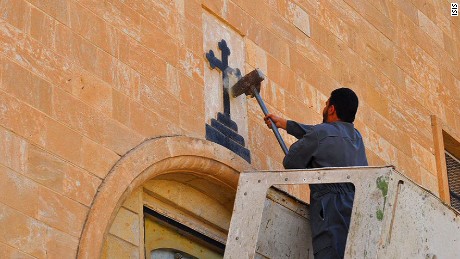
Save Us From the Time of Trial
 |
| Iraq today (CNN) |
ISIS scanned the separate groups of men and women. ‘‘You’’ and ‘‘you,’’ they pointed. Some of the captives realized what ISIS was doing, survivors told me later, dividing the young and healthy from the older and weak....No one was sure where either bus was going.At the Nazi killing centers:
After deportation trains arrived at the killing centers, guards ordered the deportees to get out and form a line. The victims then went through a selection process. Men were separated from women and children. A Nazi, usually an SS physician, looked quickly at each person to decide if he or she was healthy and strong enough for forced labor. This SS officer then pointed to the left or the right; victims did not know that individuals were being selected to live or die.For centuries the men with the guns, drunk with power and certitude, have decided who lives and who dies. On rare occasions victims are spared if they renounce their faith.
May Christians in the very safe United States of America never be put to this test.
Tuesday, February 24, 2015
Disinvitation Pushback
 |
| I can't go but will send in a small donation. |
Invitations to speak were greeted with protest, and eventually Ms. Ali was "disinvited" and Dr. Rice voluntarily withdrew from Brandeis and Rutgers commencement ceremonies, respectively.
Disinvitation season is now a regular rite of spring. (BTW, not all disinvitations are the result of left-wing complaints; sometimes the shoe is on the other foot, as this list shows.)
The William Buckley Program at Yale has organized a little pushback with the First Annual Disinvitation Dinner. The speaker is conservative commentator George Will, who was disinvited from speaking at Scripps College over a column he wrote about how colleges are handling accusations of sexual assault.
Note: Scripps, one of the Claremont Colleges, has resolutely been women-only. Perhaps if it had diversified the student population, like Claremont Men's College did in 1976 when it became the co-ed Claremont-McKenna, Scripps would be more receptive to other ideas.
Thursday, March 06, 2014
In Earnest
50 years ago today Cassius Clay changed his name to Muhammad Ali. In 1964 the world heavyweight boxing champion was the most celebrated athlete on the planet, more famous than any quarterback, home-run hitter, or 7-foot center. Ali's conversion to the Nation of Islam was unsettling to Americans and even to blacks, who were mostly Christian.
John F. Kennedy had been assassinated four months earlier, the Beatles with their moptops had invaded America in February, and a young lady named Kitty Genovese would be stabbed to death in New York on March 13th near dozens of witnesses, none of whom lifted a finger or called for help.
The Sixties had begun in earnest.
John F. Kennedy had been assassinated four months earlier, the Beatles with their moptops had invaded America in February, and a young lady named Kitty Genovese would be stabbed to death in New York on March 13th near dozens of witnesses, none of whom lifted a finger or called for help.
The Sixties had begun in earnest.
Saturday, November 17, 2012
Peace, Just Not There
The Middle East once again threatens to boil over: Israel, Egypt, Syria, Libya, Iran, Iraq---there's no conflict-free zone. Elsewhere, however, there are nascent signs of peace.
Google and Apple are talking about resolving all litigation [bold added]:
Google and Apple are talking about resolving all litigation [bold added]:
The companies have been exchanging proposals on using binding arbitration to reach a licensing agreement over patents that are essential to comply with industry standards on how phones operate. Such an agreement could lead to a global settlement of all of their patent disputes, Apple said in a Nov. 15 filing.Stocks rose on Friday after signals from both parties that the impasse over the "fiscal cliff" may be resolved:
the top lawmakers emerged from the White House meeting, which lasted more than an hour, with uncharacteristic optimism that they would reach a deal in coming weeks. [snip]Of course, the devil is in the details, but at this point any deal is better than no deal. Let's hope that the emotion surrounding Thanksgiving next week is one of gratitude, not fear or disappointment. © 2012 Stephen Yuen
Leaders from both parties and aides to Mr. Obama said they agreed to make concessions to achieve a deal. For Democrats, that included a willingness to curb entitlement programs, such as Medicare. For Republicans that meant a willingness to raise tax revenue.
Wednesday, September 12, 2012
"He loved that part of the world, he loved the people, he spoke the languages and he really loved his job."
 |
| Chronicle photo |
Ambassador Christopher Stevens grew up in Piedmont and went to UC-Berkeley and Hastings Law School. Son of a cellist and stepson of a well-known music critic, Ambassador Stevens was destined for a life in the foreign service:
He could often be found practicing his Arabic, studying Middle Eastern history or rehearsing lines for musicals at Cal - in which he often played characters with a maturity beyond his years, said Austin Tichenor, a childhood friend and Berkeley classmate.John McCain:
"He had a gravitas about him, which suited him well in the foreign service, I suspect," Tichenor said. "It always tickled me to see him do official State Department speeches because he's so serious, he has his ambassador face on. But when you got him one-on-one, he was just funny."
"Chris Stevens is one of the finest people I've ever known in my life," McCain said. "He loved the Libyan people. They loved him. He and I were down there on election night and people were saying, 'Thank You America.'"
"I guarantee you the one thing Chris Stevens did not want is for us to abandon Libya."
Thursday, November 12, 2009
One Week Later
Malik Nadal Hasan - there's a rhythmic staccato to the three names of the man who perpetrated the horror at Fort Hood one week ago. Two syllables and five letters each, consonants and vowels alternating. Even the sound of his military title, "Major,” gloves in.
The mind wandered after the initial shock. The mind searched for relationships. Muslim, Jordanian, that fits a profile, but psychiatrist? An Army major? And Virginia Tech where he took ROTC? a flukish connection to another massacre of innocents.
Faith in our institutions has become increasing shaky. Big banks and insurance companies teeter on the edge of insolvency, churches are rife with scandal, and hospitals incubate killer infections. And the safest place in the country – the center of a large military base—proved to be no haven. Malik Nadal Hasan, another villain in a decade full of villains, committed an atrocity. But perhaps his most damaging blow was to discomfit those of us who sit safely thousands of miles away. © 2009 Stephen Yuen
The mind wandered after the initial shock. The mind searched for relationships. Muslim, Jordanian, that fits a profile, but psychiatrist? An Army major? And Virginia Tech where he took ROTC? a flukish connection to another massacre of innocents.
Faith in our institutions has become increasing shaky. Big banks and insurance companies teeter on the edge of insolvency, churches are rife with scandal, and hospitals incubate killer infections. And the safest place in the country – the center of a large military base—proved to be no haven. Malik Nadal Hasan, another villain in a decade full of villains, committed an atrocity. But perhaps his most damaging blow was to discomfit those of us who sit safely thousands of miles away. © 2009 Stephen Yuen
Wednesday, November 11, 2009
Veterans Day
The picture that seems to be crystallizing is that last Thursday’s massacre at Fort Hood is another example of Islamic terrorism. It’s another reminder that, however much we may wish that it weren’t true, war and killing have ever been part of the human condition.
Today we honor those who took up arms to protect us. In this month of Thanksgiving we especially give thanks to our Veterans. Our debt to you can never be repaid.

Today we honor those who took up arms to protect us. In this month of Thanksgiving we especially give thanks to our Veterans. Our debt to you can never be repaid.

Friday, May 02, 2008
Unpopular
President Bush is not only the most unpopular president in modern history, he’s the most polarizing. Only 1% of the population is neutral or undecided about him.
A CNN/Opinion Research Corp. survey released Thursday indicates that 71 percent of the American public disapprove of how Bush is handling his job as president…One person who views President Bush favorably is historian Paul Johnson.
"Bush's approval rating, which stands at 28 percent in our new poll, remains better than the all-time lows set by Harry Truman and Richard Nixon [22 percent and 24 percent, respectively], but even those two presidents never got a disapproval rating in the 70s," [CNN polling director Keating] Holland said.
After September 11th, he buckled down quickly to this unprecedented attack on America, determined that such a treacherous outrage should never occur again. Nor has it. It is worth inquiring why. There is no doubt that attacking the American homeland remains the prime objective of Muslim fundamentalist leaders. Yet they have not done so. One reason for this is the success of Mr. Bush's team in learning the lessons of Sept. 11 and building a security system of impressive strength and sensitivity.Future Paul Johnsons will assess whether this president’s unpopularity was deserved. But, as we wrote over two years ago , we don't have to wait to make this declaration: Mr. Bush is the most consequential president since Ronald Reagan. © 2008 Stephen Yuen
Equally, if not more important, is the way in which Mr. Bush--partly by accident but mainly by design--has switched the war's theater of operations to the death-dealers' territory. The number of Muslim fanatics who have been killed by the Allies in their operations or who have killed each other in Sunni-Shia clashes must be reckoned in the hundreds of thousands. We must remember that every extremist killed in the suburbs of Basra or Baghdad or in the hills around Kabul or Kandahar means scores, perhaps hundreds, of Western civilian lives saved.
Subscribe to:
Posts (Atom)