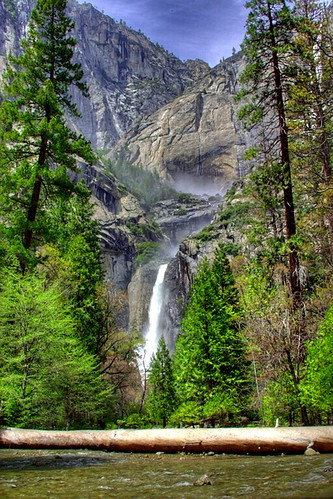
Showing posts with label Yosemite. Show all posts

Thursday, October 16, 2025

Yosemite: Still a Great Place

My brother visited Yosemite last week
The government shutdown has produced reports of lawless behavior at Yosemite National Park. The Interior Dept. calls these reports "fake news":
Officials at the U.S. Department of the Interior are now challenging the idea that the park has been left vulnerable during the federal shutdown. And while the National Parks Conservation Association told SFGATE that 50% of Yosemite’s employees are currently furloughed, officials with the Interior Department are saying that staffing levels are adequate to handle unlawful incidents taking place during the shutdown.
However, according to SFGate
What’s changed, according to sources who have lived and worked around the park for decades, is that visitors are taking advantage of the shutdown and becoming more brazen in their pursuit of illegal activities.

Climbers have been dealing with BASE* jumpers launching off El Capitan for decades, Ken Yager, president and founder of the Yosemite Climbing Association, said in a phone call. In some cases, they come very close to the climbers, and, “It’s terrifying,” he said. Normally, they do this in the early morning or right at dusk, when darker skies make them less likely to get caught, Yager continued, and some even time their jumps to coincide with ranger shift changes.

What’s different now, he said, is that people are BASE jumping in broad daylight, which is probably safer and certainly more scenic. “Maybe they’re getting a little bolder now, because of what they’ve been hearing about the park,” he said. “But you know, those guys better be careful, because it’s still illegal and there’s still law enforcement.”
*Grok: BASE jumping is an extreme sport where individuals leap from fixed structures—Buildings, Antennas, Spans (bridges), and Earth (cliffs)—and deploy a parachute to safely land. The acronym "BASE" represents these four types of launch points.

Comments:
1) The libertarian in me isn't bothered by unauthorized BASE jumping, unless it jeopardizes the safety of climbers and other park goers. Surely most participants don't wish to hurt others and will follow posted guidelines.
2) Park staffing is inadequate to handle mass lawlessness in normal times. If sizeable numbers of people come to Yosemite because they believe they won't get caught breaking rules, they would be right, shutdown or not.
3) My brother went to Yosemite last week. He had a great trip, and nothing untoward occurred. Also, there were no entrance fees or rangers due to the shutdown. Granted, his experience is only anecdotal, and is about as generalizable as videos of peaceful Portland neighborhoods and the absence of homeless tents in parts of San Francisco.

Monday, October 06, 2025

One Stop Shopping in Sonora

( Valentino/SFGATE)
Guns and booze can be bought together at the Sportsman in Sonora.
The Sportsman — the last standing business in California where patrons can simultaneously buy a beer and a firearm — is encased in a historic brick building between the town’s main drag and its police station. The store-and-bar is as much a tourist destination as it’s a living room for some in the gateway town. On a weekday afternoon, two locals nursed Michelob Ultras beneath a television showing a Giants game while another man put down the next installment on a deposit for a rifle.

Storekeeper Steve Kane toggled between the two sides of the slim room. One half of the tawny-walled store is a pub with numerous framed photos of past and current customers. The other side is reserved for firearms — pistols and rifles — contained behind glass casings. A six-shooter goes for $250 while a .22-caliber rifle costs more than $600...

A fixture of Sonora but an oddity for the rest of the state, the Sportsman routinely draws tourists from around the world who enter with a wide-eyed gaze before Kane warmly welcomes them in. “I tell them, ‘This is a unicorn.’ You’ll go your whole trip in the United States and never see this,” he said. “And being in California, that’s what makes it crazy.”
The Sportsman also sells cigarettes, which means that it is overseen by a single Federal agency (Alcohol, Tobacco, and Firearms). Is this what is known as a regulatory advantage?

Thursday, June 05, 2025

Ahwahnee Hotel: Unsatisfactory

One of our best vacations this century was an unplanned trip to the Ahwahnee Hotel in Yosemite.

We roamed the uncrowded 98-year-old national landmark shortly after the new year in 2009. The snow made it difficult to get in or out, and we were "forced" to extend our stay. No worries--no one in our party complained.

So we were disappointed to read that the Ahwahnee Hotel has been mismanaged, according to reports from the National Park Service.
Rodent activity, improper food storage, lapses in facility maintenance and other public health concerns are among the pervasive issues called out in the report. The park service also dings Yosemite Hospitality for failing to conduct inspections.

Yosemite Hospitality received an overall “unsatisfactory” rating. That’s the lowest possible rating and a downgrade from previous years; in 2023, 2022, 2019 and 2018, Yosemite Hospitality received a “marginal” rating in its annual review.
The litany of problems will take years to correct. I'm glad we went when we did.

Saturday, February 22, 2025

Yosemite-Adjacent Vacation

(2009 photo)
Our trip to Yosemite National Park in January, 2009, was unplanned yet turned out to be much better than we had a right to expect. The youngster had never been to Yosemite, and we happened to be only an hour away while driving home from another event.

We snagged a room at the Ahwahnee Hotel and extended our stay because of heavy snowfall. Both the hotel and the Valley floor with the famous landmarks were uncrowded, and we wandered to our hearts' content.

After that pleasant experience I have had no compelling desire to return.

On the nature trail
A family member was meeting some friends to see the popular Yosemite "Firefall" this weekend, and on Thursday I offered to accompany him on the 3½-hour drive. He readily agreed, and I bunked with him at the Rush Creek Lodge and Spa, which is outside the Park, 26 miles from the Visitors Center.

While he went to meet his friends, I spent a very pleasant day walking around the Lodge and its nature trails. I dined at the restaurant, which had a limited number of selections that were excellently prepared, and I relaxed with a book.

Sometimes one can have an excellent vacation without planning or having to "do" anything. As for my traveling companion, he got his pictures of Firefall, and we both came away happy.

Friday, February 21, 2025

We Escaped the Vortex This Time

(Baron/Lynx/Chronicle)
Some family members will be heading east to the Sierra mountains today, and we're lucky that California is out of the path of the polar vortex that is hitting much of the country.
The majority of the country will wake to bone-chilling temperatures Thursday, with dozens of temperature records at risk of being broken.

The massive outbreak of cold air is connected to the polar vortex, a lobe of frigid air that has broken away from the North Pole and settled over the middle of the country.

The shot of cold air won’t impact California or the West Coast. In the wake of a weak cold front that passed through Wednesday, a high-pressure ridge has developed near California, shielding the state from the cold air and from a powerful storm system set to drench the Pacific Northwest this weekend.
According to the National Oceanic and Atmospheric Administration (NOAA) the Arctic polar vortex
is a band of strong westerly winds that forms in the stratosphere between about 10 and 30 miles above the North Pole every winter. The winds enclose a large pool of extremely cold air. (There is an even stronger polar vortex in the Southern Hemisphere stratosphere in its winter.) The stronger the winds, the more the air inside is isolated from warmer latitudes, and the colder it gets.
A normal, stable polar vortex stays in the stratosphere above the Arctic, which gets extremely cold in the winter while we in the mid-latitudes experience warmer air and moderate winters. The polar vortex isn't always stable, however.
“We did have a sudden stratospheric warming in January,” explained [NOAA's Dr. Amy] Butler. “The polar vortex weakened. It got stretched out of shape and slid southward off the pole. Most of the time when this happens—and it happens on average about every other year in the Arctic—some part of the mid-latitudes will ultimately experience a cold air outbreak."
What causes the polar vortex to get "stretched out of shape" is the $64,000 question, and while some blame their favorite culprit, global warming, Dr. Butler refuses to take the bait: [bold added]
I don’t think there is any convincing evidence of a long-term trend in the polar vortex. What we see in the record is this very interesting period in the 1990s, when there were no sudden stratospheric warming events observed in the Arctic. In other words, the vortex was strong and stable. But then they started back up again in the late 1990s, and over the next decade there was one almost every year. So there was a window of time in the early 2010s where it seemed like there might be a trend toward weaker, more disrupted or shifted states of the Arctic polar vortex. But it hasn’t continued, and more and more, it’s looking like what seemed to be the beginning of a trend was just natural variability, or maybe just a rebound from the quiet of the 1990s.”
Not only does the data not yet support the global-warming-causes-colder-winter hypothesis, the NOAA goes on to describe how leading climate models give conflicting results:
Some climate model experiments do predict that continued warming will lead to a weakening of the polar vortex...At the same time, other model simulations predict that warming and sea ice loss will lead to a stronger polar vortex.
I've decided to hold onto my internal-combustion-engine vehicles for a few more years; there's always a gas station nearby so I won't freeze to death in my car when another vortex hits, and I can't say the same for EV charging stations.

Thursday, July 23, 2020

Sierra Club: They Thought They Were Protected

Some conservatives have decried leftism's "long march" through American institutions like universities, entertainment, mass media, churches, and big-city governments. With few worlds left to conquer, progressives are turning on liberal institutions that once gave them succor, such as the Sierra Club:
Teddy Roosevelt and John Muir at Glacier
Point in Yosemite National Park in 1903.
(Chronicle image)
The executive director of the Sierra Club apologized Wednesday for its “substantial role in perpetuating white supremacy,” and said John Muir, the club’s founder and an icon of the environmentalist movement, was a racist.

In his early morning post on the organization’s website, Michael Brune said that just as Black Lives Matter activists are pulling down monuments to Confederate leaders, the club must re-examine its past and “take down some of our own monuments.”

That includes Muir, who Brune admitted was beloved of many of the club’s members and whose writings “taught generations of people to see the sacredness of nature.”

But Muir also was close friends with Henry Fairfield Osborn and others connected to the eugenics movement, which looked to sterilize those whom white supporters of the movement pegged as “deficient”: the poor, physically and mentally disabled people, and those of “unfit” races, including Black, Latino and Jewish people.
Though I've often disagreed with Sierra Club policies, I respected their single-minded dedication to the environment. One always knew where they stood.

I could not care less about what John Muir said about non-whites like myself; Yosemite National Park and Sequoia National Park would not exist without him, and I give thanks for a life whose accomplishments far outweighed its faults.

Straying from its original mission into wokeness not only will dilute its effectiveness, but the Sierra Club will likely experience a melting away of existing members and their donations. We have seen this phenomenon occur in churches and college alumni associations and newspaper/magazine subscriptions.

I suppose that I should be happy about the slow dismantling of an institution whose politics are different from mine, but I'm not.

Wednesday, October 10, 2018

If a Road Opens in the Forest, but Google Says It's Closed...

Mariposa roads are now open on Google Maps
The economy of Mariposa (pop. 2000) depends on tourists stopping by on the way to Yosemite National Park. After fires and floods closed not only Mariposa but also Yosemite, just as tourist dollars have started flowing again, yet another problem has surfaced:
Google Maps. The popular navigation app is regularly showing that roads to and from Mariposa are closed, when really they’re not, making it appear as though the region is still gripped by disaster.

At least four such errors have occurred in the past two months, according to numerous reports from residents. Efforts by retailers, county leaders and even the National Park Service to prevent the misinformation have been unsuccessful, meaning only more lulls in tourist traffic — and an emerging sense in the community that a small town is of little concern to big tech
. Sad observation from a Mariposa businessman:
“It’s not like people say they don’t believe you when you tell them the road is open,” Shaw said, recalling countless back-and-forth with potential guests. “But they’re essentially saying Google is more believable than you are.”

Tuesday, August 26, 2014

Foolhardiness Defeated, Applause is in Order

Before Hetch Hetchy valley was dammed. (Sierra Club photo)
Entranced by visions of a vanished valley of Eden, environmentalists put forward a 2012 San Francisco ballot initiative to drain the Hetch Hetchy reservoir.
It failed in a landslide, 77-23 percent.
Two years ago California's water shortage was already apparent. If the measure had passed, today's drought emergency would have made the destruction of the O'Shaughnessy Dam one of the most foolhardy acts in California's history (it supplies water to over two million people).

To prevent another chance of a single election in a single city from having such a catastrophic effect on the lives of a much larger population, the San Francisco PUC declared that the greater Bay Area has a say in the matter. Per the Mercury News:
the San Francisco Public Utilities Commission has approved a plan to block the draining of the famed reservoir unless the 26 cities and water districts in San Mateo, Santa Clara and Alameda counties that receive Hetch Hetchy water give their approval.
It's rare for the general welfare to prevail over powerful special interests, and rarer still for public agencies to cede power willingly to ensure that such interests remain stymied. Applause is in order. © 2014 Stephen Yuen

Tuesday, July 10, 2012

"Their Initiative is Insane"

Pre-1923 Hetch Hetchy  (Bancroft Library via SJ Mercury)
One of America's oldest environmental disputes will continue at the ballot box this November. San Franciscans will decide whether to create a plan to drain the Hetch Hetchy reservoir; if the measure passes and a credible plan is drafted, the vote to proceed will likely occur in four years.

After the great earthquake and fire of 1906 San Francisco cast about for stable sources of water. In 1923 the newly built O'Shaughnessy Dam flooded the Hetch Hetchy Valley in Yosemite National Park over the objections of the Sierra Club and its founder, John Muir. Today the Hetch Hetchy Reservoir serves about two million customers in the San Francisco Bay Area, including the 30,000 people in our town of Foster City.

Photos show that pre-1923 Hetch Hetchy rivals the beauty of Yosemite Valley itself, and one can sympathize with the environmentalists of one hundred years ago.  However, by 2012 Northern Californians have become so dependent on Hetch Hetchy water that many of environmentalism's normally strongest supporters, such as Democratic Party politicians and Silicon Valley businesses, are opposed to even considering the draining of the reservoir.
"We have to stop this one," said Carl Guardino, president of the Silicon Valley Leadership Group. "Hetch Hetchy is a critical water source not only for San Francisco, but throughout Silicon Valley. It is critical to our economy. We care deeply about this."

San Francisco Mayor Ed Lee was more blunt. "Their initiative is insane and attempts to fool voters into wasting millions to restudy local water sustainability projects that are already being implemented in San Francisco," he said.
Opposition to the Hetch Hetchy restoration initiative is another example of an elementary fact of political life:  over time the benefits from government programs attract powerful constituencies, and the programs become nearly impossible to shrink, let alone eliminate.  This is true regardless of the merits of the case. In November count on the initiative to fail.

Thursday, January 08, 2009

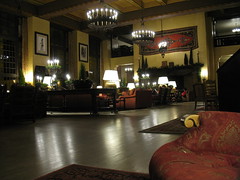
At the Ahwahnee

The view from Room 204


The Ahwahnee Hotel, like the Royal Hawaiian of my childhood hometown, has a rich and storied history. The Yosemite landmark’s art, architecture, and ambience reek of old wealth, the kind so old that it frowns on silver certificates as disreputable tender. With the sand in my hourglass dwindling even faster than my money, however, it was time to pull my nose away from the window and go through the door.

I walked up to the Ahwahnee's front desk and inquired about a one-night stay. (The inclement weather and the half-empty parking lot suggested that my chances of securing a room were good.) The manager glanced at my, er, extremely casual garb and helpfully suggested that if I waited until 6 p.m., and if there were still rooms available, he would cut the rate. The prospect of looking for different lodging on icy roads in the dark, especially with an irate spouse, was not worth the potential savings: "I'll take it now."

Our weekend trip had begun on impulse, so we hadn't packed clothes that would pass muster as dinner attire in the Ahwahnee dining hall. No matter. We sat down to a fine meal at the Mountain Room at Yosemite Lodge and watched a movie about Yosemite's history.

We returned to the Ahwahnee and spent the evening in the Great Lounge, quietly reading, sipping coffee by the fire, and tapping on our laptops and iPhones. The atmosphere took me back to my college days, with the added benefit of the Google.

Our day at Yosemite and the Ahwahnee turned out better than we had planned (to be sure our "plans" had been quite unformed). However it turns out, 2009 has started on a positive note.


© 2009 Stephen Yuen

Wednesday, January 07, 2009

Away Too Long

We entered Yosemite National Park early Sunday afternoon. Traffic into the park was light; most vacationers had already gone home. Sunlight gleamed off the granite cliffs, and snowmen sprouted in the white meadows. We stopped to take pictures.

It had been decades since we had visited Yosemite. Our excuses: it was too crowded, the road was too winding, and the pollens gave us severe allergy attacks. After one glimpse of the waterfalls, however, we knew we had been away too long. © 2009 Stephen Yuen

Tuesday, July 18, 2006

Wild Parrots of Telegraph Hill


I’m a sucker for shows that are filmed at places where I’ve lived. It could be that I have a childish need to retrace the steps of a famous actor like Jimmy Stewart or Steve McQueen, or a desire to feel superior to writers who take liberties with the locale by transporting Jack Lord instantaneously from one end of Oahu to the other in a couple of minutes.

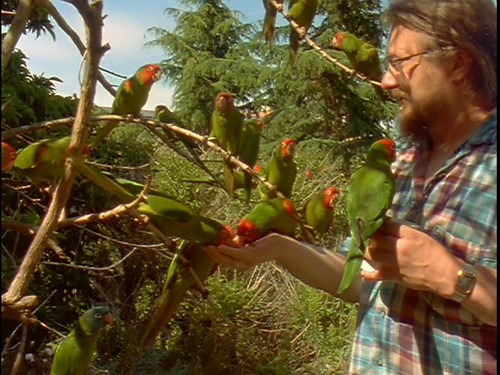
A revelatory documentary like The Wild Parrots of Telegraph Hill perhaps pinpoints the real reason: the joy of discovering unfamiliar aspects of a familiar place. For 18 years I have looked out the window at Telegraph Hill, where unbeknownst (to me, at least) escaped conure parrots have multiplied into a flock that now numbers well over one hundred. The parrots have acclimated well to San Francisco, where the main perils are not cold weather but insufficient food and the red-tailed hawks who can swoop down on inattentive birds.

The film also tells the story of Mark Bittner, the pony-tailed musician who came to San Francisco in search of fame, fortune, and purpose. He found the latter by caring for injured members of the flock (and may well finally achieve the former as this “little” movie grows in popularity). Mark Bittner subsists on the largesse of others and seems untroubled by his economic circumstances; what worries him is the welfare of the birds.

On the surface Mark Bittner looks and sounds like any other burnt-out child of the Sixties. But the film spends time getting to know him and looks beneath surface appearances.

The parrots have names like Mingus, Connor, Picasso, and Sophie. We observe their interactions with each other and their relationship with Mark. Playing on our anthropomorphic instincts without overtly manipulating them, the movie brings along the audience so that it listens more closely to a statement by Mark near the end that it would have dismissed had it been made at the beginning:
All life is one whole, it really is. There’s a story that the [Zen Master] told. He went to Yosemite. He sees this big waterfall coming over this cliff. It’s one river at the top of the cliff. But as it falls the river breaks up into all these individual droplets. Then it hits the bottom of the cliff, and it’s one river again. We’re all one river till we hit this cliff. That distance between the top of the cliff and the bottom of the cliff is our life. And all the individual little droplets think they really are individual little droplets until they hit the bottom, and then they’re gone. But that droplet doesn’t lose anything. It gains. It gains the rest of the river.
&copy 2006 Stephen Yuen