Showing posts with label Water. Show all posts

Thursday, September 18, 2025

Low-cost Solar Power That Increases the Supply of Fresh Water

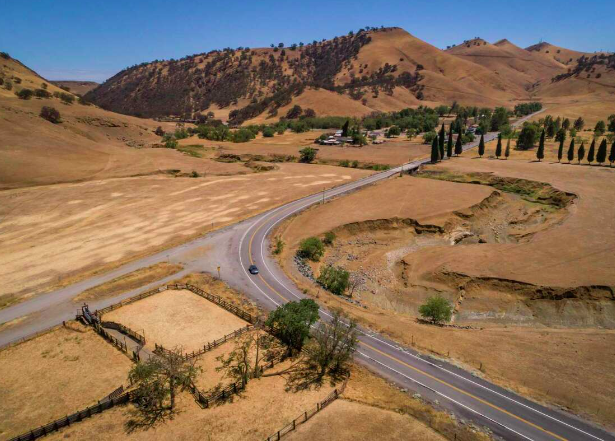
Solar panels over 115-foot-wide canal in Hickman, CA (SFGate)
Three years ago we posted about a creative concept for green energy production:
Putting solar panels over California's aqueducts will reduce evaporation and generate green energy.

The California Department of Water Resources is funding the $20 million pilot program with the intention of learning where solar panels might be viable along the state’s 4,000 miles of canals and aqueducts.
In 2025 the program has begun implementation: [bold added]
Near Hickman, California, just outside Modesto, a 110-foot-wide grid of solar panels now tops a section of canal, arching over the gently flowing water. Solar projects have long been a crucial piece of the state’s movement to clean energy, and these panels are part of a new project that’s hoping to do far more than just generate electricity. Dubbed Project Nexus, the $20 million state-funded initiative hopes to better understand whether these installations can be an even more efficient approach to solar energy.

The waterways already irrigate much of the state’s crops, but now they will also cool the solar panels, just by nature of being underneath them, increasing the panels’ efficiency. Meanwhile, the panels will shade the canals, reducing evaporation and suppressing aquatic weeds. Between this installation and a 20-foot-wide section that was completed on another part of the canal in March, the project could generate a total energy output of 1.6 megawatts while producing a host of other benefits.
We seem to have lost the societal vigor to replicate the vast infrastructure projects of the 20th century--the dams, aqueducts, highways, power generation and transportation systems--that elevated the standard of living for every American. However, nothing should stop us from the more modest ambition of improving sections of that infrastructure when opportunities present themselves.

Wednesday, July 09, 2025

Vaillancourt Vigil

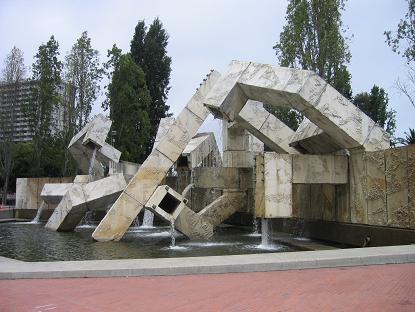
The fountain is fenced off and "closed"
per the green sign (Chron photo)
The future is bleak for San Francisco's 54-year-old Vaillancourt Fountain.
a San Francisco city official said publicly for the first time that the controversial concrete sculpture is not part of the renovation plan for Embarcadero Plaza.

“We did look into keeping the fountain on-site,” Recreation and Park Department Project Manager Eoanna Harrison Goodwin told a decidedly pro-fountain audience, “but once we got the cost estimate, it is beyond our project budget.”

The revelation, while not the final word on the 710-ton sculpture, was perhaps the most discouraging sign yet for its ardent supporters that its days on Embarcadero Plaza may be numbered.
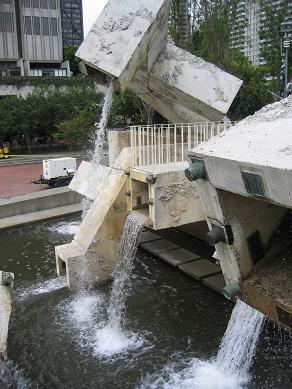
Your humble blogger will be sad to see it go. Although Vaillancourt Fountain is not classically beautiful, watching it when the water is flowing is a unique experience. From 2004:
The Vaillancourt fountain in Justin Herman Plaza is hard to love. After the 1989 earthquake destroyed the freeway off-ramp, the fountain’s complementary big brother, some said it lost its raison d’etre.

Because it was expensive to power the pumps, the water had been turned off since 2000. Vaillancourt fountain became a silent, concrete jumble in the midst of a waterfront that is growing greener and softer.

Depending on the way one is facing, the harsh angles overwhelm the view of the renovated Ferry Building, the nearby park, or the beauteous Bay beyond. The fountain became a grimy sculpture, a favorite resting spot for the ubiquitous pigeons, who further despoiled its surface and walkways. It became such an eyesore that some called for its demolition.

Last month the pumps were turned on, and the area was transformed. The sight and sounds of the rushing water bring life to a dead corner of Justin Herman plaza. Children skip along the walkway beneath the waterfalls, the tourists take their pictures, and the pale tower denizens leave their cubicles to munch on their sandwiches in the sun.

Monday, June 23, 2025

The Deep Lagoon

It was unusual for the lagoon to be deep enough for water skiing at the beginning of summer, but one speedboat was going back and forth yesterday afternoon. The dog had never seen a skier before and stopped to watch for ten minutes.

It was also deep enough for a pod of pelicans, which is a rare sight in an often-dry area that has no fish. Ducks and geese are common, but these were pelicans, so it was my turn to watch.

We got back to the house after an hour had elapsed. The family said the dog was probably tired after all that walking. I looked at him, and he wagged his tail. I gave him a treat. It would be our secret.

Monday, April 14, 2025

Silver Lining

Parts of Southern California are in extreme drought:
New data compiled by the National Oceanic and Atmospheric Administration shows that large swaths of both California and Nevada are facing down a summer of extreme drought, particularly in the southeast corners of those states. And the summer heatwaves haven’t even hit yet...

The U.S. Department of Agriculture has already designated much of Southern California and southern Nevada (and all of Arizona) as being in a drought so severe that growers and farmers are now eligible for emergency financial relief. Counties such as Kern, Los Angeles, Riverside and San Bernardino are considered primary natural disaster areas, meaning they’ve been in a severe drought (or worse) for at least eight consecutive weeks. By June, the National Interagency Fire Center said that “above normal [significant fire] potential” is forecast for “portions of central and Southern California.” By July, that potential “will expand into more of California and much of the Northwest.”
The silver lining is that the reservoirs are full:
Thankfully, it’s not all doom and gloom. Farther north, California’s water levels are robust, thanks in part to a healthy Sierra Nevada snowpack. The state’s major reservoirs are “well-above average” right now, and there’s even optimism up in far Northern California after researchers in the region stumbled upon a giant, 21-trillion-gallon aquifer just over the border in Oregon. Still, just months after a cascade of devastating wildfires ravaged Los Angeles, there’s already a sense from some prognosticators that this summer could be hot, dry and dangerous.
California is fortunate that it has had three wet winters in a row. It won't have to pay the price this year for its inexcusable delay--to 2032--in bringing the Sites Reservoir on stream. Let's hope our luck lasts for seven more years.

Wednesday, February 12, 2025

CA Water: Following the Rule Curve

February storms have dispelled concerns over a dry January: [bold added]
So much rain fell in the first week of February that California’s largest reservoir, Shasta Lake, near Redding, rose 22 feet. Shasta Lake is 34 miles long. The watershed at the state’s second-largest, Lake Oroville, in Butte County, has received 24 inches of rain in the past two weeks — five times the historical average — sending the reservoir level up 23 feet from Feb. 1 to Feb. 7.

And now a new atmospheric river storm is forecast to soak the Bay Area and the rest of the state Thursday and Friday...

The rain has been so plentiful that operators of the largest reservoirs have been increasing water releases in recent days to make space for the latest storm.

The outlet valves at Shasta Dam on Tuesday,
Feb. 11 (Merc/U.S. Bureau of Reclamation)
At Shasta Lake, federal dam operators have let out 60,000 cubic feet per second since Saturday through the outlet valves at the massive Shasta Dam. That’s 450,000 gallons a second, the equivalent of 40 Olympic swimming pools every minute.

It’s a delicate balancing act, experts say. If reservoirs fill to the top too quickly in big storms, large amounts of water are released down their spillways, causing flooding to homes and communities downstream. In extreme cases, water can overtop dams, causing a risk of failure.

Operators at most large dams in California rely on a manual called a “rule curve” that is set by the U.S. Army Corps of Engineers. Evaluating decades of rainfall patterns, it recommends the highest level that each reservoir should be kept at every day, an amount that gradually increases later in the spring as winter storms dissipate.

“You are playing the odds,” [UC-Davis professor Jeff] Mount said. “What you are trying to do is balance the risk of not ending up with enough water in the spring against the risk of having too much in the winter, where you’ll get flooding.”
California is extremely lucky; says Professor Mount, "It’s unusual to get three wet years in a row.”

The men and women who operate our water infrastructure are doing an excellent job managing a complex system that is subject to both physical and manmade (make sure the fish get their share!) constraints.

Although funding was approved by the voters in 2014, it's a pity that, eleven years later, the Progressives who run the State haven't built any water storage to take advantage of the rain (the estimated completion date of the Sites reservoir is 2032).

Tuesday, August 06, 2024

Microplastics Filter

My son bought and installed a microplastics filter under our kitchen sink. He's concerned about keeping his boomer parents healthy, and, unlike me, he keeps abreast of environmental news.

I've been skeptical about all the climate doomism that makes our lives expensive and needlessly worse--get rid of our incandescent bulbs, gasoline cars, and reliable nuclear and fossil fuel power plants!--but there might be something to the concerns about microplastics, which are in the seas around us: [bold added]
Microplastic particles are widespread in Monterey Bay anchovies and the diving seabirds that eat them as a main food source — which could possibly impact the birds’ reproductive systems, according to a new study.

Scientists at UC Santa Cruz, UC Davis and the San Diego Zoo Wildlife Alliance studied microplastic pollution in Monterey Bay by testing microplastic particles in the water and in anchovies and common murres, a bird species found in abundance in the region.

They found that 58% of anchovies and 100% of murres had microplastic particles in their digestive tracts, according to the study published Nov. 4 in the Environmental Pollution journal.

The study also comes two months after California became the first state in the United States to begin requiring water agencies to test for microplastics, which can be found everywhere from clothing, food packaging, drinking water and the ocean. Another recent study by Stanford University scientists found that whales are ingesting “colossal” amounts of microplastics that mainly come from the fish they feed on.
The troubling increase in cancer among young people causes us to ask what's different about us when we were kids in the 50's and 60's, and the leading factors seem to be excess sugar to less sunshine and exercise. The ubiquity of microplastics may be an answer, too.

Sunday, July 28, 2024

Jesus, the Disciples, Troubled Waters

In today's Gospel reading Jesus meets His disciples on troubled waters:
When evening came, his disciples went down to the sea, got into a boat, and started across the sea to Capernaum. It was now dark, and Jesus had not yet come to them. The sea became rough because a strong wind was blowing. When they had rowed about three or four miles, they saw Jesus walking on the sea and coming near the boat, and they were terrified.

But he said to them, “It is I; do not be afraid.” Then they wanted to take him into the boat, and immediately the boat reached the land toward which they were going.---John 6:16-21
Top: Paris tableaux. Bottom Da Vinci's Last Supper
In the 2024 version Jesus and the Disciples are re-imagined on the Seine River at the opening of the Paris Olympics:
DJ and producer Barbara Butch, an LGBTQ+ icon who calls herself a “love activist,” wore a silver headdress that looked like a halo as she got a party going on a footbridge across the Seine, above parading athletes — including those from countries that criminalize LGBTQ+ people. Drag artists, dancers and others flanked Butch on both sides.
Interviews with the participants after the ceremony showed that the show wasn't just about "joy" and "artistic vision" but also the desire to mock Christianity. Unlike other religions, no one expects defenders of the faith to exact physical retribution upon the alleged blasphemers. God will judge, and God will give them reward.

Friday, May 10, 2024

God Giveth, and California Regulators Take It Away

"Lake" Oroville on July 22, 2021 (Chronicle photo)
In 2017 the Oroville dam was in danger of breaching, and downstream communities had to be evacuated. In 2021 the Oroville hydroelectric plant was shut down due to lack of water (picture, right).

Today the Oroville reservoir is at capacity. [bold added]
Lake Oroville contains 28% more water than it historically has on this date. While the lake also filled to the brim last year, three years ago water levels sank to their lowest point ever, a testament to California’s increasingly variable climate.

Oroville today (Chron photo)
This year, snowpack in the northern Sierra measured 123% at its peak, according to state data, helping boost flows in the Feather River, which feeds Lake Oroville.

Federally managed Shasta Lake, which is California’s largest reservoir, was 97% full on Monday, or about 115% of average.
At the beginning of this rainy season water managers were worried about too much rain.
Heading into the winter, many water managers were concerned that if huge atmospheric river storms pounded the state in November and December, that could have caused major flooding because there was less space left in the big reservoirs than in most years to catch runoff
Whether by luck or divine intervention California had a Goldilocks winter--above average rainfall but not too much to cause flooding. With plentiful water for everyone there would seem to be no need for austerity---unless regulators make Californians cut back because they know what's best for everyone.
Even with Lake Oroville at capacity, and other reservoirs above average, state water officials have said they expect to provide only 40% of the water requested by communities and irrigation districts in the coming year...

One of the reasons for the limited deliveries, state officials say, is an ongoing issue with the pumps that move the water. The State Water Project pumping facility in the Sacramento-San Joaquin River Delta often draws in fish and kills them, including delta smelt, chinook salmon and steelhead trout. In response, the state reduces how much water is pumped.
Who built the faulty pumps? Who decided that fish were more important than the needs of millions of Californians? Those questions are never answered in the one-party State, whose decrees must be obeyed.

Monday, March 18, 2024

Sites Reservoir May Come On Stream in 2032

Sites Reservoir will cover some of this
area in Colusa County (Merc photo)
The long-delayed Sites Reservoir will start construction in 2026 and come on stream in 2032, all contingent upon overcoming objections by the usual suspects:
If the project overcomes opposition and a lawsuit by environmental groups, the 1.5 million-acre-foot Sites Reservoir would be California’s eighth largest. It would be four times the size of Hetch Hetchy Reservoir in Yosemite National Park, which is the main water supply for San Francisco and the Peninsula. It would provide water to 500,000 acres of Central Valley farmlands, and 24 million people, including parts of Silicon Valley, the East Bay and Los Angeles.
The $4.5 billion project will be funded from a half-dozen different sources and has been "discussed on and off since the 1950s." With over 90% of the financing in place, and with a signoff from all major State and Federal agencies, Sites looks likely to happen. It's nice to know that California can still get things done.

Friday, March 15, 2024

Nyet to Neti Pots

Neti pots (Mercury News/AP)
When the hay fever gets intense and when the pills and inhalers don't provide relief, allergy sufferers can rinse their nasal passages with saline solution. However, the appliance of choice, the neti pot, now comes with a warning from the CDC: [bold added]
Neti pots are one of the better known tools of nasal rinsing. They look like small teapots with long spouts, and usually are made of ceramic or plastic.

Users fill them with a saline solution, then pour the liquid in one nostril. It comes out the other, draining the nasal passage of allergens and other bothersome contaminants...

More than a decade ago, health officials linked U.S. deaths from a brain-eating amoeba — named Naegleria fowleri — to nasal rinsing. More recently, they started to note nasal rinsing as a common theme in illnesses caused by another microscopic parasite, Acanthamoeba.

Acanthamoeba causes different kinds of illness but is still dangerous, with a 85% fatality rate in reported cases...

This amoeba can be found naturally all over the environment — in lakes, rivers, seawater and soil.

It can cause diseases of the skin and sinuses, and can infect the brain, where it can cause a deadly form of inflammation. The microorganism also has been connected to non-fatal, but sight-threatening, eye infections, sometimes through contaminated contact lens solution.

U.S. health officials have identified about 180 infections from the single-cell organism since the first one was diagnosed in 1956.

In the vast majority of cases, researcher don’t know exactly how people became infected. But in reviewing cases in recent decades, CDC researchers increasingly received information that a number of the cases had done nasal rinsing, Haston said.

Research also has indicated it’s common in tap water. A study done in Ohio in the 1990s found more than half of tap water samples studied contained the amoeba and similar microorganisms.
I use a neti pot occasionally, and warm tap water brings relief when nasal passages are swollen. However, I'm going to switch to distilled or pre-boiled water. I've lost enough brain cells already.

Thursday, February 08, 2024

Short-Term Good News About California's Water Supply

1/30/24: Oroville Reservoir is at 76% capacity
The recent storms have had a salutary effect on California's water picture:
Nearly all of California’s major reservoirs are holding more than 100% of their historic average water levels for this time of year after recent storms across the state gave several a boost.

Average total water storage across the state’s 48 biggest reservoirs has also been climbing upward since the beginning of the year, topping an 70% of capacity as of Thursday, according to state data. California’s reservoirs overall are holding 118% of their average levels of water for this time of year.
Reservoir levels are 118% of average, which is basically good news, but being at 70% of capacity is slightly worrisome at this point in the rainy season. [bold added]
Officials are carefully managing reservoirs, planning releases to ensure they do not overflow and cause floods while also maintaining enough water in case of another drought, according to the state water department.
The science of weather forecasting hasn't reached the stage where officials can predict confidently how much rain and snow will fall during the remainder of the wet season. Consequently the upcoming release of water from the reservoirs is educated guesswork.

The good news is that we won't have to let our gardens shrivel this summer. The bad news is that, because of the failure to build more storage capacity, we can't be confident about the following summer.

Wednesday, January 03, 2024

Goldilocks Weather

1/2/24: the snowpack near Tahoe (Mercury photo)
Years of drought were alleviated by the 2022-2023 wet winter, so a once-dreaded headline is actually good news:

Sierra Nevada snowpack at lowest level in 10 years [bold added]
California’s statewide Sierra Nevada snowpack — the source of nearly one-third of the state’s water supply — is at its lowest level in a decade, a major turnaround from last year when huge storms ended a three-year drought and buried ski resorts in massive amounts of snow.

On Tuesday, the snowpack was just 25% of its historical average for Jan. 2. A year ago on the same date, it was a staggering 185% of normal. The last time there was less snow at the beginning of a new year was 2014 when it stood at just 19%.

The lack of snow so far this year is due to fewer big storms hitting the state than normal. And when storms have come, they have been warmer, depositing snow mostly at higher elevations.

But the meager totals so far across California’s pre-eminent mountain range are not a cause to panic, experts say.

Not only are there three months left in the winter season, which typically ends in early April, but last year’s soaking winter filled reservoirs across the state. That “money in the bank” means chances are low that there will be significant urban water restrictions across the state this summer, even if the winter ends with below-average snow and rain.
Why a low snowpack is good news in 2023-2024:
Heading into the winter, many water managers were concerned that if huge atmospheric river storms pounded the state in November and December, that could have caused major flooding because there was less space left in the big reservoirs than in most years to catch runoff
We got rain when we needed it, and now dryness when that was called for.

That fortunate sequence was rare even in the supposedly halcyonic 19th century. (See the Great Flood of 1862, and the three severe droughts of the 19th century.)

If global warming causes weather events (as all the smart people believe), I'll have more of the same.

Note: But don't be stupid. Build more water storage like the already-approved Sites Reservoir.

Monday, January 01, 2024

New Year's Resolutions: Limited Accountability

These resolutions, reproduced from four years ago, are more like good habits to be developed than concrete goals (it's the contrast between "lose weight" and "lose 10 pounds"):

MoreLess
Reading booksWeb-surfing
WaterSugar
Getting rid of stuffBuying stuff
Taking coursesElectronic games
Writing lettersSaying "yes"
SleepTexting, esp. thank-you's
Fruits and vegetablesFried foods
ExerciseTV
OrganizationProcrastination


I'm going to apply numerical criteria; the first, "reading books," will become "read one book each month." As for the rest, I'm going to keep them to myself. Public accountability is over-rated.

Wednesday, December 27, 2023

Keeping Hydrated

Lately I've been getting Christmas presents that are more along the lines of what's good for me--e.g., books on preventing dementia and diabetes--as opposed to stuff that I might enjoy.

This year's take-better-care-of-yourself gift was a one-gallon water bottle. The doctor has cautioned that, given a family history of kidney disease, I should drink more water, which I have been doing.

But one gallon? That's a lot of guzzling, not to mention the burdens of lugging around a 8.34-lb. water bottle and making sure I'm not far from a restroom.

On day one I consumed half a gallon plus one cup of coffee. Baby steps, or in this case baby sips.

Wednesday, December 20, 2023

Environmental Lawsuits: Sure as Night Follows Day

Location of the Sites Reservoir, proposed in the 1980's
Earlier this year we repeated our lament that, despite the voters having approved $7.5 billion for new water storage in 2014, no reservoirs have been built.

The delays haven't all been due to government incompetence, however. Sure as night follows day environmental groups are suing to halt construction of the Sites Reservoir.
The $4.5 billion project, which seeks to boost water supplies for drought-plagued cities and farms, was recently put on the fast track by Gov. Gavin Newsom. The suit, though, alleges the reservoir’s environmental impact report was insufficient, failing to address harm to fish and greenhouse gas emissions — problems opponents say make the additional water hard to justify...

Sites Reservoir, planned in rural Colusa and Glenn counties, would be the state’s eighth biggest reservoir. Its water would be piped across the state, including to the Bay Area.

The facility is designed to capture water from the Sacramento River during wet years and store up to 1.5 million acre-feet for dry years, enough to meet the annual needs of more than 3 million households.
One of the lawyers for the environmental groups declared,“There are other alternatives that were really not considered that might achieve some of the same benefits.”

Since "other alternatives" included converting sewage into drinking water, he was wise not to elaborate.

Saturday, December 16, 2023

Breaching Levees: It Depends on the Context

Opening the salt pond to the Bay (SJ Mercury)
We're used to hearing about heavy rain, flooding, levee breaches, then more flooding. However, not all levee breaches are bad.
To the cheers of distant onlookers, a yellow excavator sliced through a dirt levee to open a long-captive 19th century industrial salt pond to the wild San Francisco Bay on Wednesday morning, allowing tidal waters to surge into a 300-acre future marsh in Menlo Park...

Flanking the northwest side of the Dumbarton Bridge, the now-barren pond will gain a more natural and lovely palette. Once filled with water and fresh sediments, it will support seeds that float in from adjacent marshes, then plants will germinate. This will welcome the arrival of little crustaceans, like crabs, as well as invertebrates, birds and fish...

Several major projects had to be completed before the Menlo Park pond could be safely opened.

Project managers first had to create several interior berms and levees so the pond wouldn’t increase the flood risk to nearby neighbhorhoods. That meant finding several hundred thousand yards of clean and uncontaminated dirt...

Gazing through binoculars, Wednesday’s crowd thrilled to the sight of the water’s steady flow.
Foster City has built a $90 million levee to keep Bay waters out.

Menlo Park is tearing down levees to let the water in.

Breaching levees: it depends on the context.

Monday, December 11, 2023

You Can Lead Californians to Wastewater, But You Can't Make Them Drink

(Image from San Diego Pollution Trackers)
Headline: California poised to allow ‘toilet to tap’ projects, in landmark water rule [bold added]
California water regulators are poised to approve long-awaited rules that will allow local water agencies to convert sewage — such as what drains from toilets and showers — directly into drinking water.
In what is probably an understatement
Acceptance among ordinary people who would drink the water remains a concern; [Kirsten] Struve estimates that one-third of the public is not keen on the concept. However, water experts believe that Californians are increasingly open to the concept — in part due to water scarcity struggles statewide.
Your humble blogger thinks that water "experts" are too optimistic that the public will drink treated wastewater. Many Californians don't even drink tap water now. According to a UC-Berkeley paper
The majority of Californians have access to safe surface water. Yet, 70% of Californians drink bottled water at least monthly (Lucas 2003). Over 35% of the bottled water sold in the U.S. is consumed in California and one third of Californians use such water as a primary source of drinking water (Allen 1994).
If this were a plot by the bottled water companies to increase their sales, it's genius.

Sunday, August 13, 2023

Leap of Faith

(Image from Christian Faith Guide)
This morning the lady minister spoke about Luke's Gospel lesson, the one where Jesus walks on water:
And early in the morning he came walking toward them on the sea. But when the disciples saw him walking on the sea, they were terrified, saying, “It is a ghost!” And they cried out in fear. But immediately Jesus spoke to them and said, “Take heart, it is I; do not be afraid.”

Peter answered him, “Lord, if it is you, command me to come to you on the water.” He said, “Come.” So Peter got out of the boat, started walking on the water, and came toward Jesus. But when he noticed the strong wind, he became frightened, and beginning to sink, he cried out, “Lord, save me!” Jesus immediately reached out his hand and caught him, saying to him, “You of little faith, why did you doubt?”
The lesson, the lady minister said, was that we should get out of the boat and take a chance.

During sermons I often daydream. I thought of the Lahaina woman who spent seven hours in the water to save herself. Boats were catching fire, and cars were exploding, so people saved themselves by exiting their vehicles, some jumping into the harbor.

I also thought of the 1972 disaster movie, the Poseidon Adventure, where one of the fateful decisions occurs near the beginning: do the passengers wait for help in the dining room or try to climb to the top of the now-upside down ship? The leader of the "climbers," an annoying preacher played by Gene Hackman, turns out to have made the correct decision.

Sometimes the leap of faith is the only one that will save your life.

Monday, July 10, 2023

Hawaii Not So No Ka Oi

Most of the California public artworks that use water have gone dry, a casualty of the multi-year drought that ended last winter.

In Hawaii, the State Capitol pools have been turned off for a different reason, faulty design. It's a tale to be savored by connoisseurs of ambitious ideas gone wrong: [bold added]
Pool maintenance challenges, according to DLNR [Department of Land and Natural Resources], have existed since the Capitol opened. And in response, government leaders have tried or contemplated myriad corrective plans without effective or lasting results, including use of chemicals, fish, fountains and prisoner labor.

The Capitol was designed by a predecessor to local architecture firm AHL and San Francisco-based John Carl Warnecke and Associates. The two pools totaling 80,000 square feet were lined with a waterproof membrane topped with stones, and had a plumbing system that included the airconditioning connections as well as circulation jets ringing pool sides where water spurted from openings shaped like hibiscus flowers.

Complaints about unpleasant odors from dying algae in the pools arose soon after the building opened, and were met with an early effort by DAGS [Department of Accounting and General Services] to treat the water with copper sulfate, which didn’t help.

According to a Honolulu Star-Bulletin report in 1971, adding enough chlorine prevent algae growth would be prohibitively expensive, while using fresh water also would be more costly.

The air-conditioning aspect of the pool design worked only briefly, according to DAGS, and was disconnected because of corrosion issues.

By 1976 it was costing taxpayers $30,000 a year to manually clean the pools after use of a nitric oxide compound to kill algae was discontinued because it ended up in the ocean.

A rogue attempted fix also was made in 1976 when then-Sen. Anson Chong and others dumped tilapia into the pools despite concern that waste from the fish, which can live in brackish water and feed on algae, might give rise to more algae. [Blogger's note: Anson Chong was a distant cousin and a great guy, but this wasn't his finest moment.]

Bad smells, leaks and corrosion persisted over the next decade along with vast multiplication of tilapia in the pools, one of which served as the site of the Aloha United Way keiki fishing derby in 1988 where then-Gov. John Waihee caught the first fish out of the Ewa pool.

A year later, lawmakers approved funding to turn the smelly pools into a freshwater garden where taro, giant lilies, water grass, koi, snails and mosquitoes would become a “living filter” to maintain the pools fed by rainwater channeled from Capitol grounds.

Architects Hawaii Ltd., now known as AHL, produced this plan with local engineering firm RM Towill. “People will come from all over to see this thing,” Joe Farrell, AHL’s late senior principal, said at the time.

The freshwater garden plan never bloomed.

In 1993, workers rid the pools of tilapia, around 16,000 fish, that were making pool conditions worse, and transferred them to Paradise Park in Manoa after fines were threatened for initial removal work where fish were being left to die.

Then DAGS in 1998 tried to reduce algae using machines producing chlorine dioxide, ozone and radical oxygen. But this also proved not too effective. A couple of years later, $90,000 was spent on an ozone treatment system, but pumps couldn’t distribute the ozone enough to sufficiently combat the algae.

In 2004, DAGS hired Architects Hawaii to produce a study on controlling the algae and improving the appearance of the pools.

The study was to explore a reverse-osmosis system that would use a membrane to convert brackish water to fresh water, and relieve the need for state workers to scrub and siphon away algae, a weekly task that also involved applying an enzyme spray and was assisted by Oahu Community Correctional Center prisoners.

“Whatever we end up implementing, we want it to be a long-term solution,” Russ Saito, then-director of DAGS, said at the time. “We don’t want to come back in five years and say, ‘That didn’t work.’” It’s unclear what became of the study, but by 2007 the annual pool-cleaning cost had risen to $72,000 including supplemental prisoner labor.

After DAGS requested money from the Legislature to fix the pools every year from 2005 to 2008 without success, another selfcleaning proposal was floated in 2016.

Nine lawmakers proposed adding fountains that would boost water circulation and also feature light displays choreographed with Hawaiian music, making the pools a visitor attraction.

“The construction of water fountains in the reflecting pools would make the pools essentially selfcleaning by circulating the now-stagnant water,” read the bill, which didn’t receive a hearing. In 2017 a bill proposed $100,000 for DAGS to study alternatives to rehabilitating the pools, but this measure also didn’t get a hearing.

In years since then, DAGS delayed its own efforts to improve the pools because it had higher-priority projects at the Capitol, and only more recently has the agency pressed the Legislature for urgent funding as leaks got worse and annual maintenance costs hit $120,000.

DAGS requested $30 million in 2021 to repair and renovate both pools, saying the situation required immediate attention because occupants in offices beneath the pools were being exposed to leaks and noxious fumes.

“DAGS understands the current budgetary constraints that the State is facing over the next five years but the health and safety of the Hawaii State Capitol tenants and employees is our top priority,” Curt Otaguro, then-director of the agency, said in written testimony to the Legislature. “This situation requires immediate action.”

Otaguro’s plea wasn’t well embraced. Seven House members introduced a resolution asking DAGS to defer its pool improvement plan, and the Legislature in 2021 fulfilled only $9.8 million of the $30 million DAGS request, effectively setting back improvement work.

Meanwhile, the pools had been drained and surrounded by construction barriers in 2020 so a contractor could work on soffit panels overhanging the pools.

The barriers have stayed up since then, according to DAGS, because the shallow, empty pools pose a hazard for people who might fall or jump in.

Still, leaks persist. In the Senate data systems office, sometimes smelly water that once dripped down onto a conference room table has been diverted in the false ceiling to a small trash can in the hallway.

In one basement hallway Friday, a dozen containers were positioned to catch water from the ceiling, including a 50-gallon recycling bin about half full with water.

Lawmakers got on board with a request by DAGS this year for $33.5 million to repair and renovate the pools, which the agency said has a disproportionate cost given the extent of leak damage that includes electrical conduits and circuits along with the air-conditioning duct system. There have even been power outages at the Capitol reported due to water infiltration.

The current repair plan includes installation of new water circulation and treatment systems, though Regan told lawmakers that an alternative without water in the pool basins would be a better long-term solution.

“Ultimately, when you have water, water will find eventually its way through,” he said during a House Finance Committee briefing in January.

State Rep. Betrand Kobayashi (D, Kahala-Kaimuki-Kapahulu) replied to Regan that he appreciated the waterless concept.

“The money we have put into this building has been frankly embarrassing,” Kobayashi said. Regan explained to the committee that an alternative to water could be something similar to what was done at the Hawai‘i State Art Museum, where a swimming pool in the historic former downtown YMCA building was partially filled in to create a sunken seating area with a pool-like look in 2010. “It still kind of keeps with the original theme and the intent, but it will help us to ensure that we won’t have water issues like what we’ve experienced here lately,” Regan told a pair of Senate committees at a January briefing.

Regan told the Senate committees that his sense is that SHPD will be amenable to such a change based on discussions.

Alan Downer, SHPD administrator, said no decision has been made on the desired change, and that discussion is continuing.

”The reflecting pools are an integral feature of the Capitol building,” Downer said in a statement. “They symbolize the volcanic island (the building) in the ocean. They are a critical (element to the) defining historic character of the building.”
It's easy to mock Hawaii politicians for cost overruns on trophy projects like the Capitol pools and the recently opened Skyline rail ($12 billion for 20 miles).

But my adopted state of California is much worse with its $90 billion high-speed rail system that isn't even operational after 12 years with the modest initial goal of connecting Merced and Bakersfield. And we're all holding our breath when California forces us to buy electric cars in 12 years and plug them into a solar- and windmill-powered grid.

All in all, I'd rather be in Hawaii, and that's where I'll be going later this month to visit family.

Saturday, June 17, 2023

Chased Away

At 10 a.m. yesterday the water pressure in the house dropped to zero. I looked out the window. A couple of utility trucks were in the street.

Presumably the interruption was going to be brief, else the workers would have knocked on the affected homes' doors and informed everyone. One could also infer from the absence of signs that the shut-off was unplanned.

After an hour with no water I walked across the street. The homeowner explained that his plumber had damaged the line to the neighborhood, and the City had to close the valve while contractors fixed the leak. Maybe another hour, he said.

Not wishing to wait around, especially if nature called, we left an hour early for the appointment at the Apple Store to fix an Apple Watch.

Any irritation I felt evaporated. I felt sorry for our neighbor, who may be on the hook for the street repair costs, not to mention a plumbing job gone wrong. I felt grateful to live in a City that could respond so quickly to a utilities emergency. And I appreciated living close to safe shopping malls, work-out clubs, and restaurants where we could pass the hours. When we got back in the afternoon the water was back on, and the men were still working in the street.

San Francisco is only 20 miles north, but it seems much farther away.