Showing posts with label BART. Show all posts

Saturday, September 17, 2022

From Space-Age to Dinosaur

In 1975 Daly City was at the end of the line.
BART celebrates its 50th anniversary with cars that are 50 years old: [bold added]
But half a century later, as the agency celebrates its 50th anniversary this month, many of those same silver-and-blue trains are still chugging through the Bay Area. And keeping them running — even in the country’s technology capital — requires a special breed of ingenuity.

BART mechanics rely on Frankensteined laptops operating with Windows 98, train yard scraps and vintage microchips to keep Bay Area commuters on the rails...

When a BART car runs into trouble, Shawn Stange steps back in time. He pops open a circa-2000 IBM Thinkpad running Windows 98 and opens a portal into the train’s brain — the Automated Train Control system — through the DOS computer language.

Much as if he were conducting a vehicle diagnostic test, Stange uses the software as a mechanic’s roadmap. “This stuff was written so long ago. So you have to take Windows 10 and open up a virtual Windows 98 box and then run the (DOS) program to download the log files,” he said. “It’s primitive.”
From the vantage of 2022, BART runs on obsolete software. However, those "primitive" DOS programs must have been an upgrade to the original control system. The Bay Area Rapid Transit system began service in 1972, and the first IBM-PC with PC-DOS didn't arrive until 1981, nine years later.

The repair men who can fix the cars and the electronics all have gray hair, and their specialized skills are applicable to no other transportation systems. It's a safe bet that that knowledge will be gone in the next 50 years, and it's an open question, given the many changes to come in work, commuting, urban development, AI, and alternative energy, whether BART will be around to celebrate its next 50th anniversary.

Saturday, April 11, 2020

Plus C'est la Même Chose

The effects of the coronavirus and sheltering-in-place will reverberate for years. They have revealed humanity at its best and worst, mostly the former, thankfully.

One relatively minor behavior that hasn't changed is the occurrence of BART turnstile-jumping, despite a 93% decrease in ridership: [bold added]
2018 fare evader (Chron)
BART’s two morning sweeps at San Francisco’s Embarcadero Station were pulling an average of 238 fare evaders a day off the morning-commute trains.

Many of those ejected for not having a ticket were homeless or apparently mentally ill, BART officials said...


2019: Breaking through after
double gates installed (Chron)
BART had 24,909 riders on Monday, far below the 405,000 average daily ridership before the nine-county order went out for all nonessential Bay Area workers to stay at home.

“You might have thought that a 93% reduction in riders would have meant a reduction in fare evaders as well, but that hasn’t been the case,” BART Director Debora Allen said. She added that the people who jump the gates aren’t just cheats, they are potential health hazards to the other riders and to themselves.
The current crisis has relegated some "problems" (plastic shopping bags, plastic straws) to unimportance. Others that have been festering (homelessness, open drug use) are endangering health and safety by befouling trains and buses.

Maybe this will give San Francisco the resolve, once this is over, to make the hard choices necessary to fix homelessness.

Thursday, January 09, 2020

Transportation: A Fantastic, Fossil-Fuel-Free Future

Because they know what's best for us, Bay Area central planners have been discouraging driving by means of high gas taxes, underfunded road repairs and road building, high parking fees, unique (i.e. high-priced) gasoline formulations, and shrunken driving lanes. If they want us to take mass transit, at least they're making trains more attractive, right?

Wrong: ‘I was scared for my safety’: Harassment, threats, violence follow women onto public transit
I often disembarked at Montgomery St. Station, 1988-2008
In August, Alliance for Girls released a report titled “Together, We Rise: The Lived Experiences of Girls of Color in Oakland, San Francisco and San Jose.” According to the report, girls in each city said they’d been harassed and stalked on public transportation.

“Girls know that this is an issue, and we ignore it until it’s too late,” said Emma Mayerson, the executive director of Alliance for Girls. “Public transportation is one of the greatest barriers to access services, to basic mobility, to economic empowerment.”

A 2019 report jointly released by four organizations, including the UC San Diego Center on Gender Equity and Health, found that 77% of women surveyed had been sexually harassed in a public space. Twenty-nine percent said it happened on public transportation.

BART logged 535 reports of sexual assault and lewd behavior on its BART Watch app this year through October. During the same period in 2018, there were 501 reports.
In Bay Area transportation there are fewer choices, higher prices, and low reliability. And with BART there's a bonus: sexual assault and lewd behavior with most of the victims being lower-income women of color.

It's too bad that some people are getting hurt on the way to a fantastic, fossil-fuel-free future.

Wednesday, July 17, 2019

San Francisco: Even Grading on a Curve It's Still Bad

Chronicle columnist Heather Knight asked travelers from San Francisco to compare other cities with their own. SF resident Terry Hemphill:
BART worker's regular duty: pick up syringes (Chron)
The European cities Hemphill visited featured mostly clean sidewalks without needles, poop or heaps of trash. He felt safe working on his laptop in parks or cafes without worrying that someone would snatch the device. The public transportation was efficient and tidy. He didn’t encounter people who seemed clearly out of their minds because of drugs or untreated mental illness.

There was some graffiti and litter, yes. And a few homeless people begging for spare change. But nothing like San Francisco....

But when he arrived at his South of Market condo on Clara Street, he couldn’t get in his own front door. A man who appeared homeless had dropped his pants to urinate against the entryway. When Hemphill asked him to move, the man shouted “F— off!” and continued using the door as a toilet.
Sometimes frustrated citizens spend time and money trying to fix the problems themselves. There are encouraging stories like the Bernal Heights staircase to motivate others. However, the ending isn't always happy:
[Hemphill's] alley got a little cleaner and friendlier for a while thanks to the diligence of a neighbor, Brian Egg, who cleaned the sidewalks, watered trees and chatted with other residents while out walking his dog. That was before Egg’s headless body was found last year decomposed in a fish tank. The case is still under investigation.
Some readers think the solution is "offering universal health care and a far more robust social safety net" while others opine that it's "higher expectations for decency and civility elsewhere".

Before we think the solutions involve making massive changes to American culture, institutions, and government, however, we should ask ourselves why it's only some states that have the worst problems.
The two States, California and Hawaii, where I spend all my time, seem helpless to stem the tide.

The solution is always more money, and yet the numbers keep growing. Other States, including those with warm weather, don't seem to have as great a problem. The answers are out there, but they involve single-minded dedication and reliable funding over a long-period of time
The readers' solutions sound half-hearted because, even if they work ("universal health care", "civility") they will take years to implement. Meanwhile in the once-beautiful City by the Bay homelessness is rising, residents are fleeing, and high taxes will rise higher.

Something's gotta give.

Saturday, March 10, 2018

As Easy as Predicting the Sun Will Rise in the East:

If the project doesn't get much further, historians of the future
will wonder why we spent billions connecting Fresno (pop
500,000) with Bakersfield (pop 400,000) (Chronicle photo)
I would say I told you so, but this was as easy as predicting the sun will rise in the East: California high-speed rail project facing more delays, higher costs. [bold added]
The middle-of-the-road estimate is $77 billion, according to the draft report, which will now undergo public comment and legislative scrutiny....

The bullet train’s most recent cost estimate was $64 billion, which was already double the original $32 billion price tag that was pitched to state voters when they authorized bond money for the project nearly a decade ago. The rail authority said it hopes to finish the full line by 2033, a delay from the most recent estimate of 2029.
We derided the project when we first heard about it in 2012. By 2013 and 2015 it had gotten more delayed and more expensive. IMHO, the new estimates are optimistic.

I'd bet money on this: we will put a human being on Mars before anyone travels from LA to SF on high-speed rail.

BTW, here's another great moment in public transportation: At long last, Wi-Fi coming to BART, Caltrain — in 3 to 4 years. By comparison JetBlue began offering WiFi on its flights in 2013.

The leaders of tomorrow, i.e., millennials, prefer socialism to capitalism, so we'd better get used to stories like these.

Wednesday, July 05, 2017

Nearly Every Day

From 13 years ago:
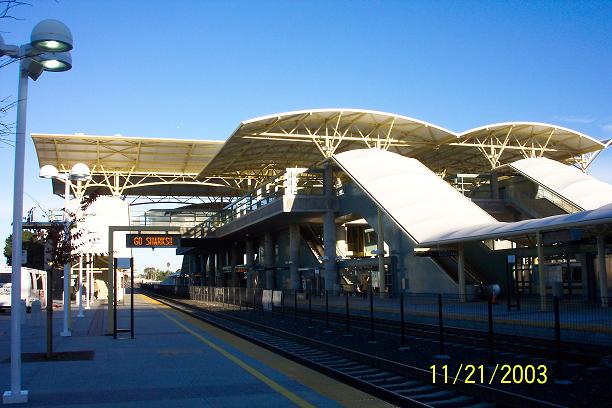
The Millbrae BART/Caltrain connection is a maze of concrete, escalators, ducts, stairs, turnstiles, and ticket machines. The designers did their best with the translucent roofing, but there are too many dark, cold areas. Yes, the station is functional, but the parking lots are mostly empty and traffic is far below expectations.
The booming Bay Area economy and the addition of a BART line to San Francisco Airport should have improved Millbrae Station's utilization. However, [bold added]
By now, BART’s Millbrae Station — with its connections to Caltrain, buses and shuttles — was supposed to see 16,500 passengers pass through its fare gates every weekday, making it the fifth-busiest station in the system.

But 13 years after it opened, it’s pretty much just another BART station, nowhere near the bustling Peninsula transit hub that planners envisioned. With just under 7,000 riders entering and exiting daily, the station ranks 27th in activity among the transit system’s 46 stations.
One of the problems is that there's little coordination between BART and Caltrain. A passenger trying to get from Oakland to Mountain View would take BART to Millbrae, then often wait more than 30 minutes for the next southbound Caltrain---and that's when both BART and Caltrain are running on time.
BART riders coming from the north and bound for Caltrain arrive on the east side of the station. To catch Caltrain, they have to ascend escalators or stairs, exit through the BART fare gates and walk a few yards across the concourse before descending to the Caltrain station’s west side.
When it's not rush hour, the drive would take one hour, and mass transit two. When Millbrae Station opened, a round-trip BART fare from Millbrae to San Francisco was less than $5. Parking was free, an obvious inducement to try the new station.

Now the round trip costs $9.30, and parking is $3. It's no wonder that BART doesn't attract more commuters; it's too expensive for low-wage earners (even if the minimum wage rises to $15 an hour), and it's too inconvenient for those with high incomes, who choose to park in downtown buildings at $25 per day ($5,000 per year).

Don't get me wrong--I'm glad the station was built. It's very useful to have an alternate means into the City since the highways are backed up nearly every day.

Monday, April 24, 2017

Inconvenient Truth: the Crime Edition

For your own sake put your laptop away 
On Saturday night dozens of "minors" swarmed a BART train at the Oakland Coliseum station [bold added]:
Witnesses told police that 40 to 60 juveniles flooded the station, jumped the fare gates and rushed to the second-story train platform. Some of the robbers apparently held open the doors of a Dublin-bound train car while others streamed inside, confronting and robbing and in some cases beating riders...

[S]even people were robbed — with the victims losing a purse, a duffel bag and five phones. Six people were robbed inside the train car, with a seventh confronted on the platform, she said. Police received no reports of guns or other weapons being brandished.

A police summary prepared after the incident said that at least two victims suffered injuries to the face or head that required medical attention.
The story resonates because it's easy to identify with the victims. BART has hundreds of thousands of daily riders, and the Coliseum station is along one of the busiest arteries.

BART isn't sharing surveillance videos "because the attackers appear to be minors." That's not the real reason, IMHO.

Crime is rampant in the area--notorious gangs are headquartered nearby---and BART doesn't want to strike fear in the heart of suburban customers commuting to their jobs in San Francisco. Also, the crime is very likely to have been committed by young, mostly non-white men who reside in the area, and BART doesn't want to inflame already-negative emotions. For the record I'm in favor of releasing the videos, not only to catch the perpetrators but also to protect the public.

In the March for Science this weekend marchers, and many California authorities, proudly said that they were on the side of "truth." Apparently, they meant only truths that they agreed with.

[Update - 4/25: BART keeps riders in dark about teen mob robbery.]

Friday, March 11, 2016

The Real Problem

This week's local transport news was puzzling to those who don't take BART regularly:
If you take up more than one seat you could fork up $100....The first offense would be $100 and the second $200. Anything after that, as much as $500.
Sure, your humble blogger is irritated when seat hogs won't move their bags when people are standing, but he prefers to handle this matter via moral suasion than the BART police. And causing a rude human being to pay $100 or more seems like an overly severe penalty for his lack of courtesy.

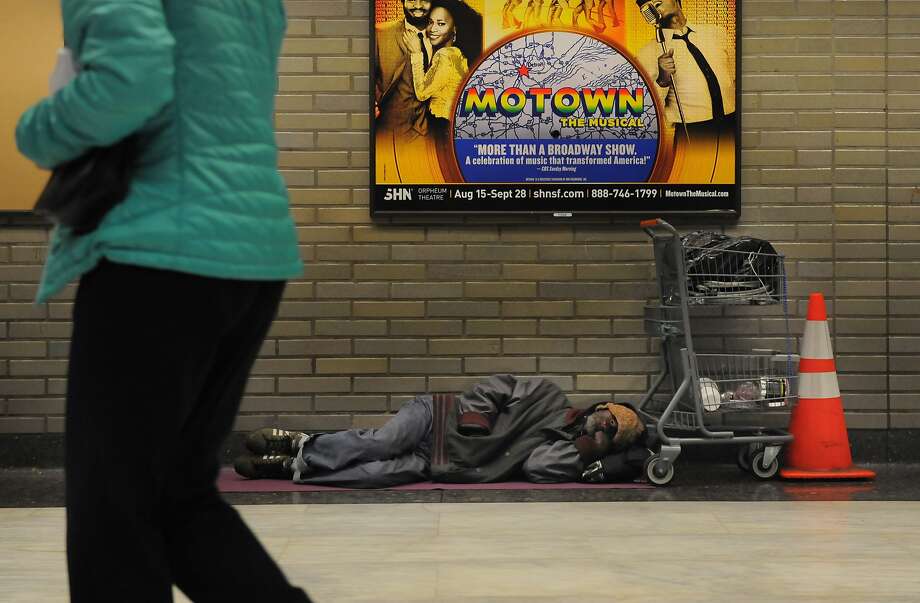
Homeless people stay in the BART stations, too. (SF Gate)
SF Chronicle columnist Debra Saunders says the real problem is about the homeless, who use the trains as shelter: [bold added]
If a simply inconsiderate passenger is taking up an extra seat for a backpack or luggage, another commuter will ask that person to make room. It’s only when the two-seat hog seems hostile, mentally ill or inebriated that others hesitate to inquire. Smell is also a factor.

During the winter months, the homeless can be especially vexing. When you are riding the train to work, it’s irritating to see others taking up space during heavy commute hours in an effort to stay warm and dry. The public pays fares to use BART as a conveyance, not to ride in railcars that double as homeless shelters (for which working stiffs also pay).

Also contributing to the dysfunction: Once you pay the minimum fare, you can ride all day.
The BART police don't have a rule for making people move, hence the seat-hog proposal.

A better course of action might be to address the ride-all-day behavior. For example, there could be an ordinance to make passengers leave the system after a certain amount of time has elapsed. BART police already "audit" the tickets of passengers; why not use ticket scanners to make sure they entered, say, within the past three hours? (Such a three-hour rule can be suspended if there's a train delay.)

A related story -- Study: BART is second-germiest transit system in the US

Monday, October 21, 2013

Anxious Weekend

After an anxious weekend the BART strike, chapter 2 (chapter 1 was in July), was apparently settled. The trains will roll again tomorrow after disrupting the daily schedules of hundreds of thousands of commuters who rely on BART. However, we're not out of the tunnel entirely because the agreement must still be approved by union membership next week.

The region's vulnerability to transit strikes has given rise to calls to outlaw them by some California Democrats. (Transit strikes have been banned even in such labor-friendly bastions as Chicago, Washington, D.C., and New York.) The San Francisco Chronicle says that it's time:
This strike may represent the most egregious and most counterproductive overreach by the unions. They and their consultants should have recognized in July that public sentiment was not with them.

Their obliviousness has brought the issue to the fore: Why should workers in a service so essential to Bay Area life and safety even be allowed to strike?
BART is fairly quick, reliable, and cheap, and, excluding the intra-San Francisco Muni system, far more people in the Bay Area rely on it every day than all other forms of public transportation. BART is also a good example of the danger of entrusting too much power to a single supplier, public or private, for-profit or non-profit.

We who live on the Peninsula are fortunate to have several commuting options to San Francisco: SamTrans express buses, CalTrain, BART, and, of course, one's own car. Diversification is good, because it means that you have a back-up plan. © 2013 Stephen Yuen

Tuesday, July 02, 2013

Too Much Power

San Bruno station is shuttered during the strike
Diversification isn't just a desirable attribute of investment portfolios, it's a fundament of capitalism. If purchasers of goods or services are too reliant on one supplier, purchasers are vulnerable to supply disruptions, price hikes, unfavorable contract renegotiations, and other characteristics of monopolies.

"Natural" monopolies, such as public utilities that have no competition because of their economies of scale, are regulated by the government. When the government operates the monopoly, consumers are for the most part helpless.

For thousands of commuters Bay Area Rapid Transportation (BART) trains are the only transit method. Alternative transportation--including driving--from the East Bay to San Francisco is costly and can be much slower. That is why the BART strike, which began Monday, is so devastating. It's also dysfunctional (bold added):
BART's labor stoppage is polluting the air, wasting commuters' time and, at least by one estimate, costing the overall Bay Area economy $73 million per day.

The most public sticking points that led to the strike have been raises and pension contributions, a dispute that is separated by $17.53 million a year.
When the monopolist sneezes, everyone catches cold---a cautionary tale about granting any entity, public or private, too much power over everyone's lives.
© 2013 Stephen Yuen
[Update - 7/5/13: trains will resume service for 30 days as management and unions attempt to reach a deal.]