Showing posts with label Bush. Show all posts

Saturday, November 27, 2021

Return of the Greedy Corporation....Excuses

Gerald Ford's pleas to Whip Inflation Now failed,
as did his 1976 election campaign. (Ad Age)
As predictable as the sun rising in the East, Democrats are blaming inflation on corporate greed.
White House officials said Mr. Biden would continue publicly calling out industries that he believes are raking in large profits while raising prices for consumers, amid calls from some of Mr. Biden’s outside advisers to respond aggressively to inflation to counter mounting criticism from Republicans.
Sen. Elizabeth Warren adds her two cents:
Wondering why your Thanksgiving groceries cost more this year? It’s because greedy corporations are charging Americans extra just to keep their stock prices high. This is outrageous.
Through the Bush, Obama, and Trump Administrations inflation ranged between negative 0.4% and 3.8%. For the past several months inflation has run above 5%. [bold added]
The Labor Department said the consumer-price index—which measures what consumers pay for goods and services—increased in October by 6.2% from a year ago. That was the fastest 12-month pace since 1990 and the fifth straight month of inflation above 5%.

The core price index, which excludes the often-volatile categories of food and energy, climbed 4.6% in October from a year earlier, higher than September’s 4% rise and the largest increase since 1991.
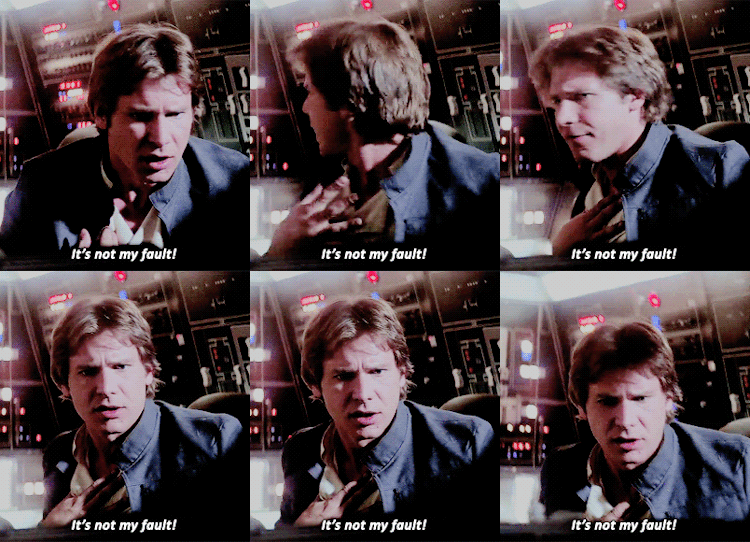
(GIF from rebloggy)
Not only have "greedy corporations" failed to raise prices significantly for the previous 20 years, boardroom avarice has been dampened by the growing emphasis on "stakeholder capitalism" and Environmental, Social, and Governance goals. In my humble opinion--and I'm no economist--business is not to blame for high prices.

And inflation is not the fault of the government, as those in charge of government have said.

It's truly a puzzlement.

Saturday, April 24, 2021

Not Completely Woke

Calhoun College was renamed
after Grace Hopper, computer
scientist and USN rear admiral
In 2017 Yale renamed Calhoun College [one of its 14 residential colleges] because of "John C. Calhoun’s legacy as a white supremacist and a national leader who passionately promoted slavery."

In 2018 numerous Yale students and alumni "expressed outrage" against the nomination of alumnus Brett Kavanaugh to the Supreme Court--not to mention tried to get Law Professor Amy Chua fired for her support of Justice Kavanaugh.

For the record your humble blogger agreed with the Calhoun change but was appalled at the way leftists went after Brett Kavanaugh on the uncorroborated recollections of a questionable witness.

The fact that the woke press, so diligent with digging into the past of non-Progressives, dropped the subject as soon as Brett Kavanaugh was sworn in, is a strong indicator that they knew the whole thing was a sham. Frankly, I'm still interested in finding out if there was something to the story, and, if there is not, who instigated and promulgated the fake narrative.

There's a distinct difference between marshalling facts to prevail in an argument--as in the case of Calhoun/Hopper--versus making up stuff in order to win the day. There's enough of the latter going on everywhere, and Yale students, especially the elite at Yale Law, ought to know better.

It was refreshing to discover, however, that Yale has remained true to liberal principles by honoring a distinguished alumnus even though his family is the epitome of the New England blue bloods that were instrumental in founding the country.

1948: Babe Ruth meets the future president
Headline: Yale Baseball Field Named in Honor of George Bush ’48
...historic Yale Field, which has hosted the likes of Babe Ruth, Lou Gehrig, and Ted Williams, will be named George H.W. Bush '48 Field in honor of one its most accomplished alumni, George Herbert Walker Bush, who captained the Yale baseball team in his senior season...

Bush started his Eli career as a first baseman in 1945, after serving his country as a naval aviator during World War II — the youngest in the U.S. at that time. After remarkable service to his country, he returned to the baseball diamond and the classrooms of Yale.

He went on to earn a degree in economics in less than three years, and was elected captain of the baseball team in his senior season. Bush helped his teams to two College World Series, in 1947 and 1948.

After graduation, Bush began working in the Texas oil business, and, in 1966, was elected to the U.S. House of Representatives, launching his career in public service. He served as ambassador to the United Nations and to China, and then as director of the Central Intelligence Agency. Under President Ronald Reagan, he served two terms as vice president. In 1988, Bush was elected the 41st President of the United States.
It's good to know that George H.W. Bush's character and record of accomplishment triumphed over the disadvantage of his heritage.

Saturday, December 01, 2018

GHWB: A Man of Character

George and Barbara, 1960's (WSJ photo)
George H.W. Bush's death last night was another reminder that the greatest generation has all but passed from the scene. Mr. Bush was the last American president to serve in World War II. Presidents Eisenhower, Kennedy, Johnson, Nixon, Ford, Carter, Reagan, and Bush all wore the uniform.

Much has been made of the loss of civility in politics after the senior President Bush departed office.

Navy Lt. George Bush (Time)
I suspect that much of the "civility" was derived from the realization by these Presidents that today's political opponents were yesterday's allies in the life-and-death struggle that was WWII. Those who fought share an unbreakable bond with each other and with those who never came back.

Another oft-remarked element of World War II was that everyone served, from the richest blue bloods to the poorest farmers and inner-city workers. On the battlefield, if you're focused on racial or religious or class distinctions, you're dead. George Bush, perhaps influenced by his wartime experience and unlike some members of his class and heritage, never looked down on anyone.

Of all of his characteristics the one that struck me the most is how he would hand-write personal notes to everyone, many of whom he don't know personally. One of the busiest men in the world would take the time for others who couldn't possibly be of any help to him. R.I.P.

Tuesday, September 18, 2018

The Unappreciated Man

Remembering the tenth anniversary of the financial crisis, WSJ columnist Greg Ip says George W. Bush doesn't deserve the opprobrium heaped upon him:
Mr. Bush’s legacy is overshadowed by many controversies of his own making, such as the U.S. invasion of Iraq, but his responsibility for causing the crisis that would cost his party the White House was at most minor and shared with predecessors.
Greg Ip's main point, however, is that President Bush deserves credit for rescuing the world's financial system during the critical months near the end of his presidency:
The day after Lehman Brothers failed [September 15, 2008], Treasury Secretary Henry Paulson and Federal Reserve Chairman Ben Bernanke went to President George W. Bush with bad news. Insurer American International Group Inc. needed $85 billion or it, too, would collapse.

Though unhappy and frustrated, Mr. Bush approved the loan, saying, “If we suffer political damage, so be it,” Mr. Paulson later wrote.

Scholars of the crisis rightly focus on the decisions that the three crisis managers—Mr. Paulson, Mr. Bernanke and New York Fed President Tim Geithner—made to rescue the financial system. Though unpopular at the time and still second-guessed, their actions were vital in avoiding a second Great Depression. Yet most would have been impossible without the president’s support, which Mr. Bush gave unreservedly from start to finish.
In 2008 it was far from clear what to do (image from
http://economicsofcontempt.blogspot.com)
President Bush made mistakes, but he also made courageous decisions during his second term. When everyone--Democrats and Republicans--were sickened by Iraq and called for U.S. withdrawal in defeat, he ordered the 2007 surge that rescued the war to such an extent that Joe Biden declared in 2010 that victory in Iraq "could be one of the great achievements of this administration." Mr. Bush's decisions after the Lehman bankruptcy likewise revealed the character of the man.

In 2005 I thought that President Bush would be viewed as a consequential (not the same as great) President. Some of his decisions have been over-ridden by both events and successors, but I have come to appreciate his character. Like George Washington, George Bush has stayed away from politics and declined even to defend his legacy. Long after we are gone, I suspect that historians will treat him more kindly.

Tuesday, April 17, 2018

First Among Ladies

Two future Presidents and one First Lady, 1947 (Time)
Barbara Bush was the last of the "traditional" First Ladies, that is, she didn't have a career outside the home. Neither did she care to look the part of a lawyer or a librarian--in fact she "famously wore fake pearls and a $29 pair of shoes to her husband's Presidential inauguration" in 1989.

Barbara Pierce Bush was the daughter of Marvin Pierce, the publisher of women's magazines Redbook and McCall's, each a big deal pre-Internet. Her ancestor was Thomas Pierce, who was a resident of Charleston, MA in 1634 (Thomas wasn't on the Mayflower).

She was so blue-blooded that looking like a blue-blood didn't matter to her at all.

R.I.P.

Monday, September 11, 2017

The Non-Power of Words

(Jeff Koterba)
Has it really been 16 years after the worst terrorist attack in American history?

A few months after 9/11 President Bush introduced the Axis of Evil formulation in his 2002 State of the Union address:
"States like these, and their terrorist allies, constitute an axis of evil, arming to threaten the peace of the world. By seeking weapons of mass destruction, these regimes pose a grave and growing danger. They could provide these arms to terrorists, giving them the means to match their hatred. They could attack our allies or attempt to blackmail the United States. In any of these cases, the price of indifference would be catastrophic.”
By 2006 the nation had already become weary of the lack of progress. WaPo:
“Nearly five years after President Bush introduced the concept of an ‘axis of evil’ comprising Iraq, Iran and North Korea, the administration has reached a crisis point with each nation: North Korea has claimed it conducted its first nuclear test, Iran refuses to halt its uranium-enrichment program, and Iraq appears to be tipping into a civil war 3 1/2 years after the U.S.-led invasion.”
Today prospects for peace are in a worse position than ever vis-à-vis Iran and North Korea, and moderately better in war-torn Iraq.

Saturday, September 02, 2017

Well, It Oughtta Be True

During a natural disaster it's not just Donald Trump that the media tries to make look bad, it's Republican presidents in general. The Washington Post, on disaster reporting standards during the Bush years:
New Orleans Mayor Nagin and Police Superintendent
Compass after Hurricane Katrina (CBS photo)
One of the great media-fed myths of Katrina was that criminality, violence and looting swept New Orleans after the breach of the city’s levees. There were apocalyptic stories about snipers shooting at rescue helicopters, roving gangs indiscriminately killing and raping throughout the flooded city, and the Superdome overflowing with dead bodies.

Almost none of it was true.

Much of the defective reporting stemmed from exaggerated or wholly inaccurate comments from official sources, including the mayor and police chief, said W. Joseph Campbell, the author of “Getting It Wrong: Debunking the Greatest Myths in American Journalism.”
Sensationalist reporting boosts sales and generates clicks. As a bonus, if it hurts politicians that the media detests, why should facts and journalistic standards get in the way of the story?

Monday, April 10, 2017

Peggy Picks Up a Pulitzer

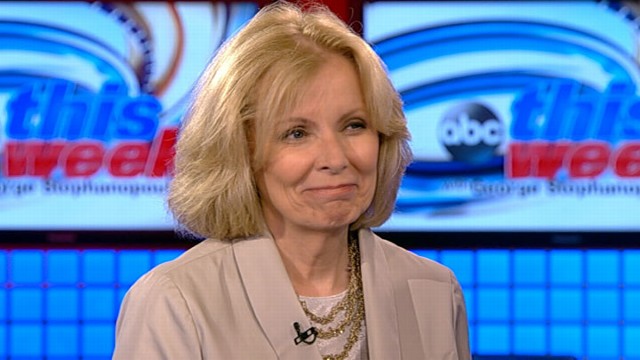
Peggy Noonan is a panelist on ABC's Sunday talk show.
Wall Street Journal columnist Peggy Noonan wins the the Pulitzer Prize.

Ms. Noonan is one of the very few political professionals who became successful, trusted journalists (the late Tim Russert and William Safire also come to mind).

Excellence in journalism requires knowledge and facility with the language. It also requires a willingness to set aside biases and personal associations in the quest for truthful reporting.

Ms. Noonan was a former speechwriter for Ronald Reagan and George H.W. Bush ("thousand points of light" and "kindler, gentler nation" were her creations) and tends toward conservative viewpoints, but she has been critical of Republican politicians and laudatory of Democrats when her principles demanded it.

Long may she write.

Below is her most recent Journal essay, What’s Become of the American Dream?

Monday, October 17, 2016

No Vision

One of the strange aspects of this political season is that the economy, jobs, and government deficits are afterthoughts in the national conversation. The most likely reason--aside from the pull of talking about emotional topics and celebrity personalities--is that the candidates and their experts don't really know what to do. The usual tools, i.e., government spending, tax cuts, low interest rates, haven't worked. Like peace in the Middle East, economic growth has proved elusive no matter who's been in charge.

Some say that this is a return to the old normal. The long post-World War II boom was super-normal, the result of a special confluence of factors: [bold added]
The workforce everywhere became vastly more educated. As millions of laborers shifted from tending sheep and hoeing potatoes to working in factories and construction sites, they could create far more economic value. New motorways boosted productivity in the transportation sector by letting truck drivers cover longer distances with larger vehicles. Faster ground transportation made it practical, in turn, for farms and factories to expand to sell not just locally but regionally or nationally, abandoning craft methods in favor of machinery that could produce more goods at lower cost. Six rounds of tariff reductions brought a massive increase in cross-border trade, putting even stronger competitive pressure on manufacturers to become more efficient.
The initial wave of technology adoption created jobs, but now technology is inexorably grinding them away.
What some economists now call “secular stagnation” might better be termed “ordinary performance.”
The advent of genius machines will render unnecessary the skills of two-thirds of the workforce. In other words, Average is Over:
America is dividing itself in two. At the top will be 10% to 15% of high achievers, the "Tiger Mother" kids if you like, whose self-motivation and mastery of technology will allow them to roar away into the future. Then there will be everyone else, slouching into an underfunded future of lower economic expectations, shantytowns and an endless diet of beans.
For the record, your humble blogger does not subscribe to this bleak vision. Seemingly under our noses a new space age is dawning.

Humanity may currently be viewed as superfluous, redundant, and inferior (to intelligent machines), but as they migrate to the stars 7-10 billion human beings are each unique, irreplaceable, and valuable in an infinite universe. Cheers!

Wednesday, April 20, 2016

The Hand, the Eye, the Image

"Let me draw you a picture" is a favored learning technique, and it may also be the most effective way of committing something to memory.
a group led by psychologist Jeffrey D. Wammes recruited sample groups of students and ran seven different trials of essentially the same experiment on them. In all of the trials, the scientists started with a list of 80 simple words—all nouns and all easy to draw, such as balloon, fork, kite, pear, peanut and shoe. A random series of 30 of those words were flashed on a screen along with instructions either to draw the object or write down its name.

But no matter how many variations of the test the researchers ran, one result was consistent: Drawing the object beat every other option, every single time.
GWB self-portrait (People)
Your humble blogger has zero artistic ability but is thinking of taking a few drawing or painting classes, if for no other reason than to stave off age-related memory loss.

Note: once again George W Bush leads the way.

Monday, September 15, 2014

Premature Declarations

Then:
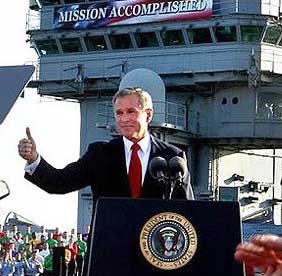
Now (actually, 2012):

Saturday, July 26, 2014

The Color Purple, At Best

In 2010 President Bush explained his often-mocked 2001 statement about looking into Vladimir Putin's soul:
“The reason why I said that is because I remembered him talking movingly about his mother and the cross that she gave him that she had blessed in Jerusalem,” Bush told [radio host Hugh] Hewitt. [snip]

Putin then told the story of recovering the cross from a house fire and said that when a worker found the piece of jewelry it was as if it was meant to be. Bush writes that he remarked, “Vladimir, that is the story of the cross. Things are meant to be.”
Whatever it was in 2001, it's clear what color Putin's soul is today:
The 21st century czar has mastered the dark art of stirring up problems that only he can solve, so that Western leaders find themselves scolding him one minute while pleading with him the next.
President Bush was guilty of wishful thinking. And the current President, who hopes that something or someone else will stop Vladimir Putin, seems to be as disconnected.

Saturday, May 25, 2013

In Praise of Divided Government

It's a cliché that the party who holds the White House deplores divided government, while the party out of power likes it very much. The principal objection to divided government is that quick, bold, necessary actions are stymied. To this humble observer that's a feature, not a bug.

When the Democrats had control of Congress and the White House from 2008 to 2010, they passed Obamacare without a single Republican vote. When the Republicans were similarly situated in 2003 to 2006 and part of 2001, they passed the so-called Bush tax cuts, arguably a major source of today's deficit problems. (It should be noted that Democrats were roughly split on the Patriot Act and Iraq War resolutions, so it's a reasonable supposition that even if congressional Democrats had slim control, George W. Bush would have gotten his legislation through, thanks to solid Republican support.)

Now we are seeing another advantage of divided government: congressional hearings on possible Administration malfeasance. Yes, investigations into the current raft of scandals are interfering with Executive Branch operations, and yes, there is grandstanding and partisan obstructionism going on, but there are also important issues at stake concerning the free flow of information prior to a Presidential election (the time when the people have the most say in their government) and the abuse of the enormous powers of the Internal Revenue Service, the agency that has information on everyone and where everyone is presumed guilty, not innocent.

I'd like to see something get done this year on immigration reform and tax simplification, but if inaction is the price we pay for divided government, so be it. © 2013 Stephen Yuen
[Update - 5/31: Ann Althouse on the 2014 elections: "Regardless of how directly Obama is implicated and how much any given voter wants to blame Obama, the scandals make a strong argument for opposite-party control of Congress."]

Friday, May 17, 2013

The Sensibility of House Republicans

No, really, House Republicans may be acting sensibly:
House Republicans say they will not overreach on probing the Obama administration, having learned lessons from investigating the Monica Lewinsky scandal during the Clinton administration. [snip]

Impeachment is not something that has been bandied about around the House GOP leadership table, according to GOP leadership aides and a House Republican member who spoke on background.
Unless there is solid proof of high crimes and misdemeanors (using the people's definition, not lawyers' understanding) by the President, House Republicans should quash all mention of the I-word. Mr. Obama is still popular and could become an object of sympathy if there were a rush to start impeachment proceedings.

It's difficult to imagine that he would ever be as unpopular as his predecessor, but Mr. Obama may well descend to that level after three and a half more years of scandal and ineffectiveness, not to mention being the butt of late-night humor.

Thursday's Jay Leno:
This week will mark the 37th time House Republicans have tried to repeal Obamacare. If Republicans really want to do away with Obamacare they should endorse it as a "conservative non-profit" and let the IRS take it down!

A lot of critics are now comparing President Obama to President Nixon. The good news for Obama: at least he's no longer being compared to President Carter!

Tuesday, May 14, 2013

Six Months Later

A few days after President Obama's re-election your humble observer opined:
Now that the election's over we are likely, finally, to learn the truth about:
  • Benghazi
  • Obamacare's costs
  • End-of-year defense layoffs
  • FEMA's before-and-after performance on Hurricane Sandy
  • Unemployment statistics
  • Whether General Motors is really healthy
  • What the President meant when he said he would be "flexible" on missile defense
  • Six months later only Benghazi and Obamacare are still deemed to be important topics, but two are enough to serve the President's opponents; prolonged national conversations on either are unlikely to be helpful to the Administration's goals. A scandal that has seemingly come out of nowhere--also unhelpful, to say the least--is the IRS' targeting of "Tea Party" and "patriot" groups (actions suspected by conservatives over a year ago but ignored by the mainstream media).

    Unfortunately for the President, none of the current set of problems can credibly be laid at the feet of obstinate Republicans or the Bush Administration. Welcome to your second term, Mr. President.

    Sunday, February 10, 2013

    Incineration Over Incarceration

    Quoth the NY Times:
    Mr. Obama relies on his predecessor’s aggressive approach in one area to avoid Mr. Bush’s even more aggressive approach in others. By emphasizing drone strikes, Mr. Obama need not bother with the tricky issues of detention and interrogation because terrorists tracked down on his watch are generally incinerated from the sky, not captured and questioned.
    To summarize the Times' world view,

    Obama ===> drones ===> terrorists "incinerated from the sky" ===> "aggressive approach"

    Bush ===> detention and interrogation ===> "more aggressive approach"

    The terrorists are surely grateful that President Obama has a softer policy than cowboy George Bush--wouldn't you prefer incineration over incarceration, dear reader?

    Monday, December 19, 2011

    The Jagged Line of Freedom

    Jeb Bush, former two-term governor of Florida, wants to roll back statism:
    In Washington, D.C., rules are going in the opposite direction. They are exploding in reach and complexity. They are created under a cloud of uncertainty, and years after their passage nobody really knows how they will work. [snip]

    ...we must choose between the straight line promised by the statists and the jagged line of economic freedom. The straight line of gradual and controlled growth is what the statists promise but can never deliver. The jagged line offers no guarantees but has a powerful record of delivering the most prosperity and the most opportunity to the most people. We cannot possibly know in advance what freedom promises for 312 million individuals. But unless we are willing to explore the jagged line of freedom, we will be stuck with the straight line. And the straight line, it turns out, is a flat line.
    Unlike other vocal conservatives, Jeb Bush doesn't attribute sinister motives to big-government advocates. The gigantism of the state may even spring from the well-meaning attempt to protect capitalism's losers. But the cost to innovation and animal spirits has been too high.

    Jeb Bush's conservatism with a velvet glove may just be what (and who) Republicans have been searching for. Four years ago the wounds were too raw for yet a third member of the Bush family to be part of the national ticket. In 2012 the circumstances are very different.

    Saturday, August 06, 2011

    Somehow Bush is to Blame

    According to Standard & Poor's there are 19 sovereign entities with a triple-A credit rating: Australia, Austria, Canada, Denmark, Finland, France, Germany, Guernsey, Hong Kong, Isle of Man, Liechtenstein, Luxembourg, Netherlands, New Zealand, Norway, Singapore, Sweden, Switzerland, and the United Kingdom.

    The Obama Administration came into office promising to restore the world's respect for the United States. Now we're less respectable than Liechtenstein.

    Monday, May 02, 2011

    No Beatification

    Thoughts on the death of Osama Bin Laden:

    1) If hell exists, and if OBL is not in it, then everything written about Christian theology and Christian ethics needs to be torn up into little teeny pieces.

    2) Hooray for President Obama:
    a) For going against his promise to close down Guantanamo, thereby continuing to harvest valuable information that enabled special forces to get OBL.
    b) For not dismissing but retaining the wisdom of experienced Bush Administration senior staff like David Petraeus and Robert Gates.
    c) For approving the surge in Afghanistan after dissing the successful surge in Iraq;
    d) For stepping up drone warfare despite it being---let’s be frank---a targeted assassination policy and perhaps chasing OBL from the mountains into an urban area of Pakistan.
    e) For making the final call to kill Osama Bin Laden through a boots-on-the-ground military operation and recover the body to dispel uncertainty.
    3) President Bush deserves credit for building the military, intelligence, and technological infrastructure that enabled President Obama to finish the job, but he’s not getting much credit in mainstream news reports so far.

    4) The celebration about the death of another human being, no matter how heinous, is distasteful.

    5) But if we’re celebrating a big reduction in future terrorism, that’s okay.

    6) Isn’t it amazing that there were no leaks about this operation for the past six months? Another hooray for President Obama.

    7) The silver lining that some Republicans foresaw from the 2008 Obama victory—that the country would be more unified by military action from a Democratic President because he would not be subject to criticism—is proving correct though he started yet a third war, and renditions, American fatalities, targeted killings, and innocent deaths show few signs of abating.

    8) President Obama’s order to kill three pirates in 2009 showed that he wasn’t afraid to use deadly force.

    9) President George H.W. Bush was immensely popular after the victory at the end of the first Gulf War on February 28, 1991. 20 months later the senior Bush was voted out of office. President Obama is deservedly popular for the action he took yesterday, but he can’t rest on this accomplishment because the news cycle and the emotional swings of the electorate move much faster than in 1991.

    10) We’re supposed to pray for the soul of Osama Bin Laden, but I’ll have a hard time doing that. No beatification for me.

    Sunday, February 07, 2010

    This Week: Tim Geithner

    Quick reaction to Treasury Secretary Geithner’s interview on ABC’s This Week:

    Regardless of the question (unemployment, budget deficit and ballooning debt, business’ reluctance to borrow and invest), Sec. Geithner always asked us to refer back to where we were a little over one year ago when the financial system almost collapsed. Obviously, the point he was trying to make is that the situation may be objectively bad--unemployment at 10%--but it’s better than another Great Depression. To these eyes it’s reminiscent of the Bush Administration constantly referring back to the fear we felt after 9/11 and how we should be grateful to it that we haven’t been hit again (and I am grateful, by the way).

    But gratitude was and is easily subsumed by other emotions. Gratitude is fleeting and can’t be the basis of lasting loyalty (just ask a parent how often “you oughta be grateful” wins an argument). And it won’t win in November.