Showing posts with label Iraq. Show all posts

Monday, September 11, 2017

The Non-Power of Words

(Jeff Koterba)
Has it really been 16 years after the worst terrorist attack in American history?

A few months after 9/11 President Bush introduced the Axis of Evil formulation in his 2002 State of the Union address:
"States like these, and their terrorist allies, constitute an axis of evil, arming to threaten the peace of the world. By seeking weapons of mass destruction, these regimes pose a grave and growing danger. They could provide these arms to terrorists, giving them the means to match their hatred. They could attack our allies or attempt to blackmail the United States. In any of these cases, the price of indifference would be catastrophic.”
By 2006 the nation had already become weary of the lack of progress. WaPo:
“Nearly five years after President Bush introduced the concept of an ‘axis of evil’ comprising Iraq, Iran and North Korea, the administration has reached a crisis point with each nation: North Korea has claimed it conducted its first nuclear test, Iran refuses to halt its uranium-enrichment program, and Iraq appears to be tipping into a civil war 3 1/2 years after the U.S.-led invasion.”
Today prospects for peace are in a worse position than ever vis-à-vis Iran and North Korea, and moderately better in war-torn Iraq.

Saturday, April 30, 2016

Expert at One, Expert at All

Departing from its financial commentary, Barron's ventures into the geopolitical realm with an encouraging, surprising prediction: "the Islamic State, also known as ISIS or ISIL, [will] see its power and territory greatly diminished by the end of 2017."

The claim that "ISIS will fall soon" is based on Barron's assessment of the capabilities and motivations of all the major players, including Russia, Saudi Arabia, Iran, Iraq, Syria, Israel, and the United States.

Color your humble blogger extremely skeptical. The Middle East is more complex than the most complex system, and even simple systems produce results that are unpredictable. It wouldn't take much to derail the path towards peace.

Also, sentences like the following don't inspire confidence:
Ultimately, the Islamic State will be laid low by blowback from the brutality of the caliphate. Reigns of terror generally only succeed in countries with deep and perduring totalitarian roots. The caliphate is hardly Stalinist Russia or Maoist China in its longevity.
ISIS will be "laid low" because it's too brutal? That's what has been said about North Korea, Iran, and Syria, and those regimes are still standing. (It took an invasion led by the world's mightiest military to overthrow Saddam Hussein in Iraq.)

I subscribed to Barron's to read about financial markets, not editorials why "Trump is wrong" (or right) or about how we've reached peak ISIS without a lot of doing on our part. Of course, Barron's has a right to its opinion, just as I have a right to stop paying for it.

Sunday, July 26, 2015

Save Us From the Time of Trial

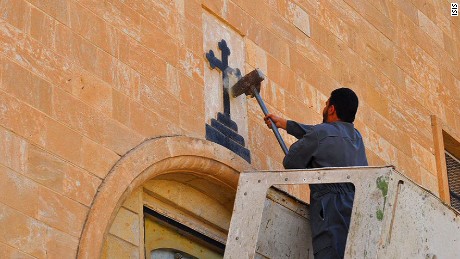
Iraq today (CNN)
NY Times: Is This the End of Christianity in the Middle East?
ISIS scanned the separate groups of men and women. ‘‘You’’ and ‘‘you,’’ they pointed. Some of the captives realized what ISIS was doing, survivors told me later, dividing the young and healthy from the older and weak....No one was sure where either bus was going.
At the Nazi killing centers:
After deportation trains arrived at the killing centers, guards ordered the deportees to get out and form a line. The victims then went through a selection process. Men were separated from women and children. A Nazi, usually an SS physician, looked quickly at each person to decide if he or she was healthy and strong enough for forced labor. This SS officer then pointed to the left or the right; victims did not know that individuals were being selected to live or die.
For centuries the men with the guns, drunk with power and certitude, have decided who lives and who dies. On rare occasions victims are spared if they renounce their faith.

May Christians in the very safe United States of America never be put to this test.

Monday, September 15, 2014

Premature Declarations

Then:
Now (actually, 2012):

Saturday, May 25, 2013

In Praise of Divided Government

It's a cliché that the party who holds the White House deplores divided government, while the party out of power likes it very much. The principal objection to divided government is that quick, bold, necessary actions are stymied. To this humble observer that's a feature, not a bug.

When the Democrats had control of Congress and the White House from 2008 to 2010, they passed Obamacare without a single Republican vote. When the Republicans were similarly situated in 2003 to 2006 and part of 2001, they passed the so-called Bush tax cuts, arguably a major source of today's deficit problems. (It should be noted that Democrats were roughly split on the Patriot Act and Iraq War resolutions, so it's a reasonable supposition that even if congressional Democrats had slim control, George W. Bush would have gotten his legislation through, thanks to solid Republican support.)

Now we are seeing another advantage of divided government: congressional hearings on possible Administration malfeasance. Yes, investigations into the current raft of scandals are interfering with Executive Branch operations, and yes, there is grandstanding and partisan obstructionism going on, but there are also important issues at stake concerning the free flow of information prior to a Presidential election (the time when the people have the most say in their government) and the abuse of the enormous powers of the Internal Revenue Service, the agency that has information on everyone and where everyone is presumed guilty, not innocent.

I'd like to see something get done this year on immigration reform and tax simplification, but if inaction is the price we pay for divided government, so be it. © 2013 Stephen Yuen
[Update - 5/31: Ann Althouse on the 2014 elections: "Regardless of how directly Obama is implicated and how much any given voter wants to blame Obama, the scandals make a strong argument for opposite-party control of Congress."]

Friday, February 19, 2010

Life Imitates a Movie (Again)

Politicians take credit for every good thing that occurs while they are in office, but last week’s statement by Joe Biden that the apparent victory in Iraq is “one of the great achievements of this administration” seemed to provoke apoplectic outrage in some of his opponents.

It does seem the height of gall that the Vice-President claims credit for the triumph of policies that both he and President Obama opposed hammer and tong, but Republicans would be wise not to over-react. First, it's always possible they're being punk'd. Second, Mr. Obama and Mr. Biden’s antiwar positions are so well-known that none but their most blinded supporters would attach credulity to his claim of victory. Simply repeating the Larry King videoclip without comment will be damaging enough to popular judgment of the Administration’s judgment.

As for my own reaction, I turn as I often do to pop culture. At the very end of the quest-filled 1981 movie Dragonslayer the young hero Galen slays the monster. The king, a desiccated husk of a man who has seen his kingdom nearly destroyed, gets out of his carriage and feebly stabs at the smoking carcass.

The villagers cheer their “dragonslayer” ruler. Life, death, tragedy, and triumph have given way to absurdity. All Galen and his maiden friend Valerian can do is exchange a knowing glance, then move on with their lives. That's advice I'm going to try to follow until November, 2012.


Below is the YouTube link to the exciting last ten minutes of Dragonslayer.


© 2010 Stephen Yuen

Saturday, November 21, 2009

Pottery Barn Redux

Now that health care legislation is moving forward in the Senate, it’s time to revisit an expensive lesson learned by the previous Administration. [In keeping with journalistic standards the following quotations have been obtained from reputable climate scientists.]

The Pottery Barn rule on the invasion of Iraq: “if you break it, you own it.”

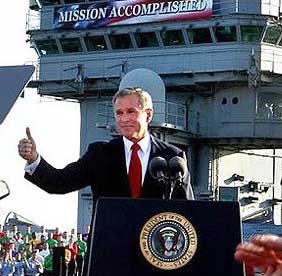
GWB: “it’s not going to be that bad. Let’s get that ‘Mission Accomplished’ sign ready.”

The Pottery Barn rule on the impact of the public option on the health care system: “if you break it, you own it.”

BHO: “Precisely. What’s the problem?”

Saturday, July 25, 2009

Palpable Disdain

Let’s put aside the questions over whether a new national health care plan constitutes “socialism”, whether it will reduce or raise costs, or whether it will stifle innovation. These are all important issues, but I have another concern that is more mundane. Will this new government program work? On the basis of the government’s performance in other areas, no, it won’t….at least not for a long time.

Iraq: The 2003 invasion of Iraq took over a year to plan. Nevertheless, by 2007 it looked like the whole enterprise was going to be a dismal failure. Though military leadership and political courage turned the campaign around, the difficulties and delays make the Iraq war successful only under the rosiest of interpretations.

TARP: The Troubled Asset Release Program allows the Treasury to purchase up to $700 billion of hard-to-sell assets from banks so that banks can continue lending. Although there is only sketchy reporting of how the funds have actually been spent, it is clear that much has been misdirected:
Many U.S. banks that got federal bailout money misused it, a special inspector general overseeing the government's financial rescue program said Monday.

While most of the 360 banks surveyed said the Troubled Asset Relief Program money they got from Washington helped them make loans or avoid a drop in lending, 40 percent said they also used the money to shore up their capital to protect against losses, Neil Barofsky, the special inspector general, said in a report. However, TARP does not allow banks to recoup losses already incurred on troubled assets.
Cash-for-clunkers: the $1 billion program (CARS) to jump-start auto sales and retire older high-mileage vehicles was supposed to start on July 1st. However, procedures were only released yesterday, July 24th.

I wonder how many months we’ll have to wait after its signing to find out how the vastly more complex and costly health plan will work. The uncertainty and confusion will freeze a large sector of our economy as we try to recover from a deep recession. Only a political class that has never had to manage a new-product introduction and lazily leaves the details to be sorted out later could show such palpable disdain for those whom they purportedly serve. © 2009 Stephen Yuen

Sunday, June 21, 2009

Terribly Un-Christian Thoughts About Iran

As the Iranian regime responds with ever increasing brutality against its own people, I think about the many U.S. and Iraqi casualties that have been caused by Improvised Explosive Devices that originated from Iran. I think about how Iran has done its best to destroy the nascent Iraqi democracy by arming death squads to kill innocents and foment sectarian strife.

And then I think about how the regime holds on to its power because the Iranian people are outgunned (but not outmanned). Well, we got guns.

Imagine: 1) a homegrown, not imposed, democratic government in Iran; 2) the postponement if not cancellation of Iran's nuclear weapons program; 3) how, with the removal of its biggest threat to survival, Israel would be more inclined to make concessions; 4) all this accomplished with no American casualties. To be sure, our hands would be wet with blood that is not our own, and that is why these are terribly un-Christian thoughts to hold on this Father's Day Sunday, full of portent and promise.

Friday, June 19, 2009

Reaping the Benefits

Andrew Sullivan, a supporter turned fierce critic of the Iraq War (primarily condemning the means rather than the end), assesses the turmoil in Iran as partial vindication of neoconservatism.
The core hope that democracy could spread in the Middle East - and that this alone would ultimately destroy Jihadism - is in some ways vindicated by this year in Iran. It remains, of course, a fantastic irony that they chose Iraq to impose this result, rather than waiting for Iran to demonstrate it. And a further irony that their opponent Barack Obama helped inspire the hopes to vindicate neoconservative dreams.
The mistakes that the Bush Administration made in Iraq were nearly fatal to the whole enterprise, but surely Mr. Sullivan could not be asserting that we should have “done Iran first”. Much as Iran’s interference caused immense mischief in the Iraqi reconstruction, an undethroned Saddam would have capitalized on Iranian turmoil to augment his power. In fact there is a strong argument that fear of Saddam, who killed hundreds of thousands of Iranians during the eighties, would have prevented Iranians from rebelling against their regime. With the Wolf at their door, Iranians would have kept quiet.

There were tremendous costs incurred by America in the Iraq War, but now that investment is producing a tremendous opportunity. Let’s hope that our leaders are wise and bold enough to figure out how to seize it. © 2009 Stephen Yuen

Saturday, April 18, 2009

A Middling Outcome Would Be A Surprise

After being laid off from her long-time employer, my friend landed a well-paying, responsible position with a European bank over two years ago. The bank announced that it will close its San Francisco office, and she’ll have to look for another job.

We circulated an offering package to a list of financial institutions that purchase transportation assets. One of our regular bidders called to say that his division will be shut down, and his company has called a halt to all investment activity.

Salespeople in our office have been diverted to working on restructuring deals that we thought were safely put to bed. New business will have to wait. In the financial services industry everyone who has not been laid off is worried about losing his job. People are keeping their ears close to the ground. There is worry, if not fear, in the air.

On the other hand, over the past 30 years our most successful deals have been transacted when the economic outlook was poor. Both the oil-patch crash of the early 1980’s and the recession following the first Gulf War enabled us to purchase high quality investments at low prices.

Why didn’t you buy more, the quarterbacks in the corner offices always ask, years later when everyone is ebullient. Well, now’s their chance to make their mark. In this uncertain environment a wise deployment of capital can earn many times your original investment, but you can also lose it all. A middling outcome would be a surprise.

Some people I know, not just the famous in New York and Washington, have prospered as critics and advisers. Now that they control the ball, I am eager to see the plays that they’ll call. © 2009 Stephen Yuen


Earnings from old deals enable us to pay the rent.

Friday, March 06, 2009

O Lucky Man

Despite the ethical failings of his appointees, despite an economic war plan that resembles firing bullets in all directions, despite the evaporation of trillions of dollars in private wealth, the President---our President---is a lucky man.

Think how much worse we'd feel about him if (a) the mainstream media were as critical about his 45-day performance as they would have been about a President McCain, and (b) there were a hot war (India-Pakistan, Russia-Georgia, China-Taiwan, Israel-Syria/Iran/Palestine) for him to contend with. Thanks should go to his predecessor for stanching the Iraq bleeding before turning over the keys. Otherwise our lucky President would be in over his head. © 2009 Stephen Yuen

Sunday, February 08, 2009

Shred of Honor

The Iraq war was the biggest undertaking of the Bush Administration, and the guaranteed consequence of something that huge and messy is that big mistakes happened. Innocents died, some Americans behaved poorly, even criminally, and, when things didn’t go according to plan, the leadership didn’t know how to respond and lost the confidence of the American people.

Part of the reason for the loss of confidence was that the media didn’t do the Bush Administration any favors. Perhaps the media did its job by headlining all the missteps and bad news (Abu Ghraib, WMD, suicide bombing, IEDs, Sunni-Shiite conflict, etc.) as soon as they were discovered. Many in the media refused to accept the Administration’s view of events and often substituted an opposite interpretation. So be it; an unrestricted press is not the price but the glory of a free society.

The stimulus bill that will be signed into law this month is a much costlier and vaster government enterprise than the Iraq war. There is absolutely no doubt that the following will occur: 1) some funds will make their way into the hands of fraudsters and illegal aliens; 2) deserving people that the programs are intended to help won’t receive their benefits; 3) government purchasing procedures will be over-ridden, and some contracts will be fast-tracked to those who contributed to politicians’ victory in November; 4) every day will see violations of the President’s principles of transparency and no-conflict-of-interest by someone in the government; 5) the recovery will be uneven, and some Americans will never get as good a job or house as the one they lost.

Will the media be as diligent in pursuing stimulus stumbles as they did Iraq war failures? If there’s any shred of honor remaining in the profession, they will. © 2009 Stephen Yuen

Monday, September 29, 2008

I Want My Billy Jeff

The events of the past few months---Hurricane Ike, the worst financial crisis since the Great Depression, the Russian invasion of Georgia---weren’t on our radar screen when the political parties were choosing their Presidential nominees. The Iraq war, which many thought would be the most important issue in the Presidential campaign, has been relegated to the inside pages. Neither Senator Obama nor Senator McCain seem up to handling the challenges of this Black Swan era, when “extreme events do happen and have a big effect” on the course of history.

Ideology is of secondary importance. We need a leader whose knowledge of economics, culture, arts, science, history, international affairs and the exercise of military power is both broad and deep. We need a President who can judge when to move quickly and when to go slow, when to act in concert with others and when to act unilaterally. We need a man or woman of experience as well as intellectual bandwidth. We need someone who can articulate his thinking clearly and bring the people around to his point of view. It’s time to repeal the 22nd Amendment. We need, and I never thought I would ever say this, William Jefferson Clinton. © 2008 Stephen Yuen

Tuesday, June 10, 2008

Not a Question of Being Liberal or Conservative

All right, let’s cut to the chase or rather 2010. In 2009 all the talk and trade sanctions in the world didn’t stop the Iranians from successfully test-firing their nuclear missile. Your CIA Director comes to you with “slam-dunk” evidence that they are going to launch several more at Israel. The Israelis can’t take them all out on their own.

You question his statement, of course, given the CIA’s dismal track record for getting the facts straight. So you call the French, the British, the Germans, the Saudis, the Chinese, the Indians, the Russians and our new friends the Iraqis. No one sends your call to voicemail, Mr. President, and they all say the same thing: yes, it’s true, Israel will be devastated if not destroyed.

You’re still not 100% sure, so you won’t strike pre-emptively. You threaten (either privately or very publicly) the destruction of the aggressor, hoping his self-interest will prevail. Of all the leading Presidential candidates of both parties, who would not be believed if he or she made such a threat? Just one, and he is going to be the Democratic nominee.

Friday, May 02, 2008

Unpopular

President Bush is not only the most unpopular president in modern history, he’s the most polarizing. Only 1% of the population is neutral or undecided about him.
A CNN/Opinion Research Corp. survey released Thursday indicates that 71 percent of the American public disapprove of how Bush is handling his job as president…

"Bush's approval rating, which stands at 28 percent in our new poll, remains better than the all-time lows set by Harry Truman and Richard Nixon [22 percent and 24 percent, respectively], but even those two presidents never got a disapproval rating in the 70s," [CNN polling director Keating] Holland said.
One person who views President Bush favorably is historian Paul Johnson.
After September 11th, he buckled down quickly to this unprecedented attack on America, determined that such a treacherous outrage should never occur again. Nor has it. It is worth inquiring why. There is no doubt that attacking the American homeland remains the prime objective of Muslim fundamentalist leaders. Yet they have not done so. One reason for this is the success of Mr. Bush's team in learning the lessons of Sept. 11 and building a security system of impressive strength and sensitivity.

Equally, if not more important, is the way in which Mr. Bush--partly by accident but mainly by design--has switched the war's theater of operations to the death-dealers' territory. The number of Muslim fanatics who have been killed by the Allies in their operations or who have killed each other in Sunni-Shia clashes must be reckoned in the hundreds of thousands. We must remember that every extremist killed in the suburbs of Basra or Baghdad or in the hills around Kabul or Kandahar means scores, perhaps hundreds, of Western civilian lives saved.
Future Paul Johnsons will assess whether this president’s unpopularity was deserved. But, as we wrote over two years ago , we don't have to wait to make this declaration: Mr. Bush is the most consequential president since Ronald Reagan. © 2008 Stephen Yuen

Friday, March 07, 2008

Should Be A Snap

After calling Hillary Clinton “a monster”,
Samantha Power, an unpaid foreign policy adviser and Harvard professor, announced her resignation in a statement provided by the Obama campaign in which she expressed "deep regret."
This most recent incident not only confirms the lack of discipline in the Obama campaign, it points to the inclination of the candidate to hire in his own image (academics, lawyers), a potential weakness that I’ve noted before.

Barack Obama’s supporters look like America—if skin color is the criterion. But beneath the skin---the relations between people, and attitudes toward work, God, and country---there are a lot of people who haven’t yet joined this piper’s parade.

Will Senator Obama hunker down and hit back against the Clinton attack machine or will he continue his “new politics” meme and remain above the fray? It’s a tough choice. On the other hand, this should be a snap for a guy who knew all along what to do about Iraq and terrorism. © 2008 Stephen Yuen

Saturday, July 21, 2007

The Mask is Off

Now that the surge is raising the prospect that America’s Iraq project might succeed, the contradictions of the left’s “oppose the war, support the troops” position have become manifest, according to Bill Kristol. No longer can soldiers be pitied as other innocent victims of Bush’s War. They are the means to implement a policy that the left despises.
The left is now turning against the troops they claim still to support. They sense that history is progressing away from them--that these soldiers, fighting courageously in a just cause, could still win the war, that they are proud of their service, and that they will be future leaders of this country. They are not "Shock Troops." They are our best and bravest, fighting for all of us against a brutal enemy in a difficult and frustrating war. They are the 9/11 generation. The left slanders them. We support them. More than that, we admire them.
War is a crucible that separates unstable alloys into more basic elements. We hate our choices, but we must choose. Evil Stalin or greater-evil Hitler? Are you with us or against us? Do you want to win---then support the troops. If you want to lose, then go ahead and vilify them. At least you’re being honest. © 2007 Stephen Yuen

Thursday, February 01, 2007

Thursday Throwaways

Bottoming Out
Stock market bottoms are reached when years of decline, interrupted by dead-cat bounces that raise false hopes, cause even the most optimistic bulls finally to throw in the towel. When everyone wants out, that’s the time to get in. If it were a stock, it would be time to buy Iraq.

Quick Chicken Soup
It took 20 minutes to wash the chicken pieces and chop the onions, leeks, celery, and carrots. If I had used the Cuisinart, the slicing and dicing would have been faster but then I’d have to clean, wipe, and put the equipment away. It’s more fulfilling to prepare food by hand; there’s something primal about phalangeal proximity to the produce.

The pressure cooker did the trick in half an hour. Et voila, dinner for three nights, perfect for cold winter evenings.

Small Comfort
San Francisco’s star has long been surpassed by the Los Angeles-San Diego megalopolis to the south, so it’s a small comfort that we’re less likely to be the target of terrorism. In his State of the Union speech, President Bush said that Al Qaeda was seeking to destroy the “tallest building on the West Coast.” The candidate was likely the U.S. Bank Building (1,018 ft.) in Los Angeles, 25th on the list of the world’s tallest buildings. San Francisco barely cracks the top 100; the Transamerica Pyramid (853 ft.) comes in at number 83. © 2007 Stephen Yuen

The Bank of America Building (779 ft.) was our tallest before the Pyramid.

Monday, November 20, 2006

All the Rage

So now the solution to Iraq is to enlist the help of the Syrians and Iranians. Brilliant. That’s like asking North Vietnam to help with the problem of the Viet Cong.

Since Vietnam parallels are all the rage, how about following Curtis LeMay’s advice?