Showing posts with label Banks. Show all posts

Saturday, August 30, 2025

Mortgage Occupancy Fraud

The top of the mortgage application requires the borrower to declare
the loan's purpose (primary residence, secondary residence, investment).
The Trump Administration is investigating three outspoken political opponents, California Senator Adam Schiff, New York Attorney General Letitia James, and Federal Reserve governor Lisa Cook, for the possible crime of mortgage occupancy fraud. Claiming that a loan is for one's principal residence (versus a vacation home or a rental property) allows the borrower to have both a lower interest rate and a lower down payment, and it has been alleged that these three knowingly lied on their applications. [bold added]
Lenders typically offer better terms on mortgages for a primary residence, and let people borrow more than they would for a second home or an investment property they may rent out.

For a primary residence, for instance, the down payment can be as low as 3% to 5%. For a second home, typically 10% to 20%. For an investment property, it is usually at least 20%.

Mortgage rates for a second home are also typically 0.25% to 0.50% higher than the rate for a primary residence, said Garth Graham, senior partner at Stratmor Group, a mortgage advisory firm. The rate is usually 0.50% to 0.75% higher for an investment property.

The average rate on the standard 30-year fixed mortgage was recently 6.58%.

Another reason people might want to claim a second home as a primary residence: Nonowner occupied properties often have higher property taxes and higher insurance premiums than primary residences, said Jon Goodman, a lawyer with a specialty in mortgage fraud.
The crime is difficult to prove, partly because it is allowable to apply for a loan on a new primary residence while living elsewhere (for example, I want to move to a new purchased condo in Arizona first, then sell my California home), and circumstances may have changed (I don't like my retirement choice after all and will continue to live in my current home). In the latter case, the bank will not normally change the loan terms as long as I continue to make the payments.

Mortgage occupancy fraud is rarely prosecuted, and most real estate participants know this. Checking the wrong box can save thousands of dollars each year. Doing the right thing when there is hardly any penalty for doing the wrong thing and it's highly unlikely that one will get caught anyway is a true test of character.

Thursday, January 16, 2025

Blue Skies Over Union Square

Just twelve months ago JPMorgan Chase CEO and Democratic Party supporter Jamie Dimon was highly critical of San Francisco and its future: [bold added]
San Francisco is in far worse shape than New York,” Dimon said in an interview Thursday on Fox Business.

“I think every city, like every country, should be thinking about what is it that makes an attractive city, you know, its parks, its art, but it’s definitely safety. It’s jobs, it’s job creation, it’s the ability to have affordable housing,” Dimon said. “Any city who doesn’t do a good job, it will lose its population — just tax more and more, it doesn’t work.”
560 Mission (Chron photo)
What a difference a year makes: JPMorgan to sign new lease expanding its presence in downtown S.F. office tower
JP Morgan will renew its lease for its longtime offices at 560 Mission St., committing to 280,000 square feet of office space.

The new term of the lease will be for five years in the 31-story office tower known as the JPMorgan Building. Real estate firm JLL represented JPMorgan in the deal. JPMorgan declined to comment on Thursday.

Previous reports show that JPMorgan occupied about 220,000 square feet in the tower previously, and its lease renewal represents a significant expansion in the building. Real estate market insiders say that JP Morgan has been working to consolidate some of First Republic Bank’s former employees into its 560 Mission office.
JP Morgan's new leases are just a fraction of the floorspace that First Republic Bank cancelled in 2024 when the latter was absorbed by JPM. Nevertheless, with the installation of billionaire businessman Daniel Lurie as its Mayor San Francisco feels like it has turned the corner. Restaurant and bar owners are optimistic.
Like Union Square used to be(Instagram)
“[The JPMorgan Healthcare Conference is] one of the best conventions of the year, and it affects us from the bottom up,” said John Konstin Jr., co-owner of John’s Grill at 63 Ellis St., which on Wednesday saw a crowd of conference badge-wearing patrons line up outside its doors ahead of its 11:45 a.m. opening. Konstin said that he brought former staff members back to work at the restaurant in preparation of the big week, which he expects will bring as many as 1,000 patrons to John’s Grill over the next three days.

“We are busy, lunch to dinner, nonstop during the conference,” he said, adding that the last six months of 2024 were “out of this world for us.”

“Business has been booming, and going into January with JPMorgan, I hope that continues,” he said...

“First and foremost, we have blue skies, that puts everyone in a good mood. But what I think is the important thing about today and this conference is what you see here (in Union Square): People sitting down and collaborating outside of the pressures that we normally deal with from our offices and behind our computers,” said Ali Tehrani, a partner at Amplitude VC, a venture firm in Canada. “This conference is really about breaking down silos, and what happens outside of the conference or in between sessions is critically important. You get to stress-test your ideas and concepts with another collaborator, versus doing it yourself.”

Tuesday, August 20, 2024

The Banks Aren't X-ing X

(WSJ photo)
When Elon Musk bought Twitter in October, 2022, for $44 billion, most financial observers opined that he substantially overpaid for the stock.

Twitter had been a giant in social media. It was unrivaled as the nation's water cooler, where everyone went for the latest news and opinions on the events of the day. Although it attracted millions of eyeballs every day, Twitter couldn't figure out how to monetize the traffic. Neither selling ads or subscriptions generated revenue to justify a $44 billion valuation.

Twitter also came under fire during the Trump Presidency as it began censoring "misinformation" that turned out to be accurate, yet allowed through information that was later shown to be untrue. The bias all went in one direction, against conservatives and for liberals.

Elon Musk believed that he could make Twitter profitable, but I doubt that his primary motivation was investment, i.e., that it would be a slam-dunk turnaround winner. IMHO, his motivation was equally to create one of the few free-speech platforms that would be widely read. Elon Musk also has a provocative streak, and the purchase of an entity that the Progressives thought they controlled was guaranteed to infuriate them. As I wrote last year
Elon Musk's current net worth has been estimated at $241 billion. His purchase of Twitter was, IMHO, for both investment and personal enjoyment, and he seems to be deriving immense pleasure from seizing control of the Progressives' playground and reminding them daily that he has it. Losing 11% of his net worth on something that interests him is not the best outcome, but he can afford it.
Nearly two years after Twitter (rechristened "X") was taken private, the Wall Street Journal reported on X's financial status:
The $13 billion that Elon Musk borrowed to buy Twitter has turned into the worst merger-finance deal for banks since the 2008-09 financial crisis...

The banks that agreed to underwrite a deal that even Musk said was overvalued did so largely because the allure of banking the world’s richest person was too attractive to pass up, according to people involved in the deal. Musk and other investors ponied up around $30 billion to buy the company, giving the banks some cushion in case things were to go wrong.

The banks—which also include Barclays, Mitsubishi UFJ Financial Group, BNP Paribas, Mizuho and Société Générale—have been able to collect hefty interest payments from the X loans. They are generally for seven to eight years and carry rates several percentage points above the benchmark for investment-grade companies. And the banks could still ultimately be made whole if X is able to cover its interest obligations and repay the principal when the loans mature...

But nearly two years after Musk’s acquisition, X’s business is still struggling to climb out of the deep hole it fell into under his ownership—the company last year said its value had fallen by more than half, to around $19 billion.

While data indicate that use of the app rose amid the explosion of political news in recent weeks, there isn’t evidence that that is translating to a meaningful recovery in the advertising revenue that long sustained the revenues of the company, which pre-Musk struggled to maintain profits. Musk has gone from telling advertisers who fled the platform to “go f— yourself” to suing them and a trade group this month, claiming they illegally conspired to boycott X. The group has said it plans to rebut the claims in court.

Servicing the loans isn’t helping X’s financial health. Even before rates stopped rising, Musk said its annual interest payments total around $1.5 billion.
Banks typically have a number of legal ways to force X to make good on principal and interest. However, IMHO, they're being patient because they have their eyes on a bigger prize--upcoming financing and/or public offerings involving SpaceX, Tesla, and other Musk-controlled entities.
The deal presents a Catch-22 for the banks. On one hand, they are eager to be well-positioned to work with Musk and his six companies that range from electric-vehicle maker Tesla to Neuralink and xAI. Many view a possible initial public offering of Musk’s rocket company SpaceX or his Starlink satellite business as a fee-generating event that they don’t want to miss out on.
Elon doesn't forget those who stuck by him and who crossed him.

Saturday, May 11, 2024

Neither a Lender or Borrower Be (to Relatives)

(Image from Etsy)
In many families the Bank of Mom and Dad (or Grandma and Grandpa) start as the lenders of last resort.

As the borrowers find out that their monied relatives can often be sweet-talked into loan extensions or even loan forgiveness the BOMAD becomes the lender of first resort.

(Disclosure: your humble blogger luckily does not have this problem in his immediate family but has first-hand knowledge of adult children and grandchildren who never fulfilled promises to repay "loans" for purchases of cars and houses.)

Now technology has stepped into the breach by formalizing and tracking these loans, making it less likely that relationships will be permanently strained. [bold added]
relationship-based loans come with inherent risks, and financial advisers generally recommend avoiding them. Roughly a third of Americans have had a falling-out over money, and the most common reason was because a loan was never paid back, according to a November survey from price-comparison platform Finder.

“Lending money puts your relationship as collateral for the loan, which is risky and can lead to resentment,” said Chris Hostetler, a financial adviser at Hilltop Wealth Advisors in Durham, N.C.
It should also be noted that the presence of "responsible" siblings complicates the situation. Resentments, especially if unequal treatment has been perceived since childhood, often come to a head when the failure to repay the loan is discovered and can poison relationships even after the parents die. Here's how software can reduce the risks of estrangement:
Platforms and apps like Namma, Pigeon and Zirtue have facilitated more than $100 million in loans between friends and family since 2020, offering practical tools and assisting with some tax record-keeping. These three services have reported low default rates, a trend financial advisers attribute to the accountability fostered by close relationships.

These loan apps and services can turn verbal agreements between friends and family into official, written contracts. They also keep track of payments and terms, and assist in adhering to other IRS guidelines, such as establishing a fixed repayment schedule.
There's anecdotal evidence that using these apps increases the likelihood of repayment. Borrowers agree to use them because a) they're in no position to argue and b) the terms are customizable and are almost always better than any bank. However, an app is not a panacea:
Even with the growth of these apps, financial advisers say those lending money should probably consider the money as a gift—if you can afford to go without it.

“If it’s a gift, then getting any money back from them is a treat,” said Tommy Lucas, a financial adviser at Moisand Fitzgerald in Orlando, Fla. “If they can’t get it elsewhere, there’s a good amount of risk that it may not be paid back.”
The old advice holds true: never lend money to a relative or friend unless you're willing to have it never paid back.

Saturday, April 27, 2024

I Want to be Part of It, New York, New York

New York still retains its allure (Chron photo).
Back in my day every MBA who majored in finance dreamt of going to New York, the financial capital of the world. The big banks and the investment banks were all headquartered there, and the latter paid by far the highest salaries, double and triple what other employers were offering. The sights, sounds, and cultural attractions were an added bonus, and the only major drawback was the high income that was required to live in NYC.

50 years later technology has eclipsed finance as the largest and most glamorous industry. Silicon Valley is the Mecca for techies, but after a few years of enduring the high cost of housing, traffic, and California taxes, many of them are leaving for other hubs that are far more amenable to buying a house and raising a family.

It may come as a surprise that a sizable contingent of Bay Area tech workers are leaving for a city that's even more expensive than San Francisco. Yes, NYC still appeals to young dreamers. [bold added]
many early career Silicon Valley professionals have migrated east despite a higher cost of living there. A recent study found that tech workers who leave the Bay Area are most likely to move to New York, where apartment rents have reached record levels, meals out are among the country’s most expensive, and the average income is lower than in San Francisco.

Until now, New York hasn’t figured as highly in the tech exodus narrative. Austin, where there are no state income taxes and four-bedroom houses often have mortgages the same as a one-bedroom apartment rental in San Francisco, was touted as a hot destination for Silicon Valley expats during the pandemic. For a bit, Miami was also talked up as a relocation option.

Now flush with wealthy investors, companies big and small, and thousands of Bay Area defectors, New York has cemented itself as the nation’s No. 2 tech hub. Its $29.5 billion in venture-capital investment in 2022 ranked second only to Silicon Valley’s $74.9 billion.

...With offices shuttered throughout the country during the pandemic, reports surfaced about Silicon Valley tech workers fleeing to Austin, Denver, Atlanta, even Puerto Rico — anywhere their money could stretch further. Why, then, would more tech employees leaving the Bay Area now choose New York over any other city?

...Aaron Sines — director of technical recruiting for Edison & Black, a New York IT consulting firm — has seen a surprising amount of tech people who can work remotely, yet still choose to move to New York. Not so shocking: Almost all those employees are in their 20s.

“A lot of it is just the overall idea of wanting to live in New York,” Sines said. “A lot of people just want that experience before they get married and have kids.”
It's not one of my major regrets, but we had our chances to move to or nearby NYC before settling down. That door has long since closed, but sometimes I wonder....

Monday, March 11, 2024

Easy Risk Evaluation

The now half-empty San Francisco
Centre was filled in 2003
It's no surprise that banks are experiencing losses on property loans in U.S. cities: [bold added]
two banks that have reignited worries about property lending in recent days are one based in the New York region, New York Community Bancorp, and one based in Japan, Aozora Bank. Shares of both banks plunged this past week after they reported increased credit concerns related to commercial property risks in the U.S...

At Aozora, the at-risk property loans identified were concentrated in big cities. Of the 21 nonperforming U.S. office loans, with $719 million outstanding, that it reported this past week, the largest chunks by city were $171 million in Chicago and $127 million in Los Angeles. “The volume of property sales remains very low,” the bank wrote about Chicago’s office market in a presentation.

In a January report, Moody’s Analytics found the biggest percentage-point increase in office vacancies among U.S. metro areas over 12 months was in San Francisco, followed by Austin, Texas.
Other concentrations of problematic real estate loans were in New York and Los Angeles. Note: every single one of the cities named in the article has a Democratic mayor. Were your humble blogger a bank risk officer he would simply deny real estate loans to cities that had Democratic leadership. (Yes, I'd miss out on some profits in, for example, Knoxville, TN or Columbia, MD, but in banking big write-offs are to be avoided more than profits on risky loans are sought). Then I'd go home and have an untroubled sleep.

Thursday, February 01, 2024

The Lazy Explanation is Wrong

Same-sex couples are denied mortgages more frequently than different-sex couples, and, when they do get approved, are charged a higher rate. The lazy explanation is that discrimination must be the reason. This study looked deeper. [bold added]
We identify same-sex and different-sex couples according to the gender of the mortgage applicant and co-applicant. Then, controlling for a rich set of lender, borrower, and loan characteristics, some of which are important in mortgage decisions but were not available in previous research like credit scores, we find that same-sex couples are 8.8 percent more likely to be denied a home mortgage than similar opposite-sex couples and conditional on being approved, are quoted an interest rate that is 0.8 percent higher. We explore heterogeneity by regions, by acceptance of same-sex marriage, and pre- and post-COVID. Interestingly, we also find that same-sex couples default significantly more (53.9%) than similar different-sex couples, which suggests an unobserved characteristic that causes same-sex couples to default more, and could explain a part of observed disparities in mortgage approval, undermining results in previous research.
It's an undisputed principle of lending markets that higher-risk borrowers are charged higher rates and are turned down for loans more frequently. To this humble observer, the fact that same-sex couples are riskier is a more likely explanation for mortgage disparity than bias. (H/T Marginal Revolution)

Wednesday, November 08, 2023

Citibank's Squeeze: I'm Not the Only One

Banks used to give out small appliances for new accounts.
Tangible non-monetary rewards look good now. (TVtropes)
Twelve days ago I wrote about my irritation at being arm-twisted into paperless banking by Citibank. Apparently, I am not the only financial dinosaur. [bold added]
Citi’s policy is one of the harshest yet for the holdouts. The effort is part of a beta program rolled out to a small number of customers who access accounts online but still get paper statements, a Citigroup representative said.

The bank didn’t say how many people received these messages. Though the policy requires customers to enroll in paperless billing to continue using their account online, they can switch back to paper later and retain access to the bank’s site and app, the representative said.
Comment 1: at least Citi didn't say "a small number of technophobic, antiquated customers."

Comment 2: Switching back to paper is not easy. "After multiple calls to the bank’s customer-service line, he was able to reinstate the paper billing."

Paper statements and invoices have been a part of audit controls for decades. For example, accountants would stamp invoices "paid" and attach a copy of the purchase order authorizing the expenditure and a copy of the check. If necessary, the cancelled check could be retrieved. I have yet to be persuaded that doing everything electronically provides as much assurance as a paper trail.

Paper invoices are a more useful reminder than e-mailed ones, which get buried in the hundreds of daily messages in my inbox. Also, because I currently handle most of the household's billings (my wife is equally capable and used to do it before my retirement), mailed invoices make it a lot easier for her to review and pay if something should happen to me.

Citibank is not the only major bank that has raised fees and minimum balances while cutting back on services. Squeezing customers occurs in a host of industries--banking, cable TV, cellphone, and magazine subscriptions, to name but a few.

I put up with it because it's a hassle to change until my tipping point--admittedly different for everyone--is reached, then my group of accounts goes elsewhere.

Friday, October 27, 2023

Sheepishly Assenting

Today, after years of requesting me to switch to paperless banking (primarily to eliminate the cost of printing and mailing statements), Citibank stopped asking nicely.

If I didn't agree to go paperless, Citi would eliminate my online access rights, the ability to send payments to vendors electronically, and the ability to transfer funds online. I could go back to the old way, that is, writing and mailing checks to everyone and making transfers at the Automated Teller Machine.

Yes, I could make them pay! I could make them process dozens of checks every month, just like they used to!

But I didn't. The convenience of electronic banking is too great, so I sheepishly assented to paperless-ness. And yes, if I really wanted a physical bank statement I could download and print one every month.

But I still don't like being forced to do something and calling it a "choice."

Friday, October 20, 2023

If You Snooze, You Get Frozen Out

Pro tip: don't try to send a copy of the deposit slip via text.
My brothers and I have a rainy-day account with combined checking and savings of $48,000. We haven't used it since 2021, but now we needed to tap those funds.

Yesterday I tried to move everything to the checking account, but, according to the online banking screen, the accounts were not "set up" for transfers.

A call to customer service revealed that the checking account was classified as dormant because there had been no activity for a year. (Posted interest doesn't count.) In dormant accounts funds couldn't be transferred in or out, nor would checks written on them be honored.

How could the checking account be re-activated? I would have to write a letter--email communications wouldn't do the trick--or we could make a deposit of any size. Obviously the latter was the easiest choice.

The last hitch came when I tried to text a copy of the deposit slip to my brothers. Repeated attempts failed. Apple, I'm guessing, blocks pictures of financial documents. I sent the information without an image, and it went through quickly. My brother made a cash deposit of $10 to the dormant account, and 12 hours later it's still "pending" (at least it's in process).

A word to the wise: there's no such thing as a "sleep well" investment. Even FDIC-insured bank accounts need to be monitored and used occasionally to see if they're functioning properly.

Friday, October 13, 2023

Double-dipping is Never a Compliment

If you don't understand this diagram, don't do double dips.
Some leveraged companies whose low-rate loans are coming due are resorting to "double-dip" loans:
Here’s how a double-dip loan generally works: A company creates a subsidiary that issues new loans and it lends loan proceeds to its parent on a secured basis, meaning the proceeds are backed by collateral. The parent also guarantees the new loans, creating a second claim on the assets. New lenders often get collateral not pledged to existing lenders. Such a transaction is called double-dip because the loan to the parent company, along with the loan guarantee, creates separate claims on company assets.

A double-dip provides additional claims against existing collateral via an intercompany note and guarantee. Double-dips must be allowed by a company’s credit agreements, and they usually are because contractual provisions have weakened over the last several years, [AllianceBernstein director Scott] Macklin said.

Companies drawn to these transactions generally have a significant amount of leverage and few options for refinancing short-term debt. Potential new lenders often are concerned a heightened bankruptcy risk for many of these companies would prevent recovering the par value of debt they provide, so they require additional protections, Macklin said.
If you're still with me, dear reader, here are my comments.

To vet the transaction a lender needs to diagram the cash flows and understand thoroughly what happens when a deal goes south.

On a macro level when money gets tight, structures get more complex. Securitizations and collateralized debt obligations were all the rage because buyers convinced themselves that the collateral was good in case the cash flows did not materialize. We know how that turned out.

Double-dips are simpler to analyze because they only involve one company and look like a way to borrow against assets that are unpledged. Prospective lenders should ask themselves: why doesn't the parent just issue the debt without all this complexity? Instead, they've got to lend to a subsidiary that's got the collateral and a parent guarantee that's worth little when things go south.

They've got to ring-fence the sub with enough protections so they can sleep at night. Frankly, I'd try to get some upside over and above the nominal spread as compensation for the risk.

From the borrower's point of view, these loans may carry a lower coupon than other alternatives, but legal, investment banking, sales-commissions, and compliance costs make them expensive.

Yes, I used to look at complex financial arrangements and didn't particularly enjoy it. But it was a living.

Wednesday, June 07, 2023

Apple Savings: Easy to Put In, Hard to Take Out

Set up took two minutes
Six weeks ago I opened an Apple Savings account to earn the highly attractive 4.15% interest rate. The major banks now offer CD's in that range, but Apple Savings still has an advantage because the account holder can withdraw the funds instantly, or so I thought:
Some customers say it has been hard to get their money out.

Nathan Thacker, who lives outside Atlanta, had been trying to transfer $1,700 from his Apple account to JPMorgan Chase since May 15. Each time he called Goldman’s customer service department, he said, he was told to give it a few more days.

The money arrived in his Chase account Thursday morning, he said, after The Wall Street Journal contacted Goldman about his and other customers’ experiences.

Others said they also had trouble transferring money from their new Apple accounts. Customer service representatives at Goldman, which holds the deposits, sometimes gave differing responses about what to do, they said. Sometimes, their money appeared to have simply vanished, not showing up in their Apple account or in the account they were trying to move it to.
Unnerved by the Journal's June 1st article, I immediately ordered a $100 withdrawal to be sent to my bank account. The credit appeared on June 2nd, a 1-day delay that I find perfectly acceptable.

The article goes on to state that withdrawals can be delayed if there are certain "red flags": [bold added]
On brand-new accounts, like Apple’s, transfers that make up a large share of the overall balance can trigger anti–money-laundering alerts or other security concerns that require additional review, according to people in the AML field. Those delays usually last five or so days, they said.

It can also be a red flag when a customer tries to transfer a large amount of money from a newly opened savings account into an account that is different from the one where the money originally came from.
The above precautions sound reasonable, but Nathan Thacker was only trying to transfer $1,700, a small transaction in banking circles.

Although one deposit and one withdrawal went smoothly, I'm going to wait until next year before putting any more funds in Apple Savings.

Friday, March 10, 2023

Silicon Valley Bank Lent Long and Borrowed Short

Police at SVB HQ in Santa Clara (Mercury News)
The failure of Silicon Valley Bank today appears ("appears" because it's still early days) to be contained to the bank itself and does not foretell other failures in the banking sector.

However, the latter possibility affected the stock market, whose major indices were down between 1 and 2%. [bold added]
SVB Financial bought tens of billions of dollars of seemingly safe assets, primarily longer-term U.S. Treasurys and government-backed mortgage securities...These securities are at virtually no risk of defaulting. But they pay fixed interest rates for many years. That isn’t necessarily a problem, unless the bank suddenly needs to sell the securities. Because market interest rates have moved so much higher, those securities are suddenly worth less on the open market than they are valued at on the bank’s books. As a result, they could only be sold at a loss.

SVB’s unrealized losses on its securities portfolio at the end of 2022—or the gap between the cost of the investments and their fair value—jumped to more than $17 billion.

At the same time, SVB’s deposit inflows turned to outflows as its clients burned cash and stopped getting new funds from public offerings or fundraisings. Attracting new deposits also became far more expensive, with the rates demanded by savers increasing along with the Fed’s hikes. Deposits fell from nearly $200 billion at the end of March 2022 to $173 billion at year-end 2022.
The failure of SVB is symbolically meaningful because it puts an exclamation mark on the decline of the tech industry in California. SVB's customers are concentrated in tech, and the steep rise in interest rates over the past year has made risky investments in those customers much less attractive.

In California financial stress has been exacerbated by high taxes and regulations, which have caused high-profile companies like HP, Oracle, and Tesla to move out of State. It is easy to imagine that the run on California's premier tech bank is related to the exodus of businesses out of the State.

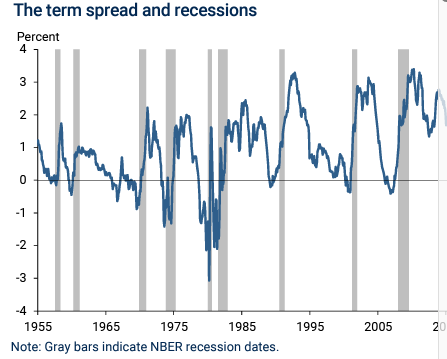
A negative number indicates the 1-year Treasury rate
is greater than the 10-year. (SF Federal Reserve)
The weekend hiatus provides time for cooler heads to prevail. According to the Journal article, SVB's problems seem to stem from lending long and borrowing short. That strategy produces regular profits, except for the infrequent occasions when the short rate exceeds the long. Duke University finance professor Campbell Harvey:
"If you lock your money up for a longer period of time, you almost always get a higher interest rate..."However, today, things are backwards - 10-year interest rates are far below short-term rates. This is known as an 'inverted yield curve.' In the past 50 years, we have seen seven inverted interest rate curves. Each one was followed by a recession."
Silicon Valley Bank bet that normal would continue. That bet proved disastrous when it kept having to refinance deposits and other short-term borrowings as rates climbed rapidly higher. Major banks are required to "stress test" for just such an eventuality; let's hope they didn't cut corners.

Monday, October 03, 2022

Scratching for Yield

This happens every time interest rates rise; it's just that the increases have been so sharp that the effect is noticeable to everyone, not just Wall Street and corporate treasurers.

Interest Rates Are Rising Everywhere—Except Your Savings Account [bold added]
The interest on my $45,900 money market fund rose
from .16% to .25% between August and September.
Sheer laziness was the reason I didn't do better.
Mortgage rates doubled this year to nearly 7%, and it has become more expensive to get a car loan or carry a credit-card balance. Yet the interest on savings accounts barely budged. In March 2020, the average annual yield on a standard savings account was 0.1%, according to Bankrate.com. It fell to a pandemic low of 0.06% after Americans’ personal saving rate peaked, and is now up to a wan 0.14%.

...[banks] still paying out meager interest can count on customer inertia: We fail to take advantage of better deals, because switching banks seems like a headache.
One reason savers haven't shopped around is inertia; another is the "headache" of switching. A third reason, IMHO, is that we've gotten used to making $thousands on the stock market, and scratching around for $hundreds in interest doesn't seem to be worth the trouble.

The great reset isn't just about re-evaluating priorities; it's about recognizing how hard it is to make a buck, working hard for it, and shopping around, both to lower household expenses and to raise the interest on one's savings.

By the way, I have not yet seized the opportunity to invest in the almost too-good-to-be-true yield (9.62%) on I-bonds. There is a $10,000 limit on an I-bond account, so under the old perspective it wasn't worth the trouble. Now that I'm scratching for yield, it is.

Friday, January 28, 2022

One Marketing Survey That Was Worth a Look

I walked to the local Citibank branch a block away and conducted a straightforward deposit transaction with the teller. Citi promptly sent an email survey (right).

First take: another marketing survey for the benefit of a large corporation. Delete.

Second take: hasn't everyone--and the banks especially--told us never to click on e-mail links or open attachments? The risk of identify theft and crooks trying to steal our money is very high. Press doubly hard on Delete.

Third take: hold on a second. That small neighborhood branch has been there for over 40 years. We opened an account with Glendale Federal, which was acquired by Cal Fed, then Citi. The big banks are always looking for ways to cut costs, and I definitely want to keep that branch open.

After carefully screening where the email came from and examining the marketing feedback site (that didn't ask for personal information), I answered the questions, giving the teller mostly 10's and a few 9's just to imply that I thought about the questions. I also typed in a comment about how friendly, efficient, and accurate she was.

Emails from "financial institutions" are risky because of the probability of fraud; this is the rare one that was worth a look.

Tuesday, January 18, 2022

The Financial World is Passing Me By

Everyone used to know how to write a "check"
Trying to sign up for a business-related insurance policy, I sent the following e-mail to the broker:
Kelly, may I just mail a check for $700 to you? I will make it payable to _____ Insurance Agency unless you instruct otherwise. Thanks.
Her answer:
Actually, I need to post an electronic payment to the policy to issue it. So a check would not work, and I cannot cash that to my agency because it needs to be applied directly to [Insurance Co. Name].

If you'd like to run it through your bank acct we can take the electronic check over the phone (routing/acct) and process that today to activate the policy.

Thank you!
I should have seen this coming when a young fellow wanted to pay via PayPal 20 years ago. My quizzical look undoubtedly amused him.

Dinosaurs didn't have the self-awareness to know that they were going extinct.

Wednesday, November 24, 2021

Just in Time

The recent upward blip in interest rates resulted in Citibank adding 8 cents, more than double the usual, to my largely inactive savings account.

It was just in time for Christmas shopping.

As the saying goes, I'll try not to spend it all in one place.

Friday, May 07, 2021

No Interest in CD's

Twelve years ago we bought bank Certificates of Deposit, which at the time provided a yield that exceeded inflation. CD's are safe because they're backed by FDIC insurance under the same terms as regular bank accounts.

We decided to "ladder" CD's. Laddering is a strategy that trades some flexibility for higher yield.

$40,000 was split into four $10,000 accounts:
2Y matures May 2011 2.90%
3Y matures May 2012 3.35%
4Y matures May 2013 3.75%
5Y matures May 2014 3.95%
CD#1: we rolled over the CD every two years.

CD#2: in 2012 we reinvested the $10,000 plus interest for two years, then cashed out in 2014.

CD#3: we rolled over the CD every four years.

CD#4: we cashed out in 2014 at maturity.

Note: "rolling over" the CD means investing the principal and accumulated interest for the same term at a market rate. The 2-year CD, for example, was reinvested for another two years at the bank's new two-year rate. Both CD#1 (2Y) and CD#3 (4Y) mature this month.

I called First Republic Bank , a reputable bank that has serviced us well, for a quote this week on our two remaining CD's. The customer service representative said that the rates were 0.40% and 0.45% for two and four years, respectively. Since the consensus inflation rate for 2021 and beyond is 2% or higher, it took only a second to decide that the funds be returned to us when the CD's mature.

The Compound Annual returns actually received on each CD are shown below. The returns show that reinvestment rates have always dropped below the original 2009 interest rates.


Note: one "convenience" of CD's is that the bank makes it easy to roll them over. The notice of maturity states that if the bank doesn't hear from us it will automatically renew the CD. So I didn't bother to talk to them after 2014.

In 2018 I received a notification that my account was "dormant" and subject to seizure by the State.


One would think that the posting of interest income would count as "activity." Moreover, the State of California could cross-reference the interest to our tax returns and see that we were, you know, alive. But I don't trust them to take the effort.

It goes to show that you can't go to sleep on even the safest investments

Wednesday, October 28, 2020

The Eviction Tidal Wave is Coming

Sign in LA (marketplace.org)
Last month we wrote about the extension of eviction moratoriums to 2021:
There is a next-to-zero chance of collecting the unpaid rent once a tenant moves out, so basically the State will have taken tens of $thousands per rental unit from property owners in order to effect public policy.

Many owners cannot afford to go without rent for a year. I know elderly landlords who rent out their homes to pay, partially, for their assisted living apartments, which cost $10,000 per month. I know another single-property owner who is taking her condo off the market.
Nationally, defaulting renters number in the millions and unpaid rent is in the $billions:
Moody’s Analytics estimates that [outstanding rent debt] could reach nearly $70 billion by year-end if there is no additional stimulus spending. The economic-research firm calculated that 12.8 million Americans would then owe an average of $5,400 from missed payments.
Small landlords have not been granted relief from property taxes, nor can they defer loan payments because their debt is categorized as commercial, not residential.

All the sympathy has been directed to the tenants who can't pay, but give a thought to the landlords whose properties are in effect being taken because of the State decreeing that legal agreements are not enforceable in one direction.

The eviction of millions, as well as repossessions of thousands of rental properties, will be upon us soon after November 3rd. Though many publications have written about it, looming evictions have not captured the imagination, and politicians have not been asked to come up with solutions.

That's too bad, because real estate experience could have been relevant in the election, and it's a mystery why the media didn't mention it more.

Thursday, October 15, 2020

COVID-19 Blew Up the Business Model

Nice house in San Jose. Hope they work it
out with the owner (Chron photo).
It was a great pre-coronavirus housing concept.

With San Francisco and prime Silicon Valley studios costing close to $3,000 per month, four unrelated individuals could be eager to house-share by paying $1,750 ($7,000 total rent) for a four-bedroom house. The middleman would lease the home from an owner-landlord for $5,000-$6,000 and would manage the hassle of credit and collections from four different renters. The intermediary would find a replacement if a tenant moved out--not too difficult in a hot job-and-housing market.

COVID-19 blew up the co-living business model. People lost their jobs and left the area. Many who kept their jobs didn't want to live with non-family members.

With the lockdowns dragging on for over six months the following headline was inevitable:

Bay Area co-living startup HubHaus implodes, stranding renters and homeowners
HubHaus, a venture-backed startup in the burgeoning new field of “dorms for grownups,” has imploded, stranding hundreds of renters and homeowners, mainly in the Bay Area.

The 4-year-old Los Altos company, which had raised $13.4 million, is undergoing “a closure and liquidation process, commencing Sept. 23, 2020,” it wrote in emails to homeowners and tenants. It’s laid off all employees, the letter said, blaming the coronavirus pandemic’s severe impact on housing. Several renters and landlords provided copies of the emails to The Chronicle.

“The company is unable to pay October rent,” the emails said, suggesting that landlords use security deposits to cover it. The emails said that tenants’ leases were being transferred to the homeowners.
When landlords go bankrupt, tenants who have paid rent are left high and dry when the bank takes over the property. When the middleman goes bankrupt, both the renters and landlords take a financial hit.

Nevertheless, there are the makings of an acceptable arrangement because the subleases "have been transferred to the homeowners." If the parties can direct their anger at HubHaus, they have a good chance of working out a deal with each other.