Showing posts with label Marin County. Show all posts

Monday, March 31, 2025

"Potato Chips for Our Dogs"

(Dickson/Chronicle photo)
Bolinas Beach was covered with jellyfish-like velella velella yesterday:
Velella velella are most commonly found on Northern California beaches in spring or early summer, according to scientists at Point Reyes National Seashore. The oval-shaped creatures are related to jellyfish and are typically bluish in color, measuring up to 4 inches long.

“When the prevailing winds shift, such as during a storm, the Velella are driven towards the coast, where they often are stranded on beaches in great numbers,” according to the national seashore’s website. “As the Velella dries out on the beach, it becomes brittle and transparent, looking like a cellophane candy wrapper.”

One velella velella, aka "by-the-wind sailor" due to its
functional sail on top (Bedolfe/One World One Ocean)
As a Southern California native, [retired professor Del] Dickson said he was familiar with Velella velella but had never seen them in such abundance. He said his German shepherd and Cairn terrier excitedly snacked on the sea creatures, which have a small disc of cartilage surrounded by a translucent sail-like structure.

“We call them potato chips for our dogs,” he said.
The sail is not manipulable, so the by-the-wind sailor, as the name indicates, goes where the wind takes it, even if it means to its doom.

Your humble blogger found velella velella to be interesting, but what piqued his interest was its name. How many other creatures have such repetitive names? Grok said these are tautonyms:
Living things with repetitive names, like *Velella velella*, are relatively rare but not unheard of in scientific nomenclature. These names, where the genus and species are identical, are called tautonyms. Tautonyms are allowed in zoology under the International Code of Zoological Nomenclature (ICZN), but they are prohibited in botany under the International Code of Nomenclature for algae, fungi, and plants (ICN). This means that repetitive names can only occur in animals, not plants, fungi, or algae.

Some well-known examples of tautonyms in the animal kingdom include:
  • *Gorilla gorilla* (Western gorilla)
  • *Rattus rattus* (Black rat)
  • *Bison bison* (American bison)
  • *Gulo gulo* (Wolverine)
  • *Meles meles* (European badger)
  • *Velella velella* (By-the-wind sailor)

    Determining an exact number of living things with tautonyms is challenging because no comprehensive, up-to-date global list specifically tracks this across all animal species. Taxonomy is a dynamic field, with species being discovered, reclassified, or synonymized regularly. However, we can estimate based on known patterns and examples.

    Zoologists estimate that there are around 1.5 to 2 million named animal species as of recent years (with millions more potentially undiscovered). Tautonyms are a small subset of these names, often arising when a species is the most representative or only known member of its genus at the time of naming. Based on anecdotal evidence and lists compiled by taxonomists, there are likely a few hundred tautonyms in zoology. For instance, a casual survey of mammals, birds, reptiles, and invertebrates yields dozens of examples (e.g., *Canis canis* for a wolf species, *Iguana iguana* for the green iguana, *Bufo bufo* for the common toad), but this is far from exhaustive.

    Given that *Velella velella* is a hydrozoan (a type of cnidarian), and considering the diversity of marine invertebrates, it’s plausible that many tautonyms exist among lesser-known groups like jellyfish, worms, or mollusks. However, without a centralized database specifically for tautonyms, a precise count remains elusive. A reasonable estimate, based on expert discussions and taxonomic trends, suggests there could be 200 to 500 tautonyms among living animal species today.
  • Wednesday, March 26, 2025

    They Chose Their Target Poorly

    Nike Ajax, Hercules, and Zeus missiles
    Before there were Nike Shoes, there was the Nike missile defense system:
    Nike missile [was] any of a series of U.S. surface-to-air missiles designed from the 1940s through the 1960s for defense against attack by high-flying jet bombers or ballistic-missile reentry vehicles...

    Hercules missile sites in the United States were deactivated starting in 1974, after the signing of the Anti-Ballistic Missile [ABM] Treaty with the U.S.S.R. Hercules missiles in Europe were replaced in the 1980s by the more mobile and accurate Patriot system. In Asia, Nike Hercules batteries in Taiwan were active into the 1990s, and South Korea continued to maintain active sites past the turn of the 21st century.
    Given that U.S.-based Nike missiles have been deactivated for fifty years, it's unlikely that this vandalism is politically motivated:[bold added]
    The National Park Service is seeking the public’s help after extensive vandalism was discovered at the historic SF-88 Nike Missile Site in the Marin Headlands.

    The incident occurred between the evening of March 15 and the morning of March 19, when someone broke into the site’s magazine, spray-painted hate speech on the walls and spilled hazardous chemicals inside, according to a bulletin released by the Park Service Wednesday.

    The vandals “may have sustained chemical burns and may have needed medical attention,” the bulletin noted.
    The crime of run-of-the-mill vandalism doesn't match the severity of chemical burns but your humble blogger admits that he doesn't feel very sorry for the perpetrators.

    Nike missile display in the Marin Headlands (National Park Service)

    Friday, July 07, 2023

    The Limits of a Golden Goose

    (Chronicle photo)
    I first drove across the Golden Gate Bridge in 1974. The 75¢ toll seems paltry now, but it was pricey enough to this starving student who thought 50¢ for the Oakland Bay Bridge was already steep.

    For the next half-century the Golden Gate Bridge District ratcheted up the tolls to fund its deficits. Higher revenue always resulted, because the number of crossings never decreased until the COVID lockdown. The problem for the District is that traffic has not recovered to 2019 levels. [bold added]
    The Golden Gate Bridge saw roughly 85% of pre-pandemic traffic levels crossing its toll plazas as of the end of May, according to agency data...

    To stay financially afloat, the Golden Gate district has slashed bus and ferry service, gradually restoring trips as ridership demand inches upward. The district also raised fares by a quarter, as well as bridge tolls, which now cost many drivers $9.75. The district has also leaned on employee attrition to prolong reaching its fiscal cliff.

    “What we’re doing right now is controlling our expenses to make our one-time federal COVID relief money last as long as possible,” Mulligan said. “We’d be running out of money, probably in the next couple of months, if we didn’t scale service.
    With more Marinites working from home and the exodus of businesses and people from the Bay Area the decline in bridge traffic appears to be permanent. It took them 86 years and a $9.75 toll, but the Golden Gate Bridge District has finally found the limits of its golden goose.

    Saturday, March 25, 2023

    Buckling Road

    We're used to seeing roads rendered impassable by mudslides or sinkholes, but this is the first time your humble blogger has seen mudslides buckle the road like an earthquake:
    A mudslide triggered by storms that rocked the Bay Area this week caused some extreme warping and buckling to a road in Novato, officials said.

    The slip caused "significant erosion" on the hillside and uncovered a PG&E gas line and possibly created pressure on the North Marin Water District aqueduct that runs from Sonoma County to Marin, the county said in a statement Thursday.
    Over the past decade we've learned that we are far from safe from Mother Nature, which is full of dangerous surprises.

    Thursday, February 16, 2023

    Marin County Leads the Way

    (Tripadvisor photo)
    Marin County became (in)famous as the land of hot tubs and peacock feathers in the 1978 NBC documentary, I Want It All Now. In the eyes of many in the national TV audience that documentary confirmed Marin County as the home of wealthy, non-traditional sybarites.

    That stereotype only applied to a small number of residents, and Marin County in any event continued to be one of the Bay Area's most desirable places to live during the next four decades. That is, until last year.
    from July 2021 to 2022, Marin lost more of its population than any other county in the Bay Area over the same time period, according to estimates recently released by the California Department of Finance. The county’s population dwindled by about 6,600 people — a loss of 15 residents for every 1,000 people that lived there in 2021...

    (Chronicle graph)
    One reason why Marin County lost population, experts said, is that its residents haven’t had a lot of kids lately — nor are they likely to.

    The county’s median age of 46.9 years is the highest of any Bay Area county, and more than nine years higher than the state overall...

    All of these factors — older population, low number of jobs relative to nearby counties and high rate of move-outs — are connected to Marin’s lack of housing, [Public Policy Institute's Hans] Johnson said.

    Marin built just 5,862 homes from 2010 to 2021, or 32 units per 1,000 residents as of its 2010 population. That number is by far the smallest of any Bay Area county.
    When I Want It All Now was shown in 1978, California was much more diverse, culturally and politically. It was the home state of conservative governor Ronald Reagan, who would be elected President two years later, and Richard Nixon, who served as President from 1968 to 1974. Marin County was at the left end of the country's political spectrum, and Orange County was on the right. California could accommodate everyone.

    In retrospect Marin values won. The county was at the vanguard of the Progressive takeover of California, and today not a single Republican holds a California State office; the last elected Republican U.S. Senator was Pete Wilson (1988).

    In 2023 Marin may be leading California again, this time on a different path.
    while Marin may be an extreme instance of the Bay Area-wide trend in population loss, it’s still an example, rather than an outlier. California, after all, lost nearly 500,000 people in just two years, from mid-2020 to mid-2022
    Demographic trends, especially regarding birth and death rates, are difficult to reverse. Marin, the Bay Area, and California haven't hit bottom yet.

    Wednesday, December 07, 2022

    A Premium Business That Didn't Tend to the Basics

    2013: the $85 Meat Board
    Top to bottom: Broccolini fried in lard, pork chops,
    rib-eye steak, lamb chops, goat, tri-tip, Italian sausage
    During our infrequent trips through the North Bay we liked to stop at the Belcampo Meat Company in Larkspur. In 2013 the quality of the food and excellence of the staff seemed to justify the premium prices:
    The Belcampo Meat Company is "a farm, a processing plant, a butcher shop, and a restaurant [that manages] the entire production chain to bring you delicious, safe, healthy, organic, and humane meat"...

    The chops and roasts were prepared skillfully. The beef centers were medium rare, while the other meats were cooked thoroughly without being dry. None of the cuts had thick marbling, but all were tender. Aging and light seasoning brought out complex flavors; a glass of house pinot complemented the dishes perfectly.
    Our last visit was in 2018. The prices were higher, and the food wasn't quite as good as we remembered. (Experiences often do become exaggerated with the passage of time.) Maybe the decline wasn't a trick of memory, because the fall accelerated:
    Belcampo, whose slogan was “meat you can trust — transparency from start to finish,” had been passing off lower quality meats as its own. Within six months of the controversy, Belcampo shut down in October 2021. Little public attention was paid to the Siskiyou County plant, where all of Belcampo’s popular products, from sausage to steaks, were processed...

    The USDA released 81 pages of documents dating from January 2020 to November 2021, which paint a limited yet concerning picture of Belcampo’s plant: the discovery of a leaking, blood-covered box with “discolored” meat inside; mold growing on pallets; pork product giving off a “foul smell.”
    Belcampo opened a restaurant in San Mateo three miles away in late 2019. It closed during the pandemic, and we never did get to try it. Initially disappointed, we turned out to be lucky.

    Saturday, June 05, 2021

    Oyster Farming: Turning the Corner

    In 2013, despite the entreaties of California Senators Feinstein and Boxer, the Obama Administration shut down the oyster farm in Drakes Bay (store pictured on right).

    The oyster farm had been operating safely since the mid-20th century, but the Interior Department declined to grant a lease renewal.

    One might well have thought that environmentalists would have wanted to showcase Drakes Bay Oyster Farm as an example of a "sustainable" enterprise that protects the environment while benefiting consumers, workers, and owners.

    But the mask slipped. IMHO, progressives use kind words if they do not hold the dominant hand. When they were in a position to dictate Obama environmental policies, compromise fell by the wayside.

    Perhaps they realized that overriding their political allies in Northern California was an over-reach, however, because there have been no signs that the oyster farms in Tomales Bay are on the chopping block.

    2013: The Hog Island picnic area.
    To shore up oyster farming the Marin Agricultural Land Trust granted a long-term easement to the Hog Island Oyster Company. Hog Island will use the easement for its land-based activities such as oyster holding tanks:
    It’s the first easement involving aquaculture in the history of the land trust, which was established in 1980 and has set aside more than 54,000 acres of Marin County farmland from development...

    The MALT easement designates 8 acres for mariculture, or shellfish farming activities, and leaves some acres alone because they are in riparian areas.
    The Marin Agricultural Land Trust is a non-profit trust that
    has protected more than 54,000 acres of Marin farmland, forever. MALT’s model of using conservation easements to prevent development has been replicated to save family farms all over the country.
    MALT is opposed both to developers and environmentalists that seek to convert farmland to another purpose (or no purpose at all).

    Plaudits to MALT for its support of Hog Island Oyster Co.; if that business is not environmentally acceptable, then no business is.

    Monday, July 29, 2019

    Bay Area Real Estate: Rich Getting Richer

    (Per Chronicle)
    There are clear signs that the Bay Area housing market has peaked.  While median prices have declined in only a few counties, increases were in the low single-digits.

    The number of units sold has fallen by 11-13%, indicating that deal prices would have actually declined if owners were motivated to sell.

    The low-end of the market has slowed, but the high-end is still going strong (hence the distinction between the median and average prices). [bold added]
    while Bay Area home sales were about 5% lower than last year’s second quarter, sales of homes above $3 million surged, bringing them in line with last year’s historical peak.

    Peninsula Realtor Ken DeLeon noted that foreign buyers, especially from China, are still active in the $10 million-and-up range. However, their purchases of homes in the $2 million to $4 million range “has tapered off, almost to zero,” The imposition of more stringent capital controls has made it hard for most people to get money out of China, unless you’re “uber wealthy,” DeLeon said. Most Chinese buyers purchasing high-priced homes in the Bay Area are doing it through their companies, he added.
    In related news about the high-end, the median home price in Atherton has risen to $8.1 million, nearly double the tony towns of Hillsborough and Los Altos Hills.

    A business colleague bought a house in Atherton in 1975 on a junior executive's pay (about $50,000). He was fond of telling me (bragging?) at the time that he was making more on price appreciation than from his salary.

    Here's hoping that John held on (or traded up!).

    Monday, January 08, 2018

    Saturday, September 09, 2017

    Bourgeois, C'est Moi

    I chewed very slowly
    A few specifics on that overpriced dinner last Saturday: your humble blogger ordered a 100-day Dry-Aged Burger for $28(!) because at that price it had to be pretty special, right?

    While both the texture and the flavor were excellent, I've tasted similar excellence in burgers a third that price. Well, the problem could be me---I'm also unable to tell the difference between $15 and $50 cabernets.

    There's a certain je ne sais quoi about not only affording to live in Marin County but also genuinely preferring what Marinites consume (eco-friendly, sustainable, exclusive, expensive). I cannot escape the truth: bourgeois, c'est moi.

    Monday, September 04, 2017

    Cooler Brows, Lighter Wallets

    The home AC is on the blink, and we were desperate to escape the 100-degree temperatures. On Saturday we rode in our comparatively efficient air-conditioned car to the Graton Casino in Rohnert Park, 50 miles north of San Francisco.The drive took two hours due to the holiday traffic, but no matter, we were comfortable.

    Stepping out of the car, we were hit with a blast of heat and hurried into the casino.

    Pushing on the pleasure machines
    Five hours later, I was down $100, not a bad result when a casino with a regional monopoly pays off blackjacks at 6-5 instead of the standard 3-2.

    One overpriced dinner in Larkspur, a much less congested trip south over the Golden Gate, and we were home by 9 p.m.

    Tuesday, July 11, 2017

    Because They Can

    When a business struggles, it has to find a way to keep up with the competition--for example, retail stores vs. Amazon---else it fails. When a monopolist struggles--for example, electric utilities vs. homeowners' solar panels--it makes some effort to change, then petitions for rate increases that are usually granted. When a government monopolist struggles, it always raises rates.

    Four years ago the Golden Gate Bridge District, which at $6 charged the highest toll in the Bay Area, eliminated human toll takers under the guise of cost reduction. We griped:
    I'm all for government operating more efficiently, even if that means some jobs will be lost. In this case, however, efficiency means a significantly degraded service, a service which everyone must use because there are no feasible alternatives. Drivers who don't wish to open an account, prepay a toll, or mail in a check have no choice. It's the bureaucrats' bridge, not ours.
    We threw in the towel and obtained a FasTrak reader though we cross a toll bridge about once a month. (There's a surcharge if the District takes a picture of your license plate and bills you; there's also a chance you could be caught in red-tape hell.) We keep a $25-$50 credit on FasTrak, which means the authorities have a permanent, interest-free loan from us and hundreds of thousands of drivers.

    Of course, none of these actions stopped toll increases: [bold added]
    Starting Monday [July 3, 2017], the majority of bridge traffic — two-axle cars — will be charged the increased rate to cross one of the world’s most famous bridges, according to the Golden Gate Bridge, Highway and Transportation District.

    A discount will remain on FasTrak electronic passes as an incentive for Bay Area motorists to use them. Under the new rates, FasTrak users will pay $6.75 per crossing.

    For those without FasTrak, the bridge’s automatic license plate scanner — which snaps a photo of license plates and mails an invoice, even to out-of-state motorists — will go from $7.50 to $7.75. The toll gates are cashless. The toll hikes were initially approved in February 2014 by the bridge agency’s directors, who said they needed the additional funding to recover from a budget deficit.

    Bridge overseers have enacted regular, similarly sized toll increases since then, with annual rate rises scheduled through 2018.
    They do it because they can.

    Friday, March 24, 2017

    Checking Out

    (Graphic from Paragon)
    The human animal is, of course, more complex than one-dimensional economic man. Nevertheless, economic motivations are powerful and often are the principal driving force for behavior. The high cost of housing is finally turning the tide on Bay Area population movement. [bold added]
    the number of people moving out has begun to catch up with the number moving in, new census data show.

    In fact, in some parts of the Bay Area — including Santa Clara, San Mateo and Marin counties — already more people are leaving than arriving, according to the estimates released Thursday, which cover the period from July 1, 2015, to June 30, 2016...

    “Job growth has slowed, and that leads to a lessening in demand to live in the Bay Area,” said Hans Johnson, a senior fellow at the Public Policy Institute of California who had not seen the new census figures. “But it’s not like we’re having outright job losses or increasing unemployment. That’s not happening.” [snip]

    “The key here is being able to afford to live in the Bay Area,” said Johnson. “Jobs and housing are really the primary criteria driving people’s decisions. It’s kind of a balancing act between the two. If jobs predominate, people are moving in. If housing predominates, you have less people moving in.”
    The Bay Area is not...yet...Hotel California, where "You can checkout any time you like, But you can never leave."

    Thursday, October 15, 2015

    Think We're Here to Serve YOU?

    For two years Juanita the duck was "a beloved mascot and friend to all at the Bello Gardens assisted-living home on Mariposa Avenue in San Anselmo."

    When she flew a short distance away, Juanita was turned in to the WildCare rescue center, where she has remained for 28 days.
    federal rules say stray ducks are wild animals until proved otherwise. The law, they [at WildCare] say, prohibits Juanita from being reunited with the two dozen bereaved, heartsick and moping senior citizens at Bello Gardens.

    [Juanita] is not going anywhere until the U.S. government makes up its mind whether she is a pet duck, a wild duck, a lost duck or simply a misunderstood duck.
    It's easy to see why bureaucrats are taking their time: once human happiness is allowed into consideration, what other rules will crumble? And having to answer awkward questions at annual performance reviews can be such a bother.

    From 8/20: Seven ducks in a box.
    [In retrospect we were fortunate that we didn't involve government or non-profit agencies in our own duck-rescue efforts.]

    Saturday, April 11, 2015

    Novato Errand

    The big-rig crash in the North Bay disrupted our plans somewhat, but we did manage to be on time for the appointment. The Novato veterinarian examined our adopted guinea pig, who turned out to be problem-free.

    The guinea-pig rescue lady was relieved to hear the report. She reconnected with her former charge by trimming her hair. The animal lovers in the group chatted amiably about all matters cavy for about an hour.

    Meanwhile, I silently gave thanks to Steve Jobs for inventing the iPhone.

    Monday, March 09, 2015

    Rescued from San Quentin

    The beach at San Quentin village 
    We visited the lady who runs a guinea-pig rescue service in San Quentin. She has a view overlooking the beach, where swimmers frolicked in San Francisco Bay.

    (The beauty of San Quentin village stands in sharp contrast to the infamous prison, home to the largest death row in the United States.)

    There were six potential companions for our female, who has been alone since December.

    Five GPs mingle on the upper deck
    A four-year-old long-hair named Pumpkin seemed suitable--they didn't fight after two hours together in close quarters.

    Pumpkin is now ensconced in her own cage in the guinea pig room; as a precaution against infection or incompatible behavior, we will keep them separate for a week. It's early, but the results are promising.

    Monday, December 16, 2013

    Muscio's Italian Restaurant, Novato

    Attendance in our church would go up if it had Monday
    night football on two flatscreens above the bar.
    Arriving in Novato, a city 25 miles north of San Francisco, after 8 p.m., we found few restaurants open on Monday night. Muscio's looked promising because of the number of cars parked outside.

    Upon entering, we looked up to see an unobstructed view of the roof. The restaurant occupied the original location of 123-year-old Our Lady of Loretto Catholic Church.

    The waitress brought us freshly-baked garlic bread, which was consumed in short order. A second basket was used to sop up the sauce from our pasta dishes, which were uniformly excellent. Everything was made on the premises, the waitress said. She invited us to return with three discount coupons, expiring January 31st. We'll be returning to the North Bay in a couple of weeks and will take her up on it. © 2013 Stephen Yuen

    Friday, August 23, 2013

    Tomales Bay

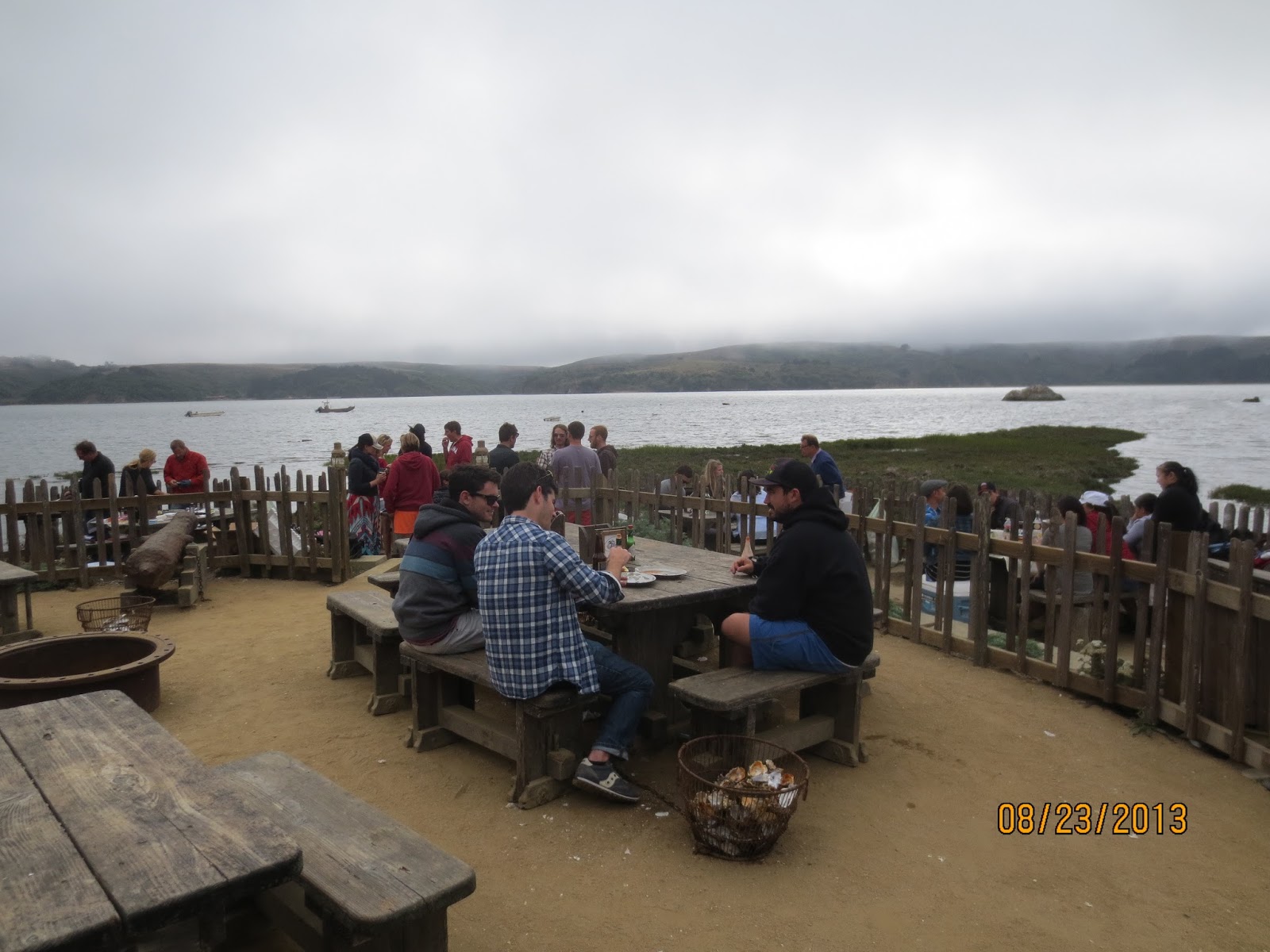
    The Hog Island picnic area.
    Inspired by our visit to the Drakes Bay Oyster Farm, we took a day trip to Tomales Bay, only a few miles from Drakes. We sampled oysters from the Hog Island Oyster Farm and the Tomales Bay Oyster Company. Being city folk, we preferred the former because one can buy the oysters already shucked for no-muss no-fuss picnicking by the bay. Though the two Tomales Bay ranches are technically competitors of their Drakes Bay counterpart, we saw many signs protesting its impending closing.

    Everyone suspects that the near-religious fervor to return the Bay and much of California to a state of nature will not be slaked by the closure of one operation, so the oyster farms are hanging together lest they hang separately.

    Here's hoping that we can accomplish both: let's keep the farms running, and let's keep the bay(s) beautiful.

    Tuesday, April 09, 2013

    The Mice Get Trampled

    The imminent closing of the Drakes Bay Oyster farm has attracted more national attention. Influential supporters and opponents are being marshaled on each side of the issue, and now there's an article in the NY Times.
    Under the [Republican energy] bill, the Energy Production and Project Delivery Act of 2013, permits for the nearly 2,000-mile Keystone XL pipeline would be expedited, the Arctic National Wildlife Refuge in Alaska would be opened for gas and oil development, more offshore drilling would be allowed – and the oyster farm’s operating permit would be extended for at least 10 years.
    Adding the 21-employee oyster farm, with $1.5 million in annual revenue, to the battles over the multi-billion dollar Keystone pipeline and Arctic drilling does the oyster farm no favors.

    Pro-environment politicians and activists who were willing to be flexible in the case of Drakes Bay may now be forced to oppose it because of the other, bigger matters at stake. In a battle of the pachyderms the mice get trampled. © 2013 Stephen Yuen

    Thursday, March 28, 2013

    Vegans, Avert Your Eyes

    Top to bottom: Broccolini fried in lard, pork chops,
    rib-eye steak, lamb chops, goat, tri-tip, Italian sausage
    The Belcampo Meat Company is "a farm, a processing plant, a butcher shop, and a restaurant [that manages] the entire production chain to bring you delicious, safe, healthy, organic, and humane meat."

    We visited the butcher shop in Larkspur and gawked at the prices--$10 to $20 a pound--of the various meats on display. Raising animals without the use of hormones and enriched feed is apparently a costly undertaking.

    After getting over the sticker shock, we sat down to dinner at the adjacent restaurant and ordered the Meat Board for $85. In for a pound (or pounds), as the saying goes.

    The chops and roasts were prepared skillfully. The beef centers were medium rare, while the other meats were cooked thoroughly without being dry. None of the cuts had thick marbling, but all were tender. Aging and light seasoning brought out complex flavors; a glass of house pinot complemented the dishes perfectly.

    Our party of four had no trouble finishing the entire spread, which included bread and lard(!) in place of butter. When one is on vacation--even a stay-cation--calories and cholesterol don't count. © 2013 Stephen Yuen