 |
| Our under-the-sink filter |
The WSJ lists ten questions to test one's knowledge of microplastics. Your humble blogger guessed on all of them and only got the correct answer on three out of 10. I'd be disappointed, dear reader, if you don't do better.
|
| Our under-the-sink filter |
Microplastic particles are widespread in Monterey Bay anchovies and the diving seabirds that eat them as a main food source — which could possibly impact the birds’ reproductive systems, according to a new study.The troubling increase in cancer among young people causes us to ask what's different about us when we were kids in the 50's and 60's, and the leading factors seem to be excess sugar to less sunshine and exercise. The ubiquity of microplastics may be an answer, too.
Scientists at UC Santa Cruz, UC Davis and the San Diego Zoo Wildlife Alliance studied microplastic pollution in Monterey Bay by testing microplastic particles in the water and in anchovies and common murres, a bird species found in abundance in the region.
They found that 58% of anchovies and 100% of murres had microplastic particles in their digestive tracts, according to the study published Nov. 4 in the Environmental Pollution journal.
The study also comes two months after California became the first state in the United States to begin requiring water agencies to test for microplastics, which can be found everywhere from clothing, food packaging, drinking water and the ocean. Another recent study by Stanford University scientists found that whales are ingesting “colossal” amounts of microplastics that mainly come from the fish they feed on.
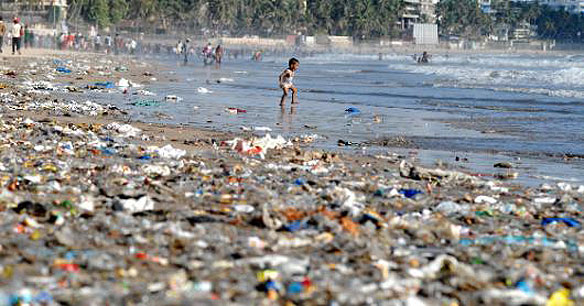 |
| 2012: Photo of an Indian beach (coastalcare.org) |
1) How harmful are environmental plastics to human and animal health?But scant scientific progress hasn't stopped California legislators from considering laws to stop microplastics from entering the oceans: [bold added]
2) What is the extent of the problem?
3) What is the cost of remedy?
California is set to become the first state, and maybe the first place in the world, to try to limit microplastics at sea...Banning plastic grocery bags in 2007 didn't work out, so let's redouble our efforts.
But there’s a problem with regulating this pollutant. Only so much is known about it — how it gets to the sea and to what extent it’s there. Also, standards for collecting and measuring microplastics are just emerging, and what level of the material may be safe to tolerate is still unclear.
“We can’t sit around and wait for the science,” said Mark Gold, executive director of the Ocean Protection Council, noting the scale of plastic pollution. “There’s a lot of things we can do in the interim.”
1) requiring MTBE to be added to gasoline for fuel efficiency, then finding out that it poisoned the water supply;When you live in a one-party State, lawmakers don't suffer the consequences of rushed legislation.
2) banning incandescent bulbs, thereby forcing the purchase of CFLs that poisoned people with mercury when they broke.

 |
| 2019 Coastal Cleanup (Chronicle photo) |
 |
| (Photo from ZeroHedge) |
in 2018, the program distributed 5.8 million syringes and collected 3.8 million, an improved collection rate of about 65 percent. There was a significant uptick in dropoff of needles at kiosks which increased to 241,080 in 2018, a more than 300 percent increase from the 59,000 in 2017.An unaccounted-for two million syringes with drug residue are an environmental disaster, whether they end up on the streets, on playground and parks, in landfill, or are swept into the Bay.
San Francisco Mayor London Breed said the city has a combined sewer system that “ensures that all debris that flow into storm drains are filtered out at the city’s wastewater treatment plants.” She called Trump’s remarks “ridiculous assertions.”The whole premise behind the ban on plastic straws was that the straws end up in the Pacific Ocean, hurting ocean wildlife.
“No debris flow out into the bay or the ocean,” Breed said.
But, of course, Trump overplayed his hand by falsely claiming drug needles on San Francisco streets are washing into the ocean. Rather than having to deal with a national focus on the city’s homelessness failures, local officials got to turn the story around as just another Trump lie. And they were right, of course. The needles don’t wash into the ocean.
They end up on sidewalks and in parks.
 |
| Water bottles at SFO: get 'em now (WSJ photo) |
First they came for our plastic grocery bags. Then they came for our plastic straws. Now they’ve come for our plastic water bottles at SFO. Yes, you read that right. Starting Tuesday, the sale of plastic water bottles will be banned at San Francisco International Airport, one of the few places they actually make sense. California has many dumb laws and statutes and bans, but this one is especially brainless—spurred by futile self-righteousness.Thanks to passing laws against things they don't like, Californians don't have guns being acquired by felons or the mentally ill, don't have human trafficking, and don't have people addicted to illegal painkillers. Despite its success, it's puzzling why the rest of the country doesn't want to be more like California.
After running late for your flight after a 30-minute security line only to have TSA confiscate your Fiji water bottle, you’ll now have to stop at a crowded water fountain to fill your own metal flask. Or buy an overpriced glass or aluminum bottle at the concession stand, paying another 10 cents for a bag. And your teeth will chatter if you drink through a paper straw. Of course you could risk dehydration instead: Men lose up to a half-gallon of water during a 10-hour flight. Oddly, you can still buy sugary drinks in plastic bottles at SFO; only healthy, calorie-free water is banned in plastic. You can’t make this stuff up.
Other fields are even worse. Starting next year, the California Building Standards Commission will require every new home to have solar panels. This will add $8,400 to the average cost of the state’s already expensive homes. With a shortage of about 1.4 million housing units, according to the California Housing Partnership, that’s a $12 billion unfunded mandate.
But maybe the housing shortage can be solved with yet another legislative “fix.” Last December state Sen. Scott Wiener introduced Senate Bill 50, which would allow developers to ignore certain local zoning laws within half a mile of train or subway stations and some bus stops. The bill would allow five-story buildings, high density and massive parking structures. Although the bill was tabled in May, many of its growing group of supporters argued it didn’t do enough to create incentives for affordable housing. That tells me another version of this bill will pass eventually. So here’s what may happen: Many towns will preserve local zoning pre-emptively by closing their train stations. Lose-lose situation.
So what? you might ask: Just take an Uber or Lyft. Not so fast. Also winding its way through Sacramento is Assembly Bill 5, which would reclassify “gig economy” workers as employees, entitled to full benefits and a $12 minimum wage. This means the cost of rides, deliveries and even manicures would go up, up, up. The bill is an overreach because most drivers truly are temporary workers. According to the delivery company Postmates, half of delivery workers quit after 80 days and about 45% work less than nine hours a week. Once again California legislators are trying for a trifecta: Fix a problem that may not exist, kill a very Californian innovation, and damage the employment prospects of the same workers they are trying to protect.
There’s more. Proposition 64, passed in 2016, allows Californians to grow six pot plants at home. Why not seven? And there is still no measurable legal limit for driving while stoned. When hungry, you can bring your dog to restaurants. Since 2015 no one can stop you. My son worked at a nice restaurant and was told that the only thing he was allowed to ask was “Can I do anything for your service dog?” Keep your poodles away from my noodles. Meanwhile, Starbucks is rolling out sippy lids, like toddlers’ sippy cups, to replace plastic straws. Iced coffee dribbled down your shirt can certainly be humiliating.
Progressive taxes with top marginal rates of more than 50%, plus San Francisco’s proposed tax on initial public offerings, will keep housing prices high—in Incline Village, Nev. California’s electricity prices are also progressive, increasing to more than 50 cents a kilowatt-hour after users exceed a meager baseline. Of course residents can offset this by picking up an electric car, which the state deems worth an almost 30% discount.
But don’t expect auto manufacturers to make out well. The California Air Resources Board didn’t like the Trump administration’s freeze on emissions standards at 2020 levels, so it waived the waiver, requiring the tougher rules and 54 miles per gallon. Ford, Honda, Volkswagen and BMW have already cut a deal with California to meet the higher standards, but with many loopholes. Auto makers like to manufacture one car for all states, so they comply with California laws, dumb or not.
In some places, the right laws are in place but no one cares. San Francisco, like Los Angeles, has a nasty homeless problem. Fed up, voters in 2010 passed a “sit-lie” ordinance that outlaws loitering between 7 a.m. and 11 p.m. “Outlaws” in this case mean perpetrators are supposed to get a ticket. But the police don’t bother with that anymore, so Karl Malden’s famed Streets of San Francisco are filled with needles and human feces, which the city spends $30 million a year to clean up—ineffectively. But heaven forbid you want to buy cold water in a disposable bottle at the airport.
 |
| Being green: I re-use them at home. |
 |
| (From imgflip) |
The world’s largest coffee chain posted adjusted earnings of 78 cents a share for its fiscal third quarter, a 26% increase compared with a year earlier. Analysts polled by FactSet had expected earnings of 72 cents a share, excluding certain items.FWIW, I think much of Starbucks' growth is due to collecting and analyzing data on its customers. The iPhone app knows my food and drink favorites, the stores I go to most frequently, and the promotions that I respond to. Starbucks also knows how often I do a grab-and-go and how long I linger when I use its WiFi.
Starbucks’s sales of $6.8 billion were up 8%, also beating expectations. Global same-store sales growth of 6% was the strongest in three years. U.S. same-store sales rose 7%. Cold beverages helped drive growth in the afternoon, the company said, a time when Starbucks has struggled to boost sales...
Starbucks also remains focused on expanding its business in China. Net store growth there was 16% during the quarter, bringing the chain’s total to more than 30,000 locations world-wide.
Data collected by Starbucks’s digital programs is helping the company better understand what beverages customers want, said Chief Operating Officer Roz Brewer. “We know a lot more about our customers now,” she said.I agree. I don't think the sippy cups are why the stock has a 30 PE.
 |
| SBUX has nearly doubled the past year. |
 |
| (Image from Henkel.com) |
If you live somewhere with clean, safe tap water, relying less on bottled water is a great place to start reducing your plastics exposure, [Univ. of Victoria Dr. Kieran] Cox says.When out and about, plastic bottles of water are convenient, cheap, and sanitary. At home, however, a tall glass of iced water from the tap is quite pleasurable, and for me fewer microplastics tip the balance.
Bottled water was such a big contributor of microplastics that the researchers did a separate analysis; when people drink their water only from bottled sources, they ingest about 90,000 microplastic particles every year from that water, but people who drink only tap water get 4,000 of such particles a year.
“It’s a 22-fold increase in plastic consumption from a single lifestyle choice,” Cox says. “With these kinds of issues, small choices can make a big impact for you personally and for plastic pollution.”
 |
| Costco Optical will never run out of pliers. |
For a lot of people, contact lenses are a daily necessity. Market research shows 45 million Americans, about one in eight, wear contacts, meaning the United States alone consumes somewhere between five and 14 billion lenses annually. And now, new research shows all those contact lenses may end up as micro-plastic pollution in our soil, rivers, and oceans.As I slouch into my dotage, one surprising development has been that many of my penurious ways (transportation, cooking, consuming) have turned out to be friendly to the environment.
An estimated 20 percent of contact-lens wearers, studied as part of a 400-person online survey, flush their lenses down the sink or toilet, as opposed to placing them in the trash as industry experts recommend. That amounts to 20 metric tons of plastic, or 20,000 kilograms (about 44,000 pounds), flushed per year—about the weight of a small airplane. The biggest culprit? Daily-use lenses, which occupy about 40 percent of the market.
the phthalate levels of those who dined out often were nearly 35 percent higher than those of people who reported eating food purchased at the grocery store, and fast-food restaurants are a particularly strong source of the chemicalPhthalates affect the endocrine system. Forbes:
scientific studies...have shown how phthalates may interfere with sex hormones and suggested links between consuming phthalates and a variety of health problems such as birth defects, infertility, cancers, childhood asthma, obesity, and autism.Phthalates are not a substance added to food but arise from contact with wrapping and other plastics.
phthalates are chemicals used in many plastic items to help them become more flexible. Therefore, phthalates may be leeching from all of these plastic items into the food that subsequently goes into your mouth.
 |
| Plastic-wrapped meats (kirwens) |
 |
| (Chronicle illustration by John Blanchard) |
The giant mass of floating plastic that has imperiled birds and wildlife between San Francisco and Hawaii contains 1.8 trillion pieces of trash covering an area nearly four times the size of California....Two years ago we commented how scientists weren't certain about how much this massive plastic garbage heap could affect human health. Furthermore, there was some evidence that sunlight and bacteria were degrading "micro-plastic" particles, making the pollution less permanent than had been believed.
A team of scientists from the Ocean Cleanup Foundation, based in the Netherlands, said the debris field, known as the Great Pacific Garbage Patch, covers about 618,000 square miles of deep ocean and weighs 80,000 metric tons.
Researchers said that will continue to grow exponentially unless drastic measures are taken to reduce the proliferation of plastic garbage and litter back on land, and to prevent it from flowing out storm drains into waterways that lead to the ocean.More and more of our store-bought food and goods are sealed in plastic. And we wrap our non-recyclable trash in plastic bags--easier to carry and less messy--and dispose of them in the proper receptacle. It's no surprise that plastic waste from California continues to pour into the Pacific.
The huge sprawl of junk is particularly vexing to environmentalists in San Francisco and other eco-friendly population centers in California, where much of the debris probably originated.

