Showing posts with label Internet. Show all posts

Monday, July 21, 2025

Not How They Wanted to Be Remembered


Last Wednesday two executives for the private AI/data services company Astronomer were spotted by the "kiss cam" at a Coldplay concert (see above video). President Andy Byron and Human Resources chief Kristin Cabot, who are married to other people, were caught in a friendly embrace and tried to conceal their identities too late.
Days after a video of Byron canoodling with the company’s HR chief nearly broke the internet, the company said Byron had resigned from his position. “Our leaders are expected to set the standard in both conduct and accountability, and recently, that standard was not met,” Astronomer said Saturday...

In an instant, the video became a lightning rod for the public’s conflicting views on wealth, power and simmering frustrations toward the executive class, said Jeffrey Sonnenfeld, a professor of management at Yale University. “There’s a certain schadenfreude associated with this,” he said. “Here’s a takedown of the ‘haves’ versus the ‘have nots.’”

The online furor erupted shortly after the camera at the Coldplay concert panned to Byron and Cabot. “Either they’re having an affair or they’re just very shy,” Coldplay frontman Chris Martin said from the stage, as Byron quickly ducked out of frame and Cabot covered her face and turned.
The viral popularity of the video taps into the state of the culture:
A relationship between senior executives can send a message that “the rules don’t apply to us,” said Deb Muller, chief executive of HR Acuity, a technology platform that helps companies track employee investigations and complaints. Employees, vendors, customers and investors may also question the integrity of leaders.

“You have to start using some judgment when you’re in senior-level positions,” Muller said.

It’s unclear what Astronomer’s policy is, but the company said Friday it had initiated a formal investigation into the matter.

Because of the risks associated with such clandestine relationships, corporate boards are less tolerant today of executive romances than they once were. McDonald’s in 2019 fired then-CEO Steve Easterbrook because of his consensual relationship with an employee. BP CEO Bernard Looney resigned in 2023 after the oil giant said he hadn’t been fully transparent about past personal relationships with colleagues. And last year, Norfolk Southern CEO Alan Shaw was fired after a board probe found that his relationship with the railroad giant’s chief legal officer violated company policies.

None of those incidents, though, sparked the glee and gloating that the video of the Astronomer CEO and his HR chief have generated.

The schadenfreude that comes with the public takedown of a CEO, said Yale’s Sonnenfeld, “is elevated even more right now.”
CEO Andy Byron has resigned his position, and as of this writing there's no update on HR chief Kristin Cabot. Financially both should land on their feet, but their children will undoubtedly be damaged. Meanwhile, the mockery continues.

Monday, July 14, 2025

Still Appreciated by Termites, Though

Your humble blogger went to school before mobile phones, before the Internet, even before there were personal computers (I received my MBA in 1975, one year before Apple was incorporated).

Mine was a generation that did all its research in libraries, and index cards were the pathway to getting information. Today most index card drawers are empty--if they haven't been tossed out--but at Yale they have been repurposed:
If you open one of the hundreds of card catalog drawers that line the south side of the Sterling Memorial Library nave, you won’t find any cards; online catalogs have rendered them obsolete.

But you might find a surprise. Over the past few years, students and other visitors to the library have created a tradition of leaving notes in the drawers to be found by others. Some are inspirational (“keep chasing your dreams, but don’t be afraid if the path to your dream changes”) and some are aspirational (“2016. In eight years, I’ll return as a Yale student”), and they are written in many languages. It’s a delightful adaptive reuse: hardware that was once used to organize the search for knowledge now holds the promise of serendipity.
Now if I can just find a use for my slide rule....

Saturday, May 17, 2025

Artificial Education

As a boomer, I am glad most of my life was spent before smartphones (the iPhone was introduced in 2007) or even the Internet. I learned how to write, solve problems without looking up the answer, and focus on tasks for hours without being distracted. Speaking of writing, here's another reason to be grateful that I received my education when I did, and yes, I would have been tempted to use artificial intelligence (AI) had it existed. [bold added]

(Illustration from Kent State U.)
There’s a Good Chance Your Kid Uses AI to Cheat
A high-school senior from New Jersey doesn’t want the world to know that she cheated her way through English, math and history classes last year.

Yet her experience, which the 17-year-old told The Wall Street Journal with her parent’s permission, shows how generative AI has rooted in America’s education system, allowing a generation of students to outsource their schoolwork to software with access to the world’s knowledge.

Educators see benefits to using artificial intelligence in the classroom. Yet teachers and parents are left on their own to figure out how to stop students from using the technology to short-circuit learning. Companies providing AI tools offer little help.

The New Jersey student told the Journal why she used AI for dozens of assignments last year: Work was boring or difficult. She wanted a better grade. A few times, she procrastinated and ran out of time to complete assignments.

The student turned to OpenAI’s ChatGPT and Google’s Gemini, to help spawn ideas and review concepts, which many teachers allow. More often, though, AI completed her work. Gemini solved math homework problems, she said, and aced a take-home test. ChatGPT did calculations for a science lab. It produced a tricky section of a history term paper, which she rewrote to avoid detection.

The student was caught only once.
We are now in the second stage of the AI arms race in education. Teachers are using software to detect the use of AI, and students are using AI to "humanize" their writing.
Students don’t want to be accused of cheating, so they’re using artificial intelligence to make sure their school essays sound human.

Teachers use AI-detection software to identify AI-generated work. Students, in turn, are pre-emptively running their original writing through the same tools, to see if anything might be flagged for sounding too robotic.
In the workplace of the near future, using artificial intelligence will be a necessary skill. It will also be important to have human workers who can think for themselves. I am very happy to be retired and will be neither a worker or supervisor in that environment.

Friday, August 16, 2024

It's Not the Same as Lying to a Real Person

(WSJ illustration)
Yes, I have lied, and continue to lie, to websites. Like most others, I do it for my own protection. [bold added]
When you sign up with a social network, e-tailer or other service, you often have to give your name, email or phone number, and birthday. Some sites ask for a street address and more personal or private items, such as gender or mother’s maiden name.

The demands can feel intrusive, and giving sites all that information means that hackers could get access to it. So, a lot of people just sidestep the issue: They lie. When websites ask for information, they make up names, birthdays, street addresses and anything else you can think of.

“It’s a common technique for individuals to use false or pseudonymous contact information and birthdays and other personal details,” says John Davisson, senior counsel and director of litigation at the nonprofit Electronic Privacy Information Center. “So that in the event of a breach, or in the event that the company you’re providing information to wants to use it in some way, like targeted advertising or to sell to a data broker, you’re protected because the information is not high-fidelity information and not going to be of use.”
I give restaurant and retail websites fake identifying data whenever possible because the information doesn't seem crucial to the business that I want to do with them. If they catch me and kick me off, well, I can live without their product or service.

At financial institutions I have to be truthful in order to access the accounts. Although they have much more security than websites in other industries, they're not impregnable; therefore I check the activity and balances once a month.

The virtual, online world has brought many conveniences that also carry new risks. Only give out the minimum information necessary; websites are not your friend.

Tuesday, August 29, 2023

Cheaper for a Reason

School Chromebooks awaiting repair in NYC (WSJ)
In 2020 I bought an Acer Chromebook for web-surfing at public WiFi spots. In 2022 I found that there was a good reason the 2½-year-old $175 Chromebook had been so cheap: updates were free only for five years from the date of manufacture:
Why did I get only 2½ years of software updates? Because when I bought it from Amazon in 2020 it had been sitting in inventory since 2018, according to the sticker on the back.
Now schools are learning my sad lesson on a much larger scale:
Low-price, easy-to-use Chromebooks were once a boon to cost-conscious schools. Educators say the simple laptops are no longer a good deal.

Models have shot up in price in the past four years. Constant repairs add to the cost. Google imposes expiration dates, even if the hardware still works. This year, Google ceases support for 13 models. Next year, 51 models will expire...

Chromebooks have no second life. When they expire, they become e-waste. By contrast, Macs and PCs can run apps even after their native software is no longer supported. They can even be repurposed into Chromebook-like devices.
Apple still provides free updates to my 2014 MacBook Air. Though it cost $1,000 at the time, the MacBook was a much better value.

Friday, February 10, 2023

Successfully Claiming the Middle Class Tax Refund

The California Middle Class Tax Refund (MCTR) card came three weeks ago. It was time to get the money.

From news reports scammers are able to drain the account after the card is activated, so I delayed that move until I was ready to use the card.

At the local Citibank branch this afternoon, I phoned the 1-800 number on the sticker and dutifully typed in the last six digits of my social security number. A computerized voice instructed me to create a 4-digit PIN, at which point it specified the card value.

The teller asked me to insert the Citibank ATM card, input its 4-digit PIN, then insert the MCTR Visa card and type its 4-digit PIN. I said that I wanted the entire amount transferred to my checking account. The teller said that the maximum daily amount was $600 (unclear if that was a card or Citibank limitation). He transferred that sum immediately and suggested that I come back tomorrow to claim the rest.

Fearful of waiting another day, I drove to the Bank of America branch to deposit the remaining funds. After I inserted the BoA ATM card and PIN, the teller inspected my driver's license, then processed the MCTR card. She took more time with the forms than the Citi teller. In the end all was well; the rest of the money was put into the checking account.

Comments:
1) Neither bank imposed a transaction fee.

2) The fund-draining scam clearly isn't occurring at the bank branches but at other venues, like online merchants, where Visa cards can be used.

3) Today the IRS finally ruled that the MCTR payments are not taxable by the Federal government (California declared them not to be taxable by the State last year).

4) I don't see why the Franchise Tax Board couldn't issue checks, like it did in the old days. Theft losses will still occur, but the crooks will have a much harder time.

Thursday, July 21, 2022

We Are Not the Demographic They Were Looking For

Beyond Menu is a website through which customers place take-out orders. The website and app are useful for smaller restaurants that don't wish or can't afford to build ordering-and-payment features into their own sites.

Your humble blogger is no marketing expert, but the logo "BM" next to pictures of delicious dishes to which he is lactose intolerant does not convey a positive impression.

(NIH: "In the United States, about 36 percent of people have lactose malabsorption.")

Additional note: the meaning I'm attributing to "BM" is only the fourth most popular definition, so perhaps it will recede even further as geezers pass from the scene.

Tuesday, May 24, 2022

E-Mails: a Curse and a Blessing

(Universal scribbler)
I entered the work force in an era when it was considered mandatory to respond to every phone call and letter request. The reasons were intuitively obvious: a response could lead to a sale, you're representing your company which has the highest standard of etiquette, treat others how you wish to be treated, etc.

Then telemarketing and email happened.

Re phone calls, I initially spent too much time on the phone listening to sales pitches. Worse, I fell for a few of them and was usually disappointed by paying too much for products that fell shy of promises. Now every call from a number that I don't recognize goes to voicemail, and even within that group I ignore nine out of ten messages, which are, no surprise, from telemarketers.

I receive over a hundred emails a day. The majority go to the aol account that was originated in the days of floppy disks and dial-up modems. The yahoo and google mailboxes were created for specific purposes and capture the remaining traffic. The only vestige of traditional etiquette is that I always open and answer emails from individuals whom I know and apologize to if their message goes unanswered because it got buried or was sent to the junk folder.

The sea of communications from people trying to reach others to serve their own purposes has become a modern burden:
So many of us spend our days ruled by email: constantly refreshing, wading through detritus, paralyzed by the pressure of crafting a reply to the one note that actually matters. The moment we reach inbox zero, and few of us ever do, the ding sounds again.
Consultant Greg McKeown's suggestion:
Start your day by writing a list of priorities on a piece of paper. Block two half-hour slots on your calendar to really deal with your email—rather than scrolling through constantly—and ignore it the rest of the time, he says.
Regardless of the tech tools at one's disposal, one must spend 30-60 minutes a day on email in order not to lose control of the inboxes. E-mail supposedly has improved our lives immensely, but it sure has us stressing while sucking up our time.

Monday, March 07, 2022

Different, and Not in a Good Way

2020: Acer Chromebook
Two years ago we bought an Acer Chromebook 14 to web-surf and email in public places. For $175 it appeared to be a good deal.

I didn't know that it had less than a 3-year effective life span. Chromebook software expires:
Once a Chrome OS device expires, the device might continue to function as expected, a Google spokesman said, but over time “there could be incompatibilities with some websites, applications or management policies with no ability to fix them.”

Earlier devices receive updates from Google for five years. Devices released in 2020 and later will be supported for up to 8½ years, depending on the model.
Why did I get only 2½ years of software updates? Because when I bought it from Amazon in 2020 it had been sitting in inventory since 2018, according to the sticker on the back.
The problem is that many Chromebooks stay on the market for years, so the lifespan can be much shorter when the buyer takes off the plastic wrap.
Rueful comments: 1) there was a reason the Chromebook was cheap; 2) having gotten used to Apple's free updates for the 8-year-old MacBook Air, and Microsoft's support of Windows XP for 12 years, I thought long-term support for tech products was a given.

This is another example of how Google is different, and not in a good way.

Monday, February 28, 2022

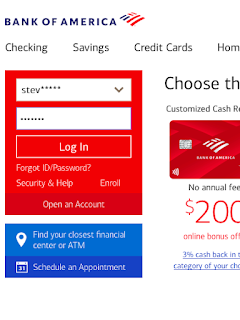
Bank of America: Not Optimal

Asterisks hide passwords from users, too
It's possible to have too much security on an internet bank account.

As many websites do, Bank of America's replaces password characters with asterisks (*) shortly after the characters are typed in. Because passwords now have numbers, special characters, and both lower-case and capital letters, the probability of a mistake has increased as passwords have become lengthier. But one can't see what has been typed.

Unlike all my other financial and shopping accounts, Bank of America does not have a "show" or "eye"(👁) button that allows the user to turn off the asterisks.

After 3 password failures, Bank of America locks the account. And yes, that has happened to me, and I had to call the bank and spend an hour satisfying the person at the other end that I was not a scammer. The bank had me at its mercy, because the fee structure almost forces retail customers to cancel paper statements in favor of electronic access, which makes it impossible to check or reconcile with a locked account.

I've also gotten to the third and final login attempt several times, when my aging arthritic hands shook with trepidation (okay, some poetic license here).

Bank of America does allow FaceID to login on the iPhone, but the user can do it on only one account--I was locked out of one of the other two which required a typed password.

All the above is a protracted preface to a simulation that showed
that five was actually the optimal number—the sweet spot we were hoping to identify. When allowing five attempts, the number of lockouts were minimized, with no adverse effect on security.
Bank of America would make me a happier customer if: 1) the Password field had a "show" option; 2) the account would lock after the fifth attempt, not the third; 3) iPhone FaceID would work on every account, not just one. I would like all of those changes, but I am not expecting any.

Come to think of it, why am I staying with them?

Thursday, April 01, 2021

Fake and Funny

Today is April Fool's Day, and the web is rife with hoaxes that are variations of fake pictures, videos, words, in fact any information that can be digitized. (Google's April Fool's "MentalPlex" antic is from the year 2000.)

Personally, I most admire practical jokes that were concocted before the Internet era, such as the famous Caltech pranks that included assembling a running Model T Ford in a dorm room, or the one where a student's door was plastered over so his room "disappeared."

The following isn't really an April Fool's joke because it originated a month ago and (almost) everyone knew it was fake from the beginning. WSJ: Stressed Over Getting Into College? Just Invent Your Own School
In the Reddit chatroom the women come and go
Talking of Michelangelo.
Southern Rhode Island Institute of the Arts is the most exclusive college you’ve never heard of. Why? It’s not real.

It is, however, perfectly suited to this high-anxiety moment for high-school students around the country waiting to find out if they have been accepted to college. The fake school’s founders channeled their college admissions stress into inventing a university of their own.
High school seniors from different parts of the country were commiserating over the stress of college admissions, and SRIIOTA was born. The website material grew spontaneously as more participants added to the joke.

Boomers shouldn't worry: the country is in good hands.

Sunday, January 17, 2021

The Truth, If We Are Allowed to Speak It, Will Set Us Free

Wittgenstein (Brittanica)
Having only taken a couple of 1970's-era Philosophy courses--they stopped with Wittgenstein (1889-1951)--I never read in college any of the post-modernist writers that have dominated the discourse in modern Philosophy departments.

Dabbling occasionally in the literature, I think I get the foundation of post-modernism, aka relativism: because we all are unique in terms of our genetic, family, religious, cultural, and even societal backgrounds and characteristics, there is no such thing as "objective" truth; even if there were, no one could know it because of our subjective biases. More generally, one culture is no better or worse than another.

One would think that the predominance of relativism would lead to greater tolerance in the academy--you do your thing, and I'll do mine because we don't know who's right--but instead we see intolerance of people who hold different views. There are now widespread efforts to banish them not only from small study and work groups but entire institutions.

Psychiatrist Norman Doidge, in his foreword to 12 Rules for Life, points out the inherent contradiction between the there-are-no-rules philosophy that was used to tear down the values upon which Western civilization was based, and the strict set of behavioral rules and beliefs that have arisen in its place.

It's a longish read for a blog post, but worth the time.
The hunger among many younger people for rules, or at least guidelines, is greater today for good reason. In the West at least, millennials are living through a unique historical situation. They are, I believe, the first generation to have been so thoroughly taught two seemingly contradictory ideas about morality, simultaneously—at their schools, colleges and universities, by many in my own generation. This contradiction has left them at times disoriented and uncertain, without guidance and, more tragically, deprived of riches they don’t even know exist.

The first idea or teaching is that morality is relative, at best a personal “value judgment.” Relative means that there is no absolute right or wrong in anything; instead, morality and the rules associated with it are just a matter of personal opinion or happenstance, “relative to” or “related to” a particular framework, such as one’s ethnicity, one’s upbringing, or the culture or historical moment one is born into. It’s nothing but an accident of birth.

According to this argument (now a creed), history teaches that religions, tribes, nations and ethnic groups tend to disagree about fundamental matters, and always have. Today, the postmodernist left makes the additional claim that one group’s morality is nothing but its attempt to exercise power over another group. So, the decent thing to do—once it becomes apparent how arbitrary your, and your society’s, “moral values” are—is to show tolerance for people who think differently, and who come from different (diverse) backgrounds. That emphasis on tolerance is so paramount that for many people one of the worst character flaws a person can have is to be “judgmental.”* And, since we don’t know right from wrong, or what is good, just about the most inappropriate thing an adult can do is give a young person advice about how to live.

And so a generation has been raised untutored in what was once called, aptly, “practical wisdom,” which guided previous generations. Millennials, often told they have received the finest education available anywhere, have actually suffered a form of serious intellectual and moral neglect. The relativists of my generation and Jordan’s, many of whom became their professors, chose to devalue thousands of years of human knowledge about how to acquire virtue, dismissing it as passé, “not relevant” or even “oppressive.” They were so successful at it that the very word “virtue” sounds out of date, and someone using it appears anachronistically moralistic and self-righteous.

The study of virtue is not quite the same as the study of morals (right and wrong, good and evil). Aristotle defined the virtues simply as the ways of behaving that are most conducive to happiness in life. Vice was defined as the ways of behaving least conducive to “happiness. He observed that the virtues always aim for balance and avoid the extremes of the vices. Aristotle studied the virtues and the vices in his Nicomachean Ethics. It was a book based on experience and observation, not conjecture, about the kind of happiness that was possible for human beings. Cultivating judgment about the difference between virtue and vice is the beginning of wisdom, something that can never be out of date.

By contrast, our modern relativism begins by asserting that making judgments about how to live is impossible, because there is no real good, and no true virtue (as these too are relative). Thus relativism’s closest approximation to “virtue” is “tolerance.” Only tolerance will provide social cohesion between different groups, and save us from harming each other. On Facebook and other forms of social media, therefore, you signal your so-called virtue, telling everyone how tolerant, open and compassionate you are, and wait for likes to accumulate. (Leave aside that telling people you’re virtuous isn’t a virtue, it’s self-promotion. Virtue signalling is not virtue. Virtue signalling is, quite possibly, our commonest vice.)

Intolerance of others’ views (no matter how ignorant or incoherent they may be) is not simply wrong; in a world where there is no right or wrong, it is worse: it is a sign you are embarrassingly unsophisticated or, possibly, dangerous. But it turns out that many people cannot tolerate the vacuum—the chaos—which is inherent in life, but made worse by this moral relativism; they cannot live without a moral compass, without an ideal at which to aim in their lives. (For relativists, ideals are values too, and like all values, they are merely “relative” and hardly worth sacrificing for.) So, right alongside relativism, we find the spread of nihilism and despair, and also the opposite of moral relativism: the blind certainty offered by ideologies that claim to have an answer for everything.

And so we arrive at the second teaching that millennials have been bombarded with. They sign up for a humanities course, to study the greatest books ever written. But they’re not assigned the books; instead they are given ideological attacks on them, based on some appalling simplification. Where the relativist is filled with uncertainty, the ideologue is the very opposite. He or she is hyper-judgmental and censorious, always knows what’s wrong about others, and what to do about it. Sometimes it seems the only people willing to give advice in a relativistic society are those with the least to offer.

Modern moral relativism has many sources. As we in the West learned more history, we understood that different epochs had different moral codes. As we travelled the seas and explored the globe, we learned of far-flung tribes on different continents whose different moral codes made sense relative to, or within the framework of, their societies. Science played a role, too, by attacking the religious view of the world, and thus undermining the religious grounds for ethics and rules. Materialist social science implied that we could divide the world into facts (which all could observe, and were objective and “real”) and values (which were subjective and personal). Then we could first agree on the facts, and, maybe, one day, develop a scientific code of ethics (which has yet to arrive). Moreover, by implying that values had a lesser reality than facts, science contributed in yet another way to moral relativism, for it treated “value” as secondary. (But the idea that we can easily separate facts and values was and remains naive; to some extent, one’s values determine what one will pay attention to, and what will count as a fact.)

The idea that different societies had different rules and morals was known to the ancient world too, and it is interesting to compare its response to this realization with the modern response (relativism, nihilism and ideology). When the ancient Greeks sailed to India and elsewhere, they too discovered that rules, morals and customs differed from place to place, and saw that the explanation for what was right and wrong was often rooted in some ancestral authority. The Greek response was not despair, but a new invention: philosophy.

Socrates, reacting to the uncertainty bred by awareness of these conflicting moral codes, decided that instead of becoming a nihilist, a relativist or an ideologue, he would devote his life to the search for wisdom that could reason about these differences, i.e., he helped invent philosophy. He spent his life asking perplexing, foundational questions, such as “What is virtue?” and “How can one live the good life?” and “What is justice?” and he looked at different approaches, asking which seemed most coherent and most in accord with human nature. These are the kinds of questions that I believe animate this book.

For the ancients, the discovery that different people have different ideas about how, practically, to live, did not paralyze them; it deepened their understanding of humanity and led to some of the most satisfying conversations human beings have ever had, about how life might be lived.

Likewise, Aristotle. Instead of despairing about these differences in moral codes, Aristotle argued that though specific rules, laws and customs differed from place to place, what does not differ is that in all places human beings, by their nature, have a proclivity to make rules, laws and customs. To put this in modern terms, it seems that all human beings are, by some kind of biological endowment, so ineradicably concerned with morality that we create a structure of laws and rules wherever we are. The idea that human life can be free of moral concerns is a fantasy.

We are rule generators. And given that we are moral animals, what must be the effect of our simplistic modern relativism upon us? It means we are hobbling ourselves by pretending to be something we are not. It is a mask, but a strange one, for it mostly deceives the one who wears it. Scccccratccch the most clever postmodern-relativist professor’s Mercedes with a key, and you will see how fast the mask of relativism (with its pretense that there can be neither right nor wrong) and the cloak of radical tolerance come off.
In case it's not clear, I don't like the atmosphere of fear that has been created. People are self-censoring out of concern that the mob will descend upon them next, and that they'll lose their jobs or worse.

The Internet, far from liberating humankind, has become an instrument of suppression.

Thursday, July 09, 2020

Location, Location, Location

In a study of 2,000 college students conducted before the lockdown, researchers found through GPS tracking that their subjects hung out at places that matched their personalities (extroverts at bars, introverts on home laptops, etc.), which wasn't a surprise. They also self-reported their feelings:
At each alert, they (and their phones) recorded their location, noting if they were at one of 12 commonly visited places, including a cafe, a friend’s place, the gym, their apartment, a class, a store, a religious environment, work or a party.

The students also answered five questions pertaining to their current state of mind, choosing among adjectives such as quiet, considerate, anxious, upset and lazy.
If they were in the "wrong" place for their personality type the subjects felt discordant emotions.
“People feel more extroverted, more agreeable, more conscientious, when they are in other places, compared to when they are at home,” [Stanford psychologist Gabriella Harari] said, while “people feel more disorganized and chaotic when they are at home.”
(Image from Aluance Digital)
The study confirms why an introvert like myself didn't find the past four months to be particularly troubling, while others in my household didn't fare very well.

Tele-office, tele-medicine, and tele-education aren't healthy for the majority of people, and we should open up everything as expeditiously as possible.

Yes, even for us introverts--get these people outta here because they're driving us crazy.

Wednesday, July 08, 2020

Another Karen Cancelled

As a Hawaiian-born Asian American, I never encountered overt racism until I went to the Mainland for college in the 1970's. (There was plenty of racial consciousness in the Islands; everyone was very aware of and often made disparaging comments about each other's race, culture, foods, hygiene, etc. In many ways the atmosphere was healthier then.)

At first it was surprising to be the target of epithets by people who didn't know me. It was hurtful and rare, but I always fell back on the old "sticks and stones" couplet. If you wanted to be a man like my Dad and his generation who went off to war, words were comparatively nothing and you moved on.

Mt. Tam website states that dogs aren't allowed on trails
Which brings me to a minor incident on the local news last night. A middle-aged white woman encountered a young Asian-American family on the hiking trail at Mount Tamalpais State Park. She reprimanded the family for taking their dog on the trail and uttered the phrase "you can't be in this country."

It was clear from the video that she was upset about the dog, but the father took umbrage about "you can't be in this country." The result was that the woman's face was shown on the news, she was identified as Beth Taska, a Human Resources executive, and she was fired by her employer.

Yes, Ms. Taska let out a seemingly racist remark (she claims it was misheard) and may not be in the right job. In her defense the racial identity of the family didn't seem to be what triggered the encounter. However, the father, Hiroshi, focused on the offending phrase and expanded it to mean "go back to your country." In the TV interview he talked about his resentment about being called "chink" and "gook." None of that history was Ms. Taska's fault.

Further thoughts:
1) We all have the tendency--me, too!--of attributing racial stereotypes to individuals who may not have them at all. Beth Taska may have done this to the family, but Hiroshi definitely did it to her.
2) But go easy on Hiroshi; she is the classic Karen.
3) This is an example of TV and the Internet inflaming a situation far beyond its significance to society.
4) Speaking for myself, I would never react to a personal insult if that reaction would get someone fired. Contra the saying, the words may indeed hurt, but that doesn't mean you have to pick up the sticks and stones.

Saturday, July 04, 2020

Too Useful to Get Rid Of

My Amazon shopping cart normally has 1-5 items.
Abandoned shopping carts are a burden to supermarkets that have to retrieve them. Abandoned carts are also a nuisance in the on-line world because they distort merchants' data on what products attract customers.

They also cause an administrative burden by triggering e-mail reminders to "customers"; if the messages bounce back, eventually the merchant has to intervene and delete the cart.

Which brings us to the mysterious shopper John Smith who has been abandoning carts across the Internet.
John Smith started shopping early on a recent Wednesday and didn’t stop for days.

(Image from iaffiliatemanagement)
He visited an auto-supply site where he loaded his cart with a replacement turn-signal lever, emergency strobe light and two dozen other items. He hopped over to a home-goods merchant for another 10 items including wood picture frames, address plaques, a towel rack and mailbox. He ordered one of every kind of baby bundle, ranging from about $80 to nearly $500, from a site that sells infant sleeping boxes popular in places such as Finland.

When the roughly 48-hour spree was over, John Smith did what he always does. He walked away without buying anything.

For more than a year, online merchants selling items ranging from kayaks to keychains have puzzled over the mystery shopper with the generic name behind thousands of abandoned carts.
In a triumph of investigative journalism the Wall Street Journal tracked down the serial looker. Merchants noted that John Smith always had a gmail address. Repeated telephone calls to Google unearthed the truth:
The mystery shopper is a bot of its own creation. The purpose: making sure the all-in price for the product, including tax and shipping, matches the listing on its Google Shopping platform or in advertisements. It wasn’t to cause angst to merchants due to thousands of abandoned carts.
Internet platforms and news sites have been flooded by bots that dispense fake news, sell products, and degrade debates. So why aren't they eliminated completely? Because the platforms find them useful, too.

Tuesday, April 28, 2020

Can't Stop Them, But You Can Laugh at Them

(Image from KNTV, Las Vegas)
Like everyone who's reading this, I've seen a lot of Internet scams over the years. This month I got my first "sextortion" email. The would-be blackmailer does have the password to a real account.

His threat is reprinted below verbatim, except for the substitution of "Password". I totally ignored the email and didn't suffer any of the promised consequences for a very good reason, explained below.
Subject: "Password"

𝙸 𝚍𝚘 𝚔𝚗𝚘𝚠, "Password", 𝚒𝚜 𝚢𝚘𝚞𝚛 𝚙𝚊𝚜𝚜 𝚠𝚘𝚛𝚍.

𝙸 𝚗𝚎𝚎𝚍 𝚢𝚘𝚞𝚛 𝚌𝚘𝚖𝚙𝚕𝚎𝚝𝚎 𝚊𝚝𝚝𝚎𝚗𝚝𝚒𝚘𝚗 𝚏𝚘𝚛 𝚝𝚑𝚎 𝚌𝚘𝚖𝚒𝚗𝚐 𝟸𝟺 𝚑𝚘𝚞𝚛𝚜, 𝚘𝚛 𝙸 𝚖𝚊𝚢 𝚖𝚊𝚔𝚎 𝚜𝚞𝚛𝚎 𝚢𝚘𝚞 𝚝𝚑𝚊𝚝 𝚢𝚘𝚞 𝚕𝚒𝚟𝚎 𝚘𝚞𝚝 𝚘𝚏 𝚎𝚖𝚋𝚊𝚛𝚛𝚊𝚜𝚜𝚖𝚎𝚗𝚝 𝚏𝚘𝚛 𝚝𝚑𝚎 𝚛𝚎𝚜𝚝 𝚘𝚏 𝚢𝚘𝚞𝚛 𝚎𝚡𝚒𝚜𝚝𝚎𝚗𝚌𝚎.

𝙷𝚎𝚕𝚕𝚘 𝚝𝚑𝚎𝚛𝚎, 𝚢𝚘𝚞 𝚍𝚘 𝚗𝚘𝚝 𝚔𝚗𝚘𝚠 𝚖𝚎 𝚙𝚎𝚛𝚜𝚘𝚗𝚊𝚕𝚕𝚢. 𝚈𝚎𝚝 𝙸 𝚔𝚗𝚘𝚠 𝚎𝚟𝚎𝚛𝚢 𝚝𝚑𝚒𝚗𝚐 𝚊𝚋𝚘𝚞𝚝 𝚢𝚘𝚞. 𝚈𝚘𝚞𝚛 𝚏𝚊𝚌𝚎𝚋𝚘𝚘𝚔 𝚌𝚘𝚗𝚝𝚊𝚌𝚝 𝚕𝚒𝚜𝚝, 𝚖𝚘𝚋𝚒𝚕𝚎 𝚙𝚑𝚘𝚗𝚎 𝚌𝚘𝚗𝚝𝚊𝚌𝚝𝚜 𝚊𝚕𝚘𝚗𝚐 𝚠𝚒𝚝𝚑 𝚊𝚕𝚕 𝚝𝚑𝚎 𝚟𝚒𝚛𝚝𝚞𝚊𝚕 𝚊𝚌𝚝𝚒𝚟𝚒𝚝𝚢 𝚒𝚗 𝚢𝚘𝚞𝚛 𝚌𝚘𝚖𝚙𝚞𝚝𝚎𝚛 𝚏𝚛𝚘𝚖 𝚙𝚊𝚜𝚝 𝟷𝟹𝟺 𝚍𝚊𝚢𝚜.

𝙸𝚗𝚌𝚕𝚞𝚍𝚒𝚗𝚐, 𝚢𝚘𝚞𝚛 𝚜𝚎𝚕𝚏 𝚙𝚕𝚎𝚊𝚜𝚞𝚛𝚎 𝚟𝚒𝚍𝚎𝚘 𝚌𝚕𝚒𝚙𝚜, 𝚠𝚑𝚒𝚌𝚑 𝚋𝚛𝚒𝚗𝚐𝚜 𝚖𝚎 𝚝𝚘 𝚝𝚑𝚎 𝚖𝚊𝚒𝚗 𝚛𝚎𝚊𝚜𝚘𝚗 𝚠𝚑𝚢 𝙸 '𝚖 𝚌𝚛𝚊𝚏𝚝𝚒𝚗𝚐 𝚝𝚑𝚒𝚜 𝚙𝚊𝚛𝚝𝚒𝚌𝚞𝚕𝚊𝚛 𝚖𝚊𝚒𝚕 𝚝𝚘 𝚢𝚘𝚞.

𝚆𝚎𝚕𝚕 𝚝𝚑𝚎 𝚕𝚊𝚜𝚝 𝚝𝚒𝚖𝚎 𝚢𝚘𝚞 𝚠𝚎𝚗𝚝 𝚝𝚘 𝚜𝚎𝚎 𝚝𝚑𝚎 𝚙𝚘𝚛𝚗 𝚠𝚎𝚋𝚜𝚒𝚝𝚎𝚜, 𝚖𝚢 𝚜𝚙𝚢𝚠𝚊𝚛𝚎 𝚠𝚊𝚜 𝚝𝚛𝚒𝚐𝚐𝚎𝚛𝚎𝚍 𝚒𝚗𝚜𝚒𝚍𝚎 𝚢𝚘𝚞𝚛 𝚌𝚘𝚖𝚙𝚞𝚝𝚎𝚛 𝚜𝚢𝚜𝚝𝚎𝚖 𝚠𝚑𝚒𝚌𝚑 𝚎𝚗𝚍𝚎𝚍 𝚞𝚙 𝚜𝚑𝚘𝚘𝚝𝚒𝚗𝚐 𝚊 𝚋𝚎𝚊𝚞𝚝𝚒𝚏𝚞𝚕 𝚟𝚒𝚍𝚎𝚘 𝚏𝚘𝚘𝚝𝚊𝚐𝚎 𝚘𝚏 𝚢𝚘𝚞𝚛 𝚜𝚎𝚕𝚏 𝚙𝚕𝚎𝚊𝚜𝚞𝚛𝚎 𝚊𝚌𝚝 𝚜𝚒𝚖𝚙𝚕𝚢 𝚋𝚢 𝚝𝚛𝚒𝚐𝚐𝚎𝚛𝚒𝚗𝚐 𝚢𝚘𝚞𝚛 𝚠𝚎𝚋 𝚌𝚊𝚖. (𝚢𝚘𝚞 𝚐𝚘𝚝 𝚊 𝚜𝚎𝚛𝚒𝚘𝚞𝚜𝚕𝚢 𝚘𝚍𝚍 𝚙𝚛𝚎𝚏𝚎𝚛𝚎𝚗𝚌𝚎 𝚋𝚢 𝚝𝚑𝚎 𝚠𝚊𝚢 𝚕𝚖𝚏𝚊𝚘)

𝙸 𝚑𝚊𝚟𝚎 𝚐𝚘𝚝 𝚝𝚑𝚎 𝚎𝚗𝚝𝚒𝚛𝚎 𝚛𝚎𝚌𝚘𝚛𝚍𝚒𝚗𝚐. 𝙸𝚏 𝚙𝚎𝚛𝚑𝚊𝚙𝚜 𝚢𝚘𝚞 𝚝𝚑𝚒𝚗𝚔 𝙸 '𝚖 𝚙𝚕𝚊𝚢𝚒𝚗𝚐 𝚊𝚛𝚘𝚞𝚗𝚍, 𝚜𝚒𝚖𝚙𝚕𝚢 𝚛𝚎𝚙𝚕𝚢 𝚙𝚛𝚘𝚘𝚏 𝚊𝚗𝚍 𝙸 𝚠𝚒𝚕𝚕 𝚋𝚎 𝚏𝚘𝚛𝚠𝚊𝚛𝚍𝚒𝚗𝚐 𝚝𝚑𝚎 𝚛𝚎𝚌𝚘𝚛𝚍𝚒𝚗𝚐 𝚛𝚊𝚗𝚍𝚘𝚖𝚕𝚢 𝚝𝚘 𝟺 𝚙𝚎𝚘𝚙𝚕𝚎 𝚢𝚘𝚞'𝚛𝚎 𝚏𝚛𝚒𝚎𝚗𝚍𝚜 𝚠𝚒𝚝𝚑.

𝙸𝚝 𝚌𝚘𝚞𝚕𝚍 𝚎𝚗𝚍 𝚞𝚙 𝚋𝚎𝚒𝚗𝚐 𝚢𝚘𝚞𝚛 𝚏𝚛𝚒𝚎𝚗𝚍𝚜, 𝚌𝚘 𝚠𝚘𝚛𝚔𝚎𝚛𝚜, 𝚋𝚘𝚜𝚜, 𝚖𝚘𝚝𝚑𝚎𝚛 𝚊𝚗𝚍 𝚏𝚊𝚝𝚑𝚎𝚛 (𝙸 𝚍𝚘𝚗'𝚝 𝚔𝚗𝚘𝚠! 𝙼𝚢 𝚜𝚢𝚜𝚝𝚎𝚖 𝚠𝚒𝚕𝚕 𝚛𝚊𝚗𝚍𝚘𝚖𝚕𝚢 𝚌𝚑𝚘𝚘𝚜𝚎 𝚝𝚑𝚎 𝚌𝚘𝚗𝚝𝚊𝚌𝚝𝚜).

𝚆𝚒𝚕𝚕 𝚢𝚘𝚞 𝚋𝚎 𝚊𝚋𝚕𝚎 𝚝𝚘 𝚐𝚊𝚣𝚎 𝚒𝚗𝚝𝚘 𝚊𝚗𝚢𝚘𝚗𝚎'𝚜 𝚎𝚢𝚎𝚜 𝚊𝚐𝚊𝚒𝚗 𝚊𝚏𝚝𝚎𝚛 𝚒𝚝? 𝙸 𝚍𝚘𝚞𝚋𝚝 𝚒𝚝...

𝙱𝚞𝚝, 𝚒𝚝 𝚍𝚘𝚎𝚜𝚗'𝚝 𝚑𝚊𝚟𝚎 𝚝𝚘 𝚋𝚎 𝚝𝚑𝚊𝚝 𝚛𝚘𝚞𝚝𝚎.

𝙸 𝚠𝚊𝚗𝚝 𝚝𝚘 𝚖𝚊𝚔𝚎 𝚢𝚘𝚞 𝚊 𝚘𝚗𝚎 𝚝𝚒𝚖𝚎, 𝚗𝚘𝚗 𝚗𝚎𝚐𝚘𝚝𝚒𝚊𝚋𝚕𝚎 𝚘𝚏𝚏𝚎𝚛.

𝙱𝚞𝚢 $ 𝟸𝟶𝟶𝟶 𝚒𝚗 𝚋𝚒𝚝𝚌𝚘𝚒𝚗 𝚊𝚗𝚍 𝚜𝚎𝚗𝚍 𝚝𝚑𝚎𝚖 𝚘𝚗 𝚝𝚑𝚎 𝚍𝚘𝚠𝚗 𝚋𝚎𝚕𝚘𝚠 𝚊𝚍𝚍𝚛𝚎𝚜𝚜:

16SPXbLopobZqJR5ju*VynZHmd3bodgqr35 [𝙲𝙰𝚂𝙴-𝚜𝚎𝚗𝚜𝚒𝚝𝚒𝚟𝚎 𝚌𝚘𝚙𝚢 𝚊𝚗𝚍 𝚙𝚊𝚜𝚝𝚎 𝚒𝚝, 𝚊𝚗𝚍 𝚛𝚎𝚖𝚘𝚟𝚎 * 𝚏𝚛𝚘𝚖 𝚒𝚝]

(𝙸𝚏 𝚢𝚘𝚞 𝚍𝚘 𝚗𝚘𝚝 𝚔𝚗𝚘𝚠 𝚑𝚘𝚠, 𝚐𝚘𝚘𝚐𝚕𝚎 𝚑𝚘𝚠 𝚝𝚘 𝚊𝚌𝚚𝚞𝚒𝚛𝚎 𝚋𝚒𝚝𝚌𝚘𝚒𝚗. 𝙳𝚘 𝚗𝚘𝚝 𝚠𝚊𝚜𝚝𝚎 𝚖𝚢 𝚟𝚊𝚕𝚞𝚊𝚋𝚕𝚎 𝚝𝚒𝚖𝚎)

𝙸𝚏 𝚢𝚘𝚞 𝚜𝚎𝚗𝚍 𝚝𝚑𝚒𝚜 𝚙𝚊𝚛𝚝𝚒𝚌𝚞𝚕𝚊𝚛 '𝚍𝚘𝚗𝚊𝚝𝚒𝚘𝚗' (𝚕𝚎𝚝 𝚞𝚜 𝚌𝚊𝚕𝚕 𝚒𝚝 𝚝𝚑𝚊𝚝?). 𝙰𝚏𝚝𝚎𝚛 𝚝𝚑𝚊𝚝, 𝙸 𝚠𝚒𝚕𝚕 𝚍𝚒𝚜𝚊𝚙𝚙𝚎𝚊𝚛 𝚊𝚗𝚍 𝚗𝚎𝚟𝚎𝚛 𝚎𝚟𝚎𝚛 𝚌𝚘𝚗𝚝𝚊𝚌𝚝 𝚢𝚘𝚞 𝚊𝚐𝚊𝚒𝚗. 𝙸 𝚠𝚒𝚕𝚕 𝚎𝚕𝚒𝚖𝚒𝚗𝚊𝚝𝚎 𝚎𝚟𝚎𝚛𝚢𝚝𝚑𝚒𝚗𝚐 𝙸 𝚑𝚊𝚟𝚎 𝚌𝚘𝚗𝚌𝚎𝚛𝚗𝚒𝚗𝚐 𝚢𝚘𝚞. 𝚈𝚘𝚞 𝚖𝚊𝚢 𝚟𝚎𝚛𝚢 𝚠𝚎𝚕𝚕 𝚌𝚘𝚗𝚝𝚒𝚗𝚞𝚎 𝚕𝚒𝚟𝚒𝚗𝚐 𝚢𝚘𝚞𝚛 𝚛𝚎𝚐𝚞𝚕𝚊𝚛 𝚍𝚊𝚢 𝚝𝚘 𝚍𝚊𝚢 𝚕𝚒𝚏𝚎𝚜𝚝𝚢𝚕𝚎 𝚠𝚒𝚝𝚑 𝚊𝚋𝚜𝚘𝚕𝚞𝚝𝚎𝚕𝚢 𝚗𝚘 𝚌𝚘𝚗𝚌𝚎𝚛𝚗𝚜.

𝚈𝚘𝚞'𝚟𝚎 𝟷 𝚍𝚊𝚢 𝚝𝚘 𝚍𝚘 𝚜𝚘. 𝚈𝚘𝚞𝚛 𝚝𝚒𝚖𝚎 𝚠𝚒𝚕𝚕 𝚜𝚝𝚊𝚛𝚝 𝚊𝚜 𝚜𝚘𝚘𝚗 𝚢𝚘𝚞 𝚛𝚎𝚊𝚍 𝚝𝚑𝚛𝚘𝚞𝚐𝚑 𝚝𝚑𝚒𝚜 𝚎 𝚖𝚊𝚒𝚕. 𝙸 𝚑𝚊𝚟𝚎 𝚐𝚘𝚝 𝚊𝚗 𝚜𝚙𝚎𝚌𝚒𝚊𝚕 𝚌𝚘𝚍𝚎 𝚝𝚑𝚊𝚝 𝚠𝚒𝚕𝚕 𝚒𝚗𝚏𝚘𝚛𝚖 𝚖𝚎 𝚊𝚜 𝚜𝚘𝚘𝚗 𝚊𝚜 𝚢𝚘𝚞 𝚜𝚎𝚎 𝚝𝚑𝚒𝚜 𝚖𝚊𝚒𝚕 𝚜𝚘 𝚍𝚘𝚗'𝚝 𝚊𝚝𝚝𝚎𝚖𝚙𝚝 𝚝𝚘 𝚊𝚌𝚝 𝚜𝚖𝚊𝚛𝚝.
The reason the e-mail was safe to trash: it was sent to my father, who died 10 months ago.

"I know everything about you"--no, you don't, and you missed a fact that's pretty basic.

Thursday, February 27, 2020

Preventive Purchase

2009: Lenovo IdeaPad
I bought a "Netbook" computer 11 years ago. The operating system was Windows, it had no hard disk and hence no file storage (at the time few consumers used the cloud). I used it primarily for web-surfing at public WiFi locations.

The Lenovo IdeaPad S10 Netbook cost $350. It was a pleasure to use--netbooks were much lighter compared to laptops with hard drives--but not durable. It broke after two years.

2020: Acer Chromebook
After an 11-year hiatus I bought my second websurfing-only computer, an Acer Chromebook 14. It's superior to the old IdeaPad--for example as the name implies, it has a 14" HD display--,but the functionality is basically the same. The operating system is Google's Chrome, not Microsoft's Windows. The price was right--$175 before tax--demonstrating the workings of Moore's Law.

I have other devices that can be used to websurf, but the main reason for the purchase was indeed different from 2009: there's been a rash of thefts of laptops while people are using them. I can't afford to lose one with (backed-up) sensitive information, but if thieves need a Chromebook that badly they can have it with no resistance.

In most ways the world is better, but in a few it's become worse.

Thursday, January 02, 2020

2020 Resolutions: More and Less

MoreLess
Reading booksWeb-surfing
WaterSugar
Getting rid of stuffBuying stuff
Taking coursesElectronic games
Writing lettersSaying "yes"
SleepTexting, esp. thank-you's
Fruits and vegetablesFried foods
ExerciseTV
OrganizationProcrastination

Monday, November 18, 2019

Haughtiness Oozing

A firehose of information comes at us every day. Accordingly, a filter that tells us what we need to know without tipping over to advocacy is specially valuable. I don't want to get deep into the weeds about intelligent curation--I know it when I see it!--but a wise editor decides which stories are important and, if an action is being promoted (ban fossil fuels, nationalize health care, tax both wealth and income, impeach the President) which arguments, pro and con, carry weight.

I am a paid subscriber to the San Francisco Chronicle and Wall Street Journal, both of which have not only strong opinion sections but also trustworthy news departments that frequently undermine the editorial positions. And I'm on the lookout for a few more information sources.

On the Twitter feed was an ad for Blinkist, a site that identifies "important" books, summarizes their contents, and links to the sources if the reader wishes to dig deeper. I clicked through...to my regret. Nearly every sentence was a turnoff to me, and, I suspect, many American readers. (Particularly irritating words and phrases are highlighted for your convenience.)

The Innovative App That's Trending Among Intellectuals - Blinkist Magazine

Studies have shown that last year, the typical American read 4 books. In contrast, the average number of titles completed by a Blinkist user was 26. That's why intellectuals are turning to Blinkist—because it's a proven way to get through more of the world's leading titles.

At Blinkist, we summarize the key insights from nonfiction books into 15-minute reads and listens. There are over 3,000 titles across 27 unique categories, cementing our app as the go-to destination for big thinkers.

More than 11 million people are expanding their horizons with Blinkist, with thousands of knowledge hunters downloading the app everyday.

'Blinkist encourages you to read more nonfiction books. The app contains cleverly written digests — called blinks — where books are broken down into their main arguments.'
The New York Times

So, what exactly is it that top thinkers like about Blinkist?

1. It's Backed By Science

At Blinkist, there's a dedicated team of experts who sift through the millions of books published each year to find the best ones out there. We don't just want bestsellers, we want the hidden gems, the timeless classics, books written for intellectuals, by intellectuals — because we have built an app with serious purpose and intention.

'When we started most apps were for social media or gaming. We wanted to do something different and build an app that would add genuine value to someone's life'.
– Holger Seim, Blinkist co-founder

Once the books are selected, our specialist editors identify the key ideas and themes from each book, and turn them into useful summaries of insights. The best part, all of the content is created using neuroscientific principles making all the information easy to understand, but hard to forget.
Actionable examples, case studies, and anecdotes help deliver information that's relevant, useful, and applicable to a person's life. Plus, Blinkist is tailored: as soon as people start reading, the app will start to recommend new titles that they'll love, based on their unique interests and individual preferences.

2. Built By The Smartest People In Europe

We don't rely on algorithms to choose or make our content, we choose people. We read every book ourselves, we edit and record each pack of insights. We're a team of experts, specialists with PhDs and diplomas, people who are hungry, eager, and passionate for understanding and sharing knowledge.
To ensure our app, and our content, is the best it can be — we've built a team of over 200 qualified people who want to make powerful information available to millions.

3. Join The Club Of Global Intellectuals

Millions of tech-savvy intellectuals are using Blinkist to stay ahead of their peers, and on top of their fields. Blinkist encourages readers to explore a range of different areas and genres, discovering new knowledge around exciting subjects. We know intellectuals want to expand their knowledge, which is why we have 27 topic categories, filled with a wide spectrum of titles.

Blinkist allows intellectuals to learn from the best writers and thinkers, in order to become better themselves.

4. Read The World's Most Important Books

The Blinkist library contains over 3,000 titles across 27 different categories such as Self Improvement, Entrepreneurship, Parenting, Sex & Relationships, and Management & Leadership among many others. Whatever it is you're eager to learn about, Blinkist has got you covered.

'As a productivity coach and one of the lifelong learners, I can't tell you how happy I was to find Blinkist. If you enjoy nonfiction reading and are short on time, Blinkist will be your new favorite app.'
– Karen Trepte, Huffington Post

Time-honored favorites sit next to the latest bestsellers and talked-about new titles so that you're getting a complete look across the breadth of nonfiction. There are 10 new titles added to the app every week so even the most voracious reader will never run out of great content.

5. Global Success And The Stamp Of Approval

We're proud of what we do — we believe in our product because it has meaning, purpose, and intention. Our aim is to help people learn, to allow them to grow, and to better themselves in whatever way they would like.
This was recently recognized and praised by the United Nations, who acknowledge Blinkist as a Global Leader in Learning and Education.
'With Blinkist you can boost your knowledge and gain new perspectives so that you can be a better professional, a better partner, or a better you—and finally get through your book list or make sense of the increasingly big and busy world of ideas'.
– United Nations
With a community of 11 million people located across the world — from tech entrepreneurs in New York, to meditation teachers in the Himalayas — we have a band of people spanning the globe who are all thirsty for inspiring knowledge.
Be part of it! Download the Blinkist app now and join the 11 million curious thinkers who also love to learn.
The Blinkist writer's first mistake--I guess she can be forgiven because the app originated from Germany and is not attuned to American sensibilities--is that an "intellectual" is automatically viewed favorably by an American audience. Another turnoff is the presumption that people who read 4 books a year are certainly not intellectuals but essentially stupid and inferior. Then she tries to seal the deal by appealing to our putative aspirations to be a global thinker; the app has been "recognized and praised" by the United Nations, the apparent arbiter of intellect and probity.

The haughtiness oozes from each page, but they don't have a lot to be haughty about.

Friday, July 26, 2019

Green for Show, Analytics for Dough

Being green: I re-use them at home.
Starbucks is often mocked for its responsiveness to the directional changes in progressive winds, but we need to give credit where it's due. We like the redesign of its cold drink lids, all to eliminate the plastic straws that comprise 0.03% of plastic waste.

[Digression: the straw-waste percentage is about the same as the percentage of carbon dioxide (.039%) in the atmosphere. One of the wonders of our time is the belief that the future of life on earth rests on eliminating the last speck of these "dangerous" substances. For perspective, getting rid of plastic straws would be like ordering a 200-pound person to lose 1/16th of a pound.]

(From imgflip)
Anyway, credit to Starbucks for finding a new use for sippy cups.

Mock them all you want, but Starbucks stock is on fire:
The world’s largest coffee chain posted adjusted earnings of 78 cents a share for its fiscal third quarter, a 26% increase compared with a year earlier. Analysts polled by FactSet had expected earnings of 72 cents a share, excluding certain items.

Starbucks’s sales of $6.8 billion were up 8%, also beating expectations. Global same-store sales growth of 6% was the strongest in three years. U.S. same-store sales rose 7%. Cold beverages helped drive growth in the afternoon, the company said, a time when Starbucks has struggled to boost sales...

Starbucks also remains focused on expanding its business in China. Net store growth there was 16% during the quarter, bringing the chain’s total to more than 30,000 locations world-wide.
FWIW, I think much of Starbucks' growth is due to collecting and analyzing data on its customers. The iPhone app knows my food and drink favorites, the stores I go to most frequently, and the promotions that I respond to. Starbucks also knows how often I do a grab-and-go and how long I linger when I use its WiFi.

With privacy all the rage, Starbucks has to downplay the role of data analysis:
Data collected by Starbucks’s digital programs is helping the company better understand what beverages customers want, said Chief Operating Officer Roz Brewer. “We know a lot more about our customers now,” she said.
I agree. I don't think the sippy cups are why the stock has a 30 PE.

SBUX has nearly doubled the past year.