Friday, December 17, 2010

S.O.S.

I like to think that age confers not only wisdom but morality--as the appointment with one’s maker nears, morality starts winning (e.g., the Picower settlement) in the conflict between God and Mammon. It’s logical to believe that old people care less about the world and think more about eternity. But that would be wrong.

Another of my cherished myths has been exploded, and not just by elderly Ponzi schemer Bernard Madoff.
A grim category of crime is on the rise: senior-on-senior financial fraud [bold added]. According to regulators and prosecutors, there has been a significant increase recently in the number of cases in which older investors have been taken advantage of by elderly scam artists.
Seniors are easy prey.
Elderly investors are natural targets in part because they may be more susceptible to fraud. A 2008 study by researchers at the Georgia Institute of Technology found that older adults are significantly worse than younger people at detecting whether someone who may have stolen money is telling the truth.

What's more, according to research by Harvard University economist David Laibson and his colleagues, the typical person's ability to make astute financial decisions peaks at about age 53, then wanes with each passing year; another study found that investing ability takes a steep drop after age 70.
Adding to elders’ vulnerability are the declining size and geographic dispersion of their families.

It’s in everyone’s interest (but the crooks’) to get not only their estates in order but also make arrangements such as powers of attorney and conservatorships to help wall off the thieves. But that involves money, time, planning, and perhaps, most difficult of all, frank communication between people who may not have been talking much.

It’s too easy to put this stuff off until the appointment day, when it’s too late. There may not be much stuff left. © 2010 Stephen Yuen

Tuesday, December 14, 2010

Paying for Indecision

The Wall Street Journal highlights a phenomenon that has been creeping up on us for two decades but has exploded into visibility this past week:
Welcome to the world of the temporary tax code.

In the late 1990s, there were typically fewer than a dozen tax provisions that had just a limited lease on life and needed to be renewed every year or so.

Today there are 141.

Now Congress, taking up a deal worked out between the Obama administration and Republican leaders, is poised to turn the whole personal income-tax system into something of a temporary structure. [snip]

The U.S. will have no permanent regime governing levies on salaries, capital gains and dividends, the Social Security tax, as well as a slew of targeted breaks for families, students and other groups.
There are obvious reasons why the temporary tax regime has arisen. Politicians find it much easier to leave the tough decisions to the next guy, and partisans won’t let them sign on to long-term solutions that imply a permanent defeat for their position.

A tax code that is subject to wholesale, frequent changes has its own consequences to the economy, quite apart from the specifics of marginal rates and which items are taxable or deductible. Planning has always been difficult, but now it’s extremely so. Public companies that normally are putting on the finishing touches to next year’s plans now have to burn the New Year’s Eve oil to ready presentations to their Boards, presentations that will be rife with qualifications and caveats.

Companies have been criticized for sitting on hordes of cash and refusing to hire, spend, and expand, but executives know that they can be fired, if not disgraced and personally ridiculed, for making wrong decisions. If delay improves the quality of the decision-making or allows some of the uncertainty to clear, then delay it shall be. And not everyone is a mogul who risks only other people’s money.
Bill Wiygul, whose family owns four auto-repair businesses in northern Virginia, estimates he and his wife would pay at least $20,000 more in various taxes in 2011 if Congress doesn't address parts of the code, including the Alternative Minimum Tax. The AMT snags a growing number of filers each year, and while Congress regularly limits the number affected—and likely will do so again this week or next—this has so far been an AMT "patch," never a permanent fix.

Mr. Wiygul says he would trade an increase in tax rates for greater certainty if the pain was shared by all. "We are petrified," he says. "We would be more actively pursuing expansion opportunities if we felt like the climate was more certain."
As we used to say back in the Sixties, not to decide is to decide.

Hallelujah!

And now for something that has withstood the test of time...

When I first heard the Hallelujah Chorus, the audience rose to its feet, in keeping with a tradition that purportedly began with England's King George II in the 18th century. (When the monarch stood, everyone had to stand.)

The custom of rising when the Hallelujah Chorus is played may no longer be widely known or followed. But it may be that the food court audience was just startled by the unannounced performance. And surely it would have been awkward to set aside the nachos, hot dogs, and sodas and rise smoothly from one's plastic chair.

The contemporary audience wasn't impolite; in fact it applauded loudly at the end. Few at the shopping center may have heard of King George, but he was likewise a stranger to shopping malls and flash mobs. What we and he all felt in common was the surge of emotion when the chorus belted out "King of Kings" and "Lord of Lords" in Handel's many-parted composition. Hallelujah, indeed.

Monday, December 13, 2010

Huge

Outside the sports-memorabilia store we saw a large man signing autographs. It was retired 49er Bubba Paris.

Bubba is remembered for his battles with weight (he famously failed to report to camp below 325 pounds as ordered by coach George Seifert) and cheerful oversized personality, but he’s mostly known as the starting left tackle who kept pass rushers from crushing Joe Montana.

Most of the younger shopping center crowd passed him by---Bubba’s heyday was over two decades ago--but the over-forties snapped away with their cellphones. Bubba admired the picture from our iPhone camera and said he was disappointed by his EVO.

Stating that the EVO camera (8MP resolution) should not be worse than the iPhone4 (5MP), the tech-savvy member of our family adjusted the white balance, auto-focus, and other controls on his camera. Now the EVO performed like a champ.

Bubba let us touch his ring from Super Bowl XXIII—the one where the Niners beat the Bengals on a last-minute touchdown. It was huge, as was the man wearing it.

Noble Calling

Our December calendars are packed with shopping, writing cards, and traveling. But there are a special few who set aside some precious time to helping strangers. One such angel is Jill, who every year assembles gift bags for senior shut-ins.

On Thursday afternoon I stopped by Jill’s house. 500 “stocking stuffers” had already gone to day care centers and homeless shelters. Another 200+ destined for Meals on Wheels and retirement homes were being assembled by members of the Santa Clara Thunderbird Club and the local Episcopal church.


For ten years, in good times and bad, sickness and health, Jill has soldiered on. (Here’s my post from 2006.) Beginning in the summer she sets aside sections of her house to stocking-stuffer paraphernalia. While she shops for wrapping materials she is always reminding us that she can use paperbacks in good condition, candies, and personal items that hotels routinely put out for their guests. Jill is extraordinarily persistent and patient, as is her family for supporting her calling.

Jill said that she doesn’t want publicity. Too late. A reporter from a local-news website stopped by, took some pictures, and published an article.

Jill set aside some extra bags for us to give out when we go caroling in a couple of weeks. Like I said, an angel. © 2010 Stephen Yuen

Thursday, December 09, 2010

Most Valuable, I Dare Say

Steve Jobs is MarketWatch’s CEO of the decade. The decision wasn’t close, despite tumultuous events in the world of business: the Google (now worth $190 billion) initial public offering, the meteoric rise, plunge, and stabilization of Wall Street, the government takeover and management (some say mis-management) of the automotive, banking, and health-care industries, and revolutionary developments in medicine, transportation, warfare, and energy, not to mention the rise of China and India.

This humble writer has written about Apple and Steve Jobs before, so it’s unnecessary to do another post about Apple’s rise from the ashes.

Steve Jobs underwent a liver transplant in 2009 and now appears to be in good health. He is on the list to be Time’s Person of the Year.


Apple’s valuation was a mere $5 billion at the beginning of the decade and is now just shy of $300 billion. I don’t know if Apple will overtake Exxon/Mobil to become the most valuable company in the world, but I do know that the most valuable liver in history was the transplanted organ that Steve Jobs received from an unnamed young car-crash victim. Thanks to that person and his family, the world has been changed, and I dare say for the better. © 2010 Stephen Yuen

Monday, December 06, 2010

Red Light Mean Lots of Green

San Mateo County has made “millions” from the operation of red-light cameras. Recent average monthly citations according to the Examiner are:


Daly City:         660
Menlo Park:     630
Millbrae:           343
Redwood City: 507
San Carlos:        53
San Mateo:      587

The fine is $381 for running a red light in the City of San Mateo. Simple multiplication reveals the importance of the program's revenue to the cash-strapped City, especially when measured against its payment of $6,000 per month to the equipment vendor.


As a cautious driver I don’t mind and even applaud strict, even-handed enforcement of traffic laws. But when the government has strong financial incentive to impose fines, it makes me deeply suspicious about whether the citations are imposed impartially.

Elsewhere on the City and County websites one finds that there are several convenient ways (Internet, phone, mail) to pay the ticket. Contesting a fine, by contrast, is an involved procedure. It can be costly in both time and money, and the (un)likelihood of prevailing swings many decisions in favor of shutting up and paying up.

As government acquires more power over our daily lives (is that really open for debate?) the temptation of people who work in government--not everyone, but surely many—becomes more overwhelming to use that power to enhance their own positions. People are not saintlier if they work in private industry; it’s just that businesspeople have more incentive to be nice because they can lose their customers tomorrow.

Self-interested capitalists treat their customers well in order to make more profits. Self-interested bureaucrats make more money by expanding their own responsibilities, which means raising revenue through taxes, fines, and fees. This idea, called the theory of public choice, is not new:

Public choice theory attempts to look at governments from the perspective of the bureaucrats and politicians who compose them, and makes the assumption that they act based on Budget-maximizing model in a self-interested way for the purpose of maximizing their own economic benefits (e.g. their personal wealth).

Unlike the consumer who can switch cell-phone carriers and gas stations on short notice, the “customer” taxpayer and fine-payer has little choice but to play by the rules of the bureaucracy. He must accept its decisions or dispute them at great cost. He may even be grateful if the decision doesn’t go against him completely. As a perspicacious writer said two years ago,

In a thousand ways great and small our freedoms are increasingly circumscribed. I keep an eye on the traffic cameras and slam on the brakes when the light turns yellow. I paint black water pipes white because my neighbor's sensibilities might be offended. I have to check with the city before taking down a fence or putting a new one up. Whether I drive my car every day or once a month, it must pass the same smog inspection every two years. I refrain from making (overly) snarky remarks on this blog and even in friendly e-mails because a comment made in haste could someday come back to haunt me. We have to file all sorts of forms and payments with various agencies, and they must be complete and on time.

We're light years away from living in a 20th century totalitarian state, but more of our actions than we realize are dictated by compulsory rules, whether putting on a seat belt, reaching or not reaching for a smoke or a drink, or paying a nanny. We'll cede more and more of our freedoms during the next four years, and the pity is that we won't even realize that it's happening.
&copy 2010 Stephen Yuen

Wednesday, December 01, 2010

Attitude of Gratitude

The warm afterglow of Thanksgiving has been slow to fade. Last Thursday, as many families do, we went around the table and talked about the things that we were thankful for. Yes, there are qualifiers for each item, but....we and most of our loved ones are in good health (and we have a health plan!), we are financially stable, and our personal relationships are good. Objectively speaking, our situations are not much different from those in previous years [other than the Giants winning the World Series after a 56-year hiatus!!], but our attitude is.

Cultivating an attitude of gratitude not only imparts happier feelings, it also creates a virtuous circle that is likely to improve our circumstances.
Adults who frequently feel grateful have more energy, more optimism, more social connections and more happiness than those who do not, according to studies conducted over the past decade. They're also less likely to be depressed, envious, greedy or alcoholics. They earn more money, sleep more soundly, exercise more regularly and have greater resistance to viral infections.

Now, researchers are finding that gratitude brings similar benefits in children and adolescents. Kids who feel and act grateful tend to be less materialistic, get better grades, set higher goals, complain of fewer headaches and stomach aches and feel more satisfied with their friends, families and schools than those who don't, studies show.
Regularly counting our blessings, like exercising, results in all kinds of beneficial effects. According to an academic study,
Those who listed blessings each week had fewer health complaints, exercised more regularly and felt better about their lives in general than the other two groups.
Yesterday I spoke to an executive who was resentful about the way he’s been treated by his company. He’s always made a lot of money, but cutbacks have resulted in him having to adjust his plans. What he’s most upset about is that, while he’s performed well and his employer appears to be recovering nicely from the recession, the “temporary” belt-tightening in his compensation plan now appears to be permanent.

I didn’t have anything to offer but sympathy, because I’ve walked his path before. If his company doesn’t make things better, he’ll have to. Meanwhile he’ll also have to deal with his feelings of disappointment and anger. Counting his blessings—a nice family and a nice house in a nice neighborhood—will help. He just needs to see them.
30 days after the event some of the happiness is still around in our house

Friday, November 26, 2010

It Was Easy

Anyone who's had experience preparing the Thanksgiving turkey can recount a personal horror story. Birds not properly defrosted, burnt skin, dry breast meat, lumpy gravy...the list goes on. Finally, after 30 years of failure and experimentation, I think I'm getting the hang of it.

I brined the turkey for a day--two days makes it too salty, a half-day doesn't season or moisten it enough--and roasted the 22-pound tom at 250 degrees for nearly six hours. Some cooks recommend that the heat be 325 degrees or higher because of concerns about bacteria, but I've found that the higher temperature makes the exterior flesh too dry, at least in our oven. When the temperature probe stuck deep into the thigh area measured 170 degrees, we were assured against illness (indigestion doesn't count).

Unable to resist tinkering with last year's recipe, I started the turkey breast-side down in order to brown the exposed back. Two hours was enough, and I turned the bird over. Waiting much longer risks the flesh becoming too soft and events taking a disastrous, er, turn.

Covering the bird with foil was unnecessary because the brine and lower roasting temperature kept the turkey moist. Basting with pan juices once an hour resulted in golden brown skin.

After the probe pinged, the turkey was pulled from the oven and the next hour was spent making the gravy, spooning the stuffing, and carving the roast. The critics praised the result and helped themselves to seconds and even thirds. Was it hard to make, they asked. No, it was easy, said sincerely.

Wednesday, November 24, 2010

It's All Garbage


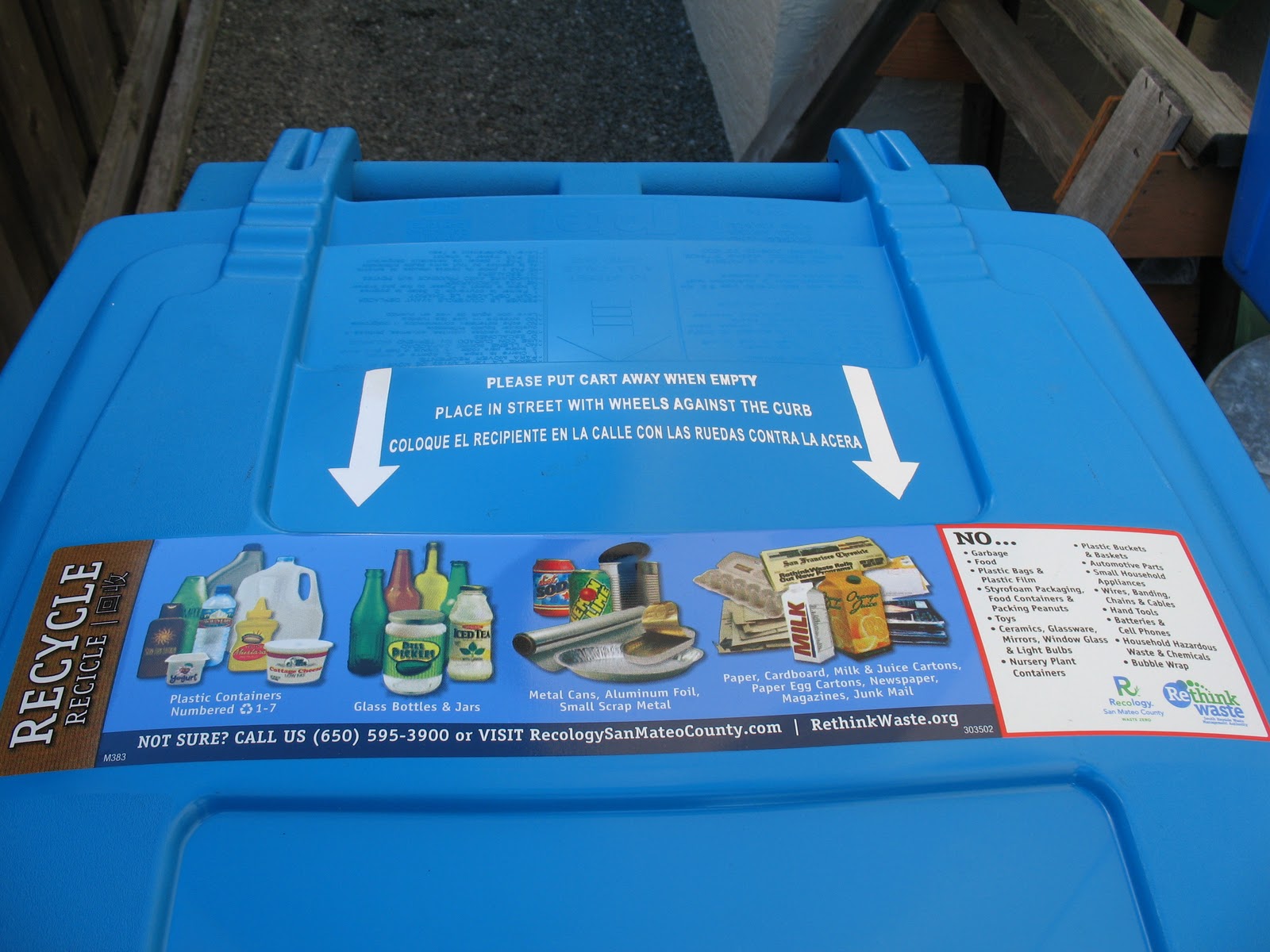
Recology will replace Allied Waste as our garbage collection company in January. Today Recology distributed three new carts to each house in the neighborhood, and the service promises to be a great improvement.

1) No longer will we have to separate our paper, plastic, and cans into separate boxes. All recyclables go into the blue cart.

2) The carts have signs to remind us which materials go into each. The signs are laminated to resist weather.

3) The black cart they gave us looks durable and expensive. Now I won't have to shop for a new garbage can. (I'm noticing that procrastination can be rewarding; sometimes problems do go away.)

4) Every week--formerly it was every other--we can put the recyclables and greens by the curb. I have mistakenly brought out the containers on non-recycle day, or not put them out when I should have. (Looking at what the neighbors are doing is not 100% reliable, because sometimes they're wrong, too.)

Communication can still be improved. I was all set to start using the carts this week--opportune timing for the Thanksgiving trash--when a few clicks informed me that the service will start in January. Anticipation increases the excitement, I suppose.

Monday, November 22, 2010

Glug Glug

When I first heard a speaker use the phrase “deep dive” last month (as in “explore in depth the topic we are discussing”), I thought his choice of words was clever; it summarized succinctly what he was doing, and even people unfamiliar with the term knew what he was talking about. “Deep dive” has actually been floating around in the consulting dictionary for years and has begun to enter the mainstream on magazine covers and TV business channels.

Last week I reviewed our consultants’ 100+-page Powerpoint presentation on industry strategy and found the overuse of the term to be irritating. The report covered a variety of topics, and after introducing each one proclaimed that it was about to deep-dive into the subject. Just tell me what you found, for crying out loud, and let me decide if you’ve covered it adequately.

My entrancement, then disenchantment, with “deep dive” is a mild example of the Feiler Faster thesis, which states that information is absorbed at such a pace that reversals of fortune (in sports, entertainment, business, politics, etc.) can occur overnight. I hope the phrase sinks into oblivion.

Sunday, November 14, 2010

Put Your Thumbs Down

When I first entered the world of business there were still clubs whose dining rooms discouraged explicitly commercial discussions. Notepads and pens were to be kept off the table, and ladies and gentlemen engaged in the art of conversation with each other because cellphones did not exist.

That societal aspiration has been obliterated. Three decades ago a movie that was purely a dinner conversation captivated the critics; now it’s nearly unknown to the under-30 crowd. No longer do we look attentively at our meal companions. Our focus is on the small glowing screen, fingers pecking messages to people whom we rarely meet face-to-face.

Last week we imposed a new family rule: when more than one person is at the table, the machines are shut off. We’re starting to rediscover each other, but we'll see how long that resolution sticks. (How well I follow my own dictate will be tested if there’s breaking news on time-sensitive investments.)

The advertising campaign for Windows Phone 7 amusingly illustrates some of the dangers of becoming too involved with our smartphones.


Microsoft's claim that its mobile product contains more "glanceable" information is questioned by the WSJ's tech writer, Walt Mossberg. Nevertheless, kudos to MSFT for a witty ad.

Monday, November 08, 2010

Incompetence

When Barack Obama and his fellow Democrats swept into office two years ago, they misread their mandate. A large majority voted for the Democrats in 2008 simply because they were not Republicans. Nearly everyone was tired of George Bush, tired of his wars (although Iraq did appear at last to be turning the corner) and fearful of a collapsing Wall Street. The 2008 Republicans did not deserve to be re-elected, and most independents and even many Republicans agreed. The GOP’s message of “I’m bad but the other guy’s worse” had predictable results. The Democratic wave that began in 2006 crested in 2008. The Democrats would probably have won anyway, but the fact that they had an attractive candidate sealed the deal.

The President and his party immediately began pursuing the liberal agenda: much greater government control of the economy, more government assistance for those viewed as “not rich”, and an end to the Iraq war. The voters, however, mainly wanted him to save the banking system from collapse and let the resilient economy recover like it normally does within 18-24 months.

All the President had to do was not make things worse. By November, 2010, with the economy and jobs on the upswing, the mid-term elections could well have made the Democratic Congressional majority even more lop-sided.

The large banks and Wall Street did survive—one cheer for that—but the pursuit of the liberal agenda birthed a health-care monstrosity filled with consequences unknown and unintended. The entire health-care sector and employers everywhere hesitated to hire as the citizenry tried to digest the health care bill. (Plopping 2,700 pages of far-reaching legislation into the economy’s midst is like Microsoft slamming 2,700 pages of code into Windows 7 without any testing.)

Once a derogatory meme takes hold—witness Gerald Ford and Sarah Palin's example—it becomes impossible to shake. The President’s supporters in the media are doing their best to tamp it down, but after the slow reaction to the BP oil spill and the failure of the stimulus package, the whiff of incompetence has become inescapable.

Saturday, November 06, 2010

I'll Start Tomorrow

A New Yorker article on procrastination: It explains a lot about why my open items get rolled forward for months. A few of the useful ideas and terms from the piece:
Procrastination is a basic human impulse, but anxiety about it as a serious problem seems to have emerged in the early modern era.

[Procrastination is] a powerful example of what the Greeks called akrasia—doing something against one’s own better judgment.

Hyperbolic discounting - as the present gets closer, short-term considerations overwhelm their long-term goals. [Example: movie rental lists, where for the movie they wanted to watch immediately, people tended to pick lowbrow comedies and blockbusters, but when asked what movie they wanted to watch later they were more likely to pick serious, important films (that never get watched when the time comes)].

The divided self – we are composed of divided selves constantly “competing and bargaining” with each other. [Pleasure-seeking self wants to watch TV in the future, so will allow hard-working self to win in the present….sometimes.]

Weapons to combat procrastination: deadlines, bets (e.g., pay if don’t lose weight), divide long-term vague objectives (e.g., being rich) into nearer-term concrete achievements (e.g., save 6% of salary in 401k).
For all our contemporary insight it’s not clear that our understanding has progressed much beyond that of the ancients. They named the seven deadly sins (pride, greed, envy, lust, anger, sloth, and gluttony), four of which I have trouble with and without which my procrastination would be largely cured. Or it just may be the devil that overpowers my angelic self when it comes time to turn off the television or put the ice cream back in the refrigerator.

Where has the time gone? There are three things I was supposed to do today but (yawn) that nap looks inviting.

Tuesday, November 02, 2010

Shouts and Tears

There are few moments in life—including happy events like weddings and births—where joy is so overwhelming that shouts and tears mingle, the arms lift in triumph, and one has to jump up and down lest one explode. In living rooms, bars, restaurants, electronics stores and wherever there was a television set last night, Northern Californians gave themselves over to the moment.

Old-timers say the spontaneous outpouring reminded them of V-J day, which marked the end of history’s most terrible conflict. Last night’s World Series victory for the San Francisco Giants celebrated “just a game,” but to the many for whom baseball is a metaphor, a reverie, an escape, a reminder, and a bequest the event was a lifetime in the waiting.

When the Giants moved to San Francisco in 1958, the future was pregnant with possibility. Some of the best players of the mid-century—and Willie Mays, who is on the short list of baseball’s greatest players ever—were on a New York Giants squad that had won the World Series in 1954. The Giants won the National League pennant in 1962 in the new Candlestick Park and lost a thrilling World Series to the Yankees in seven games, but no worries, with their talent everyone believed that they would soon get other opportunities. (The change in scenery didn’t bother their perennial National League rival, the Dodgers, who also moved west in 1958 from Brooklyn; the L.A. Dodgers beat the Yankees in the 1963 Series.) In the 48 years that followed until last night, the Giants had only two more chances, both unsuccessful, to win baseball’s crown.

Every San Francisco fan has his or her own story of hopes raised and dashed. We endured freezing night games at Candlestick to cheer Will Clark, Kevin Mitchell, Jeff Leonard, and Mike Krukow. We rooted for admirable players of talent and character to win a ring, but they never did. After 52 years we learned to reconcile ourselves to things that will never be, like a Giants title.

From the days I first heard gravelly-voiced Lon Simmons broadcast Giants (and 49ers) games thousands of miles away to my little Sony transistor radio in Honolulu, I’ve waited, then stopped waiting, for this moment. With little warning it’s here, followed by the shouts and tears.