Showing posts with label Uber. Show all posts

Tuesday, October 31, 2023

Ingenious, But He May Not Have Thought It Through

The Florida police took a selfie with the passengers,
a U.K. couple about to be married, at the arrest. (WFLA)
Sometimes you just have to tip your cap to criminal ingenuity. In this case a Florida crook knew that car-rental companies could prevent a car from starting once it had been turned off. [bold added]
A Florida Uber driver is accused of using a stolen rental car to give rides and then leaving the car running for weeks to avoid it being disabled, deputies said.

The 27-year-old Uber driver was renting a Chevy Equinox from a company in Orange County when he stopped making payments, according to an Oct. 26 news release from the Polk County Sheriff’s Office...

The company had installed devices in their rental vehicles that could be remotely activated to stop the car from restarting in the case that someone stopped paying for the vehicle, the sheriff’s office said.

But the driver knew about this feature, so instead of returning the Equinox or making the payments, he chose to leave the vehicle running for “three straight weeks” to prevent it being disabled, according to the release.

During that time, he was using the car to drive for Uber.
Sure, the guy "borrowed" the vehicle, but he did honest work for three weeks.

One has to wonder, though, what his exit strategy was since the car rental company had his information. It notified the police that the car was stolen, which led to the arrest.

Thursday, August 17, 2023

Patient in my Circumstances

In a wheelchair this ride would have been perfect.
My outpatient procedure was scheduled from 6 a.m. to 8 a.m., and, because general anesthesia would be used, the clinic would not allow me to drive home. Coincidentally, for the first time ever, I couldn't hitch a ride with anyone because of various calendar conflicts.

No problem, I told them, I'll just take a cab or Uber or Lyft. That won't do, they said, you will have to use a licensed medical transportation company.

And so it was that I Uber'ed to the appointment at a cost of $18 plus tip and hired a medical van to take me back for $100. The vehicle was equipped for wheelchair passengers and was overkill for a patient in my circumstances.

I could work myself into a lather about liability insurance, government regulations, and one-size-fits-all safety requirements. Cultivating an attitude of gratitude is better: I have the means to pay the bill, and the procedure was quick. Besides, anger often hurts the person expressing it as well as its object.

The driver made sure I got to the front door okay. There's a reason there are a dozen businesses like his in the area, and some day I may genuinely need his services.

Wednesday, December 23, 2020

Refusing Delivery

The owners of Karaage Burger in
San Mateo are happy to see us.
With so many eateries struggling to survive, we began taking delivery at least four times a week from restaurants that were old favorites as well as a few we had never tried before. (To be sure, it wasn't much of a nudge.) We loaded the Doordash and Uber Eats apps on to our phones, and the rest--and our former waistline--was history.

However, it's become clear that the delivery apps, which reimburse the food providers 20-30% below their menu prices, are only a temporary lifeline for the restaurants. (For those familiar with cost accounting, it's like charging just above marginal cost to stay alive. The restaurant covers its material and labor but not the rent, maintenance, taxes, legal, accounting, loan interest, etc.)
The potential damage to restaurants by the food-delivery apps — three of the four largest are centered in the Bay Area — has been well-documented in The Chronicle and beyond.

Delivery apps have created shadow websites to compete with their own small-business partners, which were already being charged up to 30%. Bay Area restaurants that wanted nothing to do with delivery apps were being added against their will, in at least one case with fake menus.

Then COVID-19 hit, and the weaknesses of the system were blown wide open. San Francisco lawmakers capped the delivery fee at 15% in city limits, a rule that was quickly violated.

“It was impossible for restaurants before COVID to survive with all of these apps and their fees,” SF Chickenbox owner Christian Ciscle told The Chronicle’s Justin Phillips in July. “If you’re giving 25% to 30% to an app, there’s no way you’re going to survive, or even get ahead.”
Despite the slightly increased risk of catching the coronavirus, we now order take-out as much as we can. Frankly, we want the restaurants to get our dollars, not the delivery services that are worth $billions on the stock exchange.

Whenever we pick up an order, the owners smile and wave. And I always add a tip, which I didn't used to do on take-out orders. At the end of 2020
We are grateful our family survives
And savings have remained intact
We took this chance to look at our lives
And distinguish the muscle from fat.

Saturday, October 26, 2019

California: Enjoy the Comic Circumstances

California local governments have been able to harvest significant sums from the taxi industry; permit fees have to be purchased in each city and can total $3,000 to $13,000 depending on where a cab operates.

(Chart from Rideguru)
Ride-sharing companies have severely damaged this revenue source in recent years. It had been hoped that a new California law going into effect would increase the taxes on Uber and Lyft and help taxis compete. As is too often the case, the law has unintended consequences: [bold added]
California’s new gig work law, which takes effect in January, sought to prod Uber and Lyft to turn their drivers from independent contractors into employees.

It could hit the taxi industry instead.

Taxi drivers are generally contractors. While many say they might benefit financially by making minimum wage and overtime plus benefits, they also fear their industry is so financially precarious that the additional expenses could make it collapse.

“If we weren’t struggling to stay afloat, I would probably support AB5 for taxi drivers,” Marcelo Fonseca, a longtime San Francisco driver, said of the gig-work law. But “in this current market, AB5 will probably bankrupt the taxi industry.”
Uber and Lyft plan to fight the gig-workers-are-employees law in the courts and through ballot propositions, bypassing the legislature:
Uber and Lyft don’t intend to reclassify their drivers, despite the law. They are pursuing a 2020 ballot initiative to allow independent contractor drivers to receive some benefits and minimum earnings guarantees. Uber says it will battle reclassification in court.

“The supreme irony is that these companies with their billion of dollars in venture capital can fight this off, and probably prolong that fight for a very long time, whereas the taxi industry may be subject to this on very short notice,” Gruberg said.

“If the taxi industry has to absorb employee status while Uber and Lyft get a pass because they go to the voters or drag it out in the courts for years, this could be our death knell.”
In the one-party State of California your humble blogger has grown accustomed to laws being passed and then watching the scramble to undo the unintended consequences.

We can't do anything about it, so we've learned not only to accept but enjoy the comic circumstances.

Friday, July 12, 2019

NEMT in Need of Disruption

Dad with his walker at Ala Moana (2012)
I haven't used Lyft or Uber yet, but their NEMT (Non-emergency Medical Transportation) service looks promising: [bold added]
An estimated 3.6 million Americans a year miss medical appointments due to unreliable transportation, costing the U.S. health-care system roughly $150 billion annually, according to Uber, citing independent studies. The U.S. Government Accountability Office pegged spending on NEMT under Medicare and Medicaid at nearly $3 billion in 2013. As the start of this year, supplemental benefits to Medicare Advantage were broadened to include a range of medical transportation that supports overall wellness and health—even rides to some massage appointments.
When we were unavailable to take Mom or Dad to their appointments, we tried hiring companies who specialized in NEMT for the elderly. The results were disappointing; my parents always felt rushed, and drivers didn't seem to be interested in alleviating discomfort. Plus it's costly, because the companies require us to pay for the vehicles to wait around during the appointment.

We family members know how to collapse and set up their wheelchairs and walkers, as well as assist the patients into various sedans. There's no substitute for family drivers' TLC, but hopefully Uber and Lyft can disrupt the NEMT status quo and give us better quality at a reasonable price.

Wednesday, March 14, 2018

Ready or Not, Here (Will Be How) We Go

(Illustration from Stanford Alumni Magazine)
Much like the automobile was in 1900, self-driving cars in 2018 are a curiosity. However, those who are involved in the research (major car companies, universities, and tech giants, not to mention Uber and Lyft) say that we are on the verge of a dramatic societal transformation:
Babies born today won’t ever need a driver’s license....
• Only 20 percent of Americans will own a car in 15 years.
• Passenger vehicles on American roads will drop from 247 million in 2020 to 44 million in 2030.
• Driverless technology will transform many, if not most, modes of transportation: trucks, tractors, ships, forklifts, trains, construction equipment.
• Transportation costs will drop to about 20 cents a mile, at which point everyone will have affordable access to road travel. (That’s about a threefold decline, according to a 2017 AAA report.)
Disruption may be too mild a descriptor for what is happening to our means of transportation. How we get from here to there is not merely a convenience, but rather has the potential to affect poverty levels, social standing, our daily human interactions, cultural norms and even life span, according to Stanford scientists and researchers.

On the one hand, self-driving cars could democratize transportation, making independent travel possible for many who lack it, including people who are blind, disabled, young, old or poor. Prognosticators also expect reductions in pollution, traffic, collisions and the cost of getting around, and an increase in green space as the demand for parking lots declines.

But skeptics worry that the adoption of driverless cars will eliminate too many jobs and give hackers a new way to attack, even possibly turning cars into lethal weapons. As the debate unfolds, autonomous vehicles are hitting the road in droves. Ready or not, say experts, here they come.
Autonomous vehicles, robots who are smarter, faster, and stronger than we, Mars colonies, and the elimination of disease and the ravages of age---we are rushing pell-mell into a future that is barely imaginable.

Monday, June 26, 2017

Revolutionary Upheaval in an Old Industry

Who's driving? And I thought getting rid of a clutch
was a big deal (Mercedes concept)
For most of its 100+ years as a mass-market industry, the automobile business was evolutionary--a little higher mileage, more safety, and less pollution every year on average--but now it's entered a revolutionary phase.

Technology has disrupted traditional ownership, use, and financing patterns. We may well be witnessing the end of mass car ownership.
Drivers, for instance, may no longer be drivers, relying instead on hailing a driverless car on demand, and if they do decide to buy, they will likely share the vehicle—by renting it out to other people when it isn’t in use.

Auto makers, meanwhile, already are looking for ways to sustain their business as fewer people make a long-term commitment to a car.
Other predictions: [bold added]
One-quarter of miles driven in the U.S. may be through shared, self-driving vehicles by 2030, according to an estimate by Boston Consulting Group.

Chief Executive Elon Musk has hinted that he’s preparing to create a network of Tesla owners that could rent out their self-driving cars to make money.

Autonomous vehicles could ultimately free up more than 250 million hours of consumers’ commuting time a year, unlocking a new so-called passenger economy.

the alcohol industry might see a rise in drinks consumed weekly with customers not having to worry about driving home.

...a vision of a car that replaces a vehicle’s windows with video screens that create a wraparound movie theater inside the cabin.

...“pods”—seats that can be adjusted to block a passenger from the view of the others—and there are areas in the vehicle that allow them to lock items while other people use the car.
When a product is experiencing rapid change it doesn't pay to own it if the cost reflects a life longer than three years. (An analog is real estate: if you plan to stay in an area at most for three years, you probably won't go through the expense and risk of buying and selling a house.)

We've owned all our vehicles since the early 1970's. In 2015 we leased our first car, will return it to the dealer instead of paying 67% of cost to buy it in 2018, then probably lease another one.

Wednesday, June 07, 2017

In the Name of Safety and Fairness, Of Course

Uber's self-driving cars (CNBC photo) still
have a driver for safety purposes
Despite Uber's widely publicized missteps the ride-sharing company's valuation still is estimated to be well north of $50 billion.

IMHO, bad, even criminal, behavior by employees or drivers isn't the biggest impediment to Uber's potential. Uber and rival Lyft have more to worry about from city governments intent on regulating---and, of course, taxing---the upstart transportation companies. [bold added]
City Attorney Dennis Herrera on Monday subpoenaed Uber and Lyft to disgorge records on four years of driving practices, disability access and service in San Francisco. The companies have steadfastly declined to share data other than that they have about 45,000 drivers in the Bay Area.

“No one disputes the convenience of the ride-hailing industry, but that convenience evaporates when you’re stuck in traffic behind a double-parked Uber or Lyft, or when you can’t get a ride because the vehicle isn’t accessible to someone with a disability or because the algorithm disfavors the neighborhood where you live,” Herrera said in a statement.

The subpoenas seek information on “miles and hours logged by drivers, incentives that encourage drivers to ‘commute’ from as far away as Fresno or Los Angeles, driver guidance and training, accessible vehicle information, and the services provided to residents of every San Francisco neighborhood,” Herrera’s office said.

The companies already compile that information for their regulator, the California Public Utilities Commission.
Subpoena all their records because of double-parking and accessibility? In San Francisco I don't see a lot of traffic tickets being handed out to double-parked trucks, nor do most taxis appear to be wheelchair accessible, but maybe I just need to get out more.

Uber and Lyft, if you pay big $$$ and give up the names of your 45,000 drivers so that San Francisco can register and tax everyone who drives into the City even for a couple of minutes per year, you could avoid this hassle. Nice little business you have there, Uber and Lyft, it would be a shame if something happened to it.

Thursday, June 09, 2016

Postponing Fulfillment

Uber, the ride-sharing company headquartered in San Francisco, won't become a public company soon, says founder Travis Kalanick.
“I say we are going to IPO as late as humanly possible. It’ll be one day before my employees and significant others come to my office with pitchforks and torches. We will IPO the day before that. Do you get it?”

For one thing, he said, employees at public companies wasted an inordinate amount of time checking on their money.

“If you can keep your employees from refreshing every 10 minutes to see what the stock price is, your company is going to be more geared towards the future and move faster,” Kalanick said.
At Costco in Redwood City I spotted a Porsche driven by an Uber employee. This employee appears to have plenty of money already, and an IPO would allow him to quit and do something else with his life.

Mr. Kalanick understands incentives: make them think you're the answer to their dreams, but postpone fulfilling their dreams "as late as humanly possible."

Saturday, May 21, 2016

Battery Power is Power

Uber, which matches drivers with passengers using a mobile app, implements surge pricing during peak periods. Price changes are communicated to drivers and passengers in real-time, allowing both to make rapid decisions about providing or using the service.

Uber's analysis of passenger behavior has revealed [bold added]
when you are more likely to pay double or triple the cost of your ride: when your phone battery is low.

...people are willing to accept up to 9.9 times surge pricing (ouch) if their phones are about to go dead. Data about user batteries is collected because the app uses that information to know when to switch into low-power mode. The idea being: If you really need to get where you’re going, you’ll pay just about anything (or at least 9.9 times anything) to ensure you’re getting a ride home and won’t be stranded. A person with a more fully charged device has time to wait and see if the surge pricing goes down.
In the 21st century the smartphone has become many individuals' principal conduit to information. When buyers lack information, they may pay a lot more than they need to. Knowledge is power, or in this case battery power is power.

My iPhone won't run out of juice--and I can wait for the surge pricing to pass--
with backup power. (Disadvantage: this one weighs 10 oz. and lists for $69.99.)

Monday, November 09, 2015

Efficient Markets in Transportation

The efficient market hypothesis (EMH) has been around for about half a century. Its tenets are still in dispute, but there's no question that the EMH has had a profound influence on the behavior of capital markets, if for no other reason that powerful participants believe it to be true in at least the weak and semi-strong forms [bold added]:
The weak form of EMH assumes that current stock prices fully reflect all currently available security market information....

The semi-strong form of EMH assumes that current stock prices adjust rapidly to the release of all new public information....

The strong form of EMH assumes that current stock prices fully reflect all public and private information.
Your humble observer and stock punter has found the semi-strong form to be operative; whenever a particular stock is touted in a business publication, the price rises before I could buy it at a price that would produce an extra-normal return. By the time he reads the article it's too late for the average investor to join the party.

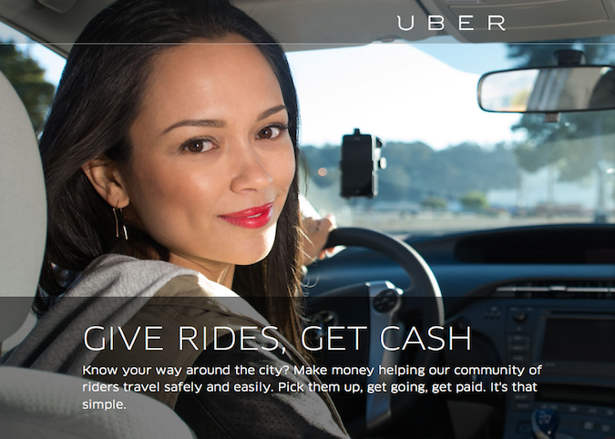
Not all drivers are personable young ladies. (Atlantic image)
Now that the Internet and mobile communications have spawned businesses that were unimaginable a few years ago, these pricing principles have also been found to apply in other marketplaces. Take the case of Uber, which matches riders to drivers as demand and traffic conditions change. One of Uber's innovations is surge pricing:
which refers to the practice of charging customers higher prices at peak times. It got a lot of attention during a snowstorm in New York in December of 2013, when rates were massively increased, up to eight times, attracting a flood of negative press and customer feedback.
In Uber supply responds to higher prices quickly, so many experienced drivers don't waste their time chasing them.
"The seasoned drivers don’t pay any attention to surge,” [driver John Sollars] said. “By the time you get to that part of the city, the surge is over. Often, even when I’m sitting dead center in the middle of a surge area, I don’t get a ride request. Then, as soon as the surge is off — bam! — here comes a ride.”

newer and part-time drivers — who account for the vast majority of Uber vehicles — do chase surges. “The online message boards are full of questions about how to get surge pricing,” he said. But Ryder Pearce, co-founder of SherpaShare, which helps drivers analyze earnings, said that many new drivers become disillusioned after chasing surges that end or getting stuck in traffic jams en route.
In the brave new mobile Internet world prices change quickly in response to new information, and achieving above-average returns is difficult. Eugene Fama is smiling.