Showing posts with label Sacramento. Show all posts

Thursday, May 23, 2024

Caltrans: Back to its Basic Mission

The Yolo 80 Corridor Improvements Project
Traffic from the Bay Area to Sacramento has gotten worse. Thousands of households (and their cars) have relocated to the Central Valley from LA and SF because of cheaper housing, newer schools, and the friendlier regulatory environment.

Meanwhile, we who remain in the Bay Area like to go on holiday to Lake Tahoe, Reno, and points beyond, which means taking I-80.

We do our best to avoid peak congestion hours, but lately it's been impossible to circumvent the traffic. Last summer it was stop-and-go in 107°F heat throughout the 100 miles to Sacramento.

After years of deliberation Caltrans has finally approved the addition of lanes to I-80 along the "Yolo Corridor," the worst bottleneck. Of course, the coastal environmentalists who don't have to endure the traffic regularly like the hoi polloi, object: [bold added]
Environmentalists balked, viewing the Yolo 80 Corridor Improvements project as a retreat from California’s ambitious climate goals. Many predicted that by adding two lanes to the interstate, Caltrans would lure commuters out of Capitol Corridor trains and into cars. But the California Transportation Commission voted unanimously last week to secure $105 million in state funds for the first phase of the project, all but ensuring construction will break ground.

It’s a shining moment for Yolo county and the city of Sacramento, a seat of governance in a rural valley, where road projects don’t usually draw massive infrastructure grants. At the same time, the Yolo 80 Corridor has become a flash point for two competing visions of transportation in California — one focused on managing congestion, the other aiming to wean people off cars.

...Collective misery about traffic, particularly among Californians who can’t afford to live near their jobs, often dwarfs concerns about carbon emissions, [UC-Davis Prof. Susan] Handy said. Politicians and agencies have to respond and show they’re taking action.

As a result, major highway infrastructure projects are proceeding throughout California. Caltrans is doubling the width of Highway 37 in the North Bay from two to four lanes for seven miles. In Los Angeles, a plan to add lanes to Interstate 710 is inching forward.

Sustainable transportation advocates argue that increasing the capacity for traffic only encourages people to drive, perpetuating the problem that engineers hope to solve. They cite the “bold climate agenda” that Gov. Gavin Newsom invoked in a 2019 executive order, which made reduction of fuel emissions a top priority for transportation spending.
Despite the highest gas taxes in the nation, California supposedly doesn't have the funds to pay for the additional lanes and will make them toll roads. Little matter, the wonder is that the project has been approved at all.

It's too much to hope that climate alarmism has peaked, but for now it looks like the government is paying attention to the immediate needs of its Central Valley citizens rather than the worries of the coastal elites that their grandchildren will get their toes wet in a hundred years.

Saturday, July 01, 2023

Hot Take

It wasn't my preferred way to start the unofficial July 1 - July 4 long weekend, but I had an appointment near Sacramento. Traffic on I-80 was stop-and-go most of the way, and the outside temperatures reached 110°F in the Central Valley. I turned on the car's AC to full, ignoring that it was a spare-the-air day; hey, I'm already doing my part by driving a hybrid.

Where I was going there was no air conditioning, and I won't sleep well.

Already I'm looking forward to the drive back in the cool cabin of the car and the relatively cooler environs of the mid-Peninsula.

Monday, May 01, 2023

Some People

How many different emotions can one detect in the faces above? One sees sadness, anger, disgust, futility, shock, and denial. Entirely absent are joy or happiness. Note also the slumped shoulders, the hands covering the faces, the crossed arms, and the clenched jaws.

It's the moment in the third quarter when Sacramento Kings fans realized that the game and the season were over. Last night the Golden State Warriors defeated the Kings, 120-100, and moved on to face the Los Angeles Lakers in the next round of the playoffs.

I wonder if artificial intelligence is advanced enough to recognize what these facial expressions mean? One thing is certain: it wouldn't chuckle at them, as some people 90 miles to the south have done.

Friday, January 13, 2023

The Delta Smelt: Let's Have a Debate

Delta smelt (Mercury News photo)
Environmental regulations that protect endangered species, specifically the delta smelt, have drastically reduced the amount of storm water that can be pumped to reservoirs:
But 94% of the water that has flowed since New Year’s Eve through the Sacramento-San Joaquin River Delta, a linchpin of California’s water system, has continued straight to the Pacific Ocean instead of being captured and stored in the state’s reservoirs.

Environmental regulations aimed at protecting a two-inch-long fish, the endangered Delta smelt, have required the massive state and federal pumps near Tracy to reduce pumping rates by nearly half of their full limit, sharply curbing the amount of water that can be saved for farms and cities to the south...

In the 1950s, the federal government built huge pumps near Tracy to send water south to farmers and cities through the Central Valley Project. In the 1960s, former California Gov. Pat Brown built even bigger pumps two miles west, near Byron, that pumps Delta water into the State Water Project, which serves 27 million people.

The pumps are enormous and over time have disrupted fish and wildlife in the Delta, including smelt and salmon, sometimes grinding them up, sometimes making sloughs run backward, and other times removing up to half the Delta’s fresh water. Once plentiful, smelt and salmon numbers crashed. This winter, only five smelt have been found in the Delta by scientists.
A small fraction of the Delta storm water can be diverted by the pumps to storage, and smelt restrictions reduce even that amount by 40%:
When the state and federal pumps are fully running, they can move roughly 10,800 cubic feet per second. That means they are unable to catch most of the current deluge even if maxed out. But since Jan. 1, they have averaged just 6,415 cfs per day — far less than their capacity.
The water districts say that they "do not have much flexibility under the law." The law is a creation of men and can be undone by men. It's time to have a full-throated debate over why preventing the extinction of a small fish is more important than the lives and livelihood of millions of Californians.

Wednesday, August 17, 2022

Après CO2, le déluge

Downtown Sacramento, 1862 (Chron photo)
Five years ago we wrote about how a wet winter (yes, they do exist) gave rise to fears of disastrous floods in Northern California.

There is historical precedent: in the Great Flood of 1862 Sacramento and much of the Central Valley was submerged. No one's predicted when such a flood will recur but we remarked half jokingly,

"One Thing is Certain: Climate Change Will Take the Blame"

It's no longer a joke. Scientists are warning that climate change will make Great Floods more likely and more severe. [bold added]
Storms seem hard to fathom now, with California in its third year of drought. But climate change is making both drought and rainstorms more prolonged and intense, climatologists believe.

The dense 13-page treatise [“Climate change is increasing the risk of a California megaflood”] uses the Great Flood of 1862 as its model. An overwhelming series of storms turned the entire Central Valley into an inland sea and washed out what is now Los Angeles and the cities of Orange County. That flood caused an estimated 4,000 deaths as the equivalent of 10 feet of rain fell over a span of 43 days, according to references.

The study says that climate change is dramatically increasing the risk of megastorms like the one that spawned the 1862 flood, so that an event that would have occurred only once every two centuries is becoming one that might occur around three times each century. Just as worrisome, the consequences could be worse now due to the combined conditions of human-induced global warming, sprawling development and wildfires.

Recent analysis has suggested that “such an event would likely produce widespread, catastrophic flooding and subsequently lead to the displacement of millions of people, the long-term closure of critical transportation corridors and ultimately to nearly $1 trillion in overall economic losses,” the study states.
Global warming, aka "climate change," is responsible for mega-droughts and mega-floods.

It causes ocean warming and ocean cooling.

There's nothing it can't do.

Wednesday, July 06, 2022

Homelessness Moves to the Capital

Sacramento encampment (Calif Globe)
California's homelessness problem is not confined to the coastal cities.
But the city of Sacramento actually has more unsheltered homeless people — and a higher share of them compared with its population — than San Francisco, according to just-released data.

Within the city limits of Sacramento, just over 5,000 unsheltered people — those living in vehicles and tents — were counted in a new homelessness report, compared with about 4,400 people in San Francisco.

But with Sacramento’s population of 525,000 versus San Francisco’s 874,000, that works out to a rate of 952 per 100,000 in Sacramento versus 503 per 100,000 for San Francisco.

The total count of homeless people in the city of Sacramento was not available.
San Francisco has had to deal with large numbers of homeless for years, and hundreds of millions of dollars have been spent developing a shelter network. A major part of Sacramento's problem is due to a recent housing-price escalation resulting from people moving from the coast to the Central Valley.

IMHO, Sacramento's problems are more easily fixable because there's more land to build housing and homeless shelters, and job holders will find it easier to make a rent payment (a one bedroom costs $1,302 and $2,225 in Sacramento and San Francisco, respectively, per the Chronicle). In addition, Sacramento doesn't have the same Gordian knot of San Francisco regulations that prevent things from getting done.

Let's hope California's capital city shows us the way.

Monday, April 25, 2022

Rocklin Repast

We were done with the tax returns for family and friends, and a 9-month project for the church had coincidentally wrapped up. It was time to reward ourselves with an overnight trip to Central California.

The head ordered the ahi salad, but the
heart wanted the drunken-pig fries.
We stopped for lunch in Rocklin. An upscale burger-and-brew operation, the University of Beer, had opened six locations in the Sacramento Valley.

The prices were roughly the same as in the Bay Area--$20 for an entrée--and the portions were larger. As the designated driver, I wistfully scanned the extensive beer collection and settled on ice water.

My annual physical was fast approaching, so I also passed on the calorie-laden burger that I really desired and ordered an ahi salad.

Everything was well-prepared, and the ingredients were fresh. My companion let me taste his order of burger and fries.

Next time I'll have what he had, and someone else can drive.

Wednesday, December 01, 2021

A Quiet Monday Evening

Lincoln pond at sunset
The freeway--it has a soundwall--is only a few hundred feet away, but there's much less noise in Lincoln than in our residential neighborhood on the Peninsula.

Maybe it's the halo effect. I like the Sacramento hills, which biases me toward all other aspects of Central Valley life.

I like the spread-out feeling and the aforementioned quiet. Even the air seems cleaner, which doesn't make sense because this area is close to the wildfires.

The real estate websites say that home prices in Placer County have gone up by more than 20% in the past year. Builders are noticing, and new developments are springing up on what used to be farmland.

The coronavirus only accelerated the trend of leaving the over-priced, over-crowded coasts. The great migration shows no signs of abating.

Tuesday, November 30, 2021

No Argument from Me

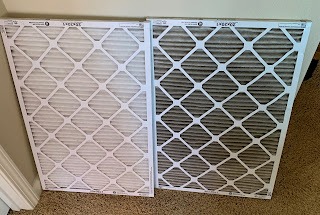
The old filter (right) and its replacement.
We hadn't visited our friend in the Central Valley for 1½ years, i.e., since the beginning of the pandemic.

After the usual pleasantries and catching up, I offered to change the furnace filter, which task involves climbing a ladder. Perhaps there's an engineering advantage to placing the intake on the ceiling of the second floor, but IMHO this HVAC system was poorly designed for humans.

The filter had turned black, the residue of two summers of wildfires. Our friend texted back later tonight and said the air was much "fresher."

Perhaps her feelings were colored by the above picture, but if the good feeling raises another person's opinion of me, I'm not going to argue.

Tuesday, November 23, 2021

The Central Valley is Looking Better and Better

WSJ illustration: blue dots show where Bay
Area ex-residents are resettling.
In April we commented on a Chronicle editorial that decried the migration from the coasts to Central California. The Chronicle declared the growth of the suburbs "unsustainable", which struck us as wishful thinking:
No, Progressives, your scare tactics won't work ("drought","fire country"), not to mention your sniffing at the plebes ("sprawl", "unsustainable"). And what's with the suburbs fostering climate change? Sacramento, which you control, has ordered us all into electric cars in a few years, so transportation won't be a source of bogeyman carbon.

It's your emptying cities which frighten us with homeless encampments, rampant burglary, drugs, usurious rents, filthy mass-transit, filthy streets, and labyrinthine regulations, which all come with extra taxes for the privilege of living and working in your precious highrises.
Six months later the trend shows no signs of abating. WSJ: Californians Flee the Coast to Inland Cities in a Mass Pandemic-Era Exodus
The pandemic boosted the flow of households from California’s coastal counties to other parts by nearly 50%, postal data show.

A net 97,000 households left the Los Angeles metropolitan area, and the San Francisco metro area lost about 67,000. The city of San Francisco lost a net of 44,000 households last year, about one-eighth of its total. Many from the city settled in the Sacramento metro area, about 90 miles northeast.

In Southern California, the center of the state’s shift, the Inland Empire had a net gain of 25,000 households last year, according to the postal data. That figure doesn’t count immigration, a longtime source of new Californians.
Roseville, near Sacramento, has some nice stores
but I doubt they'll be hit: too many guns and
Republicans, and the people support the police.
As if to put an exclamation point on the pay-more-get-less life by the Bay, organized smash-and-grab gangs attacked pricey stores in multiple cities the past weekend.
“It was a wild weekend,” (Alameda County Sergeant Ray] Kelly said, referring to sprees in Hayward, Walnut Creek, San Jose, Oakland and San Francisco, where roving bands of thieves swarmed into stores, grabbed as much merchandise as they could carry and escaped in getaway cars.

In Oakland the caravans grew particularly violent, as police encountered hundreds of drivers roaming the city on Friday, seeking out cannabis businesses for attempted theft, authorities said.
And why should the gangs worry? Property theft less than $950 is only a misdemeanor, so hardly any victim bothers reporting it. And if you're unlucky or stupid enough to get caught, San Francisco DA Chesa Boudin ended cash bail for all criminal cases, so criminals will be out in no time.

This weekend, for the first time in two years, I'll be visiting the Sacramento area, where life seems more civilized.

The Central Valley is looking better and better.

Thursday, May 13, 2021

Spending More and Getting Less

We took a Federal and California tax return to the Post Office today. Both were required to be postmarked by Monday, May 17th, and we did the mailing a few days early. (These returns weren't ours, which were mailed on April 14th.)

First-class mail service has deteriorated. It will take four days to deliver the 1040 to Fresno, which is 180 miles (3¼ hours) away.

Worse, the USPS estimates that Form 540 will be delivered on Tuesday to Sacramento, which is 110 miles (2 hours) from Foster City. It takes five days to get a piece of mail to the State Capitol.

If speediness were crucial I would have driven the tax returns to the destinations myself, as I've done a few times in my career.

Services that the government provides---police, schools, mail, tax processing, border patrol, public health--have experienced well-publicized failures during the past year. During the same period the private sector has erected the infrastructure to work from home and produced COVID-19 vaccines years earlier than anyone had a right to expect.

Meanwhile, based on its stellar record, the government takeover of the economy continues apace with an explosion of taxes and spending....

Monday, May 03, 2021

Palo Alto Loved Big Government Until It Came for Palo Alto

A friend's modest Palo Alto 3BR sold for $1.3MM in 2011.
$300K was put into it. Zillow's current value is $3.3 MM.
Liberals often turn conservative, that is, anti-big-government, on issues that affect them personally. The latest example is deep-blue Palo Alto's resistance to State directives to build multifamily housing:
Housing advocates say the city has a unique opportunity to change the course, and embrace multifamily housing rather than individual lots to help counteract housing and school segregation. But an uphill battle is on the horizon.

Shortly after the Palo Alto City Council tightened restrictions against multifamily housing, a group of anti-growth homeowners and politicians held a town hall arguing that more housing could lead to problems and urged attendees to challenge a state directive for the city to approve 6,000 new homes by 2030.
To halt construction the usual bag of tricks are being employed: insistence on time-consuming environmental studies and protests against traffic and "developer giveaways." But this time the tactics are being used against the Progressive dream of dense housing along mass-transit corridors.

One surprise is denigrating the Sacramento housing directive as "Soviet economics", which I didn't think had any traction in the town that is home to Stanford University. One would think that the woke who dominate the campus and the town would welcome a chance to bulldoze single-family homes and small shopping centers to create a demonstration city of high-rise apartments. So far the lack of enthusiasm is shocking.

Friday, February 19, 2021

Surreal ID

For your mild amusement:

DMV Mistakenly Issues Driver’s License With Photo Of Woman Wearing Face Mask
Lesley Pilgrim received the ID in the mail with a greeting reading, “Congratulations, enclosed is your newly designed California driver license.”

“I knew the picture was not going to be good because license pictures are never good, but I did not expect the picture to be with my mask on,” Pilgrim said...

Lesley Pilgrim in real life
When it was her turn, the DMV employee took two photos, the first still wearing her mask, the second without it.

“I sign it and I then I go home, and unfortunately he had used my picture with my mask on, and that’s what showed up on my Real ID,” Pilgrim said.
Since the DMV took with- and without photos, one would think that they could just reissue her a correct Real ID, but they're making Ms. Pilgrim come in again.

Note 1: we drove to Roseville two years ago to get the Real ID because we anticipated doing a lot of traveling in late 2020 and beyond. Hah!

Note 2 - the DMV has more serious problems than using the wrong photo: Security breach at DMV contractor may have exposed personal information of millions of California drivers

Saturday, January 16, 2021

COVID-19 Projections: Another Reason to Leave the Bay Area

Firehouse in Old Town reopens today
Sacramento is heading in the right direction, while the Bay Area remains locked down. [bold added]
The Greater Sacramento region’s available ICU capacity is currently under 10%, but the state’s data models project it will hit 19% in the coming weeks. Officials announced Tuesday that the region would move back into the purple reopening tier — the tightest of the four, but less restrictive than the ICU-based lockdown.

The state bases its evaluations on regions, rather than by individual county, because hospital systems rely on one another for patient transport and other support, said Dr. Nancy Williams, health officer for El Dorado County.

The area — which is part of the Greater Sacramento region along with Alpine, Amador, Butte, Colusa, Nevada, Placer, Plumas, Sacramento, Sierra, Sutter, Yolo and Yuba counties — will now be allowed to reopen outdoor dining and some small businesses and services such as hair salons, museums and movie theaters. Hotels can reopen to recreational travelers.
Firehouse filet (2016) 
We know at least a dozen Bay Area residents who have re-located to the Greater Sacramento area because of its much lower house prices, lower cost of living in non-real estate categories, and up-to-date amenities.

The region's medical facilities are excellent, and SF and Peninsula specialists are less than two hours away. Concerning the better coronavirus outlook, the reason could be lower population density. It's certainly not money, because the counties in the Central Valley are doing better than we who live in wealthier zip codes.

As noted in our visit to towns near Sacramento three years ago, they're on our short list of places to retire.

Friday, April 19, 2019

The Revolution Eats Itself

A phrase that's become popular in conservative circles is Annals of Leftist Autophagy, which began with the New Criterion in May, 2018:
It is a truth universally acknowledged that revolutionary sentiment is inherently expansionist and, if unimpeded, always winds up devouring its earlier partisans.

As we write, the social-justice chain Starbucks, famous for hectoring its customers about progressive politics and serving expensive burnt coffee, is being boycotted because a store manager in Philadelphia had two black loiterers arrested and removed by the police.
Once one notices the phenomenon, one sees it everywhere. Autophagy, i.e., when the body eats itself, occurs metaphorically when Ivy League colleges discriminate against Asian-American applicants, when anti-Semitic statements are justified if the right people speak them, and when white working-class union members are called "deplorables."

A current example is from California, where some leftist politicians are trying to alleviate the housing shortage by forcing communities to accept dense housing near train stations. They're getting push-back from other leftists.
Still waiting for Al Sharpton's outrage (Chron photo)
A provocative mailer by a deep-pocketed Los Angeles activist equates a state housing bill with “Negro removal,” a comparison that prompted state Sen. Scott Wiener and San Francisco Mayor London Breed to fire back Thursday.

The ad, paid for by Michael Weinstein, appeared on cable television, snowballed on social media and popped up in mailboxes throughout the city this week. It features a picture of famous black author James Baldwin with a quote about San Francisco’s urban renewal policies, which displaced thousands of African Americans from the Fillmore.

“San Francisco is engaging ... in something called urban renewal, which means moving the Negroes out. It means Negro removal,” says the quote, attributed to Baldwin in 1963.

It’s juxtaposed with a picture of Wiener, whose bill, SB50, seeks to put more housing near transit stations and job centers.
Frankly, I don't know who's going to win this argument. Just get the guillotines sharpened.

Saturday, March 09, 2019

More Civilized

Having neglected to renew my passport, I had to get a REAL ID:
Look for the bear on CA REAL ID's 
You will need a REAL ID driver license or ID card if you want to continue using your driver license or ID card to do any of the following:
  • Board a domestic flight starting October 1, 2020.
  • Enter secure federal facilities or military bases starting October 1, 2020. (Note: Check with the federal facility/military base before your visit to verify their identification requirements.)
  • Purchase firearms or ammunition. (Note: Check with the firearms dealer you plan to visit to verify their identification requirements)
  • Roseville DMV (Yelp photo)
    Because the nearest available times at Peninsula DMV offices were months away, we scheduled an appointment for today at the Roseville DMV, 20 miles northeast of Sacramento. The Roseville office was spacious--it's less than five years old--and there was no waiting in the appointment line (the other line had 20 people).

    We had brought all the required documents (social security card, birth certificate, two proofs of California residency, e.g., property tax or utility bill or bank statement), so the whole process took 90 minutes.

    On the Coast we like to think of ourselves as the California elite, but frankly, in many ways Valley life is more civilized.

    Tuesday, January 01, 2019

    Happy New Year, But Resolutions Start Tomorrow

    New Year's Day is a holiday, and we're on holiday, too, so resolutions start tomorrow.

    In Rocklin we ordered brunch at the Window Box cafe. The corned beef hash--sliced, not ground--was a coruscation of color.

    Reluctant to disturb its symmetry, I eventually relented. It tasted as good as it looked.

    The casino Food Court was crowded on New Year's Day.
    A family member wanted to try his luck at the nearby casino. It was a New Year, but for him it was the same old result.

    I spent most of the afternoon at the food court. The WiFi was intermittent, but I was able to do some work that didn't require an Internet connection. (Often without the Internet I find myself to be more productive, but that's just me.)

    Tomorrow I'll get serious. We'll see how long that lasts.

    Friday, November 09, 2018

    The Most Destructive Wildfire in California History

    KFC restaurant, Paradise, CA  (Chronicle photo)
    Stopping in Vacaville on Thursday morning, we espied a gray haze on the horizon. The smell of burning wood was in the air, signaling a nearby fire. By the time we got to Sacramento, 35 miles away, the air should be clear. However...

    Little did we know that Sacramento was on the way to the source of the smoke over 120 miles away. The so-called Camp Fire had "exploded near Chico" that morning.
    Paradise or Hell? (Chronicle photo)
    The massive Camp Fire that exploded near Chico in Butte County on Thursday is now the most destructive wildfire in California history. Officials announced Friday that the Camp Fire, which continues burning, destroyed 6,713 structures as of Friday evening. It has also killed 9 people and dozens remained missing a day after it began.

    The blaze reached 90,000 acres by Friday evening — more than twice the size of San Francisco — and was 5 percent contained, according to the California Department of Forestry and Fire Protection.
    Eleven years ago my uncle, the best mechanic I ever knew, passed away. His home was in Paradise, most of which has been destroyed by the Camp Fire. I still miss and think often of him and my aunt, but I'm glad they're not here to experience this.

    Friday, August 24, 2018

    Superior Syrup Retention

    Waffles at Awful Annie's.
    Though my blood tests have cautioned that I was prediabetic, I generally ignore limitations on sugar intake when out of town. That's especially true for breakfast, when pancakes and French toast tempt this hungry traveler.

    Lately, I've been ordering waffles, which I heretofore had not fully appreciated. Unlike with pancakes, maple syrup doesn't run off to the side because it's trapped in the little squares, which as an added benefit allow one to slather on more butter.

    Food Network host Alton Brown on differences between pancakes and waffles:
    — Pancakes may be brown on the outside, but they’re floppy, soft and spongy, with an interior that looks a lot like cake.

    — Waffles, on the other hand, are crisp on the outside and light on the inside, like beignets, funnel cakes, hush puppies or doughnuts. In short, waffles are fried, only instead of being immersed in hot oil, they are encased in hot-oil-covered metal.

    A few points about waffle batter:

    — Waffle batter contains a higher percentage of sugar (for caramelization) than pancake.

    — Waffle batter includes a bit more fat (for a crisp exterior) than pancake.
    Waffles have more sugar and fat, but they had me with the superior syrup retention.

    Thursday, June 28, 2018

    Wandering About

    After I took her to Sutter Emergency in March, I urged my friend to get a colonoscopy to ascertain the source of her abdominal pain. If she did schedule one (the procedure requires sedation, hence separate transportation), I offered to drive the 2½ hours to Placer County to take her.

    As the saying goes, "Don’t let your mouth write a check your a** can’t cash.” Her appointment was at 7 a.m. today, so I drove in last night.

    I had a half a day to kill, so it was an opportunity to walk around downtown Lincoln. I wandered into the Lincoln Museum, which displayed items from the mid-19th to the mid-20th century.

    Kids like playing on these typewriters.
    Unfortunately few know how to fix them.
    A fact that you didn't know and didn't care about: Lincoln was named after railroad businessman Charles Wilson Lincoln. (That's no surprise if you knew the town was founded in 1859, before the 16th President took office.) Like other towns in California, Lincoln's economy was based on farming after the Gold Rush. Coal- and clay mining followed. All were helped by the Central Pacific Railroad, which ran through Roseville 15 miles away.

    I talked with the volunteer docents, who were proud of their town's history. Seeing an Asian face, they brought up the subject of the Japanese-American internment camps. They mentioned how many of the families could return to their farms after the War because the neighbors had kept up the properties and paid the taxes. If that was even partly true, then Lincoln residents had behaved better than most.

    Livestock scale.
    The museum was quite small--two large rooms and a gift shop. The displays were neatly arranged, but surely there was more stuff in a warehouse. No, we don't have a warehouse, one of our supporters lets us use his garage.

    It hadn't occurred to me previously, but I'll add Lincoln to the list of places to retire.