Showing posts with label Social Security. Show all posts

Thursday, March 20, 2025

Social Security Nostrum Undermined

In one of his usual tweets slamming the Trump Administration, Mark Cuban undermines a Democratic nostrum for social security funding: Social Security payroll taxes are imposed upon wages, salaries, and other earned income up to a ceiling of $176,100 in 2025. The employee pays 6.2%, or $10,918.20 into the SS system, and the employer matches the tax so that a total of $21,836.40 is credited to the employee. When he retires, the employee gets his money back, plus a return, as Mark Cuban says.

Some liberals want to eliminate the tax ceiling so that executives who make, say, $2 million, will remit payroll taxes of $248,000. Left unsaid is their advocacy of a ceiling on benefits; the millionaire retiree won't get his money back in order to keep the system solvent.

The problem with the liberal solution is that Social Security will stand revealed as just another welfare program, another transfer from rich to poor. Social Security was never sold as a transfer program but originated by FDR as a retirement program where participants received benefits proportionate to their contributions.

Although I disagree with most of what Mark Cuban says, give him credit for acknowledging a truth about Social Security that many on his "side" won't acknowledge.

Tuesday, October 22, 2024

The Subtlety of Politics

For the past month I've been watching the candidates for national office give speeches and interviews. I've been impressed with the ability of J.D. Vance to respond to questions, hostile or otherwise, and show that he has more than a surface knowledge of the issues. Of the four candidates I think he is the most skilled at dealing with the press.

Below is an example, albeit during a friendly interview with Fox News' Dana Perino:


At the 1:25 mark he says "You can't just walk into a McDonald's and sign a W-9 and actually go onto the payroll." (The W-9 is the IRS form in which a new employee declares his Social Security Number to his employer.) The fact that Mr. Vance knew the correct form number and stated it when he didn't have to was impressive to this career accountant.

Additional comment on McDonald's: there's a ridiculous controversy about whether Kamala Harris worked at McDonald's. She claims that she did, and her detractors say that she didn't; neither side has produced evidence to support their position, and McDonald's has no record of her employment. (The Harris campaign believes that she worked during the summer of 1983 at the McDonald's on Central Avenue in Alameda, California.)

There's an easy way to check. Just ask the Social Security Administration:
We can give you copies or printouts of your Forms W-2 for any year from 1978 to the present. You can get free copies if you need them for a Social Security-related reason. But there is a fee of $62 per request if you need them for an unrelated reason. You can also get a transcript or copy of your Form W-2 from the Internal Revenue Service. However, state and local tax information isn’t available if you e-filed your tax return.
How tough would it be for Kamala Harris to request a copy of her 1983 W-2 from the SSA or IRS and put the matter to rest? The fact that she hasn't done so is a strong indicator that she did not work at McDonald's, but of course yours truly is just a simple accountant who knows nothing about the subtlety of politics.

Friday, May 31, 2024

Just Say No

Two weeks ago I remarked upon the reason I no longer sign up for ID-theft services:
They always involve sharing with yet another company very detailed information, such as date of birth, social security number, bank account and brokerage account numbers, where one has lived for the past forty years, whether one owns or rents, etc. To me the risk of that new company being breached by a hacker or a crooked employee is greater than the benefit of that company's protection.
In other words information can't be stolen if it wasn't out there in the first place.

(WSJ image)
One's Social Security number is among the items that should be most zealously guarded. That, along with one's date of birth, allows access to one's medical and financial records over the phone. (I speak from recent personal experience.) However, many companies who have no legal necessity. such as tax reporting, to have the social security number of customers routinely ask for them. [bold added]
In many cases, there’s a simple solution to this: Just say no. According to privacy and security experts, in many situations we shouldn’t have to turn over our number. And if we refuse to give it, organizations often will back down.

“Skip it if you’re filling out something that isn’t a legal document, related to a loan or opening a financial account,” says Rachel Tobac, chief executive of SocialProof Security, which helps companies protect themselves from malicious hackers. “If somebody then comes up to you and says, ‘Unfortunately, it stinks, but we really need to get your Social Security number to verify you,’ you can simply ask them to access your records with some other form of ID and see what happens. Sometimes, they should be able to.”
I'm so old I remember when one's social security number was routinely printed below one's address on checks. Now writing a check itself isn't safe:
When you write a check, you're providing a wealth of personal information, including your name, address, bank account number, and signature. This sensitive data can be exploited by fraudsters for identity theft or other malicious purposes, putting your financial security at risk. ‍
Life is much better than it used to be, but not in every case.

Monday, August 29, 2022

Retirement: How Much is Enough?

A $2 MM net worth is in the top 10% of
the 65-69 age cohort (myroadtofire)
Back in 2005 my friend Phil and I had a conversation about how much we would need to retire comfortably. The assumptions were:

1) we wouldn't have a defined-benefit pension plan;
2) we would be collecting Social Security and participating in Medicare.
3) our house mortgages would be paid off;
4) our assets would be the total of everything in our taxable savings, stock brokerage, 401(k) and IRA accounts;
5) the tax attributes of various assets would be ignored;

We agreed that we would need more than $1 million, but $2 million would be the goal if we still had a few years of mortgage payments.

Without doing actuarial analysis or investment projections, a nest egg of $2 million would allow us to withdraw $100,000 for 20 years, and that would be plenty enough to support a middle-to-upper-middle-class lifestyle.

17 years later, $2 million in investable assets may still be the right number.

The WSJ profiles four (4) retirees who have net worths (including their homes) of $2 million - $4 million. They all spend at least $93,000 per year, and none have cut back substantially because of economic conditions. Some, however, eye the volatile stock market with trepidation.

How much is enough? Some of the people in the article--and your humble blogger--don't know the exact number, but we know that $2 million doesn't get us there.

Friday, June 03, 2022

Coping with Inflation

(WSJ illustration)
The WSJ publishes 15 Ways Consumers Can Deal With—and Even Benefit From—Rising Inflation. Below are my comments in italics:

What’s your inflation rate?
In the CPI-U [consumer-price index for all urban consumers], motor fuel represents approximately 5% of assumed total household spending and is up 44% from April 2021 to April 2022. Used cars and trucks represent approximately 4% of the total and are up 22.7% over the same period. So if you can hold off on buying a new car, for instance, you can feel less of a sting from those big increases.
My personal inflation rate is lower than the average because the largest expenditures (mortgage and car payments) are fixed. Variable components have a discretionary element, e.g., chicken can be substituted for beef, and we can dine out two days a week instead of three. So we're lucky--we certainly feel the inflation, but the non-inflatable part of our budget is high, and we are willing to substitute lower-priced items in most cases.

Be aware of shrinkflation
Product companies will slowly “shrink” the contents of the packages and goods you buy while charging you the same price. This means a price hike for you. The package of strawberries now has five fewer strawberries. The bag of chips has more air and less chips than usual. The roll of toilet paper went from 264 sheets to 244 sheets...

One way to deal with shrinkflation is to try to stick with generic store brands because those tend to be the last to shrink...It also helps to only buy fruits and vegetables that are in season.
Perhaps there's brainwashing involved, but about half the time I don't find generics to be as good or effective as branded products, so that suggestion doesn't work for me.

Instead, my problem is kind of the opposite but is an opportunity to save money: don't buy more than you're going to use before it spoils. I buy too-large packages of perishable items, for example, two loaves of bread for $7.50 instead of one for $5, then have to throw out the second because of mold. Switching to smaller-size packages raises the per-item cost, of course, but the overall expense is lower.


Delay Social Security
Every year that Social Security benefits are delayed past full retirement age, the amount of the eventual benefit increases by 8%.

Thus, an individual with a full-retirement-age benefit at 67 years of $1,000 a month could increase their benefit to as much as $1,240 by delaying to age 70—an increase of as much as 24%. And the annual CPI increase is based on this higher amount.
My health is good but not great, and there's a good chance I will make it to 90. However, there are many personal friends, relatives, and acquaintances my age for whom stuff happened, so I claimed full benefits at 66 rather than defer until 70. Deferral is a good plan if you're in good health and are financially comfortable.

Buy the car you’re leasing
New-vehicle prices rose 13.6% since March 2021, while prices for used cars/trucks were up a whopping 34.7%. If you have a vehicle lease expiring soon, you possess a valuable way to avoid those higher prices.

That’s because your vehicle’s lease-end price was set when your lease began, prior to the current inflation...

Even if you really want to get rid of it, buy it anyway. It’s now a (lightly) used vehicle whose market value has jumped about 35% in the past year. So sell it yourself, and pocket the profit on the difference before buying something else. If you simply return it to the dealer, they will do the same thing and, of course, share none of the profit with you.
We bought out our leased car three months ago. It was the right thing to do, kind of like going to the dentist.

Seek a higher return on happiness
Take a moment and think about what you’re spending money on and why. And then stop spending money on the unnecessary things that don’t bring you joy. After all, if you stop spending money on something, by definition, you are no longer impacted by inflation in that area...

take just a week (a month is even better) and commit to deliberately reflecting on every single expenditure made during that period—from the auto-payment on that streaming service to filling up your gas tank—transformational things can happen...thinking about that one expenditure allows you to rethink where you are going—literally and figuratively.
COVID-19 caused a lot of people to reflect on their lives before inflation struck. What one needs vs. what one wants is an age-old question, but it's still relevant. I want the latest iPhone but the almost-four-year-old iPhone XS Max satisfies all my needs (except for status and techno-lust), so resist temptation!

Ask for a raise
The salary increases one normally gets are likely to be below the rate of inflation, so it is important to ask for higher raises...Given the state of the labor market—this time in favor of workers—summon up courage and go ask for the raise. You need it.
I only expressed unhappiness to management about my pay a couple of times in my career. Each time I was fully prepared with comps, a list of extra things I did, and even a worst-case scenario if the discussion went south and I had to leave the company. Even if the worst-case scenario is improbable, it's good to go through in your mind (see "happiness" above) and enter negotiations with the confidence that walking away from a job isn't so bad.

Time your expected purchases
Consumers are often advised to have cash and other liquidity available for unexpected expenses, such as house or car repairs or even medical bills. But there is another use for that cash on hand: making expected purchases on sale and ahead of time. While this only works for nonperishables, there is real value to be reaped by buying goods when the price is right and in quantities that make sense.

...households tend to hold inventories of consumer goods worth about $1,100 on average. By shopping strategically and optimally managing their inventories, households can potentially earn returns well above 20% on their “household working capital.” The key is not to stockpile too much at full cost and buy only when the price is right.
Stockpile supplies when prices are low. Clothing, however, carries the risk that tastes change: you may not like the swimsuit you bought on sale last winter.

Don’t add explicit inflation protection
While there’s nothing wrong with maintaining a long-term allocation to Treasury inflation-protected securities (TIPS) for diversification, tactically adding them as a hedge may not have the intended effect. TIPS performance is driven by unexpected changes in inflation expectations. So while inflation is high today, the likelihood of inflation expectations surprising to the upside going forward seems low now that the Federal Reserve is actively tightening monetary policy.

Gold, meanwhile, has been an awful inflation hedge since gold futures began trading in 1975, in part because they tend to rise in anticipation of inflation (rightly or wrongly) rather than with inflation.

Even with the recent period of higher inflation, average inflation is less than 3% over the past five-year and 10-year periods. So rather than adding an explicit inflation hedge, you are better off reviewing the underlying assumptions of your financial plan to focus your attention on items that are within your control.

Plus, most investors already own the best asset to combat inflation: stocks. A big reason stocks beat inflation over time is that corporate earnings and dividends tend to grow faster than inflation.
I followed my own advice from one year ago, and it holds up: If we are going to reprise the 1970's, shift some investments into real estate, gold, art, or more stable foreign currencies that can keep up with dollar inflation. (I would recommend cryptocurrencies, but I don't understand them well enough.) Get out of bonds and low-growth dividend paying stocks. If you have variable-rate loans, convert them to long-term fixed-rate debt.

Control your lifestyle creep
spending inertia is very common and, oftentimes, there are some expenses that can be cut out with minimal impact. A good place to start this budgeting process is to simply pull all of one’s bank account, credit-card and debit-card statements and look for any recurring expenses for subscriptions or services that may no longer be needed.
COVID's silver lining: we bundled our shopping expeditions, doctor's visits, etc. to minimize car trips before gas spiked, cut back on recreational travel, and cooked more often. We're spending less in total than we did before COVID but I draw the line on subscriptions; we're keeping them all.

Account for shadow inflation
Do you remember when your restaurants gave you free bread and butter? When soda refills were free? Or when your hotel room was automatically cleaned, and you could count on fresh turned-down sheets before bedtime? With the cost of goods rising rapidly, along with the current labor shortage, many of the services we have grown accustomed to are no longer included without an extra fee...

Since it is likely right now that the cost of goods and services will continue to rise, build a buffer into your budget for spending on meals and other services that are affected by this cost increase.
The message seems to be that freebies are a vanishing species, hence inflation is worse than we thought, and we should "build a buffer." Very helpful! (sarc)

Buy inflation-indexed stocks
Investors should purchase stocks from established companies—such as supermarkets—whose revenues are indexed to the inflation rate. Inflation is a basket, and the best thing correlated with the change in the price of the basket is exactly the basket. Food is sold in supermarkets and, therefore, the inflation rate of food is highly correlated with the revenues of those companies. Because those companies have small margins, their earnings also are correlated with the inflation rate. Hence, buying a claim on the revenues or the earnings has to be correlated with the inflation rate.
My own preference is for real estate stocks or the hard asset itself. Though risky, real estate returns, especially with leverage, exceed inflation.

Update your résumé
I encourage individuals to update their résumés. Given the tight job market, there’s an opportunity for many employees to find new positions that will pay them more—and a higher salary is obviously a benefit in an inflationary environment. But workers may be able to find a job that is more personally satisfying as well.
The retirement nest egg is big enough so that I don't have to go back to work...yet. If inflation continues for a couple more years, then the résumé will have to be dusted off.

Watch for falling prices
One strategy for dealing with inflation is accelerating certain purchases. This might seem counterintuitive given the impact of inflation on the economy. However, in certain scenarios it is possible to selectively capitalize on the current environment. Many consumers will need to cut spending on discretionary items, so a lack of demand may cause the prices of various nonessential goods to decrease. This can present a unique buying opportunity.

If you planned to pursue new hobbies in retirement, for instance, and are fortunate enough to have ample cash flow, it’s possible to make the most of this inflationary environment by accelerating the purchase of select recreational items as their prices fall. The key is to identify where you have some financial flexibility and make the most of what is otherwise a very challenging situation.
Prices fall with products that no one else wants (duh!). Time to fill your space with hardcover books and CD's.

Invest in alternative energy
Investors may want to consider alternative-energy stocks as an inflation hedge...But the war in Ukraine has further underscored the importance of sourcing alternative energy...While traditional energy may outperform over the near-term, the drive toward clean energy seems unlikely to reverse and may present a better long-term opportunity for socially responsible investors and the planet.
Even if you don't buy alternative energy stocks, get out of fossil fuel companies like Chevron and Exxon-Mobil. Their shares have doubled in the past year, so take the profits. The long-term prognosis is bad.

Better insulate your home
One of the best investments for a return on your dollar is to better insulate your home. This is particularly important given the current higher costs of fuel. Often, you can get a free energy assessment from your power company, with a to-do list for lowering your energy costs.

The upgrade will eventually pay for itself—sometimes in as little as three to five years—and you will have lower heating and cooling bills that will outlast this inflationary period. If it takes five years in saved electrical and fuel bills to recoup the expense, you likely just got a lifetime 20% return on your insulation investment. And as the costs of fuel and electricity go up, so does your percentage saved.
Insulating the house has been recommended for decades, and we haven't done it because we're highly allergic to the dust that project will create. Besides, it's cheaper to wear a sweater during the winter and go to the air-conditioned mall, library, or theater during the summer.

A few final words of advice, applicable to non-inflationary times, too:

1) Temper your lifestyle to be less than your income (easy to say, but pride and pleasure are powerful obstacles);

2) Pay off your credit card balances every month;

3) Do all you can to make your marriage work.

Saturday, September 25, 2021

Age is Not Just a Number When Benefits Are at Stake

The Kobayashis--Yuichi (retired), 67, and Sachiko, 64,
-- work part-time and full-time, respectively. (WSJ photo)
"Japan is by far the world’s oldest nation, with more than 29% of the population 65 or older" but has figured out a way to solve the problem of too many old people: [bold added]
Japan is at the forefront of change. Millions of people have learned they no longer are old, but merely “pre-old.”

That is the terminology suggested by both the Japan Gerontological Society and the Japan Geriatrics Society, which say the 65-to-74 range now should be called “pre-old age.” The government says the idea is worth looking at and has modified its annual White Paper on the Elderly to make clear it isn’t necessarily calling people in their 60s elderly.
While being called "pre-old" is complimentary to 65-74 year olds who practice good health habits, Japanese are suspicious of the motivations behind the word change.
Among the pre-old set, fear remains that the redefinition, even if advocated only by independent bodies, simply encourages the austerity-minded Ministry of Finance to slash benefits.

Meiko Yamamoto, 74, who works at a medical-clothing factory, said she agreed that many people remained active at a more advanced age these days, but she said wider recognition of that might lead to an unhappy result. “I suspect the government is likely to delay offering pensions,” she said.
Americans would be immediately on their guard if the Federal Government initiated a "pre-old" demographic classification. Because of a long history of instituting vocabulary changes to prepare people for real policy changes, most elderly will gladly accept the tradeoff: continue to call us "old" but don't you dare touch our Social Security and Medicare benefits.

Friday, May 14, 2021

Wealth Survey

On a day like this I feel wealthy, and it's not from owning one of those houses.
Eighteen years ago my work colleague, Phil, and I were musing about retirement over a beer. The question before the panel: what should our financial situation be to have a comfortable retirement? The initial bid was $1 million + a paid-up house + Social Security and Medicare coverage.

Then we thought about the traveling we would like to do, the 3-years-old-or-less cars we would like to have in our driveway, and the need for long-term care, and the bank-account objective was raised to $2 million, which is easy to do when the sun is shining and you're on your third beer. The conversation was only half-serious--after all, we weren't yet on Medicare--so we had to keep working anyway.

In the intervening years Phil retired, sold his Bay Area house, and moved to Palm Springs. Whether he hit the goals we set on that distant afternoon, I don't know, but I hope he's happy. Happiness, and its relationship to wealth, is a subject more for philosophers, psychologists, and priests than accountants, but we hone in on wealth because financial measurements are objective and easier to obtain.

In the Bay Area one needs to have $3.8 million to be "wealthy". [bold added]
Respondents to the 2021 Modern Wealth Survey from Charles Schwab said it takes an average net worth of $3.8 million to be wealthy in the Bay Area, down $700,000 from $4.5 million in 2020. If you’re just aiming for “financial happiness,” that carries a price tag of $1.8 million in 2021 compared to $2.1 million in 2020.

A mere $1.3 million is enough to make you “financially comfortable” in 2021, versus $1.5 million in 2020, according to the survey responses.
Speaking from personal experience, I can tell you that "financial happiness" was not achieved at $1.8 million (the Schwab survey amount includes one's house).

While having enough money to make ends meet is necessary, it's not a sufficent condition for happiness. For that you have to look elsewhere, maybe in Palm Springs.

Sunday, February 10, 2019

Time to Face the Music

"Walking into the Light", Singh (fineartamerica)
You can't change your mind on a subject if you haven't thought much about it in the first place. Yes, I haven't contemplated my own death (and this from someone who's collecting Social Security).

Not planning for one's demise--we're not just talking about writing a will---is a big mistake; author Katy Butler says that a good death involves much preparation. First, people should specify what a "good" death means for themselves. For her:
My wish is to die in my own bed, cared for by people I love—clean, comfortable and relatively free from pain. I hope to have time to say my goodbyes and give my final blessings.
For many others:
In the Kaiser study, most people cared much more about not having their families financially burdened by their care or distressed by tough medical decisions; having their medical preferences honored; and dying in peace spiritually, with their loved ones around them. Living as long as possible was at the very bottom of most people’s lists.
Obtaining a good death can be treated as a project, like remodeling one's kitchen. It may be off-putting but it helps to concretize the task: set your goals, lay out the milestones, think about alternative strategies (for dementia, Parkinson's, cancer, etc.), and figure out how to finance each one.

Other advice:
Find your tribe and arrange caregivers. ....You do need one fiercely committed person to act as a central tentpole and as many part-timers as you can marshal. People who die comfortable, well-supported deaths at home tend to have one of three things going for them: money, a good government program or a rich social network of neighbors or friends...

Take command of the space. No matter where death occurs, you can bring calm and meaning to the room. Don’t be afraid to rearrange the physical environment. Weddings have been held in ICUs so that a dying mother could witness the ceremony, and dogs have been smuggled onto hospital floors...

Think of death as a rite of passage. In the days before effective medicine, our ancestors were guided by books and customs that framed dying as a spiritual ordeal rather than a medical event...A spiritually mature individual was expected to contemplate it ahead of time. Without abandoning the best of what modern medicine has to offer, return to that spirit. Don’t reduce the end of your life to a medical procedure or strip it of ceremony and humanity. Make sure you live and die as a full human being.
John Lennon sang, "Life is what happens when you're busy making other plans." But if we don't plan for it, we won't get the end of life that we want.

Wednesday, September 05, 2018

Take It or Leave It

I came across this WSJ article after deciding to claim Social Security benefits at the full retirement age of 66:

Readers Argue for Collecting Social Security Right Away But our advice is still to delay benefits as long as you can.

Reader arguments were: 1) You never know what's going to happen; 2) Related to (1)-- the breakeven age of 82 is too far away; 3) Taking SS benefits sooner will preserve one's nest egg; 4) There can be a favorable impact on others' payouts under disability or special circumstances.

The letter-writers did not dissuade author Glenn Ruffenach, who argues for waiting:
First, many Americans simply haven’t saved enough money for retirement. And second, many of us will live longer than we imagine. (For 65-year-olds today, more than 1 in 3 will live to age 90, and more than 1 in 7 will live to 95.) We are likely to need every dollar we can get our hands on in later life, and waiting to claim Social Security is one of the best ways to do that.
Comments:
1) I haven't reconsidered my decision to claim benefits now. (By the way, Social Security does allow you to reverse your decision if you give the money back within 12 months.)
2) Counter-intuitively, I'm beginning to think that people with more income and assets should claim SS now because of income taxes on required minimum distributions from IRAs and 401(k)s. Also, if a high-income person has a rate of return of 8% or higher, then investing the lower SS payout now will beat the higher payouts later.
3) The basic advice may well be: if you need the money now, wait; but if you don't need the money, take it!
4) These general rules ignore a host of other factors, such as the likelihood that Social Security and the taxability of benefits will change, the solvency of the system, the rate of inflation, and individual considerations (health, dependents, spouses).
5) Maybe the rule should be: there are so many variables that it's impossible to make the right decision without consulting a professional advisor.

Note - related to (2) above: this chart by the Motley Fool says that the crossover age is 90 if the recipient takes the lower distributions now and invests them at 5%.

Monday, September 03, 2018

The Fruits of My Labor

(Image from ABC Fine Wines and Spirits)
On this Labor Day I made the decision to enjoy the fruits of my labor sooner rather than later. Specifically, I decided to claim full Social Security retirement benefits when I turn 66 rather than wait until I am 70. Waiting ("deferral") would result in a monthly payment that would be 32% higher and would very probably be the wise choice if I lived a long life, but wrong if I do not. How long would I have to live to make deferral the right decision?

The crossover age, simplistically, is 82.5 years. Assume that the full retirement benefit at age 66 is $1,000 per month, while the deferred benefit at age 70 is $1,320. At 82.5 years the 66 y.o. claimant shall have received (82.5-66)*12*$1,000=$198,000 in the aggregate, and the 70 y.o. claimant shall likewise have received (82.5-70)*12*$1,320 =$198,000.

The chart prepared by Charles Schwab (below) shows the breakeven longevity to be 76 (early retirement claimant at 62 vs full retirement at 66), 79 (early retirement at 62 vs deferred retirement at 70), and 82 (full retirement at 66 vs deferred retirement at 70).


Focusing on the crossover ages is, however, too narrow a perspective. The longer a Social Security recipient lives, the bigger the gap between the curves and the more incorrect would be the decision to take benefits earlier.

On the other hand the inclusion of a discount rate shrinks the advantage of deferral. (The previous analyses assumed no discount rate, i.e., a dollar today was worth the same as a dollar in the future.)

There are several ways of looking at discount rates, but one simple approach is to view it as the rate one earns on savings. For example, if the rate is 3%, a dollar received today would grow to $1.127 after 48 months, assuming monthly compounding. Including interest, the full retiree would have amassed $51.06 by age 70, not the $48 in the simplistic no-interest analysis. Because the deferral cash flow has a bigger gap to make up, the crossover age at 3% interest becomes 87.

If the earnings rate is 6% the crossover age is 101. (Your humble blogger has--cough--outperformed this rate over the long term, though truthfully there have been some down years when I could least afford it). Extrapolating past performance into the future, as financial institutions always disclaim, is not guaranteed, but doing so argues for taking the money now. Getting to 101 is pollyannish, even for me. (And, yes, a number of friends' deaths by the age of 72 have influenced my deliberations.)

Tuesday, April 26, 2016

Global Warming: Bug or Feature?

Adding to the litany of woes for climate-change alarmists: (bold added] 
the Nature study showed that 80% of Americans live in places that regularly receive better weather than 30 years ago, using those preferences as a baseline. That’s because winters so far have been warming disproportionately than summers, so Americans have gotten to enjoy less cold winter months without—so far—having to experience equally extreme summers.
Global warming has made winters less cold (good), while summers are not that much hotter (not-so-bad). The foolish public, reveling in the warmth. Doesn't it know what's in its best interest?

The result of this survey was predictable based on the public's reaction toward warnings in another important area. After years of hearing that the financial sky was falling (Medicare is insolvent, Social Security is going bankrupt), Americans stopped believing, or perhaps caring, about financial doom. Maybe the government will indeed run out of money (whatever that means) in 20 years, but the majority seems to have decided to let tomorrow take care of itself.

As for sea level rise in eighty (80) years, that's tomorrow's tomorrow.

In most counties (including ours) the weather has become more pleasant (Time graphic)

Wednesday, November 04, 2015

I Wish I Were Older Just This Once

Optimizing Social Security benefits for a married couple can be a complex analysis. Factors to be considered are the couple's ages, historical earnings, future earnings (if applicable), and life expectancies. A bit of research and number-crunching revealed that our own best strategy would be to file-and-suspend. The Chronicle explains [bold added]:
It lets a spouse, say a husband, who reaches full retirement age (around 66) file for his own retirement benefit and immediately suspend it so that it can continue to grow [blogger's note: about 8% per year] until he reaches age 70. His filing lets his wife immediately begin collecting a spousal benefit, as long as she is at least 62. Then, at age 70, he begins collecting his own, higher benefit.
The Bipartisan Budget Act of 2015 eliminated this strategy for everyone who is not yet 66 years or older as of May 1, 2016. Neither of us will turn 66 by then.

Comments:

1) File-and-suspend is a strategy generally employed by seniors with above-average incomes.

2) The Republican Congress passed a bill that "hurt" one of their constituencies.

3) The media didn't publicize how the Republicans compromised. Puzzling, isn't it?

4) While some planning is essential, this is an example of why it doesn't pay to invest too much time or money (unless one's net worth or income puts one in the top 1%) into building a complex financial model based on rules that can be changed with a stroke of the pen.

5) I wish I were older just this once.

Saturday, August 08, 2015

Big Headache

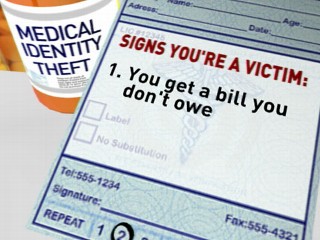
The Explanation of Benefits (EOB) statement arrived from our insurance company; it concerned a hospital visit that had never occurred. A stranger had successfully used a family member's Social Security number and birthdate to receive treatment and have it charged to our insurance. Phone calls to the hospital and insurance company corrected their records, and we weren't liable for any charges.

(Image from ABC News)
We were victims of a burgeoning cyber-crime, medical ID theft, and were lucky that the consequences weren't worse.[bold added]
Medical identity theft—in which someone fraudulently uses data to bill for medical services—affected 2.3 million adult patients in 2014 versus 1.4 million in 2009...

Thieves use many ways to acquire numbers for Social Security, private insurance, Medicare and Medicaid. Some are stolen in data breaches and sold on the black market. Such data are especially valuable, sometimes selling for about $50 compared with $6 or $7 for a credit-card number, law-enforcement officials estimate. A big reason is that medical-identification information can’t be quickly canceled like credit cards.
Medical privacy laws, enacted to protect patients' welfare, make it difficult to disentangle the thief's records from one's own:
Federal medical-privacy laws bar a person’s access to someone else’s data, even if the information is in their own files, medical experts say.
Despite the knotty problems, we are confident that medical identity theft will become much less of a problem: privacy laws will change, ID technology will improve, and the medical payments system will be overhauled. In the meantime, we are checking our statements and guarding our data.

Tuesday, July 29, 2014

Good News from an Impressive Work

The good news [bold added]:
Medicare will be able to continue paying full hospital benefits for its elderly or disabled clients without any changes in the law through 2030.
The not-so-good news for those who collect disability payments:
the Social Security disability-insurance program....will be able to pay only 81% of benefits starting in late 2016 unless Congress intervenes. Roughly 11 million Americans collected a total of $140 billion in Social Security disability benefits last year.
The first selfish question that arises in the mind of every reader, including your humble observer, is: how old will I be when the money runs out for the programs that affect me? The reaction may be relief or despair, but either way, through the mechanism of government or the ties of family, our children will be taking care of us.

By the way, the 2014 Social Security trustees' report is an impressive work. One can quarrel with its assumptions and calculations, but the report incorporates all the factors (mortality rate, immigration, economic growth, fertility rate, etc.) that should be considered in this complex analysis.

Monday, June 23, 2014

Unfortunately, Math is Involved

The complexity of Social Security has been likened to an atypical conversation about salary with one's employer:
You can pick from dozens of different ways to be paid and hundreds of different start dates, and each will produce a different salary. We offer some guidance, but we're short-handed. As such, deciding when and how to collect a paycheck is essentially up to you.

"So…what would you like to do?"
To make the optimal decision, the Social Security recipient should have a financial model--probably a spreadsheet--that projects her cash flow over her expected remaining life before the addition of Social Security benefits. If she's married, the model should include the pre-SS income and expenses of her spouse.

The impact of various choices (for example, claiming reduced benefits at age 62 vs. the highest benefits at age 70, or selecting spousal benefits instead of benefits based on one's own earnings) should be added to the model cash flow. The incremental SS benefit each year, after tax, should then be discounted (the theoretically correct rate is open to question, but a reasonable starting point is whatever one expects the inflation rate to be) to calculate the net present value, and one should select the option that produces the maximum NPV. 

Of course, not one person in a hundred attempts the above, even those (ahem) who have worked in financial analysis for decades.

Simple rules of thumb--like waiting to claim benefits if one can afford to--don't always produce the optimal result. True, benefit payments reach their highest point by deferring them until age 70, but the file-and-suspend strategy at age 65 (or whenever full retirement age is reached, depending on one's date of birth) may produce a higher net present value. That's the strategy that we eventually are likely to follow.

I thought there wouldn't be any, but unfortunately math is involved. © 2014 Stephen Yuen

Tuesday, June 18, 2013

Getting the Most from Social Security

Boston University professor and Social Security expert Laurence Kotlikoff, after years of studying Social Security's "devilishly complex" provisions, has formulated three general rules for maximizing one's lifetime benefits:
Rule A: Take Social Security's really good deal, namely waiting to collect much higher benefits, over somewhat fewer years.

Rule B: Take spousal, survivor, mother/father, and child benefits, which may be available to you based on your current or former spouse's earnings history.

Rule C: Make sure that following Rule A doesn't undermine following Rule B and vice versa.
Using a hypothetical example, CBS Moneywatch confirms his approach:
A working husband files for his benefits at full retirement age [currently 66 to 67, depending on one's date of birth], and his spouse (with little or no earnings history) files for her spousal benefits.

The husband's request to file also includes an immediate request to suspend his benefits. By doing this, his wife can begin to receive her spousal benefits.

Later, ideally at age 70, the husband can claim his benefits when the monthly amount is larger.
There are many exceptions, of course, to the traditional-American-family-plus-lengthy-golden-years scenario. Both spouses may have long earnings histories, either or both may have divorced and remarried, either or both may have poor health, or the family finances may not be able to afford deferring the benefits. Most individuals will require expert help to run the numbers; failing that, they may decide to make an important and irreversible decision based on "gut feel."

It is a sad fact of modern life that interactions with our government, such as paying taxes, receiving benefits, or applying for permits and licenses, are complex and burdensome, where the penalties for making a mistake can be significant. Thanks go to Prof. Kotlikoff, whose articles on Social Security are a regular feature on pbs.org, for helping us to navigate these treacherous waters. © 2013 Stephen Yuen

Tuesday, May 07, 2013

The Question at the Center of Everything

Nearly 50 people showed up for the PARCA session on independent housing. (The Parents' Association for Retarded Children and Adults was formed 62 years ago and is now known by the acronym rather than its original name. The session was entitled "Transition toward Independence: Independent Housing for People with Developmental Disabilities.") They heard speakers from the Golden Gate Regional Center, the San Mateo Department of Housing, HIP Housing, West Bay Housing, and PARCA.

Many of the faces in the audience have become familiar over the years. The welfare of loved ones who will never truly be "independent" is a lifelong task. There rarely are solutions given in these sessions; but maybe they'll learn of organizations, laws, and people who can help solve some of the problems.

Their charges have differing medical conditions, the government classifications are different (e.g., Social Security Disability, GGRC client), and the caregivers have differing degrees of financial resources and expertise. But even those who can bequeath a house and other assets to their loved one know that someone will need to make sure that the bills are paid, the faucets are fixed, and the prescriptions are filled.

Everyone is tormented by the question at the center of everything: who will look after our loved one after we're gone? For most of the people there are years, even decades, to answer the question, but answer it everyone must. © 2013 Stephen Yuen

Monday, March 25, 2013

Take the (Retirement) Money and Run

The following financial news item may seem alarming:
Combined pension deficits among the 100 largest U.S. corporate pension plans soared last year to a record $388.8 billion, according to actuarial and benefits consulting firm Milliman Inc.
In a later paragraph, we discover:
At year end, the 100 largest pensions were 77.2% funded combined, down from 79.2% at the end of 2011, Milliman said.
It's really not that bad. Using simple arithmetic, we can easily calculate that the present value of these pension plan obligations is about $1.7 trillion, while the assets are a little over $1.3 trillion. Because of the size of the assets already in the plan, rising financial markets can reduce the deficit significantly. Also, depending on the age of the workforce, companies have years, perhaps decades to make up the shorfall, if any. Workers who participate in these plans should not lose any sleep over the security of their retirement.

All that said, I jumped at the chance to take my pension in a lump sum when I early-retired several years ago. Very roughly, the lump sum was about the same as ten times the annual pension (for example, receive $100,000 now or $10,000 per year from age 65 until death). My employer was a company with an investment-grade credit rating and can easily manage indefinitely its total required actuarial contribution of a few million dollars per year. Making good on the pension obligations was not a concern. Nevertheless, I elected the lump sum and rolled the distribution into an Individual Retirement Account.

The reasoning was: 1) Take the bird in the hand. If I were hit by the proverbial bus, the funds would be in the estate. If there were an emergency, the funds would be available. 2) If I did live to a ripe old age, I was confident that I could beat the returns that my company would earn on its pension assets. 3) Tax flexibility was also a benefit. During a high-income year, no funds need be withdrawn from the IRA. Distributions would occur in low bracket years. (Note: flexibility is reduced after the age of 70 1/2, when "required minimum distributions" must commence.)

So far, everything is going according to plan. Though there's more work to be done than waiting for and depositing a monthly check, I'm less worried now that I have taken the retirement money and run. Wish I had the same option for my Social Security checks, though....... © 2013 Stephen Yuen

Saturday, December 29, 2012

The Fiscal Cliff is Not the Real Problem

The Government balance sheet
As Washington works through the weekend to avoid the fiscal cliff, U.S. News editor-in-chief Mort Zuckerman says that the current budgetary woes (the U.S. budget deficit for fiscal 2012 was $1.1 trillion) are dwarfed by the liabilities that the U.S. government is adding each year [bold added]:
Today the estimated unfunded total is more than $87 trillion, or 550 percent of our GDP. And the debt per household is more than 10 times the median family income.

.... the real annual accrued expense of Medicare and Social Security alone is $7 trillion. The government's balance sheet does not include any of these unfunded obligations but focuses on the current year deficits and the accumulated national debt.
The government balance sheet is not only less transparent, but misleading for not including material obligations (below information obtained from 2011 GAO report) that any private-sector entity would be prosecuted for omitting.


If there's one New Year's hope that your humble observer has for public governance, it's that legislators and the public have better information to gauge the consequences of their decisions. One place to start would be in government reports that are held to the same requirements that are demanded for the rest of us. © 2012 Stephen Yuen

Sunday, April 18, 2010

Relieved and Guiltless

Some of the people in my circle have formed a very negative attitude about the Tea Party movement which is attracting adherents across America. Tea Partiers thus far don’t seem to have developed a fully consistent set of ideas (government’s too big, don’t raise my taxes, but don’t touch my Medicare); the movement shares many aspects of libertarianism but has a long way to go to become a governing philosophy.

But I am sympathetic to the view that government is growing much too large. This opinion is not so much ideological as it is pragmatic or “scientific”, that is, induced from personal experience. The services that government delivers, such as health care and education, are complex, but no more so than operating an airline or an oil company.

Public servants whom I’ve met mean well, but they’re not subject to the cruel discipline of the market place that forces them or their bosses to make hard choices or be out of business completely. Public sector layoffs do happen, but there is no practical possibility that my woe begotten State of California , for example, will declare bankruptcy and restructure the long-term contracts that are the source of much of its fiscal problems.

As government’s role expands from protector (police, fire) to provider, consumers are forced to obtain the goods and services they need by navigating a bureaucracy instead of shopping amongst competitive sellers. Members of our family have spent innumerable hours reading regulations and instructions, filling out forms, and trying to get through to a real person who will answer our questions. It’s frustrating to apply for the medical, education, unemployment, and other financial benefits for which we qualify. Often, we have given up.

[It’s common at this point to level the charge of hypocrisy against smaller-government advocates if they apply for government benefits. Well, these people may have wanted a world with lower taxes and lower spending, but they lost the argument. To me it’s not hypocritical to apply for Social Security benefits when they’ve been paying Social Security taxes for 40+ years or seek unemployment benefits when they and their employers have been paying Federal and State unemployment taxes. After the law is enacted, if a person, regardless of his position in the debate, pays his taxes, he gets to claim benefits.]

I digress. The real purpose of this meandering post was to celebrate the passage of another April 15th. If you think the benefits side of government is confusing, you should see its revenue/tax side. (I’ve written before about my frustration—here’s an example--regarding not the level but the complexity of the tax system.)

This year I had spent long days compiling our 2009 information and got the basic forms mailed by noon on April 15th. It was only in the late afternoon when I remembered a limited liability corporation (LLC) that I had created over a year ago. This LLC is a so-called “disregarded entity” for income tax purposes, but fees and forms still have to be filed. After they cash my check I know these pieces of paper are destined for the giant warehouse that we saw at the end of “Raiders for the Lost Ark.” However, if I ignore the rules it will doubtless be a black mark on my permanent record somewhere. [BTW, a “permanent record” on every citizen was widely believed to exist during the paranoid 50’s and 60’s; it was dismissed as an urban legend in subsequent decades. Who’s crazy now? (:-) ]

But enough caviling. For the past two nights I’ve slept the blissful sleep of the relieved and guiltless. It’s a beautiful Sunday in the neighborhood and 72 degrees F. I’m closing the laptop and going outside. I hope you, dear reader, do the same. © 2010 Stephen Yuen