Friday, July 14, 2017

This Conspiracy Makes Sense.

Nearly everyone knows the adjective, how about the noun form?

Donald J. Trump, Jr., naïf:

Donald Jr and Fredo (John Cazale) (Vox juxtaposition)
when the Obama administration couldn’t get permission from the FISA court to surveil Trump, they allowed Veselnitskaya back into the country to take part in those Washington activities aside from whatever legal work she supposedly would be doing, and in the meantime the administration’s pals at Fusion tasked Goldstone with attempting to hook Trump Junior, whose performance makes him not a terrible analog for Fredo Corleone, into a meeting at Trump Tower to pass along “opposition research.”

And once that meeting — which on its surface was a waste of everyone’s time — was had, the Obama administration now had something to sell to the FISA court to get that warrant — from which they snagged Mike Flynn and gave the Democrat party and the media a mechanism to shroud the Trump administration in what can best be described as a rather dubious scandal. Remember how Hillary Clinton was accusing Trump of being a Putin’s puppet at the October 19 debate?
The hypothesis, at its essence: The Obama Administration ensnared the Trump campaign by allowing visa-already-denied Natalia into the U.S. just in time for a meeting with Donald Junior. Aha! Junior is meeting with Russians! FISA warrant approved.

Even liberals will admit that this "conspiracy" makes more sense. The much smarter Democratic operatives played chess while the Trump rubes thought the game was checkers. Yet, somehow, the naïfs won when it counted.

Not Miracle Whip, Just a Miracle

Homeroom's mac-and-cheese waffles (SF Gate)
Skipping National Mac and Cheese Day is the price one pays for middle-onset lactose intolerance.

I will never darken the doors of Oakland's Homeroom Restaurant, whose entire entrée menu consists of variations on the popular comfort food.

I will never again dine on the sliced hot dogs and Kraft mac-and-cheese that I loved as a child. Perhaps it's just as well, because boxed M&C contains "phthalates — which have been linked to genital birth defects in baby boys and behavior problems in older kids."

I played baseball in the streets with the neighborhood kids and climbed six-foot-high jungle gyms, falling once onto a hard asphalt surface and never making that mistake again. I walked a mile to and from school with busy urban traffic whizzing by. And now it turns out that phthalates were in the mac and cheese.

It's a miracle I'm still alive.

Thursday, July 13, 2017

Diversity in Pedagogy

(Photo from eljay.org)
Mills College of Oakland has fired five tenured professors in a cost-cutting move [bold added].
Mills, one of only 36 women’s colleges remaining in the United States, is again deep in the hole. But unlike dozens of other women’s schools that have voted in recent decades to admit men to solve financial woes, Mills trustees made a controversial decision of a different kind this summer: They fired tenured professors, a move rare in academia and unprecedented at Mills.
With 1,400 students--about two-thirds undergraduates--Mills has long been known as an excellent private college. Wikipedia: [bold added]
In 2015, U.S. News & World Report ranked Mills sixth overall among colleges and universities in the Western U.S. (regional universities) and one of the top colleges and universities in the Western U.S. in "Great Schools, Great Prices," which evaluated the quality of institutions' academics against the cost of attendance. The Princeton Review ranks Mills as one of the Best 380 Colleges and one of the top "green" colleges in the U.S. Washington Monthly ranks Mills as one of the top 10 master's universities in the U.S.
I attended college in the 1970's, after men's universities, including mine, had gone co-ed. I wondered why the arguments that applied to admitting women to men's schools (enriched educational experience, diversity of opinion, enhanced preparation for "real life," social benefits, etc.) weren't relevant to men attending women's schools. The double standard was one of the reasons that I became disenchanted with the progressive agenda.

Today I'm glad that Mills has chosen to remain the way it is. Women's colleges are disappearing, now that the main reason for their existence has vanished:
  • The earliest women’s colleges were founded in the mid-19th century to give women access to higher education. This was a time when many people believed that it was unnecessary to educate women whose place was in the home, and that rigorous study could be unhealthy for women.
  • In 1960 there were about 230 women’s colleges.
  • In 2014, there were 47 women’s colleges in the U.S. and Canada.
  • There's a sameness to university education across the country: high costs, racially diverse student populations, women in the majority, leftist politics, and poor job prospects for non-STEM (science, technology, engineering, mathematics) majors.

    Schools that once catered to specific groups--blacks, women, military, Christian--have become rare. It's important to preserve them, not just for students who wish to learn in a different environment but also because innovation springs from a diversity in pedagogy. Two cheers for Mills.

    Wednesday, July 12, 2017

    Prime Day Savings

    I didn't know I needed a combined corkscrew and bottle opener until I saw it on Amazon's website during Prime Day. The same can be said of a stainless steel chips-and-dip bowl, a pet-hair cordless vacuum, and three--count 'em, three, no less--accordion files to file all the papers that I've been meaning to scan electronically.
    Add caption
    My bicycle cover has some holes in it, so I'll take one of those. Of course, one can use another pair of inexpensive earbuds.
    They're always getting lost or broken. Sure, I don't "need" any of this stuff, but look at all the money I've saved.

    Tuesday, July 11, 2017

    Because They Can

    When a business struggles, it has to find a way to keep up with the competition--for example, retail stores vs. Amazon---else it fails. When a monopolist struggles--for example, electric utilities vs. homeowners' solar panels--it makes some effort to change, then petitions for rate increases that are usually granted. When a government monopolist struggles, it always raises rates.

    Four years ago the Golden Gate Bridge District, which at $6 charged the highest toll in the Bay Area, eliminated human toll takers under the guise of cost reduction. We griped:
    I'm all for government operating more efficiently, even if that means some jobs will be lost. In this case, however, efficiency means a significantly degraded service, a service which everyone must use because there are no feasible alternatives. Drivers who don't wish to open an account, prepay a toll, or mail in a check have no choice. It's the bureaucrats' bridge, not ours.
    We threw in the towel and obtained a FasTrak reader though we cross a toll bridge about once a month. (There's a surcharge if the District takes a picture of your license plate and bills you; there's also a chance you could be caught in red-tape hell.) We keep a $25-$50 credit on FasTrak, which means the authorities have a permanent, interest-free loan from us and hundreds of thousands of drivers.

    Of course, none of these actions stopped toll increases: [bold added]
    Starting Monday [July 3, 2017], the majority of bridge traffic — two-axle cars — will be charged the increased rate to cross one of the world’s most famous bridges, according to the Golden Gate Bridge, Highway and Transportation District.

    A discount will remain on FasTrak electronic passes as an incentive for Bay Area motorists to use them. Under the new rates, FasTrak users will pay $6.75 per crossing.

    For those without FasTrak, the bridge’s automatic license plate scanner — which snaps a photo of license plates and mails an invoice, even to out-of-state motorists — will go from $7.50 to $7.75. The toll gates are cashless. The toll hikes were initially approved in February 2014 by the bridge agency’s directors, who said they needed the additional funding to recover from a budget deficit.

    Bridge overseers have enacted regular, similarly sized toll increases since then, with annual rate rises scheduled through 2018.
    They do it because they can.

    Monday, July 10, 2017

    Mastering a Subject in the Age of Twitter

    At the Barnes and Noble entrance.
    Malcolm Gladwell popularized the 10,000-hour rule ("you need to have practiced, to have apprenticed, for 10,000 hours before you get good.")

    I am not so naive as to believe that I can master a subject in 30 seconds. I am just trying to know enough to bluff my way through cocktail party conversations.

    Sunday, July 09, 2017

    Money Isn't Everything

    The WSJ columnist cites a seven-year-old study that merits revisiting. The question: Can Money Buy Happiness? [bold added]
    In 2010 Daniel Kahneman and Angus Deaton analyzed data from over 450,000 responses to a daily survey of 1,000 U.S. residents by the Gallup Organization. They found that money does influence happiness at low to moderate levels of income. Real lack of money leads to more worry and sadness, higher levels of stress, less positive affect (happiness, enjoyment, and reports of smiling and laughter) and less favorable evaluations of one’s own life. Yet most of these effects only hold for people who earn $75,000 a year or less. Above about $75,000, higher income is not the simple ticket to happiness that we think it is.
    This study is another confirmation of the hierarchy of needs that Abraham Maslow postulated over 60 years ago. A certain threshold of income---on average $75,000 p.a. in 2010---is necessary to provide for physiological and safety needs. Higher-order, "softer" goals (love, belonging, social- and self-esteem) are harder to achieve and often impossible to "buy".

    It sounds corny, but these higher-order objectives usually cannot be attained by explicitly seeking them. For example, a man may try to impress a woman, the woman sees through him and may go along in the short term, but a bond that results in lasting happiness depends upon factors other than money. In other arenas, if making partner or earning tenure is openly transparent, the candidate, regardless of merit, often fails because of his visible ambition.
    For whosoever will save his life shall lose it: and whosoever will lose his life for my sake shall find it.--Matthew 16:25

    Saturday, July 08, 2017

    The New Company Town

    The American company town reached its heyday between Reconstruction and the 1920's. The lack of basic services across the nation's empty expanses necessitated that businesses create schools, stores, and churches for their workers; the number of company towns reached an estimated peak of 2,500 about a century ago, after which the automobile and rising affluence reduced the importance of living close to one's employer.

    Here in the Bay Area the original raison d'être---providing basic services---for company towns had vanished long ago; nevertheless, company towns are being carved out in existing, highly developed cities.

    Google's planned 1.2 million sq. ft. campus (Verge)
    Google dominates Mountain View (pop. 80,000):
    At a January 22nd, 2013 meeting, Google's VP of real estate David Radcliffe gave the city council something of an ultimatum. "We can either grow up, taking the buildings we have now and making them bigger and denser, or we can sprawl out in a continued march through neighboring business parks and communities."

    The company has bought or leased a total of nearly 2 million square feet since that meeting, including giant parcels west, south, and east of the company's traditional North Bayshore haunts.
    Facebook's Anton Menlo apartments
    Facebook is building a $120 million complex in Menlo Park (pop. 33,000):
    The social network said this week it is working with a local developer to build a $120 million, 394-unit housing community within walking distance of its offices. Called Anton Menlo, the 630,000 square-foot rental property will include everything from a sports bar to a doggy day care.

    One of Facebook's corporate goals is to take care of as many aspects of its employees lives as possible. They don't have to worry about transportation—there's a bus for that. Laundry and dry cleaning? Check. Hairstylists, woodworking classes, bike maintenance. Check.
    And then there's Apple's "spaceship" headquarters in Cupertino (pop. 61,000):
    Steve Jobs' vision (Wired photo)
    Everything in this building is the best. The toroid glass of the roof curves scientifically to shed rainwater....Of course, it only has 9,000 parking spaces, but that’s supposed to encourage people to take an Apple shuttle to work. And once they arrive, they’re not going to want to leave. The fitness center has a climbing wall with pre-distressed stone. The concrete edges of the parking lot walls are rounded. The fire suppression systems come from yachts. Craftspeople harvested the wood paneling at the exact time of year the late Steve Jobs demanded—mid-winter—so the sap content wouldn’t be ruinously high.
    Apple and Google (Alphabet) are the two most valuable companies in the world; Facebook is #7 and rising. For the sake of the 21st-century company towns that they are building, here's hoping that these companies stay valuable for a long, long time. (Term for the kiddies to look up: white elephant).

    Friday, July 07, 2017

    Exercise Can Make You Sick

    Norway has two million(!) sheep.
    News item: Sheep poo makes Norwegian cyclists sick.
    Of the 300 cyclists who took part in the TransØsterdalen race at the end of June in southeastern Norway, at least 50 were struck with fever, stomach pain and diarrhoea in the days following the competition, according to public broadcaster NRK.

    "This is most likely a Campylobacter infection," race doctor Tor Halvor Bjørnstad-Tuveng told NRK, referring to a bacteria which is present in the intestines of many animals.

    He said material from the sheep droppings, which have decomposed during heavy rain and projected on the bikers' route, must have sprayed onto their bottles, faces and hands as they rode by.
    Ah, the great outdoors, just smell that....fresh air.

    Your humble blogger's monkey mind hopped to this great moment in television from the 1960's:

    Thursday, July 06, 2017

    My Furniture Has a Mind of Its Own

    There's undoubtedly a manual release if the bed retracts while you're still sleeping (right?). (Ori photo)
    If you have nightmares about your bed swallowing you at night, then this furniture is not for you. [bold added]
    With the push of a button—or, with future versions of the software, at the sound of a voice or wave of a hand—pieces of Ori furniture will slide up, down, or over, reconfiguring spaces in mere moments. The harder you press the arrow button on the interface, the faster the wall will move—an interaction Larrea says is like moving a heavy wall with one finger. A bed can disappear, to make room for a work desk. A wall can come down, to create private spaces in an otherwise open studio apartment. A 350-square-foot apartment will, ideally, function more like a 600-square-foot one.
    In a market where a one-bedroom apartment can be $1,000 more than a studio, a $10,000 investment in the Ori system will be paid back in a year. It's much cheaper to have a living room change into a bedroom than to have the "luxury" of moving from one room to the other. How many rooms can one physically occupy at a time?

    Wednesday, July 05, 2017

    Nearly Every Day

    From 13 years ago:
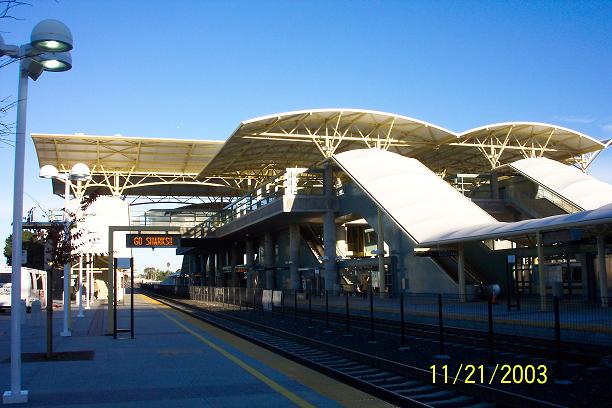
    The Millbrae BART/Caltrain connection is a maze of concrete, escalators, ducts, stairs, turnstiles, and ticket machines. The designers did their best with the translucent roofing, but there are too many dark, cold areas. Yes, the station is functional, but the parking lots are mostly empty and traffic is far below expectations.
    The booming Bay Area economy and the addition of a BART line to San Francisco Airport should have improved Millbrae Station's utilization. However, [bold added]
    By now, BART’s Millbrae Station — with its connections to Caltrain, buses and shuttles — was supposed to see 16,500 passengers pass through its fare gates every weekday, making it the fifth-busiest station in the system.

    But 13 years after it opened, it’s pretty much just another BART station, nowhere near the bustling Peninsula transit hub that planners envisioned. With just under 7,000 riders entering and exiting daily, the station ranks 27th in activity among the transit system’s 46 stations.
    One of the problems is that there's little coordination between BART and Caltrain. A passenger trying to get from Oakland to Mountain View would take BART to Millbrae, then often wait more than 30 minutes for the next southbound Caltrain---and that's when both BART and Caltrain are running on time.
    BART riders coming from the north and bound for Caltrain arrive on the east side of the station. To catch Caltrain, they have to ascend escalators or stairs, exit through the BART fare gates and walk a few yards across the concourse before descending to the Caltrain station’s west side.
    When it's not rush hour, the drive would take one hour, and mass transit two. When Millbrae Station opened, a round-trip BART fare from Millbrae to San Francisco was less than $5. Parking was free, an obvious inducement to try the new station.

    Now the round trip costs $9.30, and parking is $3. It's no wonder that BART doesn't attract more commuters; it's too expensive for low-wage earners (even if the minimum wage rises to $15 an hour), and it's too inconvenient for those with high incomes, who choose to park in downtown buildings at $25 per day ($5,000 per year).

    Don't get me wrong--I'm glad the station was built. It's very useful to have an alternate means into the City since the highways are backed up nearly every day.

    Tuesday, July 04, 2017

    Monday, July 03, 2017

    Cross-Cultural Marketing

    We've previously noted how one of Japan's popular soft drinks, Calpis, had to change its name to the non-cringeworthy Calpico when it was introduced to the American market.

    The Daio Paper Company should likewise consider a name change for its GOO.N diapers. Goon has several meanings in the English language, none of which are positive.

    The diapers appear to be an excellent product whose high price won't deter parents in this market. Perhaps "Glow" or "Good'n Dry"?

    Sunday, July 02, 2017

    Love Isn't Logical

    Our household has been home to guinea pigs for over ten years. Affectionate, quiet animals, guinea pigs demand little attention (unless they're sick).

    Through the local Episcopal Church we have been long-time contributors to the Heifer Project, which donates farm animals to Third-World villages and instructs recipients on how to care for, use, and breed the animals under the "teach a man to fish" principle. We've taken field trips to the Heifer Project's demonstration farm, now closed.

    "Cuy" = guinea pig; a cuyeria serves...(World Ark)
    These two of our interests converge in South America, where guinea pigs are a source of protein in the village diet. The Heifer Project has an active guinea-pig program in Peru.
    In 2013, Heifer Peru started working in Ccorca to help families raise and sell guinea pigs. The animals, which are indigenous to the Andes, have been a food staple in the region for thousands of years, and are an important part of local culture.
    Unlike large animals, guinea pigs are eaten in one sitting and do not require refrigeration. Yes, that's a very practical point of view, unlike incurring pocket-pet medical expenses that vastly exceed the cost of the pet herself. But love isn't logical.

    Saturday, July 01, 2017

    Appreciated by the AARP Crowd

    In the great Costco vs. Amazon debate (we regularly buy from both) Costco gets more of our shopping dollar, even combining our Whole Foods spending with Amazon. One of Costco's advantages is the value proposition of its private Kirkland label.

    Kirkland jeans are under $15 and reasonably durable, but lately my two pair have been getting a little snug--from repeated dryings, of course. "New relaxed waist" is a timely innovation that might turn off the skinny teens and 20-somethings that shop at Costco but will be appreciated by the AARP crowd.

    Lots of marketing data went into this one.