Thursday, October 27, 2011

Diocesan Convention

Friday night mass at Grace Cathedral
It was a beautiful weekend in the Bay Area, and I spent it indoors. Every October members of 108 Episcopal churches in Northern California gather at Grace Cathedral for the Diocesan Convention.

Prayers are said, reports are presented, resolutions are made, and officers are elected. Given all the business that had to be conducted---the Diocese has 162 years of legal and procedural barnacles encrusting its activities---it was remarkable that we completed the agenda within the allotted nine hours.

Bay Area attendance has dwindled to a weekly average of 8,500 Bay Area worshipers. Bishop Marc called for renewal--we dare not call it evangelism!--by telling our story to the community. There is an ingrained reluctance and much Scriptural support against tooting one's horn, but in these cacophonous times one can't be completely silent. The church and church members perform many unpublicized acts of charity; some people in the wider community might be interested in joining the Church if they heard about them.

The spirit of comity pervaded the meeting hall, even during the contentious debate on Israeli settlements. The proposed Resolution called for "divest[ment] from all companies that enable the Israeli occupation of the West Bank and East Jerusalem and to boycott all products manufactured in Israeli settlements." The church would urge other organizations, such as the $236 billion California Public Employees’ Retirement System (CalPERS), to liquidate investments in such companies, which included names like Boeing, Motorola, Caterpillar, and General Dynamics.

To soften its seeming one-sidedness, the Resolution was amended to acknowledge the rights of both Israelis and Palestinians to self-determination, statehood, safety, and security. Nevertheless, the Resolution was defeated, 171-144, in a show of hands. We live in one of the most liberal Dioceses in one of the most liberal Protestant denominations, but this one was too much to swallow. Other resolutions, which pertained to church matters, passed overwhelmingly.

After the convention adjourned, we passed by Occupy SF demonstrators marching along Sixth Street. There are many different ways, over and above mere working and consuming, that people choose to participate in civic society, and some of them were on display on this beautiful weekend in the Bay Area.

Monday, October 24, 2011

Remarkably Prescient

Siri, Apple's artificial intelligence system for the iPhone 4S, is one of the final building blocks necessary to realization of Apple's vision of computing. The "Knowledge Navigator" video was produced in 1987.

Wednesday, October 19, 2011

The Year of Bottoming Out

Bishop Marc made his biennial visit last Sunday, and the church was packed. Turnout was impressive, considering that at the same time the 49ers were playing in Detroit in the NFL's game of the week. Perhaps it is true, as the Bishop said afterwards, that the decades'-long decline in Episcopal attendance has been arrested. On the other hand many of us do have TiVo.

Bishop Marc alluded to Herman Cain's 9-9-9 tax plan when he meditated on the "render unto Ceasar" Gospel passage. (I wonder if part of the inspiration came from Monday's tax deadline.) When we are first introduced to the story, we are struck by Jesus' cleverness in evading the questioners' effort to elicit an anti-government answer. But the passage goes deeper than that, said the Bishop. All things come from God, so we are not talking about parallel tax systems to divvy up the boodle (not his words--we in the pews have to use terms that we understand) but the nature of things, of wealth, and of ownership.

After he was done with the homily the Bishop welcomed a group of enthusiastic confirmees as full-fledged members of the Anglican Communion. I surreptitiously checked the football score on the iPhone; after falling behind 10-0 early, the Niners came back to take the lead 12-10 at the half (the final score was San Francisco 25, Detroit 19).

Perhaps this is the year that a lot of things take a turn for the better.

Monday, October 17, 2011

Simplification Isn't Simple

Last year's 46-page return.
Gradually clearing the clutter of our financial affairs, I managed to reduce our 2010 tax return by three pages. (Shrinkage could also have been correlated with less income in some activities.)

Today, October 17th, is the absolute deadline for filing 2010 income tax returns. The only way for us to file on April 15th would be if we were to divest ourselves of some investments whose records for the previous year aren't finalized until August. Getting out would be complicated, not to mention costly, from a tax and legal point of view.

If simplification were simple, more people would do it.

Sunday, October 16, 2011

Upside Correction


Another reason to feel sanguine: after the two-week October rally, market indices and most balanced portfolios have climbed back to even for the year. For Apple investors like yours truly, our joy at being up 30% since December is not unadorned because of the death of the company's great and glorious founder. We await Tuesday's earnings call with both anticipation and trepidation.

The travails of the European Union were the prime reason for stocks' near-collapse over the summer. Last week's signs of cooperation among the major European powers, plus some reassuring noises from U.S. Treasury Secretary Geithner, seem to have stabilized markets. We are not out of the (Bretton) woods yet, but the euro's survival seems assured in the short term.

So enjoy the rest of this year. Next year, when the United States elects a President, promises to be exciting and not in a good way.

Friday, October 14, 2011

What a Difference a Year Makes

The Vaillancourt Fountain is going full blast. Water transforms the skeletal frame, infusing the plaza with life.

On this fall morning only a few tourists stroll by. Seagulls and pigeons abound, waiting for the lunch crowd. Pickings will be slim. Pedestrian traffic has been declining for years. And this is Friday, which has become a half-work-day or working-from-home day at many firms.

Last year around this time the Embarcadero was buzzing with sports fans as the Giants marched through the playoffs. Now it's back to subdued normalcy. Thank goodness---for productivity's sake.

Tuesday, October 11, 2011

Reason for Optimism

Despite wars, joblessness, and the crumbling of the global financial system, there is reason for optimism:
Lions (5-0) to host 49ers (4-1) in battle for … NFC supremacy?
--Sports headline in the San Jose Mercury News
No one thought that the NFL Game of the Week in mid-October would be the San Francisco 49ers vs. the Detroit Lions. Both teams finished with six wins and ten losses last year, and most experts at the beginning of the season predicted only modest improvement at best. The Niners and Lions exemplify how quickly fortunes can turn for the better (we are sadly familiar with how they can turn in the other direction).

The teams' recent success is of course attributable to their rosters of talented players, but the, er, lion's share of the credit has rightly gone to the coaches. In the Bay Area we read regular reports of how former Stanford coach Jim Harbaugh has instilled expectations of winning into a moribund San Francisco franchise. Detroit coach Jim Schwartz has been equally lauded.

The Great Man of History theory fell out of favor in the 20th century as thinkers became enamored by "-isms" that said individuals don't make much difference. But surely our lives would be poorer if Martin Luther King, Henry Ford, Albert Einstein, Jonas Salk, or Steve Jobs had not lived. And on a much less important stage Jim Schwartz and Jim Harbaugh are showing that the theory lives on.

Thursday, October 06, 2011

"Without Steve Jobs, Where's the Excitement Going to Come From?"

...said a tech reporter on CNN last night.

In my lifetime a businessman's death had never merited the above-the-fold headline in the newspaper. Until this morning.

The passing of Steve Jobs was the lead story in not only the national dead-tree press but also the major TV networks and the most trafficked portals of the World Wide Web. (Here are the Steve Jobs bios from the NYT, the WSJ, and the LAT.)

Most of us who live in the Bay Area never met Steve in person, but we lived in his world. We bought Apple IIs and (sigh) Apple IIIs. Everyone knew someone who worked at Apple; we heard scuttlebutt about great secret stuff in the Cupertino labs. We switched to Excel, just because it came out on the Mac, when everyone else was using 1-2-3 spreadsheets on the PC.

We dreamed big because of Steve. Sure, Hewlett and Packard started up in the garage, but H & P did it in 1939. The two Steves showed that garages still were magic in the '70's. Inspired by their example many Bay Area denizens quit their corporate jobs and tried their luck. Most of us failed the first time out, but having caught the bug and lost the fear, we kept trying until we did make it.

The kids of Apple doffed their ties early, quickly followed by the rest of the Valley. It took a couple of decades for business casual to conquer the final redoubts in San Francisco's financial district. You couldn't tell who was rich or important by the way people dressed, so you had to treat everyone as if they were a millionaire.

When Steve was fired in 1985, he looked like just another guy who had reached his level of incompetence.

After the ministrations of a series of conventional CEO's failed, Steve returned to a nearly bankrupt Apple in 1997 and initiated the most remarkable turnaround in business history.

All is sweetness and light now, but at the time he made some ruthless decisions that tested the loyalty of the Apple faithful. He killed the clone licensing program, thereby accelerating their demise. (A $2,000 Power Computing clone that I had purchased in 1994 was nearly worthless three years later, and $2K was real money back then).

The new iBooks and iMacs looked interesting, but familiar ports were gone, replaced by a newfangled Universal Serial Bus that required us to buy USB printers and other peripheral devices. And where was the built-in floppy disk drive (available only as an external extra)? How were we supposed to move data from computer to computer?

As the vastly larger PC universe adopted Steve's changes, we began to trust his vision. As Steve's judgment proved correct at each major fork in the road, our caution gave way to anticipation, then overwhelming excitement.

Of course we stood in line for the "insanely great" product that Apple was about to release--available on-line or in the Apple store in the next 30 days--but what we were really eager to see was which entire industry was going to be created, upended, or destroyed in the next couple of years.

Steve Jobs has been compared to Edison, Disney, Rockefeller, and post-Industrial Revolution business titans. Perhaps it's not too much of an overstatement to reach further back in history for the apt comparison---Steve Jobs was both visionary Oracle and young Alexander, who died with worlds left to conquer. R.I.P. © 2011 Stephen Yuen

Tuesday, October 04, 2011

All Creatures Great and Small


Under azure skies priests from our local Episcopal church performed the annual Blessing of the Animals at the Foster City Dog Park. The Feast of St. Francis is celebrated by Catholics and Anglicans around the world to honor the patron saint of animals and the environment. The official date is today, October 4th, but we celebrated the Feast last Sunday, a fortuitous decision given the rains that began Monday.


A steady stream of four-legged creatures came forward. Dogs comprised the overwhelming majority. Young or old, large or small, calm or feisty, sure or unsure...all were welcome, just like their owners, to receive the laying of hands and a short prayer.


Cats were also well represented. As in previous years ladies from the Homeless Cat Network passed out brochures that promoted both the health and reduction of the population of feral cats. HCN's efforts to spay, neuter, feed, and adopt abandoned felines not only protect the cats but also the birds of the Bay.


There were no untoward incidents. Guinea pigs and birds were left alone by larger species. Two-legged animals cooed, stroked, and admired all the four-legged ones who were there. Nearly 800 years after his death, Francis of Assisi may be one saint who would be pleased at the works that have been done in his name.

Monday, September 26, 2011

Hale Nalu

Hale - home
Nalu - 1) Disappeared, lost; 2) Waves, surf.

One of the universal childhood experiences in Hawaii---at least when I was growing up---was camping underneath the stars. The mild temperatures and sounds of the ocean compensated for the lack of a mattress, and falling asleep was not difficult.

Not surprisingly, the warm climate also makes some choose homelessness as a rational response to the high cost of living, more than they would in other states:
As in other temperate places — like Santa Monica, Calif. — Hawaii’s climate is a draw to people looking to live outside. “I love it: free rent, free electricity,” said Sherri Watson, 43. “Who wants to stay in a bed-bugged shelter?”
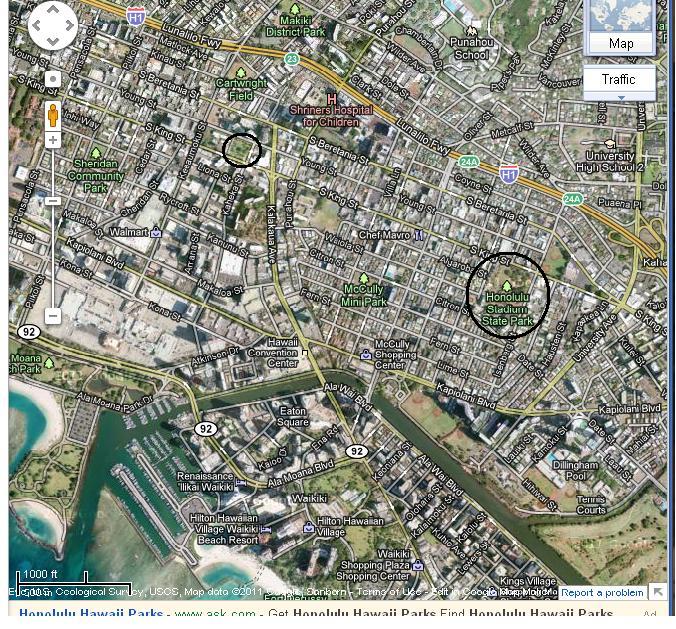
I had a couple of hours to kill between my visit to the downtown government offices and a dinner near the University of Hawaii. Walking east ("Diamond Head" to Honolulu old-timers) along King Street, less than a mile from the Honolulu beaches, is a chastening experience. The sidewalks and roads needed repair, and many of the buildings could have used a coat of paint. But the most disheartening sights were the tents in the park.

One ray of hope is that the Hawaiian unemployment rate of 6% is well below the national average of 9%. Let's hope that the recovery of the tourist trade continues and the tents get folded up.

Along King Street I walked past two parks where the homeless pitch tents.

At King and Kaheka Streets

Honolulu Stadium Park

Wednesday, September 21, 2011

Suddenly Important

September 21st has suddenly become an important date in the family scrapbook. My baby brother tied the knot today. Congratulations, Rich and Keli!

Risky Short Position

One of the drawbacks of getting older is the shrinking of body parts that we want to enlarge and the enlargement of those that we want to shrink. Muscles and neurons waste away, while cute button noses elongate to stalactite proportions. The overall effect is diminution: my old driver's licenses record the fact that I've lost nearly an inch in height over the past 20 years.

And, sadly,
The process accelerates with age, particularly after age 70. In one long-running study of more than 2,000 Baltimore residents, men lost an average of 1.2 inches between ages 30 and 70, and a total of 2 inches by age 80. Women lost an average of 2 inches between 30 and 70 and 3.1 inches total by age 80.
Above-normal height loss is an indicator of poor health.Osteoporosis increases the risk of hip and other bone fractures, and in men there is a correlation, as yet unexplained, between height loss and coronary artery disease. The future, more than ever, belongs to the thin, tall, and young.

Saturday, September 17, 2011

Still Waiting

My Hawaii State ID card will expire in a few months, five years after I received it. Through no basis other than my incurable optimism I expected the renewal process to take much less time than it took to get the original ID. My expectations were misplaced.

One can fill out the original or renewal form online, but one still has to show up in person, after making an appointment, to take pictures and present documents; filing online will cut the wait time to about 90 minutes. However, this avenue wasn't open to me, since the earliest appointment was in two weeks and I would be traveling in one week. [Aside: this is one of the biggest concerns about government-run health care--the cost is nominally low but everyone would be forced into long queues, though individuals may be willing to pay more to cut down the wait. Rightly or wrongly, people generalize from their experiences at the Dept. of Motor Vehicles, the Post Office, the airport, or even at the Tax Collector and ask, why would government be more efficient this time?]

It may not look so bad, but there are another 30 people past the door.
I'll spare you the details, dear reader, and just say that I entered the line at 1 p.m. and left with my new ID card at 4:30. In a small sign of progress the ID card won't have to be renewed for eight years. (Watch for my follow-up post in 2019.)

After document inspection, another wait for the photo.

Thursday, September 15, 2011

Ah, Chew

Red Fox Casino lavatory sign, Laytonville, California

When you use a word that can be either noun or verb, make sure your meaning is obvious.

The greater grammatical offense may be the use of scare quotes around "Do Not." Scare quotes are meant to convey irony or a meaning opposite from the plain text; they are a distancing mechanism. Somehow I don't think the writer means to be ambiguous.

Sunday, September 11, 2011

I'll Take It

I saw it on TV, like almost everyone else. I shuffled to the kitchen table with my cup of coffee and pushed the remote. The TV was set to Channel 11, NBC. It was 5:45 a.m. The Today Show was on; strange, normally it doesn't start till 7 a.m. on the West Coast.

The camera was fixed on the World Trade Center. Black smoke was pouring out of one of the towers. There were no jump cuts or commercials to distract the unblinking eye. Katie Couric's voice seemed dispassionate as she described how an airplane had crashed into the building. Surely it was a small plane and a horrible accident.

Then the second jet hit, another struck the Pentagon, and the towers fell. Other images are seared into our memories--the Pennsylvania field that became hallowed ground, the throngs who lustily cheered the deaths of thousands, flames and smoke everywhere, the weeping, the exhausted searching and the death of hope.

The fear gripped us for a long time. Not knowing has that effect. Who did it and why, how powerful were they, what's next, what should we do, what can I do?

Everyone--even those who were in charge of our government--can list major mistakes in the past ten years. All the criticisms have at least some plausibility: we waged war against the wrong people, maybe we shouldn't have gone to war at all, we mistreated prisoners, we had intelligence that was grossly wrong, we sacrificed too many of our civil liberties, we didn't pay the cost of the wars, and we are no farther along in being energy independent or securing the safety of Israel.

But if we are honest with ourselves, we will remember the worst of our fears:

1) we would be hit again and perhaps lose a major city; this event coupled with our response, could forever change the character of America;

2) if the attack were biological, we could lose much more than one city;

3) oil supplies would be disrupted, maybe cut off for a long time, and usher in a new Dark Ages;

4) Israel, surrounded by powerful enemies, could be destroyed.

5) A state of war would exist between the West and the Islamic world, which has over a billion people.

Ten years later none of these fears has been realized, yet victory, which we can't even define, seems as distant as it was in 2001.

I'll take it. © 2011 Stephen Yuen