Showing posts with label Syria. Show all posts

Wednesday, July 10, 2019

If I Can Do It, You Can Do It

It's a familiar sports story: an athlete becomes associated with a political position, some fans object, and boycotts ensue. In this case the athlete is Draymond Green, and the politics are about being pro-Israel, not anti-American.[bold added]
Chef Reem Assil (Chronicle photo)
[Palestinian-Syrian chef] Reem Assil, who has been praised by publications like The Chronicle and Food and Wine, has played a vital role in sparking Oakland’s Fruitvale neighborhood as a food destination. One of her signatures at her Arab bakery, Reem’s California, has been the “Draymond Green,” a seasonal vegetable wrap.

The chef’s decision to stop selling the dish is linked to Green’s 2018 visit to Israel. While there, Green posed for a photo holding a military rifle as though he were a sniper, during a stop at the base of an Israeli Defense Force counter-terrorism unit, the Yamam.
Draymond Green was one of the leaders in having the Warriors reject a visit to the Donald Trump White House after the team won the NBA Championship, so I'm sure he has empathy for Reem Assil. In his words
“In order to effect change, you have to stand for something. If you go about it the same way, you do the same things you do if everything is normal, then you won’t effect change.”

Saturday, April 14, 2018

Deconflicting With the Russians, Not So His Critics

The April 7th Syrian attack on their own people (Xinhua)
Our reality-show President--and I mean that in the nicest way--had to show that he was different from his predecessor. After repeated warnings to the Syrians against the use of chemical weapons, the U.S. was boxed in a corner. It had to respond to the April 7th attack that killed 40-70 non-combatants (let's discount the argument that it was a false flag operation, i.e., the Syrian government didn't do it, which both Russia and Syria claim).

The response had to be meaningful "without triggering a broader conflict with Russia and Iran." [bold added]
For the U.S. and its allies, the solution was to strike three targets, including a scientific research center in Damascus and a weapons-storage site west of Homs where no Russians were believed to be present...

The U.S. didn’t notify the Russians about the targets, but it reduced the risk of a clash with the Russian air force by letting their commanders know what airspace American and allied forces would be using—a process the Pentagon dubs “deconfliction."

The effort to avoid a clash with Russian forces appeared to succeed. The Pentagon said it didn’t detect the firing of any Russian surface-to-air missiles, though Syrian surface-to-air missile batteries were fired.

Still, the limited nature of the military intervention is likely to yield only limited gains, experts said.
Mr. Trump has many in Washington believing that he is crazy because of his hyperbolic tweets, criticism of his own staff, personnel turnover, and reaction to seemingly trivial events and statements.

Yet he backs off from crossing bright red lines, for example, when a Federal judge stays an Executive order Mr. Trump abides the stay while at the same time issuing fierce, often personal, criticism of the judge (Andrew Jackson famously defied Supreme Court rulings, an action Mr. Trump has not yet emulated).

Not attacking the Russians is another red line he didn't cross.

Note that after the joint operation with the U.K. and France the President composed a tweet meant to drive his critics into a frenzy.

Friday, April 13, 2018

War Finds You

Missiles over Damascus (AP via Chronicle)
President Trump announced airstrikes against Syria today,
a reprisal for an attack last week that killed at least 43 civilians and injured hundreds more.

The decision to strike was aimed at cutting off the production and use of chemical weapons in the country, President Donald Trump said at the White House on Friday night.
The Economist headline from two weeks ago, Why Donald Trump is unlikely to start a catastrophic conflict, is not greatly reassuring, but we'll take it.
it is still hard to imagine Mr Trump starting a war unless he thought he would gain from it personally, and he would not gain from a bloodbath.
Faint praise.

Saturday, April 30, 2016

Expert at One, Expert at All

Departing from its financial commentary, Barron's ventures into the geopolitical realm with an encouraging, surprising prediction: "the Islamic State, also known as ISIS or ISIL, [will] see its power and territory greatly diminished by the end of 2017."

The claim that "ISIS will fall soon" is based on Barron's assessment of the capabilities and motivations of all the major players, including Russia, Saudi Arabia, Iran, Iraq, Syria, Israel, and the United States.

Color your humble blogger extremely skeptical. The Middle East is more complex than the most complex system, and even simple systems produce results that are unpredictable. It wouldn't take much to derail the path towards peace.

Also, sentences like the following don't inspire confidence:
Ultimately, the Islamic State will be laid low by blowback from the brutality of the caliphate. Reigns of terror generally only succeed in countries with deep and perduring totalitarian roots. The caliphate is hardly Stalinist Russia or Maoist China in its longevity.
ISIS will be "laid low" because it's too brutal? That's what has been said about North Korea, Iran, and Syria, and those regimes are still standing. (It took an invasion led by the world's mightiest military to overthrow Saddam Hussein in Iraq.)

I subscribed to Barron's to read about financial markets, not editorials why "Trump is wrong" (or right) or about how we've reached peak ISIS without a lot of doing on our part. Of course, Barron's has a right to its opinion, just as I have a right to stop paying for it.

Sunday, July 26, 2015

Save Us From the Time of Trial

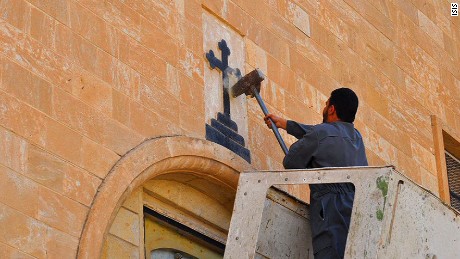
Iraq today (CNN)
NY Times: Is This the End of Christianity in the Middle East?
ISIS scanned the separate groups of men and women. ‘‘You’’ and ‘‘you,’’ they pointed. Some of the captives realized what ISIS was doing, survivors told me later, dividing the young and healthy from the older and weak....No one was sure where either bus was going.
At the Nazi killing centers:
After deportation trains arrived at the killing centers, guards ordered the deportees to get out and form a line. The victims then went through a selection process. Men were separated from women and children. A Nazi, usually an SS physician, looked quickly at each person to decide if he or she was healthy and strong enough for forced labor. This SS officer then pointed to the left or the right; victims did not know that individuals were being selected to live or die.
For centuries the men with the guns, drunk with power and certitude, have decided who lives and who dies. On rare occasions victims are spared if they renounce their faith.

May Christians in the very safe United States of America never be put to this test.

Tuesday, February 25, 2014

His (In)actions Speak Loudly

The United States has overwhelming economic, military, cultural, and, yes, moral superiority over Russia. Yet Vladimir Putin is running rings around Barack Obama.

Historian Paul Johnson [bold added]:
Whatever one may think of Putin’s moral posture–which is deplorable–he is regarded as strong, decisive and vigorous, pushing Russia’s interests at all times, with considerable success. In contrast, Obama is written off as weak and irresolute, with no clear short-or long-term aims. He gets high marks for rhetoric but scores zero for action. In short, he’s a windbag. [snip]

President Obama is missing two crucial chances [Syria and the Ukraine] to take a stand for decency and humanity against the forces of evil and is handing Putin an easy victory. History has placed Obama in a position in which he can be held responsible for the freedom or servitude of two peoples. Putin has far fewer resources but has been using them with skill, consistency and determination. It’s terribly sad that at this juncture the U.S. is led by a man with so little regard for his nation’s role in upholding and extending freedom and that the forces of evil should be winning battles with so little effort.
Barack Obama's critics say that he is weak and vacillating, but IMHO, the election of 2012 showed otherwise: the President is capable of great ruthlessness in intimidating and silencing political opposition by means fair or foul (IRS audits and NSA surveillance).

Where is that man today? One hopes that plans are afoot to reverse what appear to be American setbacks in Afghanistan, Eastern Europe, Iraq, Iran, and Syria. If nothing happens, one is left to conclude, sadly, that what his opponents said is true: the assertion of American interests and the promulgation of American values in the world are not important to Barack Obama. © 2014 Stephen Yuen

Friday, September 13, 2013

Syria: the Thinnest Reed

I didn't support Mr. Obama (twice), but he is the Commander-in-Chief, and the use of chemical weapons on innocent civilians by Bashar al-Assad was an atrocity, so I'm predisposed to support whatever the President decides to do about Syria, whether it be negotiations, threats of force, or actual use of force. The condition for me and most Americans has to be: whatever the plan, it should be well thought-out, explainable, and have reasonable prospects of success.

For an excellent orator, however, President Obama left many people confused by his speech on Tuesday:
I determined that it is in the national security interests of the United States to respond to the Assad regime’s use of chemical weapons through a targeted military strike. The purpose of this strike would be to deter Assad from using chemical weapons, to degrade his regime’s ability to use them, and to make clear to the world that we will not tolerate their use. [Comment: OK, chemical weapons are a big national security problem, a "targeted military strike" apparently is the answer.]

I will not put American boots on the ground in Syria. I will not pursue an open-ended action like Iraq or Afghanistan. I will not pursue a prolonged air campaign like Libya or Kosovo. This would be a targeted strike to achieve a clear objective: deterring the use of chemical weapons, and degrading Assad’s capabilities. [Comment: however, the U.S. military won't go all-in, there won't be boots on the ground or by inference lots of killing and damage.]

The United States military doesn’t do pinpricks. Even a limited strike will send a message to Assad that no other nation can deliver. I don't think we should remove another dictator with force -- we learned from Iraq that doing so makes us responsible for all that comes next. But a targeted strike can make Assad, or any other dictator, think twice before using chemical weapons. [Comment: on the other other hand, the U.S. attack won't be so pinprick-y small that it won't hurt. Certainly we don't want to remove Assad. Mr. Assad, we just want you "to think twice before using chemical weapons" next time.]

I have, therefore, asked the leaders of Congress to postpone a vote to authorize the use of force while we pursue this diplomatic path. I’m sending Secretary of State John Kerry to meet his Russian counterpart on Thursday, and I will continue my own discussions with President Putin. [Comment: a Congressional authorization would have strengthened his hand in negotiating a peaceful resolution, and everyone knows that. Even some Republicans were willing to go along because they know how the game is played. Instead, Kerry will go into the negotiations empty-handed.]
As in the case of Benghazi, your humble observer still holds out hope that these terrible events and America's seemingly feeble responses and pronouncements have a sensible explanation because there's a lot more going on than our government can share with us. But that's a thin, thin reed. © 2013 Stephen Yuen

Monday, September 02, 2013

A Long Ways From Consensus

Map of Syria (Washington Post) 
The Washington Post performs a public service by running Syria: the Very, Very Basics. It's helpful to learn a few facts about a country--such as its population is 22.5 million, ten percent of whom are Christians--before the United States starts killing a bunch of its people.

The article doesn't say whether Syria is a threat to the United States, whether the vital interests of the United States are at stake, whether the use of chemical weapons against its own people is sufficient justification for a U.S. military attack, or exactly what's supposed to happen next.

Update: the WaPo lists the five "smartest" arguments, positive and negative, concerning a Syrian intervention.
  • (Against) Intervention could actually help Assad.
  • (For) The norm against chemical weapons is worth preserving.
  • (Against) Strikes would only make things worse.
  • (For) Smart strikes could break the political deadlock.
  • (Against) Strikes would make little difference but to highlight larger U.S. failure.
  • IMHO, before military action is undertaken the arguments in its favor should be overwhelming. Moreover, a clear majority of the American people and their representatives in Congress should be in support. We are a long ways from consensus.