Showing posts with label Cooking. Show all posts

Wednesday, May 14, 2025

The Perfect Egg

The "perfect" boiled egg (Di Maio/WSJ)
Your humble blogger will go through some time and effort to acquire good food, but I don't love boiled eggs enough to spend over half an hour preparing them:
A group of Italian scientists has cracked the secret of how to boil a perfect egg.

The catch? It takes 32 minutes, two containers of water held at different temperatures, and a fastidious chef moving the egg between the containers every two minutes...

The scientists aimed to cook an egg evenly throughout. The conundrum was that an egg’s layers—its yellow yolk and white albumen—cook at different temperatures. Eaters risk a chalky yolk if they want a fully cooked white, or a runny white if they want a creamy yolk.

Transfer eggs between pots every 2 minutes
To achieve perfection, [Prof. of materials engineering Ernesto] Di Maio’s group, aided by mathematical models, simulations and experiments, invented “periodic cooking,” a method that calls for starting an egg in a pan of boiling water, leaving it there for two minutes, transferring it to a bowl of tepid water at 86 degrees Fahrenheit for another two minutes, and repeating the cycle eight times.

That’s 16 steps.

The goal is to keep the yolk at a consistent temperature of around 149 degrees Fahrenheit while still cooking the white, which usually needs to reach 185 degrees Fahrenheit to cook.
This is the ideal task for our first AI robot. It will never lose count of how many transfers it made and will make each transfer at the two-minute mark. It will do the job I won't do and do it better than I could ever have done it

Monday, August 26, 2024

The Cowboy Wok

Yet another cooking appliance that's catching fire:
There is a new cooking fixture at backyard barbecues, hiking trips and tailgates across America: the cowboy wok.

Also known as a discada or simply a disco, this sizable metal disc is a versatile cooking pan designed for use over an open fire, propane burner or grill. Similar to paella, the term discada refers to the specialized pan and the dish commonly prepared in it.

Initially fashioning them from farm plow discs, cowboys and ranchers long embraced them to prepare hearty meals over the campfire. The cookware subsequently became a mainstay in Northern Mexico and the Southwestern U.S. for generations.
They're bigger than an Asian wok and much heavier. One aficionado uses one that weighs 65 pounds. Were I a hunter who likes to cook his game over an open flame the discada would be an essential part of my toolkit. But I'm not the target market, and my woks will do just fine.

Thursday, November 23, 2023

Thanksgiving, 2023

(WSJ photo)
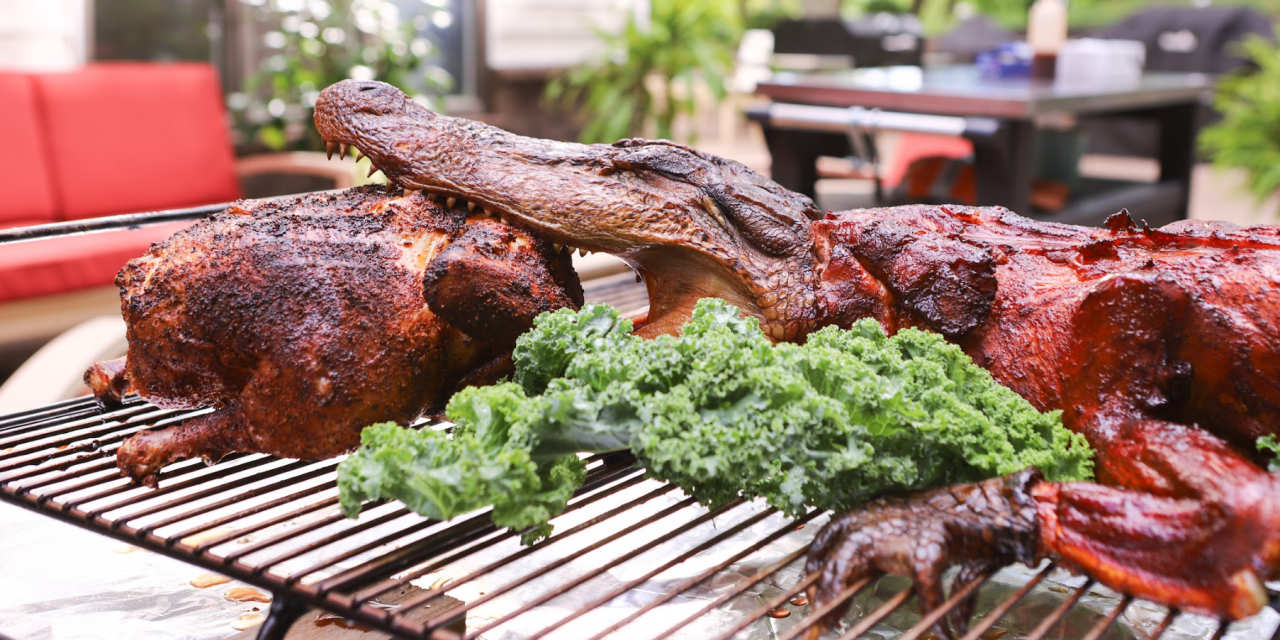
Like many others, we're not making a turkey today, but this is ridiculous:
[Kimberly Darling] forgoes the familiar turkey in favor of an alligator she traps on one of her many hunting expeditions, then she brines, smokes and wraps it in bacon before serving her guests.

“People walk in and they’re like, ‘Oh, my God, that’s a literal alligator. What did we sign up for?’” she says.

But the mild taste and tender texture can’t be beat, adds Darling, a 40-year-old nurse anesthetist who lives near Chicago.
I retract my statement. This is not ridiculous. This is America. What a country.

Wednesday, May 17, 2023

An Iron-clad Rule

(WSJ illustration)
For decades we had been using non-stick cookware. When the first group of pans lost their non-stickiness, we blamed ourselves: we had been scrubbing too hard, we were using abrasive cleaners, we had turned the burner on too high, etc. Softening our techniques didn't work; the cookware surfaces still wore out.

We finally converted over to steel and ceramic pots and pans because of practicality but more importantly for health reasons: [bold added]
When the first Teflon pans—then called the “Happy Pan”—were marketed in the U.S. in 1961, they were advertised as “an amazing new concept in cooking” and packaged with a free spatula. The Happy Pan’s nonstick surface was made from a substance called PTFE (polytetrafluoroethylene). The compound was discovered in 1938 by an American chemist, Roy Plunkett, who would later be awarded the John Scott medal by the city of Philadelphia for an invention promoting the “comfort, welfare and happiness of humankind.”

Whether Plunkett’s invention was really such a boon for humanity is now in question. PTFE is part of a huge family of chemicals known as PFAS, called “forever chemicals” because, once released into the environment, they last almost indefinitely; they have ended up in drinking water and in people’s bloodstreams. Early versions of Teflon and other nonstick pans were manufactured with PFOA added to the PTFE. That additive has been linked to a range of health conditions, including some cancers. PFOA was phased out of nonstick pans in the U.S. by 2015 and has been banned in the EU since 2020, but it can undoubtedly still be found in some older nonstick pans lurking in people’s kitchens.
The egg fries at the lowest setting.
More recently we've (re)discovered the joys of cooking with cast iron. An induction cooktop heats up the iron quickly and efficiently. Also, if the pan was seasoned properly, there's very little scrubbing; in fact some cooks recommend wiping, not washing, the surface in order not to remove the oil.

Much of life's journey has turned out to be an odyssey, where we find out that our parents and grandparents knew the best way to do things.

Thursday, September 15, 2022

Pressure Cooking

The winner, flanked by her proud grandparents.
Last night was the first time I had watched MasterChef, and I did so under the urging of a finalist's grandparents, who are good friends.

The three contestants all worked under tremendous pressure, not only preparing each dish from scratch within a strict one-hour limit but having to answer questions on camera while they were furiously engaged.

Our friends did a good job of keeping the outcome to themselves for nearly a year, though it wasn't hard to guess from their reminders to watch the show.

When their grandaughter Dara Yu emerged victorious, it was a redemptive moment for a young woman who as a teenager lost her father tragically.

Life has ups and downs, and at the tender age of 20 (when filmed) Dara already has had more than the rest of us.

Tuesday, February 15, 2022

Valentine's Day Dinner

At $12.99 per pound the rib steak was 50% higher than pre-pandemic, but:

1) We hadn't splurged on this cut since last fall;

2) Home-cooked steak would still be cheaper than dining out, which is what we usually do on Valentine's Day.

COVID-19 and inflation seem to have caused long-lasting changes in the shopping and dining habits of Americans:
Americans continue to stockpile food and household goods.

Many are spending more time at home and remain uncertain about product availability. Some have moved from tight-spaced apartments in cities to more spacious suburban homes, and inflation is spurring a search for savings by buying in bulk.

After more than 20 years of steady but slow sales growth, sales at bulk retailers Costco Wholesale Corp., Walmart Inc.’s Sam’s Club and BJ’s Wholesale Club Holdings Inc. rose 26.6% in dollars and 18% in volume during the fourth quarter of 2021 compared with the same quarter of 2019
Though restaurants have reopened, Americans are eating billions (!) of meals more at home than before the pandemic:
At the height of the pandemic, Americans ate 88% of their meals at home, according to retail research firm NPD Group, up from 83% pre-pandemic. Meals eaten at home have since leveled off to about 85%, but the 2 percentage point increase from 2019 levels is equivalent to an estimated 2.9 billion meals and snacks per quarter, NPD says.
BTW, after two years of working on our skills in the kitchen, the steak turned out a perfect medium rare.

Friday, November 26, 2021

Turkey Day, 2021

It's been 40+ years of trial and error, and it bore fruit in yesterday's turkey.

Think of all the possibilities:
  • Fresh or frozen?
  • With stuffing or without?
  • Turn the bird?
  • Wrap the turkey in foil?
  • Change the temperature during roasting?
  • Brine beforehand?
  • Rub with spices and/or oil?

    Three hard-to-make side dishes were store-bought.
    Each of the above in turn has many options. Stuffing recipes are innumerable, temperature adjustments can be high to low or vice versa, how long before turning the turkey over, if at all, etc.

    My wife's late aunt had a reliable method for keeping the meat moist---cover the turkey with a wet paper shopping bag, replacing it every hour as it dried out. We stopped using that technique when supermarkets switched from paper to plastic.

    Here's the 2021 recipe. On Tuesday wash the fresh turkey, pat dry, and season all over. (I used salt, pepper, and garlic.) Leave uncovered in the refrigerator until ready to cook. On Wednesday evening rub with butter and roast in oven, breast-side down, at 400 degrees for 40 minutes. Turn the bird and roast at 400 for 20 minutes. Pour 2 cups wine or apple cider over bird. Adjust the temperature down to 170 degrees and roast for 12-20 hours until inner thigh temperature reads at least 160 degrees. Baste if skin appears dry (I only did this once). After removing turkey from oven, allow at least 30 minutes before carving.

    My limit was one plate plus a second helping of turkey.

    I had to save room for the pumpkin pie.

    I hope you and your loved ones had a Happy Thanksgiving.
  • Wednesday, June 09, 2021

    Making Lists and Getting Serious

    I can point to a few recipes I've learned, some books I've read, and clutter I've cleared, but basically it's been an unproductive 15 months. During the pandemic it's easy to make excuses for not tackling projects that matter. Now's the time to make lists and get serious.

    Yes, it's time to get the ducks in a row.

    Monday, April 19, 2021

    New Taste on the Block

    Trader Joe's Umami seasoning
    It took a hundred years for a "new" taste, umami, to be acknowledged by food science. [bold added]
    In 1907, while enjoying a bowl of soup made with dashi broth and kombu seaweed, the Japanese chemist Kikunae Ikeda had an insight that would change the culinary world. He noticed a taste that wasn’t sweet, salty, sour or bitter.

    Ikeda gave this hard-to-describe savory taste a name—umami—and went on to identify the specific amino acid that triggered it.

    Scientists in Europe and the U.S. remained skeptical about whether umami really was a taste until a receptor for it was discovered on the tongue almost a century later, in 2000. Today, it is taken for granted by most scientists and chefs...
    Now kokumi has come on the scene.
    Trader Joe's umami seasoning and
    garlic sprinkled on beef ribs:
    maybe they'll have kokumi.
    The newer taste, kokumi, is even harder to describe than umami, but it is potentially just as important for understanding how and why we enjoy food. In Japanese, the term koku describes foods that have the kind of mouthful “thickness” often imparted by fats—what English speakers might describe as rich. “It feels like a physical sensation,” says the culinary scientist Joshua Evans. It works “by coating the mouth and becoming more intense and being extended in time.” When asked what foods have koku, Japanese food experts list wild boar, adult wasps, duck eggs and aged sake, as well as long-simmered and fermented dishes.

    Koku reflects a sensory experience most closely allied with touch, influenced by aromas and textures. Adding the Japanese suffix -mi, meaning taste, highlights the specific taste detected by the tongue. The precise nature of kokumi remains the subject of great debate among sensory scientists and chefs, in part because it can’t be detected on the palate on its own; rather, it modifies other tastes and flavors.

    The earliest kokumi research focused on the contribution of garlic to foods. In 1990, Japanese scientist Yoichi Ueda discovered that if he added diluted garlic to two types of soups, people eating them would describe having more sensations associated with kokumi. Subsequent research isolated amino acids in the garlic that seemed to cause the effect, including glutathione.

    A Japanese lab claims to have identified the taste receptor triggered by glutathione, and scientists elsewhere have discovered that glutathione and other compounds appear to trigger kokumi in yeasts and in other foods. These include long-cooked meats such as chicken in chicken broth; some cheeses, such as Blue Shropshire, Gouda and Parmesan; and fermented foods like beer, soy sauce and fish paste.

    Some sensory scientists remain skeptical. Paul Breslin, a nutritional sciences professor at Rutgers University, contends that the term kokumi will be difficult to understand and use “until the scientific and nonscientific community can agree both on its definition and on the prototypical eliciting stimuli”—that is to say, until we know more.

    For all the uncertainty, kokumi has two potentially important implications. The first relates to our understanding of human evolution; the second, human health—especially efforts to create foods with fewer calories but more flavor. In both cases, kokumi may provide a kind of missing link.

    Our ancestors didn’t have to be able to give kokumi a name or know its chemical sources to enjoy it. Our own research suggests that one key to the adoption of fire by humans, and the invention and adoption of fermentation, was the flavor of cooked and fermented foods. It is known that humans (as well as dogs, gorillas and chimpanzees) prefer cooked foods over raw foods. Humans also tend to prefer many fermented foods relative to their raw counterparts. But it has long been unclear why.

    One possibility is that humans evolved a preference for complex aromas and the experience they contribute to flavor. Uncooked meat and rotten meat that is full of pathogens both tend to have simpler aromas than cooked meat or meat that is fermented and full of beneficial fermentation microbes. It is also notable that cooked meats and fermented foods tend to have kokumi.

    We might picture an ancient human ancestor holding up a piece of meat that has been cooked on the fire, pleased by its aromas but also by the rich mouthfeel of its kokumi. Our ancestors didn’t have to be able to give kokumi a name or know its chemical sources to enjoy it.

    Chef-researchers employed by top restaurants, such as Nabila Rodríguez Valerón at Copenhagen’s award-winning Alchemist, are now eagerly experimenting with the ways in which kokumi could be featured in modern meals to make foods that taste rich but are low in fat. A recent study by Ciarán Forde at the Clinical Nutrition Research Center in Singapore discovered that if the amino acid associated with kokumi is added to beef broth, particularly in combination with umami flavors, consumers perceive the broth to be richer and to have more calories.

    Many traditional recipes from cultures around the world appear to already take advantage of this kokumi effect. For example, adding onion and garlic to soup stock to give it a fuller, deeper flavor. Often recipes start with a step in which chopped onions are soaked in fat or oil, in effect amplifying the flavors of those fats and oils. Kokumi is a taste that asks us to think of food holistically.
    At least it's organic
    Cooking in fat and oil makes dishes taste better, though traditional food vocabulary--sweeter, saltier, etc.--is inadequate to describe what made the food more enjoyable. Now we know that it was umame and kokumi.

    However, I'll probably pass on the wild boar and most definitely the adult wasps. (By the way, how did "Japanese food experts" know that adult wasps are redolent--food critic word--with kokumi?)

    Monday, April 12, 2021

    When Gaining Weight Wasn't a Problem

    In a world where one is forced to be a locavore, where there is no refrigeration, and where starvation is a much more severe problem than obesity, the cook has very different priorities.

    Ladies and gentlemen, a 1750's recipe book from Yale's Rare Books Library:

    Friday, March 26, 2021

    Breakfast of Champignons

    Dried (left), fresh (right), mushroom salt (middle)
    Over the past year your humble blogger has spent many hours in the kitchen trying out various ingredients and cooking methods.

    Mushrooms have proved to be a can't-miss flavor enhancer, infusing different cuisines with complexity and heft. Apparently many home chefs have likewise discovered fungal joy.

    Mushroom consumption has taken off:
    (WSJ illustration)
    According to projections from the firm Transparency Market Research, the global mushroom market is expected to reach $69.3 billion by the end of 2024, up from $34.1 billion in 2015. Some of this growth is being driven by consumers in China, but the biggest share of the market is still in the U.S. and Canada, where mushrooms are suddenly associated with “wellness.”...

    Mushrooms may not be as high in protein as meat (although they do contain 1-3% protein by weight, depending on the species), but they are rich in B vitamins, high in fiber and, perhaps more important, so rich in meaty flavors that you hardly miss meat...

    Why do mushrooms taste so meaty? The short answer is that, like meat, they are rich in the umami flavor compounds that impart a savory or brothy taste.
    In simple Chinese dishes such as chicken asparagus or beef broccoli I've found that replacing half the meat with mushrooms is not only flavorful but reduces the requirement for sodium-filled soy or oyster sauce.

    As we strive to reduce our carbon footprint, mushrooms should be eaten on more than a spore-adic basis because it's the morel thing to do.