Showing posts with label Libya. Show all posts

Sunday, October 20, 2013

O, the Humanity (Reprise)

I cut a lot of slack to politicians when they make predictions. I may think that they're dead wrong when they claim, for example, that lower government spending or higher taxes are the way to solve the debt problem. But they probably aren't "lying", i.e. knowingly spouting something untrue; they may be indulging in wishful thinking---heck, they may even believe with all their heart in what they're saying.

But when politicians say something utterly false--and they know it--concerning past events, the normal reaction is to get angry (perhaps because people don't like the answer to "what kind of fool do you take me for?"). However, the explanations can be so laughable that their ridiculousness disarms us.

Every six months or so the Obama Administration is good for such a howler that I can't be angry at them.

September, 2012 - the attack on the American consulate in Libya, as well as uprisings across the Middle East, was due to an obscure YouTube video. President Obama, on 9/12/12:
"What we do know is that the natural protests that arose because of the outrage over the video were used as an excuse by extremists to see if they can also directly harm U.S. interests."
May, 2013 - the IRS targeting of tea party organizations was the work of low-level agents in Cincinnati:
the IRS has identified two "rogue" employees in the agency's Cincinnati office as being principally responsible for the "overly aggressive" handling of requests by conservative groups for tax-exempt status
October, 2013 - the first reason (the President did list others later in his 10/21/13 press conference) that the Obamacare website doesn't work:
"the number of people who have visited the site has been overwhelming, which has aggravated some of these underlying problems."
An amateur video, Cincinnati IRS agents going rogue, and healthcare.gov being so popular the website froze. Laughter being the best medicine, the President is correct about one thing: because of Obamacare many of us are feeling better already. © 2013 Stephen Yuen
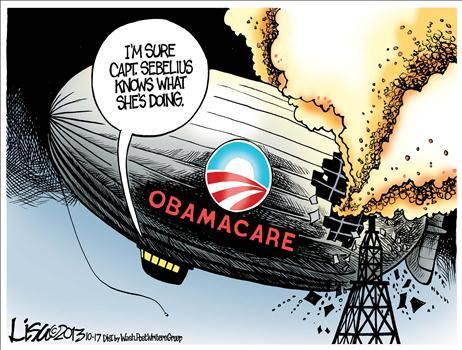
Lisa Benson cartoon

Saturday, May 25, 2013

In Praise of Divided Government

It's a cliché that the party who holds the White House deplores divided government, while the party out of power likes it very much. The principal objection to divided government is that quick, bold, necessary actions are stymied. To this humble observer that's a feature, not a bug.

When the Democrats had control of Congress and the White House from 2008 to 2010, they passed Obamacare without a single Republican vote. When the Republicans were similarly situated in 2003 to 2006 and part of 2001, they passed the so-called Bush tax cuts, arguably a major source of today's deficit problems. (It should be noted that Democrats were roughly split on the Patriot Act and Iraq War resolutions, so it's a reasonable supposition that even if congressional Democrats had slim control, George W. Bush would have gotten his legislation through, thanks to solid Republican support.)

Now we are seeing another advantage of divided government: congressional hearings on possible Administration malfeasance. Yes, investigations into the current raft of scandals are interfering with Executive Branch operations, and yes, there is grandstanding and partisan obstructionism going on, but there are also important issues at stake concerning the free flow of information prior to a Presidential election (the time when the people have the most say in their government) and the abuse of the enormous powers of the Internal Revenue Service, the agency that has information on everyone and where everyone is presumed guilty, not innocent.

I'd like to see something get done this year on immigration reform and tax simplification, but if inaction is the price we pay for divided government, so be it. © 2013 Stephen Yuen
[Update - 5/31: Ann Althouse on the 2014 elections: "Regardless of how directly Obama is implicated and how much any given voter wants to blame Obama, the scandals make a strong argument for opposite-party control of Congress."]

Tuesday, November 13, 2012

Benghazi: We Don't Know Anything

After the 9/11 murder of four Americans in Benghazi, U.N. Ambassador Susan Rice went on all the Sunday talk shows to lay the blame on an obscure video. The immediate reaction of many viewers was incredulity. Not only was the Innocence of Muslims hardly seen by anyone, the abundance of anti-Islam materials that has arisen since 2001 makes it hard to see why this particular low-budget excrescence was the catalyst for the widespread violence that roiled the Middle East, not just Benghazi.

However, your humble observer could not accept the explanation of some Republicans either--that the video was (falsely) blamed because the Obama Administration was reluctant to admit that its foreign policy had failed. Both explanations are too easily discredited after a few days of Congressional hearings.

One can believe the worst of one man's motives, but surely not everyone in the CIA or the State and Defense Departments would fall on their sword for the President unless there were good national security reasons. For example, there have been rumors that assassinated ambassador Chris Stevens was linked to arms shipments to Syrian rebels, or that the CIA was running a secret prison in Benghazi.

After the David Petraeus love triangle story took everyone by surprise less than a week ago, then mushroomed into a love-hexagon over the past few days, one thing is certain. We don't know anything.

Friday, November 09, 2012

Now That the Election's Over

Now that the election's over we are likely, finally, to learn the truth about:

  • Benghazi
  • Obamacare's costs
  • End-of-year defense layoffs
  • FEMA's before-and-after performance on Hurricane Sandy
  • Unemployment statistics
  • Whether General Motors is really healthy
  • What the President meant when he said he would be "flexible" on missile defense

    Your humble observer believes that the President will wind up unscathed on at least some of these issues, so this post is not a criticism of him.

    The mainstream media turned a blind eye to these questions in the run-up to the election. Their neglect was a gross dereliction of its duty to help the electorate make informed choices.

    Reporters sometimes have to choose between their professed responsibility to discover and disclose the truth (please, no sophistry about the subjectivity of knowledge) and their personal politics. CPAs tabulate inventory counts that could unexpectedly lower their clients' earnings. Scientists report the harmful side effects of experimental drugs and possibly negate millions of dollars and years of research. Even lawyers, who have a primary responsibility to their clients, have a duty to disclose material facts that could help the other side.

    If the press had pursued these 2012 stories with even a fraction of the enthusiasm with which it pilloried the Bush Administration over Hurricane Katrina, Abu Ghraib, Guantanamo, and the 5.5% unemployment rate in 2004, then it would be deserving of the esteem with which we regard most of our venerable professions. After its performance in 2012, it's doubtful whether the press will ever recover, and we all will be the poorer. © 2012 Stephen Yuen
  • Wednesday, September 12, 2012

    "He loved that part of the world, he loved the people, he spoke the languages and he really loved his job."

    Chronicle photo
    His murder marks a possible turning point, not only for this year's Presidential campaign, but also for America's entire Middle Eastern policy. Before his death becomes a symbol and rallying cry in the coming weeks, let's take a moment to honor the man.

    Ambassador Christopher Stevens grew up in Piedmont and went to UC-Berkeley and Hastings Law School. Son of a cellist and stepson of a well-known music critic, Ambassador Stevens was destined for a life in the foreign service:
    He could often be found practicing his Arabic, studying Middle Eastern history or rehearsing lines for musicals at Cal - in which he often played characters with a maturity beyond his years, said Austin Tichenor, a childhood friend and Berkeley classmate.

    "He had a gravitas about him, which suited him well in the foreign service, I suspect," Tichenor said. "It always tickled me to see him do official State Department speeches because he's so serious, he has his ambassador face on. But when you got him one-on-one, he was just funny."
    John McCain:
    "Chris Stevens is one of the finest people I've ever known in my life," McCain said. "He loved the Libyan people. They loved him. He and I were down there on election night and people were saying, 'Thank You America.'"

    "I guarantee you the one thing Chris Stevens did not want is for us to abandon Libya."

    Saturday, April 02, 2011

    Sad Summation

    The longest sentence I read today:
    It is always a dangerous thing for a president to start a war without Congress, without a consistent mission, without a coherent methodology, without a plausible end game, and without a clue who our rebel allies are or just how strong their opponent actually might be — contingent on a fickle UN, impotent but oil-enthused allies, and a passive-aggressive Arab world, all to prove a point that we could reinvent our military into a humanitarian rescue force, subordinate to international unelected bodies — and all the more dangerous during the golfing, basketball-playoffs, and resort seasons.
    Sadly, it makes a lot of sense.

    Friday, March 25, 2011

    K.M.A.

    The first American missiles were fired only a few days ago, and already the battle for Libya--or whatever the historians end up calling it--has bequeathed to the English language another euphemism for waging war. Kinetic military action is more benign than "incursion" or "invasion" and sounds more active than "police action." IMHO, however, it will not have a lot of staying power.

    The phrase has been the target of mockery less than 24 hours after it was uttered, and not only from political opponents. Its too-cleverness engenders ridicule, which left unchecked causes lasting damage to the respect which every Administration needs in order to govern.

    Another negative is the abbreviation for Kinetic Military Action. "KMA" has a different meaning in the urban dictionary. The mild vulgarity coincidentally has been used by Democratic politicians in some well-known examples.

    We can't be too critical of NSA official Ben Rhodes for his coinage. "Kinetic" had already been used in Bush Administration briefings, and "kinetic military action" seemed to be a logical construction. It turned out to be a bridge too far.

    Wednesday, March 23, 2011

    If You Strike the King You Must Kill Him

    The United States has initiated military action in a third Middle Eastern country.

    Let's acknowledge: 1) Colonel Qaddafi is a brutal dictator who has imprisoned, tortured, and killed many of his own people; 2) Libyan terrorist actions are known to have resulted in the deaths of hundreds of Westerners over the past 42 years; 3) If Colonel Qaddafi leaves office--voluntarily or not--many will rejoice and few will mourn; 4) President Obama's actions so far are within the bounds of the War Powers Resolution enacted during the Nixon Administration.

    All that said, American policy toward Libya is a confusing muddle of objectives, methods, and resources. The President said "it is U.S. policy that Qaddafi needs to go." However, the military's orders fall well short of regime change: the United States is attacking Libya's air defenses and through the enforcement of a "no-fly zone" has curtailed Qaddafi's ability to slaughter Libyan rebels and innocents. The hard work of overthrowing Qaddafi will be left to the rebels, who lack the means and skills, and coalition partners, who probably lack the will.

    If Qaddafi battles on and the coalition partners lose their resolve, what then? The President said on March 18th: "The United States is not going to deploy ground troops into Libya." President Obama has holstered the threat of sending the marines to the shores of Tripoli. We have struck the king and are leaving it to others to kill him.

    When Saddam survived the first Iraq war, removing him later became much more costly. Let's hope that history doesn't repeat.