Showing posts with label IRS. Show all posts

Tuesday, October 22, 2024

The Subtlety of Politics

For the past month I've been watching the candidates for national office give speeches and interviews. I've been impressed with the ability of J.D. Vance to respond to questions, hostile or otherwise, and show that he has more than a surface knowledge of the issues. Of the four candidates I think he is the most skilled at dealing with the press.

Below is an example, albeit during a friendly interview with Fox News' Dana Perino:


At the 1:25 mark he says "You can't just walk into a McDonald's and sign a W-9 and actually go onto the payroll." (The W-9 is the IRS form in which a new employee declares his Social Security Number to his employer.) The fact that Mr. Vance knew the correct form number and stated it when he didn't have to was impressive to this career accountant.

Additional comment on McDonald's: there's a ridiculous controversy about whether Kamala Harris worked at McDonald's. She claims that she did, and her detractors say that she didn't; neither side has produced evidence to support their position, and McDonald's has no record of her employment. (The Harris campaign believes that she worked during the summer of 1983 at the McDonald's on Central Avenue in Alameda, California.)

There's an easy way to check. Just ask the Social Security Administration:
We can give you copies or printouts of your Forms W-2 for any year from 1978 to the present. You can get free copies if you need them for a Social Security-related reason. But there is a fee of $62 per request if you need them for an unrelated reason. You can also get a transcript or copy of your Form W-2 from the Internal Revenue Service. However, state and local tax information isn’t available if you e-filed your tax return.
How tough would it be for Kamala Harris to request a copy of her 1983 W-2 from the SSA or IRS and put the matter to rest? The fact that she hasn't done so is a strong indicator that she did not work at McDonald's, but of course yours truly is just a simple accountant who knows nothing about the subtlety of politics.

Monday, April 08, 2024

Tax Audits: Good News and Bad News

(Image from mymcmedia)
There's good news and bad news if you're worried about being audited. The bad first: [bold added[
The most recent data suggests the IRS is still focused on the middle class. As of last summer, 63% of new audits targeted taxpayers with income of less than $200,000. Only a small overall share reached the very highest earners, while 80% of audits covered filers earning less than $1 million...

Tigta reports that revenue-agent recruitment is “far below” the agency’s target, and it hired only 34 in the first six months of its expansion, according to trade publication Government Executive. That compares with its goal of 3,700 in the first year.

The agency faces the same tight labor market as any other employer, but the job specs aren’t bad. A typical salary for these agents is about $125,000, plus public-employee perks such as up to $60,000 in student-loan forgiveness. But for one reason or another, America’s treasurers and accountants aren’t lining up to become federal tax collectors.
Thousands-fewer IRS agents reduces the likelihood that anyone would be audited (good), but Joe Biden's focus on under-$200,000 returns (bad) puts the lie to his promise that the agency would focus on over-$400,000 returns. Disappointing, to say the least.

Tuesday, October 10, 2023

Tax Day Minus 6

This pile was mailed this morning.
Due to the floods last winter the due date for most of California individual tax returns, both Federal and State, has been extended to October 16, 2023. The automatic extension applies to both the filing of the returns and the payments that are due.

I spent most of the week working on the numbers. Today we got back the final returns from the computer service, signed and dated the documents, filled out the vouchers and checks, and took the envelopes to the post office. They were mailed certified, return-receipt requested.

We are old-school and communicate on paper whenever possible when doing business with the government. Electronic documents, emails, and payments get misdirected often enough that we are comfortable using tried and true, albeit slower methods.

Tonight I will sleep better than I have in months.

Tuesday, April 18, 2023

Tax Day: Don't Get Too Comfortable With the Delays

(Image from Biz New Orleans)
Tax Day, April 15th, the day when most individuals file their taxes, was once immutable. Everyone did get a one- or two-day break when April 15 fell on a weekend and the tax deadline date was postponed to the following business day, usually Monday but sometimes Tuesday like this year, i.e. today.

As the IRS always says, an extension of time to file one's tax return is not an extension of time to pay the liability, so one has to do most of the work anyway by April 15th and cut a check, if necessary, with the extension form.

People who live in San Mateo County are "fortunate": we don't have to pay the liability or file the 2022 tax returns, both Federal and State, until Monday, October 16th, because we live in a county that suffered flood damage. We also don't have to make the 2023 Estimated Tax Payments due in April, June, or September until October 16th. With much higher interest rates than 2022, the Estimated Tax delay could be a significant benefit because taxpayers can hold onto their money longer.

With two years of COVID and one year of floods, I'm getting accustomed to postponement of the tax deadline. But like my fellow citizens who got used to receiving government benefits and not paying rent, mortgages, or student loans during the pandemic, I can't get too comfortable.

Going back to normal is hard.

Friday, February 10, 2023

Successfully Claiming the Middle Class Tax Refund

The California Middle Class Tax Refund (MCTR) card came three weeks ago. It was time to get the money.

From news reports scammers are able to drain the account after the card is activated, so I delayed that move until I was ready to use the card.

At the local Citibank branch this afternoon, I phoned the 1-800 number on the sticker and dutifully typed in the last six digits of my social security number. A computerized voice instructed me to create a 4-digit PIN, at which point it specified the card value.

The teller asked me to insert the Citibank ATM card, input its 4-digit PIN, then insert the MCTR Visa card and type its 4-digit PIN. I said that I wanted the entire amount transferred to my checking account. The teller said that the maximum daily amount was $600 (unclear if that was a card or Citibank limitation). He transferred that sum immediately and suggested that I come back tomorrow to claim the rest.

Fearful of waiting another day, I drove to the Bank of America branch to deposit the remaining funds. After I inserted the BoA ATM card and PIN, the teller inspected my driver's license, then processed the MCTR card. She took more time with the forms than the Citi teller. In the end all was well; the rest of the money was put into the checking account.

Comments:
1) Neither bank imposed a transaction fee.

2) The fund-draining scam clearly isn't occurring at the bank branches but at other venues, like online merchants, where Visa cards can be used.

3) Today the IRS finally ruled that the MCTR payments are not taxable by the Federal government (California declared them not to be taxable by the State last year).

4) I don't see why the Franchise Tax Board couldn't issue checks, like it did in the old days. Theft losses will still occur, but the crooks will have a much harder time.

Wednesday, October 05, 2022

COVID Spending: The Triumph of Hope Over Experience

There's a jokey description of second marriages--the triumph of hope over experience--that could equally be applied to "emergency" government spending.

The hope is that the spending will be somewhat effective in meeting whatever the need was this time and that there would be some oversight that would limit the waste, fraud, and abuse.

What did happen with multi-$billions being spent on COVID relief in a short period of time? The headlines, in chronological order:

November, 2020: Prisoners’ fake unemployment claims cost state hundreds of millions, California D.A.s say

October, 2021: California EDD Fraud Payments Total At Least $20 Billion

September, 2022: Covid Fraud Hits $45.6 Billion [bold added]
The IG first alerted Labor to the scope of the problem with reports in February and June last year, identifying $16 billion in potentially fraudulent payouts to large and small operators of unemployment scams. A new IG memo last week identifies $30 billion more in fraudulent payments—for a total of $45.6 billion. That’s three times what the U.S. has spent to help Ukraine fend off Russia.

The various benefit scams are well-known, and the IG revised upward the tallies of each category. Individuals who fraudulently claimed benefits in more than one state got away with $29 billion. Con artists who used suspicious email services designed to hide identities have claimed at least $16 billion. Swindlers using the Social Security numbers of ineligible federal prisoners and dead Americans landed some $400 million more.
Your humble blogger takes solace in the fact that, while government fiscal controls are a hot mess and the IRS is over a year late in processing returns, our election systems will operate smoothly in less than a month to record our satisfaction with the way things are going.

Update - 10/6: For those who insist that COVID fraud and the IRS are separable problems the following should be interesting.
Five current or former Internal Revenue Service employees were charged with schemes to defraud the Paycheck Protection Program and Economic Injury Disaster Loan Program by the U.S. Department of Justice.

The defendants allegedly obtained funds under the federal stimulus programs, authorized as part of the CAREs Act, by submitting false and fraudulent loan applications that collectively sought over $1 million, according to court documents. They then used those funds for cars, luxury goods, and personal travel, instead of the purposes authorized by the PPP or EIDL Program.

Friday, September 02, 2022

A Smart Move

(Illustration from estateexec.com)
Most middle-class Americans have a simple estate profile.

Assets may include a house, retirement accounts, stocks, cash, and personal effects. Beneficiaries of the estate are typically family and charities.

Even with such straightforwardness, there is still a smart move to make on income and estate taxes. Where possible, charitable bequests should be made from 401Ks and IRAs, while assets that have gone up in value ("appreciated assets") should go to the heirs.

This is because IRA and 401K distributions (unless they're from Roth plans) will be taxable to the heirs, while on the sale of the house or stocks they will only have to pay income taxes on the appreciation after the death of their thoughtful relative. (The charities don't pay taxes in either case.)

There are also the advantages of efficiency and flexibility.
there are two big benefits to making gifts at death using traditional IRA assets.

The first advantage is tax efficiency. Donors of traditional IRA assets at death can win an income-tax trifecta—no tax on contributions going in, no tax on annual growth, and no tax on assets at death...

The second advantage of leaving traditional IRA assets to charities is flexibility. Wills are often drawn up years before someone dies, and circumstances change. As a result, the donor may want to name different charities or donation amounts.

Making these changes is often easier with traditional IRAs than a will.
Let's say that you have a $100,000 IRA and that you wanted to leave $20,000 to your alma mater. You could create a new IRA, name its beneficiary as Old Blue College, and fund it with $20,000 from your existing IRA, leaving the remaining $80,000 for existing IRA's beneficiary. And you could do that without hiring a lawyer to rewrite your will.

You spent a lifetime earning, saving, and building an estate. Spend a few hours seing that thousands of dollars from that estate go to who you prefer, not the government.

Tuesday, April 19, 2022

Tax Day, 2022

Federal extension form 4868
Following retirement and the elimination of entities (partnerships, Subchapter S corporations) that required us to wait for K-1 forms that were frequently late, there were no excuses impediments to filing our tax returns by April 15th.

California extension form 3519
Ambition, however, fell easy prey to sloth and pain avoidance, two pillars of procrastination. Over the weekend I filled out draft tax returns with only a cursory look at deductions. (A full search involves four different credit cards and three bank accounts, i.e., the pain I was speaking about earlier.)

Two extension forms, plus checks that were more than enough to cover the liability for 2021, were mailed at the post office on Tax Day, April 18, 2022.

Having the government hold on to the money a few extra months was the cost; the benefit was the first restful sleep I've had in weeks. It was worth it.

Saturday, April 09, 2022

Against the Stereotype

Judge Ketanji Brown Jackson flanked by
husband Patrick and daughter Leila (Chron)
Do Supreme Court justices mostly make decisions that favor their own personal politics?

Partisans seem to think so (Catholic justices are anti-abortion, Democratic justices-of-color are in favor of quotas, etc.)

Indiana professor Leslie Lenkowski cites one prominent example of when justice-in-waiting Ketanji Brown Jackson went against the stereotype by ruling against the Obama Administration's targeting of a non-profit linked with Israel: [bold added]
The case involved Z Street, which provides information to the public on issues related to Zionism, Israel and the Middle East. At the end of 2009, it applied for tax exemption as a public charity under Section 501(c)(3) of the tax code. Six months later, an IRS representative allegedly told Z Street a decision would be delayed because the agency had a special unit to examine requests from groups dealing with Israel to determine whether their views contradicted the Obama administration’s policies.

Z Street sued, and the case was assigned to Judge Jackson. In a 2014 ruling, Judge Jackson dismissed the IRS’s argument that its judgments about tax exemptions had immunity from judicial review. She accused the IRS of using procedural claims to block litigation of a constitutional issue.

After Z Street finally received its tax exemption, Judge Jackson approved a 2018 agreement in which the IRS expressed its “sincere apology” for the delay and acknowledged that its criteria for approving requests for tax-exemption shouldn’t include political beliefs—though the agency still denied it had applied a political test to Z Street’s application. In her conclusion of the case, Judge Jackson declared it was “wrong” to use the tax laws against any group “based solely on any lawful positions it espouses on any issue” or its “association with a particular political movement, position, or viewpoint.”
President Obama weaponizing the IRS against his opposition was not a fevered dream of Republicans but was confirmed by government audit:
the retrospective audit turned up almost 150 organizations that had been subjected to unusually intense IRS scrutiny, generally during the early years of the Obama administration. These organizations faced what the inspector general called “unnecessary questions” and longer-than-normal delays in processing their applications. This was on top of the nearly 300 groups that a separate 2013 audit found had received special IRS attention because of their association with the tea party.
Justices appointed by a Republican President, e.g., David Souter and Anthony Kennedy, regularly disappointed Republicans. Although few expect them, don't be surprised if Justice Jackson will have a few surprises during her term.

Thursday, March 31, 2022

Taxes: Old Fashioned is the Way to Go

Despite trying to go paperless, the IRS is
buried in paperwork. (WSJ image)
More than ever, I'm glad I've retired from the tax-return business. I help a few friends and relatives, but that's it. To render proper service to a paying client I would have to spend many hours on the phone with the overwhelmed IRS trying to ascertain the status of returns filed a year ago or longer. [bold added]
Tax Day 2022 is nearly here. But just when many Americans most need answers, communicating with the Internal Revenue Service can be harder than ever.

Need to send the IRS a letter? The extra workload from the pandemic has left the agency with a paper backlog of more than 20 million tax returns, amended returns and correspondence. On March 17, Commissioner Chuck Rettig told members of Congress that even though the IRS is using extraordinary measures, the backlog won’t be cleared before year-end. The agency, he said, is tackling the pileup on a first-in, first-out basis.

Calling the IRS is nearly impossible as well, unless you have a specific number for an audit or notice. For the fiscal year ended Sept. 30, 2021, only about one in 10 calls to the agency’s customer-service line reached a representative after call volume nearly tripled during the year, according to National Taxpayer Advocate Erin Collins. The lines are still clogged.

A third barrier to communication involves taxpayers’ access to key records. The IRS’s legacy system for retrieving such information had such rigorous sign-up requirements to prevent fraud that it rejected more than half of applicants.
No tracking for returns filed with States,
who are much more reliable than the IRS.
Mom signed her paper tax returns two weeks ago, and I mailed them at the post office last Saturday, with tracking and return receipt added. No Luddite I, but there's zero trust in the IRS to process the return timely and accurately. Moreover,if there's money owed, I pay with a check in order to have evidence of the remittance.

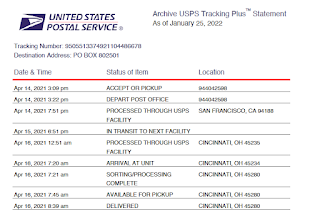
Filing our own 2020 return through the U.S. mail was the right move, because, as noted in January, the post office tracker proved that the return was delivered by April 15, 2021, while the IRS claimed it hadn't received it as of January, 2022.

Electronic payments and electronic filings are near instantaneous, but when it comes to proving that one fulfilled one's responsibilities, old fashioned paper is the way to go.

Saturday, March 19, 2022

Still Got It

Processing 2019 was important not only for
the refund but for the carryovers to 2020.
The Hawaii trip began with a pleasant surprise: Mom's 2019 Federal tax refund was waiting in the mailbox, after a delay of almost two years.

The last contact with the Internal Revenue Service had been in September, when the Service wrote that the refund should be received sometime in November, 2021.

The subsequent four-month delay was disappointing but not unexpected given the agency's ongoing troubles. Well, at least the IRS paid Mom 3% interest--taxable in 2022, of course--which is much higher than the interest paid on her bank account. The receipt of the refund holds out hope that the IRS will get around to processing her 2020 return soon, just in time to accept her 2021 return which I will file in the coming week.

The eight-day trip had two main objectives: 1) visit Mom, 92, every day in her assisted-living facility; 2) complete her 2021 income tax returns and have her sign them. (The returns are not that easy because she has a business that my brothers run for her, and the records have multiple sources.)

To everyone's surprise, including mine, I accomplished both objectives. Hah! Still got it.

Monday, January 31, 2022

IRS: It Can't Even Get the Basics Right

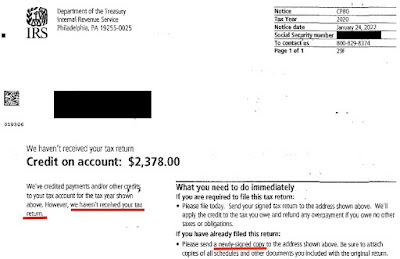
Any notice received from the IRS is upsetting, and this one was no exception. Form CP80, received last week, said that our account had a $2,378 credit and that our 2020 income tax return had not been filed.

We had mailed the return timely on April 14, 2021, along with a check for $2,378 and Form 1040-V, the payment voucher.

Everything was in the same envelope. Obviously they cashed the check and knew it was ours. How could the return have been "lost"?

The above question is sarcastic, dear reader. My mother's 2019 and 2020 tax refunds still have not been received, and getting through to talk to a live person who knows what he or she is doing is impossible.

Tracking info to Cincinnati
And I was certainly not going to accede to the CP80 request to send them another copy with a 2022 signature date. It would go to Philadelphia while the original had gone to Cincinnati. They might think the copy was an Amended Return and accuse me of not filling out a 1040-X.

So I did what we used to do in the old days: compose a politely worded business letter, free of tone, especially sarcasm.

The letter explained that the return was mailed at the Foster City Post Office and, according to the enclosed USPS tracking record, was received in Cincinnati on April 16th. Your move, IRS.

Note: the Washington Post reports that we are in the same boat with an unspecified number of taxpayers. [bold added]
As of Dec. 31, the IRS had 6 million unprocessed individual returns, including returns for the 2020 tax year...

Many taxpayers have been receiving what’s called a “CP80 Notice.” Taxpayers who had already filed a return are told to send a newly signed copy to the address listed in the notice.

Obviously, this direction has alarmed those taxpayers who conclude their original returns are probably in a pile in some IRS office waiting to be processed. Wouldn’t mailing another return just cause more confusion?

Saturday, October 09, 2021

The Beleagured Service

Your humble blogger is appalled by the size and scope of government. Originally this reaction was based on venerable philosophical arguments, i.e., people grow dependent and passive, they cannot think or do anything for themselves, they rely on someone to come to their rescue, etc. But now that we live in a society where there are more safety nets than our grandparents ever dreamed of, the bigger problem is obvious: government simply cannot deliver the functions that it has been tasked to perform.

Case in point: the Internal Revenue Service.

Fun fact: the top half of the IRS logo is the "IRS Eagle",
which I initially thought was an image of a forlorn
taxpayer dropping a return into a mailbox.
This past March, although it was at the time twelve months since it had been filed, we decided not to panic over the IRS' delay in processing Mom's 2019 tax return. The coronavirus had shuttered the IRS' processing centers, and weekly checking of the app showed that the Service had received the paperwork.

In a letter dated September 15, 2021, the IRS stated that it had received the 2019 4th-quarter estimated tax payment on February 3, 2020. The check cleared Mom's bank on February 5, 2020, and it took the IRS 19 months to post it to her account. (Private companies get written up by auditors if receipts aren't posted immediately; standards are different for government agencies.)

Mom will be getting her 2019 refund sometime in November, 2021. According to the letter
If you don't owe other taxes, penalties, interest, or legal obligations we're required to collect, we'll send you a refund of your overpayment within six to eight weeks.
We are so grateful!

I had held off as long as I could but finally mailed Mom's 2020 return because the October 15, 2021 extension deadline was imminent.

Millions of taxpayers were affected by 2019 processing delays, and the backup has affected 2020. The IRS had its worst-performing season last year.
“Paper returns have piled up — there are 5.5 million Form 1040s and over 4 million business returns that have been opened but not processed. The goal is that by year-end, the paper returns will be processed. However, there are an additional 4 million returns anticipated by mid-October,” he said...

And it’s more than just having the money to hire additional personnel, he suggested: “Even if they had the money and had the people willing to work, they couldn’t just snap their fingers and put 50, 100 or 500 people to work manning the phone lines. It takes at least 12 to 18 weeks to train someone to answer and assist callers. They have to understand the systems, and be able to understand and interpret what’s going on.”

In some cases they need to have people with better knowledge or information to help on practitioner lines, [tax chair of CPA Practitioners Stephen] Mankowski observed. “But in a lot of cases, it’s easier to explain the issues to a practitioner than it is to taxpayers,” he said. “There’s a lot of training that is necessary to have someone able to assist all levels of taxpayers."
The IRS cannot perform its basic functions correctly, yet every year Congress keeps loading new laws and new requirements on the beleagured Service. It makes one wonder if those who advocate that government provide more goods and services have actually managed any organizations--public or private--that do so.

Thursday, May 13, 2021

Spending More and Getting Less

We took a Federal and California tax return to the Post Office today. Both were required to be postmarked by Monday, May 17th, and we did the mailing a few days early. (These returns weren't ours, which were mailed on April 14th.)

First-class mail service has deteriorated. It will take four days to deliver the 1040 to Fresno, which is 180 miles (3¼ hours) away.

Worse, the USPS estimates that Form 540 will be delivered on Tuesday to Sacramento, which is 110 miles (2 hours) from Foster City. It takes five days to get a piece of mail to the State Capitol.

If speediness were crucial I would have driven the tax returns to the destinations myself, as I've done a few times in my career.

Services that the government provides---police, schools, mail, tax processing, border patrol, public health--have experienced well-publicized failures during the past year. During the same period the private sector has erected the infrastructure to work from home and produced COVID-19 vaccines years earlier than anyone had a right to expect.

Meanwhile, based on its stellar record, the government takeover of the economy continues apace with an explosion of taxes and spending....

Wednesday, April 14, 2021

Dispensing with Money-Management Cuteness

After the third iteration the tax returns came back from the processor and for the first time in memory they were done by April 11th.

Now that we've simplified our financial accounts and gotten out of pass-through businesses that never made much money but always mailed us the K-1 forms late, the tax stress is gratifyingly confined to the first four months of the year.

Because this year's due date is May 17th, I toyed briefly with the idea of sending in the California 540 now, because we're getting a refund, and delaying Federal 1040 until May, because there's a four-figure balance due.

Dispensing with money-management cuteness, I went to the Post Office and sent in both returns. Not wanting to stand in line twice was one reason, and not having to worry about a must-do item on the calendar was the other. As one gets older, reducing stress during the time we have left has become more important than money.

Thursday, April 08, 2021

Hawaii No Ka Oi (Not)

(Image from CPA Practice Advisor)
Tax practitioners breathed a sigh of relief when the IRS extended the filing deadline for 2020 individual tax returns to May 17, 2021. More importantly, the April 15th payments due, if any, were also extended to May 17th. (In normal years the returns can be filed as late as October 15th if a simple extension form is completed, but the final payment must be made on April 15th nevertheless.)

Generally speaking, the States followed the IRS' lead in postponing the filing date and payments. Below is the ranking of States, including the District of Columbia, starting with those who are the most considerate of taxpayers' needs to the one which is the least accommodating.

The Best: States with No Individual Income Tax
AK, FL, NV, SD, TN, TX, WA, WY

Postponement to July 15
MD

Postponement to June 15
LA

Postponement to June 1
IA

Postponement of Returns and Payments to May 17 (37 incl DC)
AZ, AR, CA, CT, CO, DC, DE, GA, ID, IL, IN, KS KY, MA, ME, MI, MN, MS, MO, MT, NE, NC, ND, NJ, NM, NY, OH, OR, PA, RI, SC, TN, UT, VT, VA, WV, WI

Postponement of Payments to May 17, Return Due April 15
AL

Interest and Dividend Filing plus Payment Due on April 15
NH (does not tax wages but does impose a flat tax on interest and dividends)

The Worst: No Postponement of Returns or Payments After April 20
HI

From Governor Ige's website: "After careful consideration, the Hawaii State Department of Taxation has decided not to extend the Tax Year 2020 filing deadline. Taxpayers must file their returns by April 20, 2021."

Everyone, professional or amateur, who prepares tax returns does the Federal Form 1040 first, then completes the State return off of the Federal data.

By not budging on the April 20 due date Hawaii is forcing State filers to complete the calculations on the Federal return before they have to in order to determine the payment owed to Hawaii in April. And if they haven't finished by April 20th, to be safe they probably will significantly overpay Hawaii when they file the Hawaii extension and plan to get the refund later in the year.

Well, Hawaii hasn't relaxed its quarantine requirements even if inbound travelers have been vaccinated, so its inflexibility toward tax deadlines is not surprising.

That's the Aloha spirit!

Related (3/10/21): Hawaii Senate passes what’s poised to be the nation’s highest income tax. Someone has to pay for all the empty hotels.

Wednesday, March 10, 2021

Breaking the IRS Machine: Millions of 2020 Amended Returns

Fun fact: the top half of the IRS logo is the "IRS Eagle",
which I initially thought was an image of a forlorn
taxpayer dropping a return into a mailbox.
Just two days ago we wrote about how the IRS is buckling under the physical pressure of the COVID-19 lockdown and the systemic pressure of administering benefit payments and tax law changes.

With the prospect of re-opening becoming ever more real, and new tax legislation, if any, usually occurring in the fall, one could well hope that the IRS will have a "normal" tax season and spend the rest of the year fixing its problems. But one would be wrong. [bold added]
Congress is about to change a piece of the tax code affecting the returns being filed by as many as 40 million Americans—a month after the tax-filing season started.

The move, approved by the Senate on Saturday and headed for House passage on Tuesday as part of the coronavirus-relief bill, would exempt the first $10,200 of 2020 unemployment benefits from income for households that made under $150,000. That could save households about $25 billion, but implementing the change would be a challenge for the already-burdened Internal Revenue Service, and it could lead to unusual disruptions.

As of late February, the IRS had already received more than 45 million tax returns, some of which will now likely have to be amended. And the IRS will need to reprogram its computers to include the new, retroactive change as people file returns to take advantage of it. That is happening during an already messy tax season complicated by the coronavirus pandemic, remote work and a pile of other tax-law changes.
Retroactive changes to tax law, even well-intentioned, are enormously disruptive.

There are often ways to achieve the same financial effect without resulting in millions of past-year tax returns being amended. For example, Congress could have authorized an additional payment of, say, 10% in 2021 to compensate taxpayers for the taxes they would have to pay on their 2020 unemployment benefits.

The impetus towards big government seems unstoppable, and the least that politicians can do is to make sure that the machinery of government is working well. In the case of the IRS, the machine is broken (my mother, like millions of others, still hasn't had her 2019 return processed), and Congress keeps adding to the load.

Monday, March 08, 2021

IRS Failure: Disappointing But Easily Foreseeable

Mom's 2019 status on 3/6/21.
Some government entities, such as Foster City where I live, seem to be functioning well, but the Internal Revenue Service, long the bane of nearly everyone, seems to be cracking up.

The IRS can't even perform its basic function of processing returns. One year after I mailed in Mom's 2019 tax return, the IRS2GO app (right) continues to report that the return is still being processed. From February 18, 2021: [bold added]
A group of Republicans on the House Ways and Means Oversight Subcommittee sent a letter Wednesday to IRS Commissioner Charles Rettig complaining about the backlog of approximately 11 million unprocessed tax returns from the 2019 tax year. The backlog of unprocessed mail from the pandemic has created a ripple effect that’s continuing into this year’s tax-filing season, which opened last Friday.

The problem isn’t only with the mail, which piled up last year in trailers outside IRS facilities until IRS employees could return to their offices and open it. While most of the millions of pieces of mail have reportedly been opened, much of it remains unprocessed. That’s causing headaches for taxpayers and tax professionals alike, who are coping with past due notices sent automatically by IRS computer systems, even when payments were sent months ago, according to the investigative news site ProPublica. Taxpayers have had trouble with receiving their Economic Impact Payments from last year and are also having trouble reaching the IRS by phone this year, with the agency continuing to be understaffed due to the pandemic and budget cuts in past years.
Some have tried to blame Republican Congressional representatives for underfunding the Service, and indeed that is one reason the IRS is failing.

But in my humble opinion the primary problem is that Congress has assigned new responsibilities to the IRS that it was never designed to do, such as administer penalties and credits for the Affordable Care Act, aka Obamacare, and then to dole out stimulus payments ("refundable tax credits") resulting from pandemic legislation.

When an organization is being strained, one does not pile on additional tasks without a great deal of planning. Any experienced manager knows that you can't just throw money at the situation, you have to lay out the new requirements, figure out how they can fit in with the current systems, design and test the add-ons before widespread adoption, and then train the staff.

Of course, the COVID-19 response shut down the offices for months, just when a 24/7 work schedule was necessary to give the IRS even a chance to fulfill its new duties. Large tech companies, who have people who are accustomed to working around the clock to develop new products and services, would have had a prayer. But the IRS, or any other government agency? Not a chance.

Friday, August 21, 2020

IRS: So What, We Cannot Lose Them as Customers

Despite a backlog of millions of pieces of unopened mail--some containing checks from taxpayers---the IRS is sending out late payment notices.
Rep. Neal (Accounting Today)
Many taxpayers have been receiving balance-due notices from the IRS even though they sent in their tax payments to the IRS months ago, because trailers full of mail have remained unopened since the start of the pandemic....

“IRS officials reported that, due to office closures, the IRS has accumulated a staggering backlog of unopened mail,” [Rep. Richard Neal, D-Massachusetts] wrote in a letter Wednesday to IRS Commissioner Charles Rettig. “At one point this summer, the IRS had approximately 12 million pieces of unopened correspondence in its inventory. Despite this unprocessed mail, the IRS reportedly has been sending notices to taxpayers whose correspondence and payments remain unopened. Therefore, many of the taxpayers receiving these notices already have made the payments that the IRS seeks.”

...Neal would like the IRS to stop sending out the notices when there is still so much uncertainty about what taxes have been paid by check and are sitting in unopened envelopes.
The IRS acknowledged it has received
Mom's return 5 months after it was
mailed but has yet to send the refund.
Somehow businesses that have managed to stay alive have coped with the unprecedented stress of the COVID-19 lockdown.

A broad swath of Government agencies--e.g., the CDC, the State Department, public education, and the IRS--have demonstrated gross inefficiency, if not incompetence.

Taxpayers should be given the benefit of the doubt that the mistakes lie with the IRS, not them.

It also doesn't bode well for the November elections, when enormous burdens will be placed on the U.S. Postal Service.

Thursday, July 16, 2020

Federal Government: Average Would be a Great Improvement

4 months to process, lucky
I'm not going anywhere
In the coronavirus era everyone must allow extra time to get anything done, which is especially true if one has to deal with the U.S. Government.

One prominent example: taxpayers have been granted an extra three months to file their returns--and I am grateful for the extra time--but the IRS isn't held to a deadline, relaxed or not.

We mailed Mom's paper return in March and have not yet gotten her four-figure refund. (The IRS2Go app says the IRS has not even received her return.)

The passport check cleared on March 18th.
Also in March I sent in my passport renewal application. The renewal was straightforward---no new documents were required except for an updated photo--because the last passport was issued less than 15 years ago.

Today the new passport arrived, four months and three days later. Yes, the safety of employees is paramount, but somehow other public and private organizations are managing to operate safely, with only a moderate diminution in speed. For the Federal Government just being average would be a great improvement.

[Note - June 6, WSJ:
“If you mailed us something, especially in February, it’s gonna be a while,” said Chad Hooper, an IRS worker in Philadelphia and president of the Professional Managers Association, which represents the agency’s supervisors.