Today's Google Doodle depicts the 1965 march from Selma to Montgomery in honor of Martin Luther King, Jr. As a pre-teen, I read about Selma in the two Honolulu newspapers, but it had little resonance.
In Hawaii everyone was race-conscious, but there seemed to be very little overt racism. My eighth-grade (haole) teacher had a theory that racial resentment in Hawaii was defused because each race could point to its own wealthy, powerful representatives (Chinese real estate moguls, Caucasian businessmen, Japanese politicians, etc.). Also, there were very few African-Americans in the islands; most of the ones I saw were in the military, and they certainly appeared "normal", not like the activists who were in the news.
The passions that triggered the civil rights movement and the Watts riots became real when I went to the Mainland for college. Many of my fellow students were obsessed with racial identity; they told me that I should feel angry about the way Asian-Americans were treated, and that white Americans resented all Asians because of Vietnam.
For guidance I turned to the writings and speeches of Martin Luther King, Jr. They were consistent with traditional American ideals and were a call to action to ensure that all Americans had the rights to which they were entitled under the Constitution. To spur a recalcitrant society towards that goal he fleshed out the theory and practice of non-violent civil disobedience. I came to understand, less than a decade after his death, why he is so revered.
Today Martin Luther King, Jr. would have turned 95. The assassin's bullet cut short his life at the age of 39, much too soon.
Showing posts with label Martin Luther King. Show all posts
Monday, January 15, 2024
Monday, January 16, 2023
MLK Day, 2023
Note: August 28, 2023 will be the 60th anniversary of Martin Luther King, Jr.'s "I Have a Dream" speech.
After re-reading my previous posts on Martin Luther King Day, the great man seems more relevant than ever to this boomer blogger. Unfortunately, his doctrine of non-violent civil disobedience seems increasingly quaint. Today speakers will honor him, all the while willfully ignoring what he called them to do. We must not allow our creative protest to degenerate into physical violence.
From 2010:
Martin Luther King, Jr. was an American original whose stature has only grown since his assassination in 1968. His I Have a Dream speech and Letter from Birmingham Jail are masterpieces of the rhetorical art, replete with religious themes, historical references, and poetic flourishes. Dr. King pushed, pulled, and forced a preoccupied postwar superpower to confront the difference between its glossy self-image and ugly racist reality.
He did this by conveying a vision of an America that was full of hope and was consistent with its founding ideals. He delivered that vision in soaring preacherly cadences that called, if not compelled, his audiences to act. On the holiday of his remembrance Dr. King's wisdom has not dulled with time's passage:
On non-violence:
In the process of gaining our rightful place we must not be guilty of wrongful deeds. Let us not seek to satisfy our thirst for freedom by drinking from the cup of bitterness and hatred. We must forever conduct our struggle on the high plane of dignity and discipline. We must not allow our creative protest to degenerate into physical violence.On the difference between just and unjust laws:
An unjust law is a code that a numerical or power majority group compels a minority group to obey but does not make binding on itself. This is difference made legal. By the same token, a just law is a code that a majority compels a minority to follow and that it is willing to follow itself. This is sameness made legal.On civil disobedience:
In no sense do I advocate evading or defying the law, as would the rabid segregationist. That would lead to anarchy. One who breaks an unjust law must do so openly, lovingly, and with a willingness to accept the penalty. I submit that an individual who breaks a law that conscience tells him is unjust and who willingly accepts the penalty of imprisonment in order to arouse the conscience of the community over its injustice, is in reality expressing the highest respect for law.How to effect peaceful change:
In any nonviolent campaign there are four basic steps: collection of the facts to determine whether injustices exist; negotiation; self-purification; and direct action.Dr. King asked his followers to “purify” themselves, that is, lead blameless lives in accordance with the very principles that they would demand others follow. Walking the talk remains as difficult as it is noble, and it is as relevant to leadership today as it was 60--and 2,000--years ago. © 2023 Stephen Yuen
Monday, January 17, 2022
MLK Day, 2022
No changes are necessary to last year's post on one of the great men of the 20th century:
After re-reading my previous posts on Martin Luther King Day, the great man seems more relevant than ever to this boomer blogger. Unfortunately, his doctrine of non-violent civil disobedience seems increasingly quaint. Today speakers will honor him, all the while willfully ignoring what he called them to do. We must not allow our creative protest to degenerate into physical violence.
From 2010:
Martin Luther King, Jr. was an American original whose stature has only grown since his assassination in 1968. His I Have a Dream speech and Letter from Birmingham Jail are masterpieces of the rhetorical art, replete with religious themes, historical references, and poetic flourishes. Dr. King pushed, pulled, and forced a preoccupied postwar superpower to confront the difference between its glossy self-image and ugly racist reality.
He did this by conveying a vision of an America that was full of hope and was consistent with its founding ideals. He delivered that vision in soaring preacherly cadences that called, if not compelled, his audiences to act. On the holiday of his remembrance Dr. King's wisdom has not dulled with time's passage:
On non-violence:
From 2010:
Martin Luther King, Jr. was an American original whose stature has only grown since his assassination in 1968. His I Have a Dream speech and Letter from Birmingham Jail are masterpieces of the rhetorical art, replete with religious themes, historical references, and poetic flourishes. Dr. King pushed, pulled, and forced a preoccupied postwar superpower to confront the difference between its glossy self-image and ugly racist reality.
He did this by conveying a vision of an America that was full of hope and was consistent with its founding ideals. He delivered that vision in soaring preacherly cadences that called, if not compelled, his audiences to act. On the holiday of his remembrance Dr. King's wisdom has not dulled with time's passage:
On non-violence:
In the process of gaining our rightful place we must not be guilty of wrongful deeds. Let us not seek to satisfy our thirst for freedom by drinking from the cup of bitterness and hatred. We must forever conduct our struggle on the high plane of dignity and discipline. We must not allow our creative protest to degenerate into physical violence.On the difference between just and unjust laws:
An unjust law is a code that a numerical or power majority group compels a minority group to obey but does not make binding on itself. This is difference made legal. By the same token, a just law is a code that a majority compels a minority to follow and that it is willing to follow itself. This is sameness made legal.On civil disobedience:
In no sense do I advocate evading or defying the law, as would the rabid segregationist. That would lead to anarchy. One who breaks an unjust law must do so openly, lovingly, and with a willingness to accept the penalty. I submit that an individual who breaks a law that conscience tells him is unjust and who willingly accepts the penalty of imprisonment in order to arouse the conscience of the community over its injustice, is in reality expressing the highest respect for law.How to effect peaceful change:
In any nonviolent campaign there are four basic steps: collection of the facts to determine whether injustices exist; negotiation; self-purification; and direct action.Dr. King asked his followers to “purify” themselves, that is, lead blameless lives in accordance with the very principles that they would demand others follow. Walking the talk remains as difficult as it is noble, and it is as relevant to leadership today as it was 59--and 2,000--years ago. © 2022 Stephen Yuen
Monday, January 18, 2021
MLK Day, 2021
From 2010:
Martin Luther King, Jr. was an American original whose stature has only grown since his assassination in 1968. His I Have a Dream speech and Letter from Birmingham Jail are masterpieces of the rhetorical art, replete with religious themes, historical references, and poetic flourishes. Dr. King pushed, pulled, and forced a preoccupied postwar superpower to confront the difference between its glossy self-image and ugly racist reality.
He did this by conveying a vision of an America that was full of hope and was consistent with its founding ideals. He delivered that vision in soaring preacherly cadences that called, if not compelled, his audiences to act. On the holiday of his remembrance Dr. King's wisdom has not dulled with time's passage:
On non-violence:
In the process of gaining our rightful place we must not be guilty of wrongful deeds. Let us not seek to satisfy our thirst for freedom by drinking from the cup of bitterness and hatred. We must forever conduct our struggle on the high plane of dignity and discipline. We must not allow our creative protest to degenerate into physical violence.On the difference between just and unjust laws:
An unjust law is a code that a numerical or power majority group compels a minority group to obey but does not make binding on itself. This is difference made legal. By the same token, a just law is a code that a majority compels a minority to follow and that it is willing to follow itself. This is sameness made legal.On civil disobedience:
In no sense do I advocate evading or defying the law, as would the rabid segregationist. That would lead to anarchy. One who breaks an unjust law must do so openly, lovingly, and with a willingness to accept the penalty. I submit that an individual who breaks a law that conscience tells him is unjust and who willingly accepts the penalty of imprisonment in order to arouse the conscience of the community over its injustice, is in reality expressing the highest respect for law.How to effect peaceful change:
In any nonviolent campaign there are four basic steps: collection of the facts to determine whether injustices exist; negotiation; self-purification; and direct action.Dr. King asked his followers to “purify” themselves, that is, lead blameless lives in accordance with the very principles that they would demand others follow. Walking the talk remains as difficult as it is noble, and it is as relevant to leadership today as it was 58--and 2,000--years ago. © 2021 Stephen Yuen
Sunday, January 10, 2021
Leaving It All Behind
![]() |
| Moses Striking the Rock (Tintoretto,ca.1555–1570) |
The three parts of the Exodus story—slavery and deliverance; covenant and law; worship and presence—become the three pillars of the Children of Israel’s enduring national existence.At crucial times in history--the 1860's and 1960's--the American nation was riven by extreme differences but came back from the brink--in one case it also took a Civil War--when Abraham Lincoln and Martin Luther King, Jr., called it to live up to the "better angels of our nature."
The tale of oppressive slavery in prosperous Egypt and of the astonishing deliverance and miraculous sustenance in the wilderness—the first pillar—is the constitutive national narrative, memorialized and retold annually by parents to children at the Passover Seder. Absent a relation to God, the Jewish people might still be enslaved to man; remembering our own servitude, we should deal kindly with the vulnerable.
The covenant and constituting Law—the second pillar—establish the way of life under which the people are to live and rule themselves. Not content merely to provide instruction for rectifying mutual wrongdoing, the Law is also a moral teacher, touching all aspects of human life. Its guidelines protect human dignity against abuse and self-abasement and encourage reverence for life and property, care for the needy and fair dealing in all transactions. Aiming beyond justice, the Law seeks to promote grace and gratitude, lifting human beings to fulfill the promise implied in man’s being in the image of God.
The human longing for something better than our mortal selves is satisfied in the third pillar, a place for the community to meet and to seek and commune with God. The center of communal life, it is a home for showing gratitude and seeking atonement, for prayer and sacrifice, and for dedicating personal and collective life to serving God and His higher purposes for humankind...
Thoughtful people have long detected numerous parallels between the United States and biblical Israel. We Americans, too, owe our origins to an escape from despotism and a desire for religious freedom. We, too, are a particular and distinctive people with a universal creed, one of biblical provenance: In announcing our birth, we declared that “all men are created equal, endowed by their Creator with certain unalienable rights.” We too have a constituting national law, a Constitution approved by the consent of the people. And when in the mid-19th century our Union was challenged and its founding creed repudiated, we renewed it through the sacrifice of a bloody civil war, so that, as Abraham Lincoln said, “this nation under God shall have a new birth of Freedom.”
(Image from pinterest)
Like Israel of old, we, too, have stumbled and fallen, and committed apostasy against our creed. But half a century ago, Martin Luther King, Jr. , like an ancient Hebrew prophet, summoned us to return to our ideals of liberty and justice for all, appealing explicitly to our founding creed and the brotherhood of man under the fatherhood of God. Until only yesterday, it could be said of America that it was, in G.K. Chesterton’s words, “a nation with the soul of a church.”
But times have changed. For today’s reader of Exodus, a crucial question cries out from the three-pillared structure of Israel’s founding. Can a people endure and flourish if it lacks a shared national story, accepted law and morals, and an aspiration to something higher than its own comfort and safety? Can a devotion to technological progress, economic prosperity and private pursuits of happiness sustain us when our story is contested (or despised), our morals weakened and our national dedication abandoned?
We need such a powerful voice or voices to remind us Democrats are not Communists and Republicans are not Nazis. (Both Communists and Nazis slaughtered millions of people, including their own, during the 20th century.) We need voices to remind us that we have vastly more in common in our values and dreams than in our differences.
President-Elect Biden called for us not to treat each other as enemies on November 8th, and this humble blogger, for one, will resist that temptation no matter how much I may disagree with my fellow citizens:
I pledge to be a president who seeks not to divide, but to unify. Who doesn’t see red and blue states, but a United States...Let there be peace on earth, and let it begin with me.
But now, let’s give each other a chance. It’s time to put away the harsh rhetoric. To lower the temperature. To see each other again. To listen to each other again. To make progress, we must stop treating our opponents as our enemy. We are not enemies. We are Americans.
The Bible tells us that to everything there is a season – a time to build, a time to reap, a time to sow. And a time to heal. This is the time to heal in America.
Labels:
Bible,
Biden,
Israel,
Lincoln,
Martin Luther King
Sunday, February 23, 2020
Poorer Without the Knowledge
![]() |
| Reading the Bible to his son (Getty, 1864) |
in an age of declining biblical literacy, we are in danger of losing touch with a key source of his greatness.At one time it was commonly understood that teaching about Christianity was different from preaching it. In avoiding the latter our schools have forsaken the former.
Why, for instance, did Lincoln begin the Gettysburg Address with the words “fourscore and seven years ago?” ...he knew that his audience was deeply familiar with the King James Bible and would recognize the language of the Psalms: “The days of our years are threescore years and ten; and if by reason of strength they be fourscore years.”
And so it is that we have little understanding of and identification with historical icons like Abraham Lincoln and Martin Luther King, Jr., and we're the poorer for it.
Monday, January 20, 2020
MLK Day, 2019: Now, More Than Ever
The New York Times' 1619 Project. as described by one of its critics, the National Review [bold added]:
Like Dr. King, Professor Carson fought against racism his entire life. But as an historian he praises the American experiment, not condemns it.
400 years ago there were only glimmers of the ideas that would lead to an overarching philosophy of human rights. It wasn't so much "racism" then, but the way everything worked--tribes conquering other tribes. The world view was that of Thomas Hobbes (1588-1679)--either accede to a sovereign which offered limited protection or, in a state of nature, have a life that was solitary, poor, nasty, brutish, and short.
Today most of us are blessed to live in a world where the biggest complaints are about inequality and privilege. But the answer, I believe Dr. King would say, is not to tear down the wealthy but lift up the poor. He would dream
The “newspaper of record” states that this “ongoing initiative” “aims to reframe the country’s history by placing the consequences of slavery and the contributions of black Americans at the very center of our national narrative.” It’s a conscious attempt to make the country’s “real” founding stem from when the first African slaves arrived in Virginia, rather than when the thirteen colonies declared their independence from Great Britain (or, say, 1620, when the Pilgrims arrived in Massachusetts, or 1607, when Jamestown was settled).Clayborne Carson, Director of Stanford's Martin Luther King, Jr., Research and Education Institute, agrees with the criticism: [bold added]
That kind of gets back to the 1619 Project. A lot of their focus seems to be the founding of the United States as a nation. The way I would look at that, is that at that time, for a variety of reasons, you have a predominant group, white men, beginning to articulate a human rights ideal. We can study why that happened when it happened.Clayborne Carson has made it his life's work to research and document the life of Martin Luther King, Jr.
It had to do with the Enlightenment, the spread of literacy, the rise of working class movements. All of these factors led people to start talking in terms of human rights. It was both an intellectual movement from the top down and a freedom struggle from the bottom up. People begin to speak in terms of rights: that, I, we, have rights that other people should respect. The emergence of that is important.
And it does affect African Americans. We know that from Benjamin Banneker and lot of other black people who realized that white people were talking about rights and said, ‘well we have rights too.’ That’s an important development in history, and an approach to history that doesn’t say we should privilege only the rights talk of white people. There’s always a dialogue between that and oppressed people. You have to tell the story from the top down, that intellectuals began to articulate the notion of rights. But simultaneously, non-elites are doing that—working class people, black people, colonized people.
Like Dr. King, Professor Carson fought against racism his entire life. But as an historian he praises the American experiment, not condemns it.
400 years ago there were only glimmers of the ideas that would lead to an overarching philosophy of human rights. It wasn't so much "racism" then, but the way everything worked--tribes conquering other tribes. The world view was that of Thomas Hobbes (1588-1679)--either accede to a sovereign which offered limited protection or, in a state of nature, have a life that was solitary, poor, nasty, brutish, and short.
Today most of us are blessed to live in a world where the biggest complaints are about inequality and privilege. But the answer, I believe Dr. King would say, is not to tear down the wealthy but lift up the poor. He would dream
that my four little children will one day live in a nation where they will not be judged by the color of their skin but by the content of their character.If we keep focusing on race--as the 1619 project does--we will never look past it.
Monday, January 21, 2019
Now, More Than Ever
From a speech by a great American in 1963:
Push ahead determinedly but always peaceably, and dream of an America where "my four little children will one day live in a nation where they will not be judged by the color of their skin but by the content of their character." I miss that guy.In the process of gaining our rightful place we must not be guilty of wrongful deeds. Let us not seek to satisfy our thirst for freedom by drinking from the cup of bitterness and hatred. We must forever conduct our struggle on the high plane of dignity and discipline. We must not allow our creative protests to degenerate into physical violence. Again and again we must rise to the majestic heights of meeting physical force with soul force.
(Washington Post photo)
Monday, January 15, 2018
MLK Day, 2018
From the Letter from Birmingham Jail:
![]() |
| (Washington Post photo) |
In no sense do I advocate evading or defying the law, as would the rabid segregationist. That would lead to anarchy. One who breaks an unjust law must do so openly, lovingly, and with a willingness to accept the penalty. I submit that an individual who breaks a law that conscience tells him is unjust and who willingly accepts the penalty of imprisonment in order to arouse the conscience of the community over its injustice, is in reality expressing the highest respect for law.Martin Luther King, Jr.'s actions, words, and the thought behind them made him remarkable in a century filled with great men (Churchill, Gandhi, Roosevelt(s), Einstein, Picasso, Hemingway, Pope John XXIII, to name a few).
Monday, January 16, 2017
MLK Day, 2017
Last year's post, with an addendum:
The death of Martin Luther King, Jr., occurred when I was a teenager. I admired his speeches but knew little else about him. He was part of the societal eruptions occurring on the Mainland, and wasn’t the FBI investigating him, and weren’t there rumors that he was a communist?
Race riots, the civil rights movement, Vietnam war protests, drugs, the Russo-Chinese axis, and finally the granddaddy of worries—nuclear war—all made for an unsettled Sixties. The murder of Martin Luther King in 1968, one of the most eventful years of the 20th century, was another sign of a very unstable world.
The world, of course, did survive the tumult, and with distance comes reflection and perspective. For me Dr. King is one of those rare individuals whose greatness has increased with the passage of time. His “I Have a Dream” speech is as compelling—and relevant—as ever, and his “Letter from a Birmingham Jail” is a soul-searching treatise on civil disobedience. Only recently have I begun to appreciate its wisdom.
Dr. King's words, like the Bible, have been used by people to support opposing sides of various issues. Usually at least one side engages in cherry-picking; an honest reading in context will likely make it clear where he would have stood.
For example, gay rights may be analogized to the battle against segregation.
Addendum: the Letter from a Birmingham Jail has something to say about the debate over a voter identification law (one side says it would prevent fraud, the other says it would cause intimidation). Would such a law be unjust? Your humble blogger would cheerfully show his ID to vote, as would the presumed majority who would support its enactment. In other words the majority would make the law binding on itself, making voter ID a just law by Martin Luther King's definition.
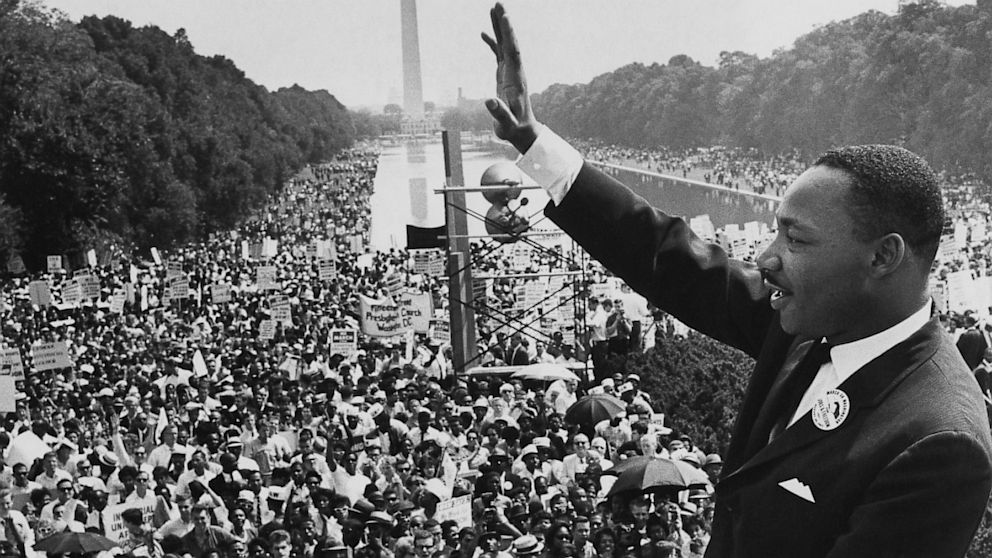
| At the 1963 March on Washington (ABC news) |
Race riots, the civil rights movement, Vietnam war protests, drugs, the Russo-Chinese axis, and finally the granddaddy of worries—nuclear war—all made for an unsettled Sixties. The murder of Martin Luther King in 1968, one of the most eventful years of the 20th century, was another sign of a very unstable world.
The world, of course, did survive the tumult, and with distance comes reflection and perspective. For me Dr. King is one of those rare individuals whose greatness has increased with the passage of time. His “I Have a Dream” speech is as compelling—and relevant—as ever, and his “Letter from a Birmingham Jail” is a soul-searching treatise on civil disobedience. Only recently have I begun to appreciate its wisdom.
Dr. King's words, like the Bible, have been used by people to support opposing sides of various issues. Usually at least one side engages in cherry-picking; an honest reading in context will likely make it clear where he would have stood.
For example, gay rights may be analogized to the battle against segregation.
An unjust law is a human law that is not rooted in eternal law and natural law. Any law that uplifts human personality is just. Any law that degrades human personality is unjust. All segregation statutes are unjust because segregation distorts the soul and damages the personality. It gives the segregator a false sense of superiority and the segregated a false sense of inferiority.Another example: the hypocrisy of climate change celebrities and billionaires who use private jets and own multiple estates.
An unjust law is a code that a numerical or power majority group compels a minority group to obey but does not make binding on itself. This is difference made legal. By the same token, a just law is a code that a majority compels a minority to follow and that it is willing to follow itself. This is sameness made legal.Martin Luther King, Jr.: something to like---and not like---for everyone.
Addendum: the Letter from a Birmingham Jail has something to say about the debate over a voter identification law (one side says it would prevent fraud, the other says it would cause intimidation). Would such a law be unjust? Your humble blogger would cheerfully show his ID to vote, as would the presumed majority who would support its enactment. In other words the majority would make the law binding on itself, making voter ID a just law by Martin Luther King's definition.
Monday, January 18, 2016
Growing in Greatness
| At the 1963 March on Washington (ABC news) |
Race riots, the civil rights movement, Vietnam war protests, drugs, the Russo-Chinese axis, and finally the granddaddy of worries—nuclear war—all made for an unsettled Sixties. The murder of Martin Luther King in 1968, one of the most eventful years of the 20th century, was another sign of a very unstable world.
The world, of course, did survive the tumult, and with distance comes reflection and perspective. For me Dr. King is one of those rare individuals whose greatness has increased with the passage of time. His “I Have a Dream” speech is as compelling—and relevant—as ever, and his “Letter from a Birmingham Jail” is a soul-searching treatise on civil disobedience. Only recently have I begun to appreciate its wisdom.
Dr. King's words, like the Bible, have been used by people to support opposing sides of various issues. Usually at least one side engages in cherry-picking; an honest reading in context will likely make it clear where he would have stood.
For example, gay rights may be analogized to the battle against segregation.
An unjust law is a human law that is not rooted in eternal law and natural law. Any law that uplifts human personality is just. Any law that degrades human personality is unjust. All segregation statutes are unjust because segregation distorts the soul and damages the personality. It gives the segregator a false sense of superiority and the segregated a false sense of inferiority.Another example: the hypocrisy of climate change celebrities and billionaires who use private jets and own multiple estates.
An unjust law is a code that a numerical or power majority group compels a minority group to obey but does not make binding on itself. This is difference made legal. By the same token, a just law is a code that a majority compels a minority to follow and that it is willing to follow itself. This is sameness made legal.Martin Luther King, Jr.: something to like---and not like---for everyone.
Monday, January 19, 2015
No Controversy Today
| (Photo from redstate.com) |
We repeatedly asked ourselves : "Are you able to accept blows without retaliating?" "Are you able to endure the ordeal of jail?Like Gandhi, whom he studied and admired, Dr. King was successful in part because he challenged the dominant culture to live up to its own ideals. He had his personal peccadilloes but was steadfast where it counted, refusing to waver from non-violence and "accept[ing] the penalty" for breaking "unjust" laws.
One may want to ask: "How can you advocate breaking some laws and obeying others?" The answer lies in the fact that there are two types of laws: just and unjust.
How does one determine whether a law is just or unjust? A just law is a man-made code that squares with the moral law or the law of God. An unjust law is a code that is out of harmony with the moral law.
An unjust law is a code that a numerical or power majority group compels a minority group to obey but does not make binding on itself.
One who breaks an unjust law must do so openly, lovingly, and with a willingness to accept the penalty. I submit that an individual who breaks a law that conscience tells him is unjust and who willingly accepts the penalty of imprisonment in order to arouse the conscience of the community over its injustice, is in reality expressing the highest respect for law.
I have tried to stand between these two forces, saying that we need emulate neither the "do-nothingism" of the complacent nor the hatred and despair of the black nationalist. For there is the more excellent way of love and nonviolent protest.
It took 14 years (1986-2000) for all 50 states to recognize Martin Luther King Day as an official holiday. Today there is no controversy; the passage of time often clarifies the greatness of a man.
Thursday, August 29, 2013
The Greatest American Speech
It has been called the greatest American speech of the 20th century. Yesterday marked its 50th anniversary.
I first saw the newsfilm of "I Have a Dream" in its entirety in 1969, the year after Martin Luther King, Jr., was assassinated. In truth I wasn't ready to appreciate it in 1963 when I was a pre-teen.
Growing up in Hawaii my friends and I were all far removed from the civil rights movement, Mississippi and Alabama. Our class had one African-American student, a friendly guy and a terrific athlete (!). It didn't seem comprehensible that some people could hate our classmate because of the color of his skin. In retrospect, although he seemed to fit in with the multiracial student body, I have absolutely no idea what he really thought or felt. (It turned out that another black kid in our elementary school at that time did feel out of place.)
The greatest American speech surprised me with its power and, yes, beauty. Sure, I had read its text, but watching Dr. King and hearing his preacherly cadences calling forth the best in each listener filled this then-teenager with emotion. He and John F. Kennedy two years earlier had asked us to look to the mountaintop. Their dreams seemed impossible, but with these men leading us perhaps we had a chance to get there. In the wink of an eye they were both gone.
Subscribe to:
Posts (Atom)