Showing posts with label Lincoln. Show all posts

Monday, November 11, 2024

Veteran's Day

Below is my post from 2013, slightly edited:

November begins on a personal note with my birthday. In recent years the celebration has been muted. (I'm at the age when I look back more than I look ahead.)

Dad, near Tokyo in 1945
Today, Veteran's Day, we remember my father and his five brothers, World War II veterans all, who have passed on. Dad's ashes are at the family church, while the others are interred at Punchbowl.

On November 19th the nation will honor the 161st anniversary of the Gettysburg Address, Lincoln's great speech in the aftermath of an horrific battle. And on November 22nd the nation will remember the life and death of John F. Kennedy 61 years after his assassination.

In a strange way revisiting traumatic events such as WW II, the Civil War, and the JFK assassination gives rise to hope. The obstacles that the nation overcame 61, 80, and 161 years ago dwarf those that it faces today, and there is no good reason why we shouldn't be equally--and ultimately--successful in solving our problems as well. © 2024 Stephen Yuen

Thursday, April 28, 2022

Unique Menu

Sushi rolls
Five years after our first visit, we were pleased to see that Tugboat Fish & Chips had survived the pandemic.

The franchisees, an Asian couple, were still offering a unique menu: sushi plates, other Asian dishes, and English seafood & chips.

When we entered the dining room, eight middle-aged Japanese-Americans were chatting amiably at a large table in the corner. It's always a plus to see locals eating in an establishment that one is about to patronize.

Lunch special
I ordered the lunch special: deep-fried cod, french fries, onion rings, tempura zucchini, and pot stickers. My companion ordered a couple of sushi rolls. The ingredients were fresh, and the deep-fried dishes were crisp and moist inside.

The bill was $30 before tax and tip, about 25% below comparable Bay Area restaurants. We'll be back, and the interval will be a lot less than five years.

Tuesday, April 26, 2022

Lincoln, California in the Spring

November 29, 2021
April 26, 2022


The winter rains didn't alleviate the drought, but they were enough to cause the pond grasses to spring to life. A hay-fever sufferer since childhood, I felt the familiar nasal tingling that presaged an attack if I didn't leave the area.

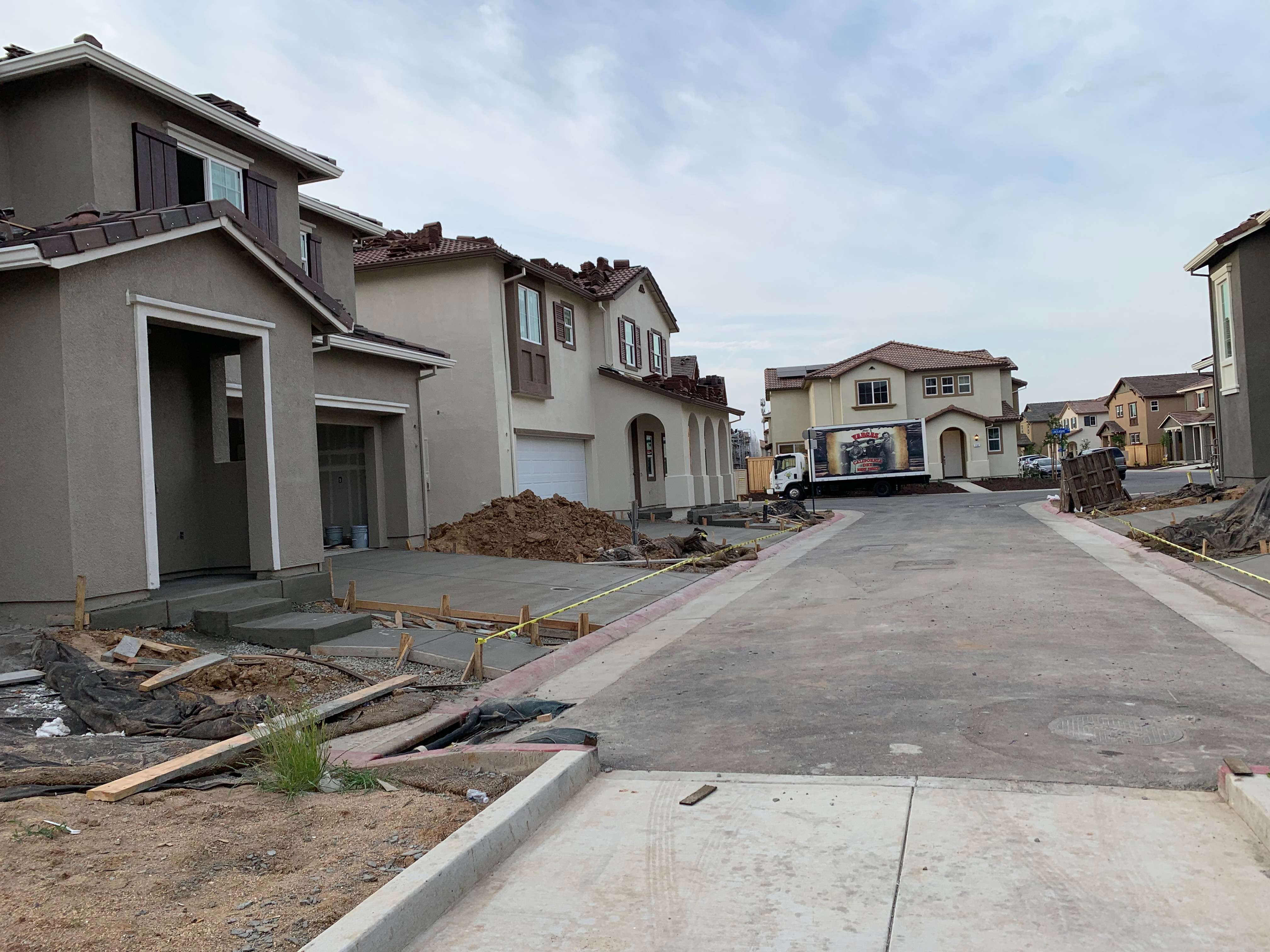
A few hundred feet along the walking path brought me to what was an empty field two years ago. New homes priced in the $500,000 range had sprung up.

The builder, D.R. Horton, has a good reputation; just the fact that the project was nearing completion during an era of material and labor shortages is a sign of competence, IMHO.

The new development was a sign of the migration inland.

For Californians looking to get away from the over-priced, over-crowded coasts--but still be close to the perks of suburban life like shopping malls, restaurants, and recreation--the greater Sacramento area is a good landing spot.

Wednesday, February 16, 2022

Reaching San Francisco's Limit

Ousted: Alison Collins, Faauuga Moliga, and Gabriela Lopez
In 2020 the seven-member San Francisco Board of Education was preoccupied, not with re-opening classes safely, but with the renaming of 44 schools that bore the monickers of flawed human beings like George Washington, Abraham Lincoln, and Theodore Roosevelt.

The school board in early 2021 removed merit-based admission for Lowell High, the crown jewel of the public school system, in order to make Lowell like the other 14 mediocre high schools in San Francisco. Again, there was little focus on re-opening.

Liberal San Franciscans had reached their limit and "overwhelmingly" voted yesterday for the recall of three Board members:
The landslide decision means board President Gabriela López and members Alison Collins and Faauuga Moliga will officially be removed from office and replaced by mayoral appointments 10 days after the election is officially accepted by the Board of Supervisors.
Supporters of the recalled commissioners blamed the usual suspects: whites, billionaires, and Republicans.
Board of Supervisors President Shamann Walton slammed the recall as being driven by “closet Republicans and most certainly folks with conservative values in San Francisco, even if they weren’t registered Republicans.”

“Trump’s election and bold prejudice brought a lot of that out, even in our Democratic and liberal city,” he told The Chronicle in the days before the election. “There are a lot of people who do not want people of color making decisions in leadership, even though the voters said that is what they want.”
In the 2020 Presidential election Joe Biden won 85% of San Franciscans' votes to Donald Trump's 13%. According to Progressive politicians and educators, Donald Trump and "closeted Republicans'" exerted sufficient power in 2022 to win a San Francisco recall election.

The perspicacity of this political analysis is only matched by the competence of San Francisco's governance.

Wednesday, December 01, 2021

A Quiet Monday Evening

Lincoln pond at sunset
The freeway--it has a soundwall--is only a few hundred feet away, but there's much less noise in Lincoln than in our residential neighborhood on the Peninsula.

Maybe it's the halo effect. I like the Sacramento hills, which biases me toward all other aspects of Central Valley life.

I like the spread-out feeling and the aforementioned quiet. Even the air seems cleaner, which doesn't make sense because this area is close to the wildfires.

The real estate websites say that home prices in Placer County have gone up by more than 20% in the past year. Builders are noticing, and new developments are springing up on what used to be farmland.

The coronavirus only accelerated the trend of leaving the over-priced, over-crowded coasts. The great migration shows no signs of abating.

Sunday, January 10, 2021

Leaving It All Behind

Moses Striking the Rock (Tintoretto,ca.1555–1570)
Chicago Professor Leon Kass points out the similarities between the stories of Exodus and America: [bold added]
The three parts of the Exodus story—slavery and deliverance; covenant and law; worship and presence—become the three pillars of the Children of Israel’s enduring national existence.

The tale of oppressive slavery in prosperous Egypt and of the astonishing deliverance and miraculous sustenance in the wilderness—the first pillar—is the constitutive national narrative, memorialized and retold annually by parents to children at the Passover Seder. Absent a relation to God, the Jewish people might still be enslaved to man; remembering our own servitude, we should deal kindly with the vulnerable.

The covenant and constituting Law—the second pillar—establish the way of life under which the people are to live and rule themselves. Not content merely to provide instruction for rectifying mutual wrongdoing, the Law is also a moral teacher, touching all aspects of human life. Its guidelines protect human dignity against abuse and self-abasement and encourage reverence for life and property, care for the needy and fair dealing in all transactions. Aiming beyond justice, the Law seeks to promote grace and gratitude, lifting human beings to fulfill the promise implied in man’s being in the image of God.

The human longing for something better than our mortal selves is satisfied in the third pillar, a place for the community to meet and to seek and commune with God. The center of communal life, it is a home for showing gratitude and seeking atonement, for prayer and sacrifice, and for dedicating personal and collective life to serving God and His higher purposes for humankind...

(Image from pinterest)
Thoughtful people have long detected numerous parallels between the United States and biblical Israel. We Americans, too, owe our origins to an escape from despotism and a desire for religious freedom. We, too, are a particular and distinctive people with a universal creed, one of biblical provenance: In announcing our birth, we declared that “all men are created equal, endowed by their Creator with certain unalienable rights.” We too have a constituting national law, a Constitution approved by the consent of the people. And when in the mid-19th century our Union was challenged and its founding creed repudiated, we renewed it through the sacrifice of a bloody civil war, so that, as Abraham Lincoln said, “this nation under God shall have a new birth of Freedom.”

Like Israel of old, we, too, have stumbled and fallen, and committed apostasy against our creed. But half a century ago, Martin Luther King, Jr. , like an ancient Hebrew prophet, summoned us to return to our ideals of liberty and justice for all, appealing explicitly to our founding creed and the brotherhood of man under the fatherhood of God. Until only yesterday, it could be said of America that it was, in G.K. Chesterton’s words, “a nation with the soul of a church.”

But times have changed. For today’s reader of Exodus, a crucial question cries out from the three-pillared structure of Israel’s founding. Can a people endure and flourish if it lacks a shared national story, accepted law and morals, and an aspiration to something higher than its own comfort and safety? Can a devotion to technological progress, economic prosperity and private pursuits of happiness sustain us when our story is contested (or despised), our morals weakened and our national dedication abandoned?
At crucial times in history--the 1860's and 1960's--the American nation was riven by extreme differences but came back from the brink--in one case it also took a Civil War--when Abraham Lincoln and Martin Luther King, Jr., called it to live up to the "better angels of our nature."

We need such a powerful voice or voices to remind us Democrats are not Communists and Republicans are not Nazis. (Both Communists and Nazis slaughtered millions of people, including their own, during the 20th century.) We need voices to remind us that we have vastly more in common in our values and dreams than in our differences.

President-Elect Biden called for us not to treat each other as enemies on November 8th, and this humble blogger, for one, will resist that temptation no matter how much I may disagree with my fellow citizens:
I pledge to be a president who seeks not to divide, but to unify. Who doesn’t see red and blue states, but a United States...

But now, let’s give each other a chance. It’s time to put away the harsh rhetoric. To lower the temperature. To see each other again. To listen to each other again. To make progress, we must stop treating our opponents as our enemy. We are not enemies. We are Americans.

The Bible tells us that to everything there is a season – a time to build, a time to reap, a time to sow. And a time to heal. This is the time to heal in America.
Let there be peace on earth, and let it begin with me.

Saturday, October 17, 2020

Renaming Solution: Disband the Committee

Abraham Lincoln High School (Chron photo)

Three months ago we remarked somewhat bemusedly upon the movement to rename scores of San Francisco schools. Even an icon like Abraham Lincoln, who, because he had to make compromises with racists to win the deadliest war in American history, is a candidate for erasure.

Reality should have set in by now. Surely changing school names would be the lowest priority as educators struggle to figure out how to re-open safely. Surely the resumption of in-person learning--as well as improving the experience of on-line classes--should command most of the financial resources and the full attention of teachers and administrators.

But never doubt the fanaticism of ideologues---reminiscent of the Scopes trial of nearly 100 years ago--to place their "religion" above the welfare of children.

S.F. might change 44 school names, renouncing Washington, Lincoln and even Dianne Feinstein
Parents and principals at 44 sites were forced to scramble this week to brainstorm new school names while also juggling the demands of distance learning in a pandemic.

Those names on the school buildings, including Lincoln, Washington and Jefferson, that have connections to slavery, genocide or oppression should be changed, according to a committee recommendation heading to the school board.

More than a third of the district’s 125 schools made the list of objectionable names, which also included Balboa, Lowell and Mission high schools, as well as Roosevelt and Presidio middle schools and Webster, Sanchez and Jose Ortega elementary schools.
Repainting the signage while the schools are (metaphorically) collapsing is like re-arranging the deck chairs on the Titanic--a cliché, to be sure, but one that some of our more junior readers may not know.

The duly elected African-American mayor of San Francisco thinks that the renaming project is of scant importance, and who are we to argue?

Monday, July 27, 2020

Take Down Their Names

He's not good enough for San Francisco
We have sailed past the destruction of Confederate iconography to the villainization of anyone who had any connection to slavery. Fine, but what are the reasons for tearing down those, like Lincoln, who were on the "right" side of history? The San Francisco school district Names Advisory Committee explains: [bold added]
According to the committee’s assessment of history, Lincoln, who led the North in the Civil War and whose name is on a Sunset District high school, wasn’t a true abolitionist because the Emancipation Proclamation only applied to states attempting to break away from the United States while some slave states remained in the union.

The report also says that Commander-in-Chief Lincoln allowed more than 35 American Indians who took part in an 1862 uprising in the Minnesota and Dakota territories to be hanged...

The committee’s criteria for removing a name includes the person being directly involved in the colonization or genocide of people, owning slaves, exploiting workers, oppressing or abusing women, children, gay or transgender people, engaging in human rights or environmental abuses or espousing racist beliefs.
The latter-day Jacobins are parading everyone to the guillotine:
Junipero Serra: “colonizer and slave owner”

Paul Revere: “settler-colonial history”

Francis Scott Key: “slave owner and wrote pro-slavery verse in national anthem”

Herbert Hoover: “accepting of white supremacy”

James Madison: “slave owner — worked at colonizing Native Americans”

James Monroe: “slave owner”

Daniel Webster: “wrote stringent fugitive slave laws”

Commodore John Sloat: “stole California from Mexico, colonizer”

John Muir: The naturalist, whose name is on a Hayes Valley elementary school, may be revered as the “Father of the National Parks” and cofounder of the Sierra Club, but, according to the committee worksheet, and more recently the Sierra Club itself, he was also a racist. The sheet also says Muir was “responsible for theft of native lands.”
I personally can't wait to see whose names do meet the criteria set forth by the Committee of Public Safety . They must truly be paragons of perfection.

Sunday, July 05, 2020

Independence Day, 2020: I've Stopped Looking For a Pony

(Business Insider image)
The headlines about President Trump's speech on Independence Day eve were uniformly negative, so I decided to exercise my right to independent thought by reading his speech in its entirety (after the break at bottom) before checking out the reviews.

A generation ago you wouldn't have blinked at most of the speech: praise for American exceptionalism, the words and deeds of the Founders, the great inventions and triumphs ("electricity, split the atom, and gave the world the telephone and the Internet. We settled the Wild West, won two World Wars, landed American astronauts on the Moon"), and a recitation of the accomplishments of the four Presidents on Mount Rushmore.

The latter allowed the President to transition to a condemnation of those who tear down monuments (he was careful not to mention Confederate symbols). He then levied a much broader attack against
“Cancel Culture"— driving people from their jobs, shaming dissenters, and demanding total submission from anyone who disagrees. This is the very definition of totalitarianism, and it is completely alien to our culture and our values...

In our schools, our newsrooms, even our corporate boardrooms, there is a new far-left fascism that demands absolute allegiance. If you do not speak its language, perform its rituals, recite its mantras, and follow its commandments, then you will be censored, banished, blacklisted, persecuted, and punished.
Throughout his term the President has been called every name in the book, including Nazi and dictator, so his opponents won't like it that he's calling them the Fascists and totalitarians.

Actually, I've decided not to read the reviews because I know they're going to say what they've been saying for the past 3½ years: the President is divisive, he's firing up his base, he's a racist and white supremacist.

From Russian collusion to the Ukraine-whatever-that-was to the emoluments clause to the Logan Act to the climate denialism to the #MeToo movement that toppled mostly Democrats to the Trumpian over- then under-reaction to the coronavirus the media has been shoveling a lot of [stuff] since 2016 and affecting outrage throughout.

I used to trust their profession of journalistic principles to believe that they had something, but frankly I've stopped looking for a pony.


Sunday, February 23, 2020

Poorer Without the Knowledge

Reading the Bible to his son (Getty, 1864)
Abraham Lincoln's life, like that of Martin Luther King, Jr.'s, was rooted in Christianity. His writings and speeches were filled with Scriptural references, which would be highly unusual in a politician of today. Also unusual: his audience understood him.
in an age of declining biblical literacy, we are in danger of losing touch with a key source of his greatness.

Why, for instance, did Lincoln begin the Gettysburg Address with the words “fourscore and seven years ago?” ...he knew that his audience was deeply familiar with the King James Bible and would recognize the language of the Psalms: “The days of our years are threescore years and ten; and if by reason of strength they be fourscore years.”
At one time it was commonly understood that teaching about Christianity was different from preaching it. In avoiding the latter our schools have forsaken the former.

And so it is that we have little understanding of and identification with historical icons like Abraham Lincoln and Martin Luther King, Jr., and we're the poorer for it.

Sunday, October 20, 2019

Holy Alliance

(Photo from tom-holland.org)
Two political opponents--radical feminism and evangelical Christianity--came together in the 1980's to outlaw pornography (they failed). Since then this unexpected alliance has reconstituted itself whenever their interests align--for example, in questioning whether transgender women are truly women.

Historian Tom Holland sees another cross-over point--The Christian Roots of #MeToo: [bold added]
“#MeToo would not have any impact—would have no resonance,” Mr. Holland says, “if it were not culturally taken for granted that men do not have the right to force themselves on their inferiors. This is a cultural given in the United States, that men do not have this right.”

It is, however, “a very, very culturally distinctive assumption.” In ancient Rome, for instance, “the essence of being a male citizen was that you had the right to penetrate pretty much anyone who was not a citizen, or the wife of a citizen, or the chattel of a citizen.” In that world, the “sexual binary” was not between men and women but between those who had power and those who lacked it.
The Christian roots of #MeToo are another example of inconvenient historical truths, like how slavery eventually became unconscionable due to the Christian belief that every human being is a child of God, or how the Republican Party was a far less racist party than the Democrats (Lincoln was a Republican, KKK leaders were Democrats, Republicans helped Lyndon Johnson pass the Civil Rights Act of 1964).

If we know where we're from it helps us get where we're going.

Tuesday, January 01, 2019

Happy New Year, But Resolutions Start Tomorrow

New Year's Day is a holiday, and we're on holiday, too, so resolutions start tomorrow.

In Rocklin we ordered brunch at the Window Box cafe. The corned beef hash--sliced, not ground--was a coruscation of color.

Reluctant to disturb its symmetry, I eventually relented. It tasted as good as it looked.

The casino Food Court was crowded on New Year's Day.
A family member wanted to try his luck at the nearby casino. It was a New Year, but for him it was the same old result.

I spent most of the afternoon at the food court. The WiFi was intermittent, but I was able to do some work that didn't require an Internet connection. (Often without the Internet I find myself to be more productive, but that's just me.)

Tomorrow I'll get serious. We'll see how long that lasts.

Friday, August 24, 2018

Superior Syrup Retention

Waffles at Awful Annie's.
Though my blood tests have cautioned that I was prediabetic, I generally ignore limitations on sugar intake when out of town. That's especially true for breakfast, when pancakes and French toast tempt this hungry traveler.

Lately, I've been ordering waffles, which I heretofore had not fully appreciated. Unlike with pancakes, maple syrup doesn't run off to the side because it's trapped in the little squares, which as an added benefit allow one to slather on more butter.

Food Network host Alton Brown on differences between pancakes and waffles:
— Pancakes may be brown on the outside, but they’re floppy, soft and spongy, with an interior that looks a lot like cake.

— Waffles, on the other hand, are crisp on the outside and light on the inside, like beignets, funnel cakes, hush puppies or doughnuts. In short, waffles are fried, only instead of being immersed in hot oil, they are encased in hot-oil-covered metal.

A few points about waffle batter:

— Waffle batter contains a higher percentage of sugar (for caramelization) than pancake.

— Waffle batter includes a bit more fat (for a crisp exterior) than pancake.
Waffles have more sugar and fat, but they had me with the superior syrup retention.

Thursday, June 28, 2018

Wandering About

After I took her to Sutter Emergency in March, I urged my friend to get a colonoscopy to ascertain the source of her abdominal pain. If she did schedule one (the procedure requires sedation, hence separate transportation), I offered to drive the 2½ hours to Placer County to take her.

As the saying goes, "Don’t let your mouth write a check your a** can’t cash.” Her appointment was at 7 a.m. today, so I drove in last night.

I had a half a day to kill, so it was an opportunity to walk around downtown Lincoln. I wandered into the Lincoln Museum, which displayed items from the mid-19th to the mid-20th century.

Kids like playing on these typewriters.
Unfortunately few know how to fix them.
A fact that you didn't know and didn't care about: Lincoln was named after railroad businessman Charles Wilson Lincoln. (That's no surprise if you knew the town was founded in 1859, before the 16th President took office.) Like other towns in California, Lincoln's economy was based on farming after the Gold Rush. Coal- and clay mining followed. All were helped by the Central Pacific Railroad, which ran through Roseville 15 miles away.

I talked with the volunteer docents, who were proud of their town's history. Seeing an Asian face, they brought up the subject of the Japanese-American internment camps. They mentioned how many of the families could return to their farms after the War because the neighbors had kept up the properties and paid the taxes. If that was even partly true, then Lincoln residents had behaved better than most.

Livestock scale.
The museum was quite small--two large rooms and a gift shop. The displays were neatly arranged, but surely there was more stuff in a warehouse. No, we don't have a warehouse, one of our supporters lets us use his garage.

It hadn't occurred to me previously, but I'll add Lincoln to the list of places to retire.

Sunday, March 18, 2018

Small-Town Church

It's been a rough week with the deaths of two elderly relatives and last night's chauffeuring of a friend to ER. I went to bed at two, woke at six, and knew that it was futile to try to get back to sleep.

So I decided to go to a local church. A priest once told me that there were only two types of prayer--help me, help me, help me and thank you, thank you, thank you; this Sunday it was an occasion for both.

Five minutes late for the 8 A.M. service I thought I would sneak in. No luck.

Both members of the congregation rose to introduce themselves, as did the lady minister. That's what I get for going to a small-town church where strangers can't hide in the back.

The community garden, where you don't need to be a
church member to plant a patch of land.

At 8:15 a.m. the morning sun shone through the red-glass cross above the altar and created a halo around the minister's head. Ten minutes later, when I took the picture (right, top), the sun had moved and the moment had passed.

A young family arrived even later than I. The kids ran around the altar while the minister celebrated Holy Communion. The Episcopal Church has loosened the liturgy quite a bit over the decades, but this was the most relaxed that I had seen.

I chatted with the grey-haired parishioners after the service. They said that couples with children have started coming. Attendance is growing, unlike most Episcopal churches in Northern California.

I hope they have room for old-timers. The next time I'm in the area I'll stop by again.

Tuesday, November 21, 2017

Long Train

Hoppers, food, coal, and tank cars: a diversified load.
In Central California Union Pacific trains are a regular sight. The wait time at crossings has risen due to the increase in freight traffic. City transplants may be irritated, but the railroads were here first.

In the San Francisco Bay Area under- and over-crossings cost in the tens of millions of dollars.

Though the population has grown in Sacramento and surrounds, it will be many years before the crowding and wealth have increased enough to justify bypass construction.

Thursday, October 05, 2017

Guns and Pancakes

Next door to friendly, well-maintained Awful Annie's is the friendly, well-maintained Lincoln Gun Exchange, the "Friendliest Gun Dealer in Northern CA".

Both are tenants of the 137-year-old Lincoln Brand Feeds building, which will soon undergo renovations.

Owner Bill Falconi:
“Not much is going to change. The building will look the same; we’ll keep the same tenants. We’re not going to split it up or tear it down.”
Guns and pancakes, side by side.

Toto, I've a feeling we're not in the Haight-Ashbury any more.

Wednesday, October 04, 2017

Awful Annie's

French toast
We stopped at Awful Annie's, a Little Orphan Annie-themed breakfast and lunch restaurant near Sacramento.

Your humble blogger has been cutting down on sugar and other carbohydrates, but glances at other tables revealed that nearly everyone was ordering pancakes or waffles.

At the waitress' suggestion I ordered French toast. According to culinary law, dietary restrictions are unenforceable away from home.

A little maple syrup and a cup of coffee rounded out an unexpectedly pleasant breakfast.

We were not disappointed.

Tuesday, August 15, 2017

Another Fusion Place

Tugboat Fish & Chips is a small chain restaurant in California. The Lincoln outlet, in a creative effort to maximize uses of the inventory, offers sushi as well as fish & chips. We ordered one of each; both were good--and 20% lower than Bay Area prices.

You may sniff at the mixed menu, dear reader, but just think of it as another Asian fusion place.

Thursday, June 15, 2017

Not Just in Silicon Valley

Pork Chop Napolitano: Pork chop stuffed
with mozzarella cheese and prosciutto.
The needle had zoomed past 90 degrees F during our day trip to the Central Valley. Stopping for an early dinner, our specifications were simple: air-conditioned dining room, fancier than fast-food, and a non-chain restaurant. Buonarroti Ristorante in Lincoln, about 30 miles northeast of Sacramento, filled the bill.

In addition to the Continental-style main dishes (veal marsala, grilled salmon, pork chop "napolitano") we ordered appetizers (ravioli, calamari) and dessert (cannoli, crème brûlée). Our expansive mood will soon translate to expanded waistlines, but when we are out of town discipline goes out the window.

With entrees ranging from $19 to $34, the price-to-value ratio was just okay, but this is not a criticism.

The remarkable thing is that these days there's nothing remarkable about finding a decent restaurant in what used to be an old mining town. As the Valley shifts from agriculture and industry to services and recreation, change is occurring all around, not just in Silicon Valley.