Showing posts with label Spain. Show all posts

Monday, October 10, 2022

Columbus Day, 2022

A Columbus statue in Pittsburgh awaits its fate (AP/WSJ)
In the debate over whether to bury or praise Christopher Columbus people say dumb things, such as
“This goes way beyond public speech,” Mr. Sague said. “From the time that Columbus met the Taino, my ancestors, his mind was thinking, how can I exploit these people mercilessly.”
Columbus thought he could find India by sailing West, and he persuaded the powerful Queen Isabella of Spain to finance his voyage. He was probably composing his excuse to the monarch who started the Spanish Inquisition in 1478 and not thinking about how he could "exploit" the "Indians" he encountered.

By the way, although "exploit" has Latin roots, the modern meaning of "use selfishly" did not come into being until 1838 and was popularized by Karl Marx later that century.

Poor Christopher, selectively condemned for all the bad that followed his voyages and none of the good, and attributed with modes of thinking that didn't exist until 400 years after his time.

Monday, October 11, 2021

Happy Columbus Day

In 2020 Columbus, OH took down
its Columbus statue (npr)
In 2021 the controversy over Columbus Day has died down; apparently people who like to argue about such things have turned their attention to other matters. But I have no doubt that they'll be back to rile everyone.

ICYMI, even the notion that Columbus "discovered America" has been attacked as one of the sources of the Doctrine of Discovery, which was used by Christian nations to justify the colonization of the world.

I'm not an ardent defender of Columbus Day. He was not a brilliant man--he mistook the New World for India after all--but his actions did affect the course of human history. Much of the good and evil that occurred after 1492 has been laid at Columbus' feet, though he was just a guy trying to make a real to pay back Queen Isabella.

Columbus and the Europeans who followed him were no saints, but the Indigenous Peoples whom they conquered were not noble savages, which ironically is also a Western concept.

From 2019's post:
Following the modern tendency of viewing the deeds of historical figures and cultures through the prism of today's morality, we eagerly await critical academic analysis of Indigenous People's practices, such as human sacrifice, cannibalism, and polygyny (one man, two or more wives).
And it's not well-publicized that the Indians of the 19th century embraced the Southern States' practice of owning African slaves:
“The Five Civilized Tribes [Cherokee, Chickasaw, Choctaw, Creek and Seminole] were deeply committed to slavery, established their own racialized black codes, immediately reestablished slavery when they arrived in Indian territory, rebuilt their nations with slave labor, crushed slave rebellions, and enthusiastically sided with the Confederacy in the Civil War.”
Take Christopher Columbus down from his pedestal if you insist, but don't replace him with others who committed reprehensible deeds.

Tuesday, November 12, 2019

It Needs a Lot of Cabbage

Next to the tubs of guacamole and mashed potatoes was a ham costing $549.99. Jamón ibérico de bellota is
from free-range pigs that roam oak forests (called dehesas) along the border between Spain and Portugal and eat only acorns during this last period. The exercise and diet have a significant effect on the flavor of the meat; the ham is cured for 36 months.
$35.714 per pound for cured pork is unimaginable to me, but Costco's hard-nosed buyers wouldn't have ordered the item unless they thought there was a market for it on the mid-Peninsula.

Monday, October 14, 2019

Happy Columbus Day

To commemorate Columbus Day the Christopher Columbus statue on Telegraph Hill was vandalized:
2008 file photo of Telegraph Hill (Chronicle)
A statue of Christopher Columbus at San Francisco’s Coit Tower was vandalized with red paint over the weekend.

The words “Kill all colonizers” were painted on the concrete that encircles the statue, said Supervisor Aaron Peskin, whose district encompasses the park.

By Sunday afternoon, crews had cleaned up the paint on the statue, located on Telegraph Hill in North Beach...

The federal holiday of Columbus Day is celebrated Monday. San Francisco supervisors voted in January 2018 to instead celebrate Indigenous Peoples Day.
Following the modern tendency of viewing the deeds of historical figures and cultures through the prism of today's morality, we eagerly await critical academic analysis of Indigenous People's practices, such as human sacrifice, cannibalism, and polygyny (one man, two or more wives).

While they're working on it we lift a glass to Christopher Columbus and Queen Isabella. Salud!

Monday, October 08, 2018

Columbian Exchange

(Image by Sutori)
The Columbian Exchange is a term coined in 1972:
Christopher Columbus introduced horses, sugar plants, and disease to the New World, while facilitating the introduction of New World commodities like sugar, tobacco, chocolate, and potatoes to the Old World.

The process by which commodities, people, and diseases crossed the Atlantic is known as the Columbian Exchange.
One of the most impactful transplants was "Isabella's Pigs" (Kenneth C. Davis. America's Hidden History):
Isabella is credited as the one who encouraged Columbus to take some pigs aboard ship, along with dogs and horses.

Once introduced to the New World, Isabella’s pigs became one of the staples of Spanish armies and colonists. Able to forage for themselves and remarkably fertile, the pigs provided a valuable source of easily transported and self-perpetuating protein. For the conquistador on the move, the pigs offered many advantages, according to historian Charles Hudson: “Pigs are the most efficient food producers that can be herded…. A pig’s carcass yields 65 percent to 80 percent dressed meat…. A four-ounce serving of pork yields 402 calories…. Pigs are unusually fecund. A female as young as nine months may become pregnant, and she can give birth to as many as twelve in a litter…. Thus a herd of pigs can increase prodigiously within a few years.”

Along with the side benefit of producing fertilizer in the form of manure, these pigs offered one other very estimable advantage to Spanish Christians, as Hudson points out. “They ate pork not only for sustenance but also to remove any suspicion that they were Jews.”

Perhaps the greatest unintended consequence of this mobile mess hall may have been the waves of disease that are credited with wiping out so much of the native American populace the Spanish encountered.....Charles C. Mann fingers the pigs, the “ambulatory meat locker,” as the possible culprit behind the deadly epidemics that swept the New World’s original inhabitants. “Swine, mainstays of European agriculture, transmit anthrax, brucellosis, leptospirosis, trichinosis, and tuberculosis. Pigs breed exuberantly and can pass disease to deer and turkeys, which then can infect people…. Only a few…pigs would have to wander off to contaminate the forest.
In honor of Columbus Day I had some bacon this morning.

Wednesday, August 09, 2017

Quiet Diversions

The North Korean regime may seem completely alien to First-Worlders, but it must have an instinct for self-preservation. North Korea is in the position of the hostage taker who is completely surrounded by a SWAT team; he knows that if he fires a single shot--which may or may not kill his hostage--he will be dead in a second. That's why I'm not worried....much.

On my list of havens from the world are art museums. Viewing an artwork online is an imperfect substitute for visiting one, but the advantage is that virtual escape is but a click, not a plane ticket, away.

The Daughters of Edward Darley Boit


The Wall Street Journal to its credit will occasionally devote space to a lesser-known work of art, in this case ‘The Daughters of Edward Darley Boit’ (1882) by portrait artist John Singer Sargent (1856-1925).
He set his large-scale composition just inside the main door of the Boits’ Paris apartment. The girls, in the foreground, are in a theatrically lighted space that melts into a darkened interior. Much of the painting’s allure lies in its careful balancing of color. Warmth slips in sparingly, through the caramel tones of a wall and the red of a dagger-shaped screen. Blackness holds the center, drawing the eye beyond the riddle of these four self-possessed children.

The most we can be confident of is their relative ages. The youngest, seated on the floor, holds a large, pink-cheeked doll and glances slightly away. The eldest stands in the shadows, in profile, next to her second-born sister. Daughter number three, distinguished by her blond tresses, is planted on pipe-cleaner thin legs at the far left, and seems to gaze inward. It is only the second-born daughter, dead center you suddenly realize, who truly looks back, her eyes alert with expectation.

Her older sister leans against an outsize vase, one of a pair. Flanking the passage into what appears to be a well-appointed parlor, the vases lend a sculptural quality to the three standing figures. A ruffle at the neck of the blond child echoes the fluting on the vases.
The WSJ art reviewer points us to a Velázquez from two centuries prior:
He borrowed his structure from Diego Velázquez’s “Las Meninas,” which he had copied on an 1879 visit to Madrid. Both works feature young girls and, unusually, are large and square. Like Velázquez, Sargent overcomes the square’s potentially deadening symmetry with a pleasing off-balance arrangement enhanced by deep space. And, also like him, he upends the conventions of group portraiture by giving each figure room to breathe. A viewer of the Boit daughters could seemingly join 4-year-old Julia on the carpet.
Las Meninas
There are beautiful aspects of the world that will long outlive our current "urgent" concerns. Quiet diversions can remind us so.

Saturday, January 14, 2017

No Woman in History has Exceeded Her Achievement

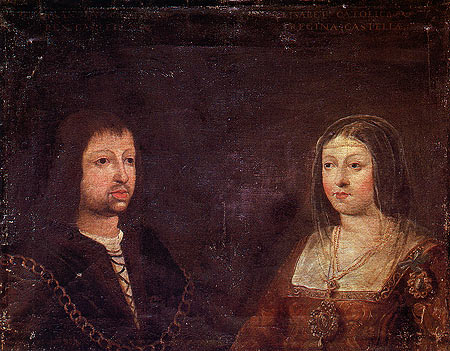
Ferdinand and Isabella - wedding portrait (Wikipedia)
This is a time when we need strong women leaders, so it's appropriate to remember one of the all-time greats, Queen Isabella, without whom the blessings of Western Civilization would not have come to the New World.

From America’s Hidden History by Kenneth C. Davis [bold and bullets added]:
In 1469…teenage cousins Ferdinand of Aragon and Isabella of Castile were married. Isabella and Ferdinand were a remarkable couple whose successes in
  • uniting several fractious small kingdoms into a nation [Spain],
  • eliminating the last vestiges of Islamic power in Iberia,
  • revving up the Inquisition, and
  • setting Spain on a path of world domination
    were extraordinary by any measure.

    “No woman in history has exceeded her achievement.” - Hugh Thomas, Rivers of Gold
  • Isabella turned down arranged marriages and chose to marry second cousin Ferdinand, who was no shy consort material. By the age of 17 Ferdinand had already led troops into battle and fathered children by two different women.
    In modern tabloid parlance, he’d be headlined a “hunk.” In fact the pair would have been People magazine’s dream royals. The tall, blue-eyed beauty Isabella and the muscular Ferdinand would have dwarfed most contemporary celebrity couples.
    Moderns will quail at the brutality of those whom history has labeled great, but one truth is that in Isabella’s time everyone behaved savagely, the Moors whom “Ferdabella” drove from Spain, the French whom the Spaniards battled in the New World, and the “Indians” in what was to become America.

    Nevertheless in the annals of atrocities there are few rivals to the cruelty of the Spanish Inquisition, which tortured and killed Protestants and Jews during Isabella’s reign, or the death and destruction wrought by the Spanish conquistadores who came after Columbus and Isabella. Another Spanish first---years after Isabella's reign but a direct consequence of the forces that she set in motion--was slavery:
    Menendez also brought along Africans as "laborers" [in 1565], which should properly give Spain---not the English in Jamestown in 1619---the distinction of introducing African slaves to what would become the United States.
    Not all of Isabella’s “achievements” may be praiseworthy, but they had a profound influence on the world that exists today.