Showing posts with label Art. Show all posts

Sunday, October 12, 2025

Canterbury Fails

Canterbury Cathedral, one of the most venerated houses of worship in Christendom, has plastered its interior with graffiti-style artwork. From the Cathedral's website:
A major new art installation at Canterbury Cathedral in which ordinary people pose questions to God has split public opinion ahead of its official launch, with visitors reporting visceral reactions to the bold graffiti-style graphics and thought-provoking questions displayed on the ancient walls. Whilst many have reported their delight and intrigue, others have been discomforted by encountering the artworks.

Featuring questions including “Are you there?”, “Why did you create hate when love is by far more powerful?” and “Does everything have a soul?”, the “Hear Us” installation is the culmination of poet Alex Vellis and curator Jacquiline Creswell’s collaboration with marginalised communities and a team of skilled artists to create vibrant handwritten literature responding to the question “What would you ask God?”.
Jesus commands His followers to minister to the marginalized and of course He does so Himself. But the marginalized story is not all kumbaya: in today's Gospel from Luke 17:11-19 Jesus heals ten lepers, but only one of these outcasts comes back to thank Jesus. The message seems to be that the lepers may not be loving people themselves, but we are to love them anyway.

Your humble Anglican is not particularly offended by the temporary graffiti stickers. Having regularly winced at the Progressive sensibilities of Anglican-Episcopal clergy (comfort the afflicted, afflict the comfortable) this is far from an extreme provocation. However, he is sorry for the tourists who were hoping to take photos of the magnificent interior.

Worse, IMHO, is the patronizing point of view of the art sponsors. If I were a law-abiding, God-fearing, hard-working "marginalized" person trying to succeed in British society, I might feel personally insulted that the Anglican church decided that the graffiti format was the best way to speak to me, much as some Black Americans might feel if white elites try to reach them using Ebonics. Snobs are often not self-aware.

Thursday, October 09, 2025

Junipero Sierra Statue: 50 Years Was Enough

What he's pointing at is a mystery (Macor/S.F. Chronicle)
Father Junipero Serra is a major figure in California history. From 1769 to 1782 the Franciscan priest founded nine missions, some of which became major metropolitan areas [e.g., Mission San Diego de Alcalá, Mission San Gabriel Arcángel (Los Angeles), Mission San Francisco de Asís, aka Mission Dolores].

Schools, roads, and monuments have been dedicated to Junipero Serra, but none stranger than the 26-ft-tall statue that was erected in 1975. Caltrans quietly removed it in August.
Caltrans officials disputed claims made by the San Francisco Archdiocese that accused the transportation agency of neglecting to inform the church of its decision to destroy a polarizing statue of Junipero Serra at an Interstate 280 rest stop near Hillsborough.

The colossal freeway icon — a 26-foot tall monument to the Roman Catholic saint who is remembered by many Indigenous communities as an enslaving colonizer — was a landmark for the last 50 years before the transit agency removed it in August.

Caltrans officials said the statue, created by artist Louis DuBois in 1975, did not meet current criteria for its Transportation Art program, which installs graphic or sculptural artwork that expresses “unique attributes of a community’s history, resources or character.” The agency reviews applications for proposed artworks by cities, counties, incorporated towns, tribal governments or non-federally recognized tribes.

Caltrans officials did not respond to direct questions about what criteria the statue failed to meet. Officials told the Mercury News that the statue was “frequently targeted” with vandalism and graffiti.
The I-280 rest stop became known for its views of the reservoir. It was also rumored to be a place for gay hookups in the 1980's.

I won't be mourning the statue's removal; it's big and not beautiful, and Caltrans had good reason to take it down quite apart from the prevalence of anti-settler ideology in academia and progressive government. A 50-year run was probably long enough.

Monday, September 08, 2025

Unsurprising Development

The water has been shut off over a year (SFGate)
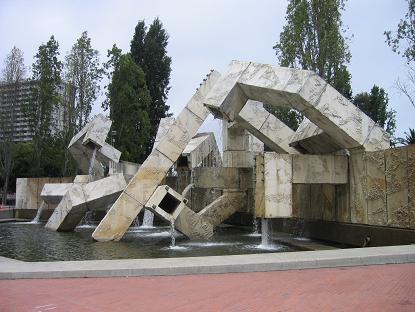
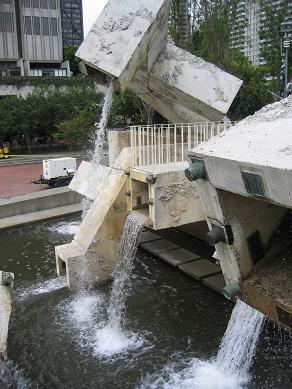
In August we commented on the City's decision to remove the Vaillancourt Fountain as part of a 5-acre development plan. As is true of every highly visible construction project in Northern California, legal methods have been employed to halt the fountain's removal.
Armand Vaillancourt, the 96-year-old artist behind the brutalist fountain in Embarcadero Plaza, tapped a lawyer to write the letter, asking the city on August 29 to “immediately cease and desist from taking any steps whatsoever that may endanger or damage the Vaillancourt Fountain.”

...If the city ignores Vaillancourt’s warning and request for the city to hand over all documents related to the fountain’s future and keep the artist in the loop on ongoing conversations, Vaillancourt and six “long-standing” architectural and cultural organizations are prepared to take legal action, according to the letter.
We have seen this play before: opposition to the removal of an old building or public work of art has not furnished a plan to pay for the repair and upkeep of the object being eliminated. In Vaillancourt's case the repair is estimated to cost $29 million. One easily foreseeable result is that nothing happens while the property deteriorates. If San Francisco avoids this outcome, it will be a good sign that it's back.

Wednesday, August 20, 2025

No Fountain in its Future

Armand Vaillancourt, 95, stands in the midst
of his water sculpture (Suzuki/Chronicle)
Last month all signs pointed to its demise. This week San Francisco filed the paperwork that will lead to the removal of the Vaillancourt Fountain. [bold added]
San Francisco parks officials this week requested the removal of the massive Vaillancourt Fountain from Embarcadero Plaza, the first written acknowledgement that they do not intend to include the controversial 710-ton sculpture in the plaza’s planned redesign...

The letter, a copy of which was provided to the Chronicle by park department officials, notes that it would cost an estimated $29 million to restore the broken-down fountain to working order. That sum almost equals the entire $32.5 million budget for the ambitious park makeover to combine the area formerly known as Justin Herman Plaza with Sue Bierman Park, creating a seamless 5-acre multiuse destination across from the Ferry Building.

The concrete Brutalist fountain, which has been a lightning rod for public opinion since its debut a half-century ago, sits in the middle of the planned multiuse area. A park department report estimates that it would cost $2.5 million to remove it.
Your humble blogger does like the fountain but he does not love it. I have no way of judging whether it's worth $29 million to the City to restore it, plus committing $millions to maintain it annually. I do hope its replacement--the "seamless 5-acre multiuse destination"--does not turn out to be an overhyped, underpriced monstrosity like most of the City's other projects, thereby making everyone regret that they were stampeded into destroying a unique work of art.

Wednesday, July 09, 2025

Vaillancourt Vigil

The fountain is fenced off and "closed"
per the green sign (Chron photo)
The future is bleak for San Francisco's 54-year-old Vaillancourt Fountain.
a San Francisco city official said publicly for the first time that the controversial concrete sculpture is not part of the renovation plan for Embarcadero Plaza.

“We did look into keeping the fountain on-site,” Recreation and Park Department Project Manager Eoanna Harrison Goodwin told a decidedly pro-fountain audience, “but once we got the cost estimate, it is beyond our project budget.”

The revelation, while not the final word on the 710-ton sculpture, was perhaps the most discouraging sign yet for its ardent supporters that its days on Embarcadero Plaza may be numbered.
Your humble blogger will be sad to see it go. Although Vaillancourt Fountain is not classically beautiful, watching it when the water is flowing is a unique experience. From 2004:
The Vaillancourt fountain in Justin Herman Plaza is hard to love. After the 1989 earthquake destroyed the freeway off-ramp, the fountain’s complementary big brother, some said it lost its raison d’etre.

Because it was expensive to power the pumps, the water had been turned off since 2000. Vaillancourt fountain became a silent, concrete jumble in the midst of a waterfront that is growing greener and softer.

Depending on the way one is facing, the harsh angles overwhelm the view of the renovated Ferry Building, the nearby park, or the beauteous Bay beyond. The fountain became a grimy sculpture, a favorite resting spot for the ubiquitous pigeons, who further despoiled its surface and walkways. It became such an eyesore that some called for its demolition.

Last month the pumps were turned on, and the area was transformed. The sight and sounds of the rushing water bring life to a dead corner of Justin Herman plaza. Children skip along the walkway beneath the waterfalls, the tourists take their pictures, and the pale tower denizens leave their cubicles to munch on their sandwiches in the sun.

Thursday, November 21, 2024

Empire of Lights

Empire of Lights (1954), (Christie's/WSJ)
If you asked the man on the street to name twenty artists--alive or dead--the odds are extremely low that René Magritte would be on the list. Yet, earlier this week his "Empire of Lights" sold for $121.2 million at a Christie's auction:
Magritte, who lived from 1898 to 1967, is known for his dreamlike takes on everyday objects, from smoking pipes to green apples to bowler hats. With this sale, he joins an elite club of fewer than 20 artists whose works have commanded nine-figure sums, including Pablo Picasso and Leonardo da Vinci. The sale, to a telephone bidder after a nearly 10-minute bidding war, also represents the first time this year that any artist has crossed the $100 million mark at auction.

...“Empire of Lights” was one of 17 canvases that the Belgian painter created between 1949 and 1964 that offer variations of the same surreal scene: A suburban house sitting in seeming darkness and yet backed by a day-lit blue sky. Sometimes, the house has a red door; other times, green shutters. Often, Magritte surrounds his houses with towering trees or a stream of reflective water. In whatever form, the juxtaposition of night and day is widely considered his masterpiece—and his bestselling motif. Christie’s version on Tuesday stood out in part because it was the biggest example to ever come to market, at 4 feet tall. It was also the first to include watery reflections.
The Impressionists and Post-Impressionists have had and continue to have their day at art auctions. The nine-figure valuation of Empire of Lights shows that the surrealists are closing fast.

The Son of Man (Singulart)
Note: although aficionados call Empire his "masterpiece," Magritte's most recognized painting is The Son of Man (1964). The apple, the bowler hat, and the hidden face have all rippled through popular culture. Concerning the apple,
Paul McCartney owned one of Magritte’s works titled Le Jeu De Morre in which the painter has featured yet another apple. Inspired by this, McCartney named the Beatles’ record company ‘Apple Corps’. This further inspired Steve Jobs to name his company ‘Apple Computers’.

Wednesday, August 28, 2024

SF Public Art: the Latest Chapter in the Culture War

Piss Christ
Lefties used to laugh at the bluenoses who wanted to put fig leaves on nude statues.

They mocked the negative reaction by many Christians to Andres Serrano's Piss Christ (1987), a crucifix submerged in a jar of the artist's urine. A work of art should provoke feelings in the observer, they said, your personal morality limits you.

Four decades later Progressives turned a blind eye to the toppling of historical public works that reflected "power, privilege, white supremacy, patriarchy and colonialism." The destruction accelerated during the George Floyd riots of 2020.
The city had its share of monuments destroyed in 2020 when bronze statues of Junipero Serra, Ulysses S. Grant and Francis Scott Key were all knocked off their pedestals by protesters in Golden Gate Park. The city removed the statue of Christopher Columbus at Coit Tower to avoid a similar fate. All four statues are now secured in storage.
2018: SF removed an "Early Days" statue depicting
a white missionary towering over a supine Indian.
Now San Francisco will spend $3 million from a Mellon grant to determine which works are acceptable and which are offensive.
San Francisco is about to embark on evaluating its nearly 100 statues and monuments to figure out which ones no longer represent the city’s values and should be removed from view, relocated or re-interpreted with explanatory plaques.

The debate over the city’s monuments began in 2018 with the removal of the “Early Days” sculpture from the Pioneer Monument in the Civic Center because it represented a Native American seated before a Spanish Catholic missionary. The effort gathered steam amid the racial-justice movement in 2020 that followed the murder of George Floyd. That year, crowds toppled statues throughout the country that glorified Confederate Civil War leaders, which critics said paid homage to the country’s racist past.

The survey of San Francisco’s civic art collection — funded by a $3 million Mellon Foundation grant — will be conducted by an outside firm and should be completed by January.

The project, called “Shaping Legacy,” was discussed at an Arts Commission meeting last week when senior project manager Angela Carrier explained that looking at San Francisco’s monuments and memorials as a whole shows “a concentration that talks about power, privilege, white supremacy, patriarchy, and colonialism.”

“These monuments no longer represent the values that we say the city stands for,” she added.
IMHO, this is a self-defeating move by Progressives. Keeping the "bad" monuments up would be a constant reminder of San Francisco's white supremacist past and prove that this claim has validity.

Another observation, updated now that Progressives control big cities, media, and the elite colleges: art, like free speech, can still provoke, as long as it doesn't go against the Progressive narrative.

We'll end this post with a quote include in the article from Stanford History professor James T. Campbell:
"To me, the real danger of these kind of exercises is not so much historical erasure as self-congratulation, with all of us pointing accusatory fingers at our benighted forbears and patting ourselves on the back for our own superior moral wisdom,” he said. “It’s worth asking what San Franciscans a hundred years from now might say when they audit us."

Sunday, August 25, 2024

The Bleakness of 1942 Wasn't So Bad

Writer Bob Greene came across a real-life reconstruction of Edward Hopper's Nighthawks on the streets of New York.
But what was this strange tableau doing on New York’s streets on a radiant midsummer afternoon? Before me stood a stage-set-like replica of the diner, its front wall and window frame constructed of wood but with no glass pane, its counter a life-size version of Hopper’s brushstroke image right down to the stools, the twin metal coffee urns, and an actor dressed in white like the counterman in the painting, poised to serve some java.

I quickly learned that this was part of a four-day off-site exhibit by the Whitney Museum of American Art to honor Hopper’s work. People lined up waiting for their chance to sit on the stools and pose as though they were part of the painting while their friends took photos of them through the make-believe window with the “Only 5¢, Phillies, America’s No. 1 Cigar” sign above it.
Edward Hopper, Nighthawks (1942), Art Institute of Chicago
Although I was familiar with the painting, it was many years after my last art-appreciation course that I began to understand why the work strikes such a chord. Bob Greene explains:
A diner late at night, with few customers and a sole employee putting in his hours, embodies a quiet drama all its own, which is what makes Hopper’s painting pack its lasting power. The dialogue—or lack of it—within the four walls is left to the imagination, rendering it somehow more profound than anything a soundtrack might reveal...

In the 1942 painting, the world outside the diner might as well not have existed. The emptiness on Hopper’s streets emphasized the closed universe within the establishment’s walls.
The characters reek of the loneliness in the urban environment (the artist said that a restaurant in Greenwich Village was its inspiration), but I would take that bleakness today, where there are no all-night diners in the big city, let alone ones with huge plate-glass windows.

Monday, August 19, 2024

A Roman Tradition

Mark Zuckerberg commissioned a seven-foot sculpture of Priscilla Chan, 39, his wife of 12 years:
The statue, commissioned by Zuckerberg, was created by New York-based artist Daniel Arsham and placed next to a tree in what appears to be a lush garden.

...The statue’s design, with its flowing silver garment, looks like a mashup of ancient Roman Sculpture and the T-1000 from Terminator 2. According to Zuckerberg, the inspiration came from the former: he captioned the photo “bringing back the Roman tradition of making sculptures of your wife.”


Priscilla Chan
Having been married nearly half a century, I've run out of ideas for gifts (that I can afford) for my wife.

Mark Zuckerberg, currently worth about $185 billion, doesn't have my problem.

Monday, July 10, 2023

Hawaii Not So No Ka Oi

Most of the California public artworks that use water have gone dry, a casualty of the multi-year drought that ended last winter.

In Hawaii, the State Capitol pools have been turned off for a different reason, faulty design. It's a tale to be savored by connoisseurs of ambitious ideas gone wrong: [bold added]
Pool maintenance challenges, according to DLNR [Department of Land and Natural Resources], have existed since the Capitol opened. And in response, government leaders have tried or contemplated myriad corrective plans without effective or lasting results, including use of chemicals, fish, fountains and prisoner labor.

The Capitol was designed by a predecessor to local architecture firm AHL and San Francisco-based John Carl Warnecke and Associates. The two pools totaling 80,000 square feet were lined with a waterproof membrane topped with stones, and had a plumbing system that included the airconditioning connections as well as circulation jets ringing pool sides where water spurted from openings shaped like hibiscus flowers.

Complaints about unpleasant odors from dying algae in the pools arose soon after the building opened, and were met with an early effort by DAGS [Department of Accounting and General Services] to treat the water with copper sulfate, which didn’t help.

According to a Honolulu Star-Bulletin report in 1971, adding enough chlorine prevent algae growth would be prohibitively expensive, while using fresh water also would be more costly.

The air-conditioning aspect of the pool design worked only briefly, according to DAGS, and was disconnected because of corrosion issues.

By 1976 it was costing taxpayers $30,000 a year to manually clean the pools after use of a nitric oxide compound to kill algae was discontinued because it ended up in the ocean.

A rogue attempted fix also was made in 1976 when then-Sen. Anson Chong and others dumped tilapia into the pools despite concern that waste from the fish, which can live in brackish water and feed on algae, might give rise to more algae. [Blogger's note: Anson Chong was a distant cousin and a great guy, but this wasn't his finest moment.]

Bad smells, leaks and corrosion persisted over the next decade along with vast multiplication of tilapia in the pools, one of which served as the site of the Aloha United Way keiki fishing derby in 1988 where then-Gov. John Waihee caught the first fish out of the Ewa pool.

A year later, lawmakers approved funding to turn the smelly pools into a freshwater garden where taro, giant lilies, water grass, koi, snails and mosquitoes would become a “living filter” to maintain the pools fed by rainwater channeled from Capitol grounds.

Architects Hawaii Ltd., now known as AHL, produced this plan with local engineering firm RM Towill. “People will come from all over to see this thing,” Joe Farrell, AHL’s late senior principal, said at the time.

The freshwater garden plan never bloomed.

In 1993, workers rid the pools of tilapia, around 16,000 fish, that were making pool conditions worse, and transferred them to Paradise Park in Manoa after fines were threatened for initial removal work where fish were being left to die.

Then DAGS in 1998 tried to reduce algae using machines producing chlorine dioxide, ozone and radical oxygen. But this also proved not too effective. A couple of years later, $90,000 was spent on an ozone treatment system, but pumps couldn’t distribute the ozone enough to sufficiently combat the algae.

In 2004, DAGS hired Architects Hawaii to produce a study on controlling the algae and improving the appearance of the pools.

The study was to explore a reverse-osmosis system that would use a membrane to convert brackish water to fresh water, and relieve the need for state workers to scrub and siphon away algae, a weekly task that also involved applying an enzyme spray and was assisted by Oahu Community Correctional Center prisoners.

“Whatever we end up implementing, we want it to be a long-term solution,” Russ Saito, then-director of DAGS, said at the time. “We don’t want to come back in five years and say, ‘That didn’t work.’” It’s unclear what became of the study, but by 2007 the annual pool-cleaning cost had risen to $72,000 including supplemental prisoner labor.

After DAGS requested money from the Legislature to fix the pools every year from 2005 to 2008 without success, another selfcleaning proposal was floated in 2016.

Nine lawmakers proposed adding fountains that would boost water circulation and also feature light displays choreographed with Hawaiian music, making the pools a visitor attraction.

“The construction of water fountains in the reflecting pools would make the pools essentially selfcleaning by circulating the now-stagnant water,” read the bill, which didn’t receive a hearing. In 2017 a bill proposed $100,000 for DAGS to study alternatives to rehabilitating the pools, but this measure also didn’t get a hearing.

In years since then, DAGS delayed its own efforts to improve the pools because it had higher-priority projects at the Capitol, and only more recently has the agency pressed the Legislature for urgent funding as leaks got worse and annual maintenance costs hit $120,000.

DAGS requested $30 million in 2021 to repair and renovate both pools, saying the situation required immediate attention because occupants in offices beneath the pools were being exposed to leaks and noxious fumes.

“DAGS understands the current budgetary constraints that the State is facing over the next five years but the health and safety of the Hawaii State Capitol tenants and employees is our top priority,” Curt Otaguro, then-director of the agency, said in written testimony to the Legislature. “This situation requires immediate action.”

Otaguro’s plea wasn’t well embraced. Seven House members introduced a resolution asking DAGS to defer its pool improvement plan, and the Legislature in 2021 fulfilled only $9.8 million of the $30 million DAGS request, effectively setting back improvement work.

Meanwhile, the pools had been drained and surrounded by construction barriers in 2020 so a contractor could work on soffit panels overhanging the pools.

The barriers have stayed up since then, according to DAGS, because the shallow, empty pools pose a hazard for people who might fall or jump in.

Still, leaks persist. In the Senate data systems office, sometimes smelly water that once dripped down onto a conference room table has been diverted in the false ceiling to a small trash can in the hallway.

In one basement hallway Friday, a dozen containers were positioned to catch water from the ceiling, including a 50-gallon recycling bin about half full with water.

Lawmakers got on board with a request by DAGS this year for $33.5 million to repair and renovate the pools, which the agency said has a disproportionate cost given the extent of leak damage that includes electrical conduits and circuits along with the air-conditioning duct system. There have even been power outages at the Capitol reported due to water infiltration.

The current repair plan includes installation of new water circulation and treatment systems, though Regan told lawmakers that an alternative without water in the pool basins would be a better long-term solution.

“Ultimately, when you have water, water will find eventually its way through,” he said during a House Finance Committee briefing in January.

State Rep. Betrand Kobayashi (D, Kahala-Kaimuki-Kapahulu) replied to Regan that he appreciated the waterless concept.

“The money we have put into this building has been frankly embarrassing,” Kobayashi said. Regan explained to the committee that an alternative to water could be something similar to what was done at the Hawai‘i State Art Museum, where a swimming pool in the historic former downtown YMCA building was partially filled in to create a sunken seating area with a pool-like look in 2010. “It still kind of keeps with the original theme and the intent, but it will help us to ensure that we won’t have water issues like what we’ve experienced here lately,” Regan told a pair of Senate committees at a January briefing.

Regan told the Senate committees that his sense is that SHPD will be amenable to such a change based on discussions.

Alan Downer, SHPD administrator, said no decision has been made on the desired change, and that discussion is continuing.

”The reflecting pools are an integral feature of the Capitol building,” Downer said in a statement. “They symbolize the volcanic island (the building) in the ocean. They are a critical (element to the) defining historic character of the building.”
It's easy to mock Hawaii politicians for cost overruns on trophy projects like the Capitol pools and the recently opened Skyline rail ($12 billion for 20 miles).

But my adopted state of California is much worse with its $90 billion high-speed rail system that isn't even operational after 12 years with the modest initial goal of connecting Merced and Bakersfield. And we're all holding our breath when California forces us to buy electric cars in 12 years and plug them into a solar- and windmill-powered grid.

All in all, I'd rather be in Hawaii, and that's where I'll be going later this month to visit family.

Saturday, May 20, 2023

Pictures on the Wall


A family member had an appointment with an opthalmologist, and so it was that we were at the Stanford eye clinic, three miles east of the university's main campus.

Rather than look at my phone I prowled the halls and gazed at the collection of '60's pop art. There were Andy Warhols and Roy Lichtensteins (pictured above) on both floors, along with less well-known artists like Allen Jones, Mel Ramos, and Guy Dill.

The screens will always be there, and when you're in a new place, even as nondescript as a doctor's office, you can be pleasantly surprised by getting up and looking around.

Sunday, March 05, 2023

Marvel at the Longevity

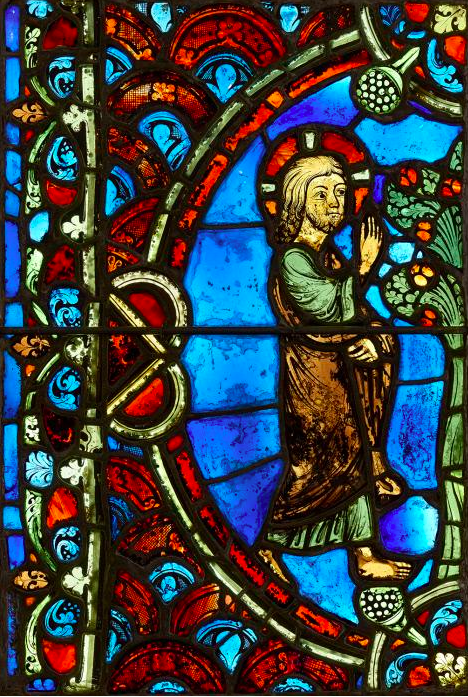
God and the Tree of Knowledge
Nasher Museum, Duke Univ
.
European cathedrals are distinguished for their craftsmanship and longevity; the component that is most remarkable, at least to your humble blogger, is the stained glass. Some pieces, like God and the Tree of Knowledge, date back nearly 800 years.

The resources needed to produce Medieval artwork were immense:
Stained glass was in great demand in the Middle Ages, and manufacturing it required large quantities of sand, wood ash and powdered metals melted at extremely high temperatures. According to one estimate, the European glass industry burned through roughly 13 million tons of firewood between 1250 and 1500...

From lumbering and harvesting to mining and quarrying, producing materials for medieval art demanded enormous amounts of manual labor, said [Pulitzer Foundation curator Heather Alexis] Smith. In the mid-1300s, the pandemic known as the Black Death killed an estimated 30-60% of the population of Western Europe, setting off decades of labor shortages...

Religious orders were perhaps the biggest drivers of environmental change in the medieval era. In sustaining their communities, monasteries often cleared forests and wetlands for farming, at times initiating large-scale building projects that required tons of quarried stone.
The greatest amount of medieval resources was used for religious purposes, and those monuments have lasted for hundreds of years.

Will our own expressions have such durability? It's doubtful, since utility is less powerful a motivator than the perceived demands of deities, and environmental constraints sap the life from invention.

Meanwhile, marvel at the stained glass.

Sunday, February 05, 2023

An Unsettled Spirit

Café Terrace at Night
Vincent Van Gogh has been celebrated in film and song for more than half a century.

His paintings command the highest prices in auction, his striking style is commonly recognizable, and his personal story--mental illness, unrequited love, self-mutilation, suicide--is the stuff of drama. Less popularly known are his Christian faith and the Christian themes that run throughout his oeuvre.
Van Gogh’s explicitly Christian works include “The Raising of Lazarus,” “The Good Samaritan” and two versions of “Pietà,” one of which hangs in the Vatican. Others are at least implicitly religious. About 30 versions of “The Sower” show a peasant at work. They also suggest the parable from the Gospels. Renderings of gardens and olive trees invoke Gethsemane. Paintings of irises may simply be paintings of irises—but the flowers tend to bloom around Easter and many believers associate them with the resurrection of Jesus.
Close-up of "Last Supper" section
of Café Terrace at Night
“Café Terrace at Night” is another magnum opus with a possibly hidden meaning. It arguably belongs to the starry-night genre, with its glimpse of the cool heavens above a warmly lit coffeehouse in Arles. Near its center, a man stands before a window with muntins that form a cross and beneath a gas lamp that could be a halo. A dozen seated diners surround him. A shadowy 13th figure darkens a doorway. Independent researcher Jared Baxter has called this Van Gogh’s “Symbolist Last Supper,” representing Jesus, the apostles and Judas.
Great artists try to convey deep truths in their work, and the act of doing so can make for an unsettled spirit.

Sunday, April 17, 2022

Easter, 2022

Resurrection of Christ by Raphael
After two consecutive years of not attending Easter services, I won't miss a third.

Resurrection Sunday is the holiest of all feast days because to Christians it commemorates the most important event in human history--the triumph of life over death.

The actuarial tables say that 80% of my life has passed, and so, as I wrote last year, after a lifetime of ignoring the Resurrection I am thinking about it more and more.

I'll even put on a tie. Yes, it's that important.

Monday, December 06, 2021

Unassuming Statue

Right outside the California Pacific Medical Center, where I received the Moderna booster, sits the unassuming life-sized statue of George D. Monardo (1921 ~ 2008).

Mr. Monardo was a World War II vet who began as a hospital administrator and rose through the ranks to become President of the Ralph K. Davies Medical Center. From his position he was able to lead funding for AIDS research and advanced technologies like microsurgery. He was active on the boards of charities and health organizations.

Why did I bother with a post on a man I've never heard of? Well, this was the first time I've gone to the CPMC on Castro, and I doubt I'll pass this way again.

More importantly, George D. Monardo represents the wonderful, accomplished people who die every year and who will be remembered by few outside of their families after some decades have passed. Well, they did make a statue to honor him, so perhaps he was a little more special than others, another of many "common men" who led uncommon lives.

Thursday, December 02, 2021

Aina ("Land")

Honolulu, like San Francisco, is replete with public art. Most works go unnoticed, as residents and visitors rush to important appointments and destinations.

And so it was that I had the Aina ("Land") sculpture all to myself on a Tuesday morning. Commissioned by Hilton Hotels, Aina was unveiled to great fanfare in 2008 outside the Grand Waikikian Hotel.
Inspired by the classic Hawaiian ring poi pounder, pohaku ku’i ai puka, this monumental ten ton arch floats on the surging waters that erupt around its three ton, black and red granite bowl or papa ku’iai and cascade down the lava rock he’eau that surrounds it.

Cutting across the top of the ring is the carved profile of the islands surrounded by a moat of water that spills on either side down the roughly textured channels that flair to its base reminding us of Hawaii’s many stunning waterfalls.
2008: how it was meant to be seen
The water has been turned off, and the flame no longer burns at the bottom edge of the ring. The depiction of the Elements--Earth, Air, Fire, and Water--is harder to discern, but the sculpture is impressive nonetheless.

The work is layered with meaning. Poi was central to the life of Hawaiians--Asian cultures place a similar importance on rice--and the poi pounder depicts the importance of food. There are three different kinds of poi pounders, and the artist chose the ring form to represent the dual image of the element Air as well as Life itself.

We learned the state motto in first grade, ua mau ke ea o ka aina i ka pono (the life of the land is perpetuated in righteousness); only now am I beginning to glimpse its meaning.

Sunday, September 26, 2021

Perspective

When Tyler Cowen posted this painting on his economics blog with no comments other than "National Gallery, London" and "15th through the 17th centuries", I blew past it. It was just a depiction of Jesus from the period, paling before well-known works by Michelangelo, Da Vinci, and El Greco.

I went back an hour later. Obviously the theme is Jesus being baptized, the figure to the right pouring water is John the Baptist, and the white bird directly above Jesus is the Holy Spirit.

To the right a second baptismal candidate is prepping himself, and to the left are three angels, the wings a clue to their identity. All parties are barefoot--even the bottom of the tree resembles a human foot. And how come so big a tree didn't have roots that bulged the ground, and why did the Jordan River look like a man-made ditch?

Well, enough wondering, ruminating, and teasing out the artist's intentions. The Internet is the death of figuring things out for oneself; it's too easy to just look up the answer.

In less than a minute the painting was identified as as the 15th century Baptism of Christ by Piero della Francesca. I had discerned the basics but certainly didn't know the following:
The original triptych frame may have included a roundel above the dove showing God the Father, which with Christ and the dove representing the Holy Spirit would complete the Holy Trinity. The figure of Christ, John's hand and the bowl, and the bird, form an axis which divides the painting in two symmetrical parts.

A second division is created by the walnut tree on the left, with white bark that echoes the white skin of Christ, which divides the painting according to the golden ratio.

Balancing the figure of John to the right, but separated from Jesus by the tree's trunk, are three angels on the left who are wearing different clothing. In a break from traditional iconography, the angels are not supporting Christ's garments, but are holding each other's hands. This could be an allusion to the contemporary Council of Florence (1431–45), whose goal was the unification of the Western and Eastern Churches. The Camaldolese monk and theologian, Saint Ambrose Traversari (+1439), who had been Prior General of the Camaladolese congregation, had been a strong supporter of the union. Such symbolism is also suggested by the presence, behind the neophyte on the right, of figures dressed in an oriental fashion, usually interpreted as Byzantine dignitaries. Alternatively, the three angels could also represent the three aspects of the Holy Trinity.

Piero della Francesca was renowned in his times as an authority on perspective and geometry: his attention to the theme is shown by John's arm and leg, which form two angles of the same size.
The backdrop of the entire painting is not the surroundings of the real Jordan River but Piero della Francesca's native Tuscany.

The Renaissance artist had embraced the period's fascination with geometry, and how perspective and symmetry enhance the beauty of the piece.

The weird white walnut tree frames Jesus on the left and balances John the Baptist to the right. I still don't know why the artist chose a tree to make his painting symmetrical nor why it is featured so prominently. In my dotage I've accepted that there are some questions I'll never know the answer to.

Sunday, September 05, 2021

The Power of That Vision

Christ the Redeemer, overlooking Rio de Janeiro
Christ the Redeemer is the most famous giant statue of Jesus, but it's only one of several, including the larger Christ the Protector under construction in southern Brazil:
Christ the Protector is one of about three dozen giant statues of Jesus that have been constructed around the world during the 20th and 21st centuries, mostly in Latin America but also in Europe, Africa and Asia. Financing usually comes from individual donations encouraged by local politicians.

Occasionally wealthy businessmen have made the figures their ego-boosting pet projects.

Colossal statues, such as the monumental medieval Buddhas of China and Central Asia that can tower over 200 feet, were not unknown before the 20th century. But their heavy material, usually stone, made it impossible to carve them free-standing at those heights. The Statue of Liberty’s substitution of copper sheathing for stone rendered her dauntingly expensive. But the invention of steel-reinforced concrete made it possible to build enormously tall free-standing statuary at a reasonable price.

Christ the Protector will be only the third-tallest statue of Jesus in the world so far. The tallest is Jesus Buntu Burake in Makale, Indonesia, completed in 2015 and soaring to 172 feet with its pedestal. But it may not hold the distinction for long: A 253-foot statue of Jesus has been planned in Tamaulipas, Mexico, although so far the project has stalled.
Large statuary causes the heart to rule the head. Through pictures and videos we can analyze the artist's message dispassionately. But in person, when we get physically close to the Statue of Liberty or the Lincoln Memorial or Michelangelo's David, something in the animal brain surfaces as the breath catches and the blood races.

Those who construct these representations of Jesus were paying tribute to their faith, and they were hoping to evoke the emotion they were feeling in others. Over a million annual visitors just to Rio alone can attest to the power of that vision.

Tuesday, June 01, 2021

The Gratitude is Overwhelming

Accounting equity is well-defined.
Woke "equity" is a muddled mess
and will never be attained.
In San Francisco a new guaranteed income program of $1,000 per month per person to help struggling artists has been beset by identity politics:[bold added]
City leaders say YBCA [Yerba Buena Center for the Arts], was chosen because it was best equipped to take on the pilot program, which was funded with $877,000 from the city’s Arts Impact Endowment, money that comes from the hotel tax, along with $60,000 of YBCA’s budget...

Curator, visual artist and organizer Rhiannon Evans MacFadyen...says an organization with expertise working with people of color should have been put in charge of the program, not YBCA.
Below are representative criticisms from "marginalized" groups' spokespersons: [bold added]
"I think it’s just the typical white savior cluelessness.”

“There is a history of inequity in arts funding, where communities of color are not trusted with the funds to do the work we know how to do really well.”

But because of historical and structural racism, she said, bigger but not necessarily better organizations are more trusted to administer programs dealing with racial equity.

“It’s a case of might makes right,” she said. “A large, white-led organization that doesn’t understand and outsources equity is rewarded for their sheer lack of expertise in equity and then leverages it to benefit their organization.”
The gratitude is overwhelming.

One of the reasons I like private charity is that there's far less fighting over the expenditures. If donors to a private foundation want to educate kids of a certain ethnicity or support artists from another, they have the freedom to do so without controversy.

But the art program in question is mostly funded from taxes, and as with any government program, there are complaints that
1) It's not enough;
2) The monies are benefiting the wrong people (the YBCA put in a "randomizer" element to avoid charges of favoritism, but they heard complaints about that, too);
3) The wrong groups are in charge of the money;
4) Only certain specialists can truly understand the plight of the intended recipients.
For nearly 20 years I've participated in various food and shelter programs in the Bay Area. The beneficiaries know that the volunteers are giving their own money and time and have never expressed resentment about our efforts, modest though they often are.

When government dispenses aid on a much grander scale, the result is often resentment and division, and yet there are calls for even more money to be spent in this manner. The voters keep electing people who say yes, so the voters must like the picture that has been painted.

Tuesday, May 11, 2021

Enjoying the Unprovocative


After noticing the seahorse on April 27th, I retraced the path and found a dolphin and a seashell within a hundred feet.

The pieces weren't inspired or inspirational, and they typify commercial art that developers suppose add a touch of class to housing developments. The images are part of the New England ambience that permeates Foster City. (We live in the Dolphin Bay development, which is next to the Edgewater Place shopping center across the lagoon from the Whaler's Cove neighborhood, etc.)

50 years ago, before nautical themes became commonplace in newly built cities, our streets were given names such as "Beach Park", "Marlin", "Shell", "Bristol", and "Catamaran."

Well, all clichés start somewhere. In the sleepy suburbs we like art that doesn't provoke.