Thursday, October 19, 2006

What's Important

Last weekend’s earthquake has made us pause in our plans to retire to Hawaii. Much as we would enjoy living there, we can’t afford to have too much of our net worth tied up in a building that can collapse in a few seconds [Then why do you live on top of the San Andreas fault? That’s not the point; the point is to leave town for some place safe before the Big One hits.]

At first blush Hawaiian residents seem less prepared than Californians to weather a natural disaster. The phone and power lines still hang on poles, making them more vulnerable and dangerous than if they were buried underground. Ramshackle structures that wouldn’t meet building codes on the Mainland can be found on all the islands.


On the other hand, no one died, no one panicked, and no one said they were victimized because government agencies weren’t responsive enough. Living in the middle of the Pacific conveys the sense that you’re on your own and that you have to work together because it will take a while for help to arrive.

It’s been said that trends start in California, and one can point to many examples where California has led the way in such disparate areas as technology, business, entertainment, fashion, and dining. But in a more important respect Hawaii is decades ahead of the rest of the nation. It is a working example of a melting pot, where different racial groups live in harmony.

My own take on why it works there is that everyone is in a minority but shares a common language and common cultural values. Also, each group can point to its own individual success stories, pre-empting the development of a resentful underclass. But enough of committing sociology.

At our family reunion in August we had many more mixed-race than single-race attendees in the generation after mine. That observation didn’t even occur to me until I started writing this post, and I don’t think anyone else noticed. © 2006 Stephen Yuen


My Family: perhaps earthquakes and the preservation of my net worth aren’t the most important considerations in deciding where to live.

Sunday, October 15, 2006

Sunday Surprise

My parents called to reassure me that they were fine. This morning’s 6.6 quake jolted their Honolulu home and knocked out the power. No TV, no Internet, just a battery-powered radio to convey the news.

Here on the Mainland CNN was running a continuous feed from Honolulu channel KITV. Reports alternated between updates from government agencies and advice to stay off the road and avoid making unnecessary calls (except for this one, of course). I changed the channel when people called in to describe how they were feeling when the earth moved. Later might be the time for personal stories. When the news is breaking, just give it to me straight.

In 1950’s Hawaii we worried about calamities that never came to pass---nuclear war, tidal waves, hurricanes, and earthquakes. In the absence of disaster we quickly become blasé. Even the continuously erupting volcanoes don’t hold our interest for long. We put up guard rails so that tourists don’t get too close to the lava and focus our attention on the next worry du jour.

Early on a clear Sunday morning nearly 65 years ago an unexpected event on the Island of Oahu precipitated a World War. This Sunday we were reminded that life still has the ability to surprise. © 2006 Stephen Yuen

Thursday, October 12, 2006

His Time is Past

Warren Buffett on how to prevent corporate scandals:
So, at Berkshire, let's start with what is legal, but always go on to what we would feel comfortable about being printed on the front page of our local paper, and never proceed forward simply on the basis of the fact that other people are doing it.
I first read Warren Buffett’s quirky missives during the late1970’s. His life is a good example of the persistence of character. He always charted an independent path and owned up to his mistakes, yet never lost faith in his judgment, which he backed with cold, hard cash. Infusing all his actions is a humility born from his religious beliefs and the chastening lessons of a long life.

Warren Buffett says that the fact that “other people are doing it” doesn’t make it right, echoing the words of millions of parents. But really, how are people these days supposed to chart a moral path? Most of the issues facing us are colored with shades of gray, like whether to answer truthfully to an employee that he might be on a layoff list, or how much financial assistance you should offer your adult child, or whether you should object to an off-color joke told by one of your friends, or whether you should give a dollar to a plainly drug-addicted mendicant.

The best defense against venality is virtue, said the ancients. We know that enforcing good behavior through the passage of laws and hiring of cops is costly. We know that doing the right thing should be voluntary and not prompted by the fear of punishment. Yet, as the authority of religion subsides, our culture acknowledges no higher power than itself. “Other people are doing it” is in fact the truth behind the power. Poor Warren Buffett: his time is past. © 2006 Stephen Yuen

Wednesday, October 11, 2006

Too Much South of the Border

This morning's news:
Five people trying to sneak into the United States from Mexico became trapped in a narrow tunnel and had to be rescued Tuesday after the largest of them, a nearly 200-pound man, got stuck trying to climb out through a storm drain, authorities said. Firefighters used jackhammers at the city's border with Tijuana to widen the opening and free the man, who had become stuck at the hips.

Monday, October 09, 2006

Uneventful

During a weekend filled with headline events---Bluegrass festival, Fleet Week, Raiders at 49ers---I stayed close to home. There was nothing that I absolutely had to do or see. Recalling that old saw about buses, if nothing on the Bay Area calendar is appealing, we just have to wait 15 minutes for the next one.

DirecTV’s digital video recorder (model R10) finally stopped working after months of steadily deteriorating performance. Although I had purchased the extended warranty from Best Buy, I was reluctant to return the now-discontinued recorder for the newer model. Beginning with the R15, DirecTV has been too cheap to pay license fees for TiVo's superior user interface (think Mac OS vs Windows or iPod vs. other MP3 players), so DirecTV devised its own software. But when the machine rebooted every 15 minutes I threw in the towel.

The Best Buy “Geek Squad” (an homage to Apple’s Genius Bar) said the R10 could not be repaired and gave me a new R15. As I suspected, the new DVR hardware works, but the interface is user-hostile. The remote control has too many buttons, and the menus aren’t intuitive. When we become a high definition household, we’ll select a cable or satellite company that offers TiVo, and it won't be our current provider.

I drove the youngster to the City to visit Maggie, who’s cut his hair ever since he was an infant. She took special care with him after his surgery and makes him comfortable. Maggie opened her own shop on Ocean Avenue and appears to be doing well. She’s hired two assistants, and the wait is an hour on weekends. © 2006 Stephen Yuen

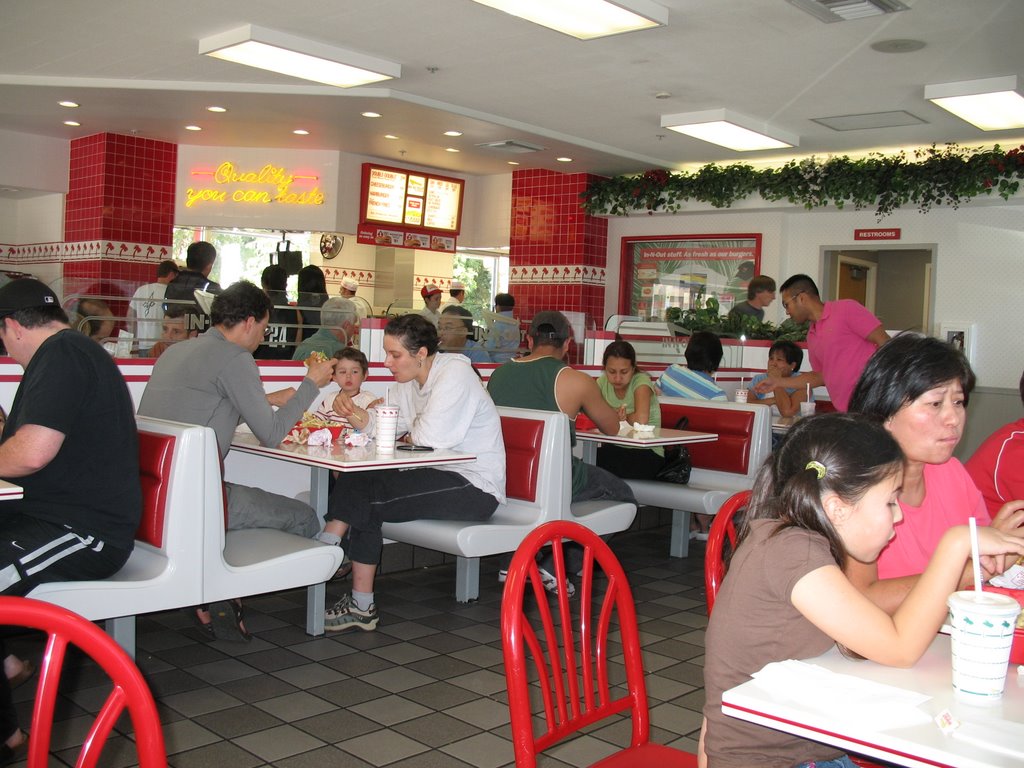
In-n-out, Daly City: the best things aren't always expensive.

Thursday, October 05, 2006

Buzzing About


Grumpily I stare at the sign. The trains are running 30–60 minutes late. I regretted that I had been in such a hurry to get to Hillsdale station this morning. I could have stopped for a cuppa joe. I look at my watch: Starbucks is just 12 minutes away, but counting the time for a round trip and the wait in line, I forego the temptation. I don’t know when the next train’s coming and I don't want to miss it.

It’s gray, drizzly, and cool, auguring a wet winter and a thick snowpack, just like last year. It’s only the first week in October, and I’m wearing a sweater and a raincoat.

[Good movie, by the way--First Monday in October, starring Jill Clayburgh and Walter Matthau. Witty and funny, Jill Clayburgh is a babe who plays the first female Supreme Court justice. Back in the ‘80’s, when they needed beautiful and smart, they called Jill Clayburgh. However, it was obvious that the scriptwriters had no idea how a conservative jurist really thinks or sounds.

Sodden thought: it would be very easy for a conservative writer like George Will or William Safire or Newt Gingrich to compose a reasoned essay arguing the liberal position, whether the topic was stem-cell research, tax policy, affirmative action, or terrorism. There are not many liberals---and none of them live in Hollywood---who could fake a convincing argument in the other direction, say, in favor of the Iraq war without the argument sounding cartoonish (Weapons of mass destruction! Bring the evildoers to justice!) and forced. They really need to mingle more with the masses.]

Well, I finally made it to the office. It’s Fleet Week, and the Blue Angels are buzzing about the Bay. May as well enjoy the show now. No telling how many more years these excess CO2 emissions will be tolerated. © 2006 Stephen Yuen

By mid-afternoon the skies had cleared.


Peace Bus: land-based vehicles can emit gases too, but when your intentions are pure, it's okay.

Tuesday, October 03, 2006

Animal Crossing

Our household has been home to many pets---rabbits, fish, hamsters, birds, and the latest guest, a guinea pig named Bubbles. The doctors periodically caution that pet dander exacerbates our allergies, but we ignore the warnings. Our furry friends give us unconditional love, a gift all too rare from our two-legged acquaintances.

Cynics and Skinnerians may scoff that we just imagine that our pets love us. Animals, they say, are just practicing learned behaviors to provoke the desired reaction from their food dispensers. The scoffers may be right, but judge for yourself: when you look into your pet’s eyes, is there an intelligence that is looking back?

Tomorrow is the day that we remember one of Christendom’s greatest saints, Francis of Assisi. Francis was the patron saint of animals and the environment. He founded the order of Friars Minor, from which sprang other orders that are prominent in Catholic and Protestant churches. And, lest we forget, we live near the city that bears his name.

During this week many churches hold a special service to bless pets and their guardians. Last weekend two ministers from our parish set up a table at the local park and said a prayer over every pet that was presented. At least 40 people showed up. It was a rare experience---strangers brought together by a common interest, chatting amicably for an hour, and no one buying, selling, or wanting anything from the other. Eight centuries after his death, the light of Saint Francis shines brighter than ever. © 2006 Stephen Yuen


Saturday, September 30, 2006

When Two or Three Are Gathered


The weather cooperated at the church dinner last weekend.

In the pre-1970 Episcopal Church it made no difference to the meaning of the church service whether one was alone in the pew or whether there were hundreds of others in attendance. Eyes were glued to the front (when heads were not bowed), noisy children were given dirty looks until they quieted, and when the prayers began worshippers promptly knelt (“hit the deck” as my old priest used to say) and stayed put until they went to the altar for Communion.

The revised Book of Common Prayer seemed revolutionary when it came out in 1976. Not only was the language updated--thee, thou, and thine became "you" and "your"--but the new services demanded that the congregation pay attention to what was going on. The Prayers of the People required regular responses from the flock, and the passing of the peace encouraged people to talk to each other, shake hands, and maybe crack a smile. While the openness and informality initially made many uncomfortable, people not only got used to it, but it’s doubtful many would want to go back.

I am acquainted with believers who will have nothing to do with organized religion. They worship in their own homes, either alone or in small groups. It is of course within their right to do so, and churches can certainly be criticized for being too structured, unspiritual, and focused on money and social-clubbing.

But I like the idea of gathering once a week with people who are from very different backgrounds and don't think like me. From sad experience I know that I've often been mistaken, so I won't learn anything by associating only with the like-minded.

And we shouldn't dismiss the access we have to the knowledge and training of ministers, deacons, and seminarians. Most questions that seem original to the neophyte are actually very old. There is nothing new under the sun, said the prophet, so save the wheel-spinning. It's a lot easier to just ask the guy (or gal) in the frock. © 2006 Stephen Yuen

Thursday, September 28, 2006

Focus Day


The Garden Court at the Palace.

It was time for a refresher course on Bloomberg. (Last year's visit to the offices may be found here.) In August Bloomberg Financial Services sent me both e-mail and snail-mail about yesterday’s seminar ("Focus Day") at the Palace Hotel. I signed up for foreign exchange, credit derivatives, sector analysis, and application-program interface (how to transfer data to Microsoft Excel).

Although I was tired, the speakers talked about features that I can use, so I didn’t doze off. Also, there’s still enough of the finance geek in me that they held my interest even through discussions of default “swaps” (a misnomer for credit insurance) and foreign exchange forwards, products that I don’t work with frequently.

Fogey soapbox: okay, I admit that I haven’t kept up with what’s going on in high finance---and part of my concern is undoubtedly based on the human tendency to be worried about what one doesn’t understand---but I am worried that trillions of dollars are being wagered each day based on mathematical models whose reliability hasn’t been proved. So the correlation between two securities is .18---would you bet your house on that? Would that relationship hold if the yuan was revalued by 20% or mortgage defaults rose by 10%?

Bloomberg has made a fortune by being an indispensable tool to those folks who make huge financial bets. It’s more than an analytical tool---you can even make trades on the system. That’s why its owner has the luxury of time to dabble in politics---and why they could afford to have sushi chefs making platters of those delectable morsels for their customers at the morning coffee break. © 2006 Stephen Yuen

Tuesday, September 26, 2006

The Media Filter

We are inundated by information. Newspapers, magazines, television, radio, and, of course, the Internet, shovel out so much data that it’s impossible for us to keep up. We rely on news organizations to discern what’s important and summarize information for us. We expect news professionals to serve a higher calling by distilling and disclosing the significant facts related to a subject, though such facts may damage the political causes that reporters may favor.

News has similarities to my profession. Accountants are duty-bound to render services to their clients, but their primary obligation is to the public and to the integrity of the financial statements. And yes, there have been some notable failures in recent years when CPA’s have forgotten or deliberately ignored the values that they profess.

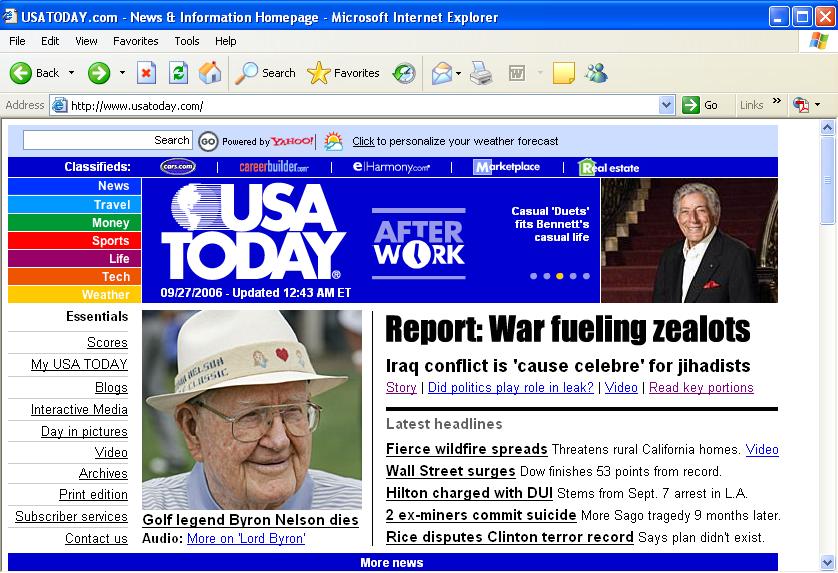
Today the government declassified portions of the National Intelligence Estimate on “Trends in Global Terrorism”. The San Francisco Chronicle headline was “Intelligence agencies say Iraq conflict encourages the global jihadist movement” The New York Times blared “Waging the War on Terror: Report Belies Optimistic View” and USA Today’s contribution was:


If these headlines indeed captured the essence of the intelligence estimate, then that would seem to be another nail in the coffin of the Bush Administration’s foreign policy. Not only was the Iraqi democracy project failing, but the United States has been placed in greater danger, not less, because of the Iraq invasion. So I decided to read the report for myself. It begins:
United States-led counterterrorism efforts have seriously damaged the leadership of al-Qa’ida and disrupted its operations; however, we judge that al-Qa’ida will continue to pose the greatest threat to the Homeland and US interests abroad by a single terrorist organization. We also assess that the global jihadist movement—which includes al-Qa’ida, affiliated and independent terrorist groups, and emerging networks and cells—is spreading and adapting to counterterrorism efforts.
Two rhetorical questions: 1) Does the bleakness of the headlines match the topic sentence of the lead paragraph? 2) Does the lead paragraph tell us anything we didn’t already know?

The report does discuss the growth in the number of jihadists and how the Iraq war has “cultivat[ed] supporters for the global jihadist movement.” However, it also points out ways that terrorism can be defeated, including succeeding in Iraq, instilling greater awareness how the victims of violence are other Muslims, and publicizing the implications of living under shari’a law if the terrorists win.

Two paragraphs in the second half of the report merit further comment. Keep in mind the intelligence estimate is dated April, 2006:
  • The loss of key leaders, particularly Usama Bin Ladin, Ayman al-Zawahiri, and al-Zarqawi, in rapid succession, probably would cause the group to fracture into smaller groups…
  • Should al-Zarqawi continue to evade capture and scale back attacks against Muslims, we assess he could broaden his popular appeal and present a global threat.
  • Now that Zarqawi has been killed, the Intelligence Estimate says that, at least for a time, the threat to US interests should be “less serious”.

    Question for the professional news organizations: why couldn’t the headline have been “Death of Zarqawi Lessens Terrorist Threat”? But if you disbelieve this part of the assessment, why do you assign such credibility to other conclusions, such as “the Iraq conflict has become the ‘cause celebre’ for jihadists”?

    I think we know the answer. © 2006 Stephen Yuen

    Saturday, September 23, 2006

    Disillusionment

    My friend is a professor at an Ivy League university. He regularly sends out e-mails on political and economic matters. Below are a few representative excerpts:
    September, 2006: The United States is a country filled with profligate spendthrift Americans self-indulgently pushing themselves ever deeper into debt on falling real incomes to satisfy their desire to live for today. The day of reckoning will come for a country led by an incompetent moron and his incompetent, brain-dead, ethically-challenged minions.

    May, 2006: Bush is a vile, despicable, completely incompetent want-to-be dictator deserving of no respect and utterly devoid of any redeeming qualities. He is a disgrace to humanity, an enemy of democracy, and an embarrassment to the American people.

    March, 2006: The U.S. keeps sinking into the gutter, led by an incompetent, duplicitous, delusional President and his administration of grossly incompetent, idealogical (sic) hacks. This country is completely delusional as people try to convince themselves how great things are.
    My friend--whom I really do like on a personal basis--has never called the current holder of the office "the President", much less "my President", because he believes the election was stolen in 2000 and again in 2004. My friend must have been applauding when Venezuelan President Hugo Chavez said at the United Nations that President Bush was "the devil" and acted "as if he owned the world". He must have cheered when Chavez "told reporters that Bush is not a legitimate president because he 'stole the elections.'"

    But imagine the disappointment that my friend must have felt when Rep. Charles Rangel, an outspoken opponent of Bush, said to Chavez: "You don't come into my country; you don't come into my congressional district and you don't condemn my president." [emphasis added] It took six years for some Democrats, but better late than never. For my friend, however, I suppose it'll be never. © 2006 Stephen Yuen
    Friday, September 22, 2006

    It Only Seemed Longer


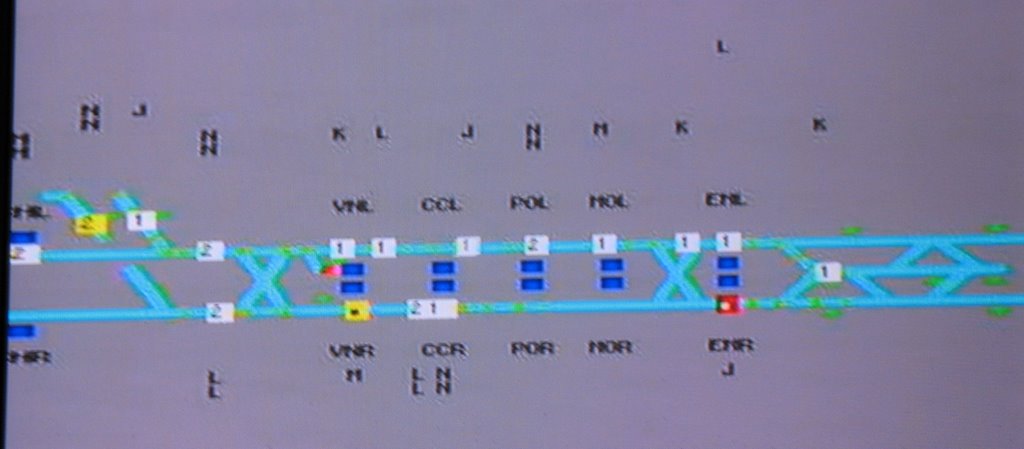
    It’s 5:30 p.m., and I’m waiting at the Embarcadero Station for the Muni light rail. The N-Judah is at Civic Center, which is three stops away, and we only have 20 minutes to make our train. The N arrives, and everyone hastens aboard.

    One couple has obviously been drinking and argues loudly with another rider who is trying to retreat gracefully. Every other word from the man is the f-bomb. The woman describes how her companion is especially fond of her private parts (her phrasing is more graphic). Our car is filled with Peninsula commuters who seem to be fascinated by their shoes. Fortunately, the Giants are not playing tonight, so our car is devoid of young fans. The couple gets off near the ballpark for more drinking: the night is still young. As for me, a quick ride home and quiet dinner was all the nightcap I needed.

    Monday, September 18, 2006

    Respect the Old Ways

    Defines,
    Definea=Lseterm = 10Yrs;,
    Defineg=Basicrnt = 440.76;,
    Define0=Rnt1 ;Rnt_Gr_Debt;,
    Define1=Rnt1 Resid1 Famort Asset01 ;Eq_Csh_Pf;,
    Define2=Rnt1 ;Uneven_Rnt_Adv;,
    Define4=Rnt1 ;Pv_Rnts_Flws;,
    Define5=Except Loan;Ref_Loans;,
    Define6=Rnt1 Resid1 Famort Asset01 State Federal ;Csh_Yld_Flws;,
    Defineai=Cod = ((12*100)*(((1+(((Treas1+(((Treas2-Treas1)/(Term2
    -Term1))*(Avg_Life-Term1)))+Debt_Spd)/200)) ^ (2/12))-1)) ; &
    Cod Based On Avg Life And Converted From S/A To Monthly &
    Frequency,

    Above is part of a data-file from financial software that I regularly use. The software originally was written for mainframes in the 1980’s, then ported to MS-DOS. The developer issued a Windows version, but it is much slower, and frankly, I don’t completely trust its calculations.

    So I use the DOS program. It requires a lot of patience and careful typing, because a single letter out of place will stop the program from running. Worse, it’s hard to find that letter because the primitive debugger isn’t very helpful in locating the problem. Last week it took me hours to figure out that “car3” should have been “cars3” in a lengthy file related to an investment in railcars.

    So why don’t we buy a more up-to-date program? Two reasons: the most important is that the accounting for many of our investments uses the old software, and in these days of Sarbanes-Oxley, when any mistake will cause a team of auditors to land on a poor accountant like a ton of bricks, it’s best to leave well enough alone when the system works, however inefficiently. (In my weaker moments I dream that SOX, with its endless flowcharting, systems testing, and error remediation, is applied to federal and state governments; they would fail control standards within 30 seconds.)

    The second reason we don’t switch is skepticism: the benefits of a new system are always exaggerated, while the costs of adoption are underestimated, and some are completely overlooked. I’ve never seen a new system do everything we needed it to do---and I’m not talking about bells and whistles but features essential to running our business. Patching and fixing the old is better than buying new.

    Don't Eat Your Spinach
    It’s not clear that Earthbound Farms can patch the fix that it’s in with the source of the E.coli outbreak still unknown on Monday morning. After the media and government swarm will come the lawyers, and the company will require a concentrated effort to work through this debacle. Even if it should survive, Earthbound Farms’ sales will suffer a huge initial dropoff in its business—no one absolutely has to eat their produce—and some customers may never return. Odwalla’s e.coli scare of 10 years ago nearly wrecked the company.

    On Saturday I took the container of mixed greens (contains spinach) back to the market. The lady in front of me didn’t have a receipt and only said that she threw out a package of spinach, but they gave her a refund, no questions asked. We had opened our container and had eaten about a quarter of the contents, but they also gave me a full refund.

    This is a reminder that canning and pasteurization were remarkable innovations in the prevention of disease. Another reason to respect the old ways of doing things.
    © 2006 Stephen Yuen

    Friday, September 15, 2006

    Mr. Fix-It

    You know that whenever President Bush calls on this guy for help, the situation is really dire. Afterthought: JB's memoirs came out in 1995. He’s worked on a few projects since then---it's time for an update!

    Tuesday, September 12, 2006

    Unclear Road

    It was T-shirt weather on Sunday. The church had a barbecue to kick off the school year, and we enjoyed the sun for a few minutes until the heat chased us indoors. The grills were trucked in by one of the parishioners. He hitched the equipment to his pickup and brought the apparatus through the back gate. Although he’s half my age, he’s much handier with tools than I am (my wife would say that’s not a particularly high standard) and a hit with the ladies. In these parts lawyers and engineers are a dime a dozen; plumbers, landscapers, and car repair guys are the real chick magnets.

    I scheduled a meeting which convened after the barbecue. It was one of those meetings where everyone wished they were somewhere else, not indoors going over the minutiae of some upcoming events. In my youth I laughed at the silly ancients who argued over how many angels danced on the head of a pin. Now I laugh because I recognize myself.

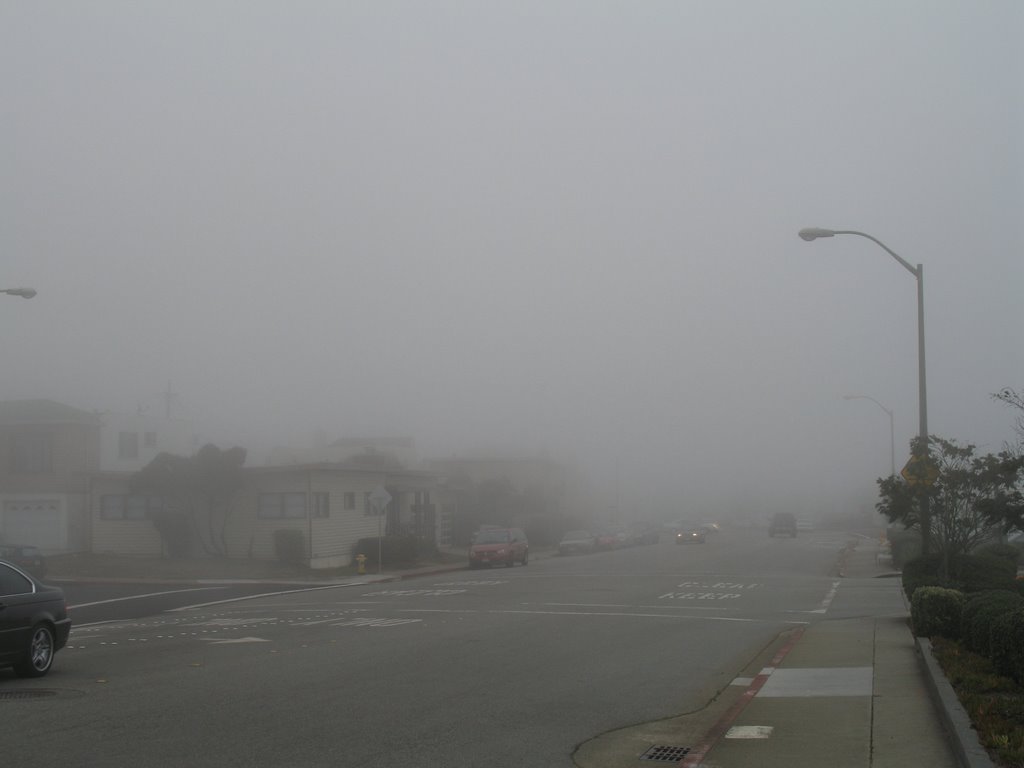
    At 2 o’clock we headed up to the City, and the warm Peninsula sunshine lulled me into forgetting to bring a jacket. In the Bay Area climates—the voguish term is micro-climates—vary widely. The fog enveloped us north of Daly City, and I had to remove my sunglasses and turn on the headlights. After parking the car, I strode briskly to keep warm. We stopped for an early dinner at a noodle joint, and I took the slow way south along Skyline Boulevard.

    Yesterday, of course, was the fifth anniversary of the attacks on the World Trade Center and the Pentagon. 9/11 set in motion a chain of events whose outcome is far from clear. Even five years later, the country is divided about what it should do. Concerning Iraq, should we pull out and cut our losses, dooming the nascent democracy and creating a (worse) breeding ground for terrorists? Or should we put in more troops, likely resulting in more violence and increasing their dependency on America? Or should we stay the course, which may be the least bad alternative but is singularly unsatisfying?

    The choices regarding Iran are worse: the Iranians appear dead set on acquiring nuclear weapons and do not appear reluctant to use them, at which point Israel will be in mortal peril. But an invasion and occupation of Iran raises a host of problems that will make Iraq seem like a picnic.

    And always, in the back of our minds, is the “unthinkable” option of unleashing the full power of America’s military might, which will guarantee our physical safety at the price of our soul.

    [Update - Victor Davis Hanson has the perfect phrase for this line of thinking: More rubble, less trouble. ]

    Thank goodness I don’t have to make those decisions. Let us pray that our leadership and its opponents (who may assume the leadership sometime in the near future) have the wisdom and courage to guide us through the fog. © 2006 Stephen Yuen

    Off Skyline Blvd. in Daly City on a Sunday afternoon in September.