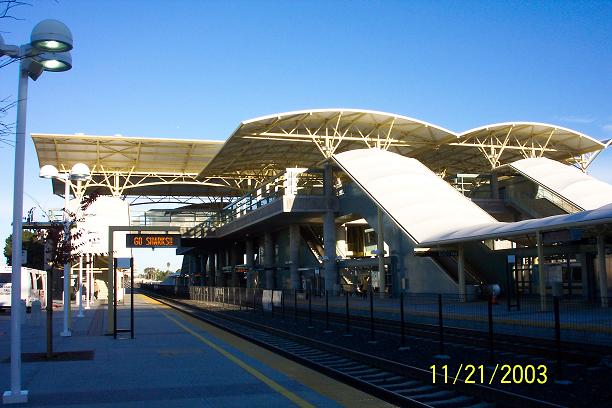
Showing posts with label CalTrain. Show all posts

Wednesday, August 05, 2020

Caltrain Discussions Reveal Character


Hillsdale, 2006: commuters and rain
In a story we've been following for weeks, San Francisco and Santa Clara counties have been trying to seize control of Caltrain from San Mateo County through a ballot measure that would provide financial relief for the beleaguered rail line.

However, the deadline for submission has forced them to eliminate governance language and draft a "clean" bill:
The deal, crafted by political leaders in the three counties over the weekend, separates the governance issues from the ballot measure. Officials in Santa Clara and San Francisco counties wanted the ballot measure to require Caltrain and San Mateo County officials to agree on governance changes before being able to spend most of the money. The deal cleans up the ballot measure with the Caltrain board agreeing to pass a resolution with those changes. The governance issues would not be part of the ballot measure language.
San Francisco and Santa Clara will likely get the control they want after November, but at least their threat to shut down Caltrain if they didn't get their way will not have succeeded.

In future negotiations, when these counties try to take the moral high ground in discussions with monied entities, we shall remember how they behaved when they had the financial upper hand.

Thursday, July 30, 2020

The Golden Rule (Those Who Have the Gold Make the Rules)

Last week we wrote about how San Francisco and Santa Clara might seek to wrest control of Caltrain as a condition of putting sales tax funding on the ballot.

On Tuesday the San Francisco Board of Supervisors formalized their threat: [bold added]
The three counties that fund Caltrain have reached an impasse that may shut down the Peninsula rail line, which is limping through the COVID-19 pandemic while carrying 5% of the passengers it had last year.

On Tuesday, the San Francisco Board of Supervisors unanimously approved putting a ⅛-cent sales tax measure on the November ballot, with controversial conditions that would tie up most of the money until the counties resolve a conflict about governance.
San Francisco progressives don't hesitate to alter existing deals when they have the financial upper hand.


In related news the State of California is withholding funds from two small California cities because they "rejected public health orders to shut down certain businesses":
At their city council meetings on Monday, leaders in Atwater, a city of 29,000 off Highway 99 in Merced County, and Coalinga, a city of 17,000 in the southwest corner of Fresno County, stood by resolutions they passed this spring allowing all businesses in their communities to reopen.

The Governor’s Office of Emergency Services warned the cities last week that they could collectively lose about $600,000 of federal coronavirus relief unless they come into compliance with state health requirements...

Atwater Mayor Paul Creighton and City
Attorney Fran Splendorio (Chron photo)
Local officials said it was an economic trade-off they are willing to make. They decry Newsom as a bully who is illegally denying them money they are owed.

Atwater Mayor Paul Creighton, who led an effort in May to declare it a “sanctuary city for all businesses,” said he worried that shutting down again would cost more in lost tax revenue and failed businesses than whatever financial aid the state is offering.
(These small cities have learned to use the vocabulary of progressives--"sanctuary"--to describe their resistance to edicts from the Capitol.)

If the State holds back funds to enforce compliance, it will do exactly what it has accused the President of doing when he threatened to withhold Federal monies from California, not to mention what he is alleged to have done vis-a-vis Ukraine.

The President's alleged misdeed was on the front pages for months and resulted in his impeachment trial. When the Governor of California does it, it's on the bottom of Page C1.

Wednesday, July 22, 2020

CalTrain Power Play

2004 Christmas week: in the COVID-19 era it looks this deserted all the time
Caltrain, the commuter rail that provides transportation from San Francisco to San Jose, is on the brink: [bold added]
Having lost 95% of the ridership it relies on for the bulk of its revenue, the vital transportation and economic link between San Francisco and Silicon Valley needs voters to throw it a lifeline by raising sales taxes an eighth of a percentage point. All local governing bodies have to do is let the people decide.

The proper course was therefore obvious to San Francisco’s supervisors: Take advantage of the dire emergency to promote class warfare and do bureaucratic battle while threatening to paralyze an irreplaceable public asset.

Supervisors Aaron Peskin and Shamann Walton have joined officials in Santa Clara County in holding up the modest tax increase while reviving demands for more control over the commuter line, which is managed by the San Mateo County Transit District, known as SamTrans.
California government officials file lawsuits against the Federal Government when the latter withholds funds to force compliance with Trump Administration policies.

But when CalTrain, which is run by San Mateo County, wants a sales tax measure, San Francisco and Santa Clara hold up the ballot to get control over CalTrain's finances.

Whatever principles they espoused in their arguments against the Federal Government go out the window when the progressives hold the pursestrings. It was all about the power.

Saturday, February 01, 2020

Housing: It Doesn't Work if You Force It

Last year we noted how some California politicians are
trying to alleviate the housing shortage by forcing communities to accept dense housing near train stations.
SB50 would have removed control of housing development from municipalities, which through zoning regulations and onerous permitting have slowed construction.
SB50 would have eased the development of small- and medium-size apartment and condominium projects by raising height limits, removing density restrictions and reducing parking requirements.

Under the bill, cities could not have blocked residential buildings of at least four or five stories within half a mile of rail stations and ferry terminals, provided they met other local design standards. [The bill] ... would have essentially eliminated single-family zoning in California, except in small coastal communities and areas at high risk of fire.
SB50 was defeated in the State senate on Wednesday. Politically this was a classic blue-on-blue battle between State central planners and the liberal "wealthy suburbs", which don't object to the regulatory State unless it affects them (e.g., building homeless shelters and high-density housing in their communities).

Historical note: eleven years ago the Bay Meadows race track was torn down (photo right). The residential-commercial complex that arose became a prototype for the planners' vision:
the mixed-use project abutting the Hillsdale Caltrain station will comprise more than 1,100 housing units, up to 1.5 million square feet of office space, 90,000 square feet of retail space and 15 acres of parks.


The Bay Meadows prototype has been disappointing in one regard. The apartments and townhouses have been anything but low-cost (current Zillow ad, right).

Saturday, March 10, 2018

As Easy as Predicting the Sun Will Rise in the East:

If the project doesn't get much further, historians of the future
will wonder why we spent billions connecting Fresno (pop
500,000) with Bakersfield (pop 400,000) (Chronicle photo)
I would say I told you so, but this was as easy as predicting the sun will rise in the East: California high-speed rail project facing more delays, higher costs. [bold added]
The middle-of-the-road estimate is $77 billion, according to the draft report, which will now undergo public comment and legislative scrutiny....

The bullet train’s most recent cost estimate was $64 billion, which was already double the original $32 billion price tag that was pitched to state voters when they authorized bond money for the project nearly a decade ago. The rail authority said it hopes to finish the full line by 2033, a delay from the most recent estimate of 2029.
We derided the project when we first heard about it in 2012. By 2013 and 2015 it had gotten more delayed and more expensive. IMHO, the new estimates are optimistic.

I'd bet money on this: we will put a human being on Mars before anyone travels from LA to SF on high-speed rail.

BTW, here's another great moment in public transportation: At long last, Wi-Fi coming to BART, Caltrain — in 3 to 4 years. By comparison JetBlue began offering WiFi on its flights in 2013.

The leaders of tomorrow, i.e., millennials, prefer socialism to capitalism, so we'd better get used to stories like these.

Wednesday, July 05, 2017

Nearly Every Day

From 13 years ago:
The Millbrae BART/Caltrain connection is a maze of concrete, escalators, ducts, stairs, turnstiles, and ticket machines. The designers did their best with the translucent roofing, but there are too many dark, cold areas. Yes, the station is functional, but the parking lots are mostly empty and traffic is far below expectations.
The booming Bay Area economy and the addition of a BART line to San Francisco Airport should have improved Millbrae Station's utilization. However, [bold added]
By now, BART’s Millbrae Station — with its connections to Caltrain, buses and shuttles — was supposed to see 16,500 passengers pass through its fare gates every weekday, making it the fifth-busiest station in the system.

But 13 years after it opened, it’s pretty much just another BART station, nowhere near the bustling Peninsula transit hub that planners envisioned. With just under 7,000 riders entering and exiting daily, the station ranks 27th in activity among the transit system’s 46 stations.
One of the problems is that there's little coordination between BART and Caltrain. A passenger trying to get from Oakland to Mountain View would take BART to Millbrae, then often wait more than 30 minutes for the next southbound Caltrain---and that's when both BART and Caltrain are running on time.
BART riders coming from the north and bound for Caltrain arrive on the east side of the station. To catch Caltrain, they have to ascend escalators or stairs, exit through the BART fare gates and walk a few yards across the concourse before descending to the Caltrain station’s west side.
When it's not rush hour, the drive would take one hour, and mass transit two. When Millbrae Station opened, a round-trip BART fare from Millbrae to San Francisco was less than $5. Parking was free, an obvious inducement to try the new station.

Now the round trip costs $9.30, and parking is $3. It's no wonder that BART doesn't attract more commuters; it's too expensive for low-wage earners (even if the minimum wage rises to $15 an hour), and it's too inconvenient for those with high incomes, who choose to park in downtown buildings at $25 per day ($5,000 per year).

Don't get me wrong--I'm glad the station was built. It's very useful to have an alternate means into the City since the highways are backed up nearly every day.

Friday, March 11, 2016

The Real Problem

This week's local transport news was puzzling to those who don't take BART regularly:
If you take up more than one seat you could fork up $100....The first offense would be $100 and the second $200. Anything after that, as much as $500.
Sure, your humble blogger is irritated when seat hogs won't move their bags when people are standing, but he prefers to handle this matter via moral suasion than the BART police. And causing a rude human being to pay $100 or more seems like an overly severe penalty for his lack of courtesy.

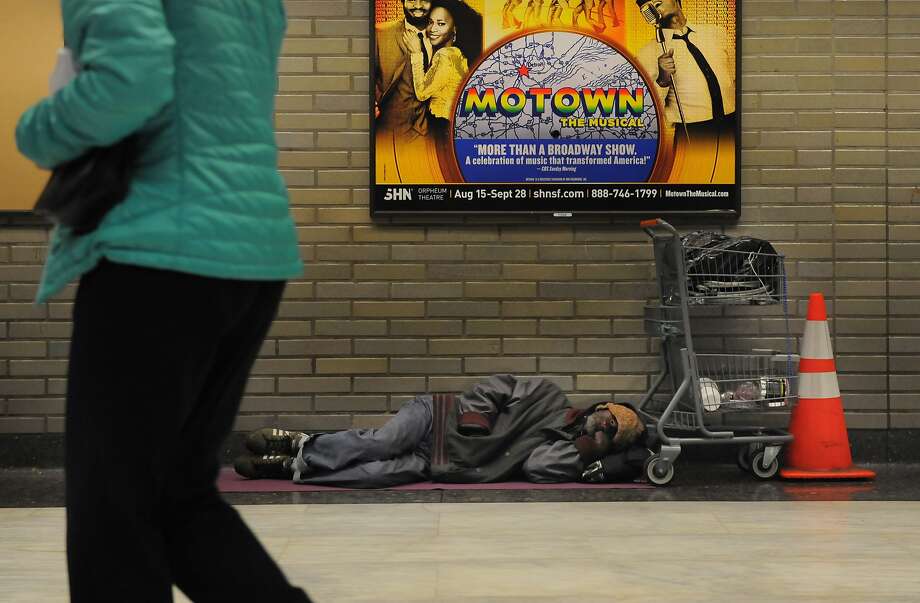
Homeless people stay in the BART stations, too. (SF Gate)
SF Chronicle columnist Debra Saunders says the real problem is about the homeless, who use the trains as shelter: [bold added]
If a simply inconsiderate passenger is taking up an extra seat for a backpack or luggage, another commuter will ask that person to make room. It’s only when the two-seat hog seems hostile, mentally ill or inebriated that others hesitate to inquire. Smell is also a factor.

During the winter months, the homeless can be especially vexing. When you are riding the train to work, it’s irritating to see others taking up space during heavy commute hours in an effort to stay warm and dry. The public pays fares to use BART as a conveyance, not to ride in railcars that double as homeless shelters (for which working stiffs also pay).

Also contributing to the dysfunction: Once you pay the minimum fare, you can ride all day.
The BART police don't have a rule for making people move, hence the seat-hog proposal.

A better course of action might be to address the ride-all-day behavior. For example, there could be an ordinance to make passengers leave the system after a certain amount of time has elapsed. BART police already "audit" the tickets of passengers; why not use ticket scanners to make sure they entered, say, within the past three hours? (Such a three-hour rule can be suspended if there's a train delay.)

A related story -- Study: BART is second-germiest transit system in the US

Wednesday, February 25, 2015

Don't Bother Honking

An SUV after it was struck by Caltrain in Menlo Park
(NBC Bay Area photo)
Caltrain express trains achieve a top speed of 70+ miles per hour, creating a long-running Peninsula traffic hazard that won't be completely solved for decades.
  • The tracks go through the heart of cities like San Mateo, Burlingame, and Palo Alto.
  • Surface roads intersect tracks at dozens of locations, where old-fashioned railway crossing gates supervise auto traffic.
  • Projects ("grade separation") to construct train overpasses have recently cost $126 million to $155 million.
  • It's a popular misconception that accidents occur because impatient drivers try to "beat the train." Some crossing roads are so congested that it's possible to be trapped on the tracks, between cars, when the crossing gates go down. Such a situation killed an Indiana visitor in 2011 and resulted in another fatality this week in Menlo Park.

    The grade separations won't be completed until the 2030's. Meanwhile, I plan to drive very conservatively at railroad crossings. Sorry about that if you're behind me, and don't bother honking.
  • Monday, October 21, 2013

    Anxious Weekend

    After an anxious weekend the BART strike, chapter 2 (chapter 1 was in July), was apparently settled. The trains will roll again tomorrow after disrupting the daily schedules of hundreds of thousands of commuters who rely on BART. However, we're not out of the tunnel entirely because the agreement must still be approved by union membership next week.

    The region's vulnerability to transit strikes has given rise to calls to outlaw them by some California Democrats. (Transit strikes have been banned even in such labor-friendly bastions as Chicago, Washington, D.C., and New York.) The San Francisco Chronicle says that it's time:
    This strike may represent the most egregious and most counterproductive overreach by the unions. They and their consultants should have recognized in July that public sentiment was not with them.

    Their obliviousness has brought the issue to the fore: Why should workers in a service so essential to Bay Area life and safety even be allowed to strike?
    BART is fairly quick, reliable, and cheap, and, excluding the intra-San Francisco Muni system, far more people in the Bay Area rely on it every day than all other forms of public transportation. BART is also a good example of the danger of entrusting too much power to a single supplier, public or private, for-profit or non-profit.

    We who live on the Peninsula are fortunate to have several commuting options to San Francisco: SamTrans express buses, CalTrain, BART, and, of course, one's own car. Diversification is good, because it means that you have a back-up plan. © 2013 Stephen Yuen

    Saturday, September 15, 2012

    Tragedy Averted

    I occasionally board Caltrain in South San Francisco and fortunately was away in LA on August 24th.

    A southbound train roared through the SSF station and nearly hit northbound passengers crossing the tracks.
    Caltrain says the "very serious" near-accident was the first of its kind in the modern history of the popular commuter line and has led to major safety changes and left two engineers on leave. [snip]

    The station is old and, unlike most Caltrain stops, does not have a gate or crossing arms that come down to prevent passengers from crossing active tracks. Usually engineers radio each other or use headlight signals to ensure the station is clear before an express train zooms through, but that apparently didn't happen this time.
    At that hour Caltrain commuters disembark to shuttles that will take them to South City biotech firms. We were lucky tragedy was averted.

    Union Pacific freight cars stored at SSF.

    Friday, July 06, 2012

    High Speed Rail: From the Middle Out

    "Middle-out" is becoming a popular design approach, whether one is talking about philosophies of engineering or economics. Middle-out also appears to be an apt description of the just-approved California high-speed rail (HSR)project.

    Central Valley (in green) will be operational first.
    The long-time dream of California planners has been to connect the San Francisco and Los Angeles megalopolises with rail transportation that is quick, cheap, and good (here we go again with the Project Triangle). [HSR is not total fantasy: both the shinkansen(Japanese bullet train) and TGV(French high-speed rail) have shown that the technologies and business models are feasible.]

    But they're going to start in the middle, i.e., the Central Valley, where the labor and land are cheaper and environmental obstacles less restrictive. After the expenditure of an estimated $6 billion, HSR will be operational between Fresno (pop. 350,000) and Bakersfield (pop. 500,000) in 2017.

    This may be engineering-wise but politically foolish. IMHO, it would have been more astute to build out from population centers, say the SF Bay Area (pop. 7 million) to Gilroy or Greater Los Angeles (pop. 17 million) to Bakersfield first. Serving the long-range commuter would accumulate political capital for problematic future funding requests amounting to tens of billions of dollars.

    Just to make clear, your humble observer is not in favor of the HSR project.  It's expense ($65 billion in today's dollars and $90+ billion, including inflation ) is only defensible under the wildest pie-in-the-sky scenarios. When one looks at the sad history of California construction overruns in projects like the Bay Bridge extension, San Francisco airport, and BART, it is even more improbable that the final cost will be justified, and it won't matter much whether it was built top-down, bottom-up, or middle-out.

    Thursday, June 14, 2012

    Caltrain: More Expensive Than I Remembered

    BART service between San Francisco and Oakland has been shut down all day and won't resume until late afternoon. Although BART still ran cars from Peninsula locations to San Francisco throughout the day, I switched to Caltrain as a precaution.

    It's common for old-timers to blanch at the escalating price of items, but I still was flabbergasted by the cost of Caltrain. A scant four years ago I paid less than $10 a day, all-in. Today it was $17.50 [$9.50 Caltrain round trip + $4 parking + $4 San Francisco light rail].  Including gasoline, it would have cost about the same to drive the 20 miles north to San Francisco and park at one of the discount lots a few blocks from the office. (By comparison BART from Millbrae to San Francisco is $10.50, including parking of $2.)

    Caltrain's recent fare hikes and higher ridership have greatly strengthened its financial position. From this infrequent commuter's point of view, however, Caltrain needs to take a breather on price increases lest its hard-won gains vanish overnight.

    Homes under construction at the old Bay Meadows site should add hundreds of Caltrain customers.

    Tuesday, March 13, 2012

    Unfolding Understanding

    Paypal executive Eric Salvatierra was killed last Friday when he was struck by a Caltrain commuter train in Menlo Park.

    Caltrain is a speedy alternative to driving in the San Jose-San Francisco corridor, but long stretches of track use old-fashioned railroad crossings on the densely populated Peninsula. (Building over- and under-crossings would cost many millions of dollars, and cash-strapped Caltrain has many demands on its budget, like replacing its aging fleet.) We are sadly accustomed to reading about Caltrain-caused deaths related to stalled cars, kids playing on tracks, and inebriated pedestrians.

    Mr. Salvatierra did not appear to fit any of the profiles, until this morning's announcement:
    The PayPal executive killed on the Caltrain tracks suffered from depression and bipolar II disorder, his family said Monday...."In the past eight months, Eric and Meredith worked tirelessly with mental health professionals to get him through his illness," the family's statement said. "In the end, he lost his fight with this debilitating disease."
    In recent years there has been a rash of teen suicides associated with Caltrain. Mental illness, like physically debilitating diseases, affects not only the sufferer but those who love them. Too often the ending is tragic. The family has asked that donations be made in Eric's name to the National Alliance on Mental Illness. (NAMI has two out of four stars on Charity Navigator.)

    Wednesday, January 26, 2011

    Charity to a Stranger

    On the way home Monday we lost an iPhone. We called its number, and a young man answered. He had found the iPhone at the Mountain View Caltrain station.

    Colin couldn't wait the 30 minutes for us to return to Mountain View. He said that he would leave the phone at the snack bar. We asked Colin for his contact information. He said he didn't believe in accepting rewards.

    We picked up the phone from the man at the snack bar, who wouldn't take a reward either. The man said that he thought Colin was a student at Saint Francis High School.

    In recent years I've spent time volunteering to help others but haven't had much experience being the recipient of a good deed. I was surprised, touched, and somewhat at a loss.

    Thank you, sir, and thank you, Colin of Saint Francis, for your act of charity to a stranger.

    Wednesday, March 03, 2010

    Highest and Best Use

    Years ago Caltrain shuttered most of its stations. The station agents were retired or let go, their ticketing function replaced by vending machines. While costs have indeed been reduced, the value of the old buildings and other real estate has largely remained untapped.

    At Hillsdale Station the old wooden building has been leased to Luke's Local, "a commuter 'market' that sells fresh produce and prepared dinner meals."

    The economics that the new tenant faces are daunting. Non-commuters won't go out of their way to shop at the station because Caltrain riders have filled all the parking spaces by 8:30 a.m. The shopping center across the street has a Starbucks, and nearby restaurants and fast food outlets already offer breakfast and dinner fare.

    In a minor show of support I bought some garlic heads for $1 each (50 cents at Lucky's). More than half of the time I don't see any other customers. It would be surprising if they're still here next year.

    Tuesday, August 04, 2009

    Caltrain: Not What They Envisioned

    Bay Meadows race track, next to Hillsdale station, has been torn down. New shops, residences, and offices will add hundreds to ridership.

    Everyone I know who tries Caltrain likes the experience. The camaraderie with conductors and fellow passengers, the clacking of the wheels and tooting of the whistle, the luxury of snacking, dozing off, and feeling superior to drivers stuck on Highway 101, and the self-satisfaction from reducing one’s carbon footprint all contribute to the pleasure of commuting by train.

    Satisfaction turns to horror about once a month when a train strikes a person or vehicle. And it’s even more tragic because many deaths are not accidental:
    Caltrain had more suicides in 2008 — 12 — than any year in its history. From the launch of Caltrain in 1992 through 2008, 62 percent of the railroad's deaths were ruled to be suicides.
    As a rider of twenty years, I’ve ridden on a train that struck an empty bus—no one was hurt—and another that killed someone. It makes little difference whether one is on the incident train or one following behind; one’s schedule is disrupted for a good part of the day.

    When an accident happens, service up and down the line is halted for at least an hour. Many commuters have learned to adapt, but I’ve observed a decrease in the number of younger people whose jobs absolutely require them to start at a fixed time. Professionals and executives have colleagues or subordinates who can cover for them; junior workers who are trying to establish a reputation for reliability do not have such flexibility.

    Caltrain suicides are especially difficult on the engineers and conductors, the former because they know they can’t stop 80-MPH tons of steel in time, and the latter who are first on the scene to assess the damage to flesh and bone. It’s a regular part of the job but surely not what they envisioned when they signed up. This year I’m making an extra effort to smile and engage the conductors in conversation (only if it appears they might welcome it, of course). © 2009 Stephen Yuen

    Monday, October 06, 2008

    Gone Loco

    The Dow is down 500 points this morning, and I'm surveying the train wreck that is my retirement portfolio. Speaking of which, Caltrain has been delayed nearly an hour because a train hit a big rig in Burlingame. Perfect. (Fortunately, there were no serious injuries.) And I had such a good weekend, too.

    Tuesday, August 19, 2008

    Not the Best Tool

    As a blogging tool the iPhone leaves a great deal to be desired. Touch-typing skills slow to 10% of normal. The iPhone doesn't permit cutting, copying, and pasting, which makes quoting and linking extremely cumbersome.

    Yet, I wouldn't trade it for anything, though it's taken me half an hour to peck this with my index fingers. Now that it's standing room only on Caltrain, having an iPhone makes the commute fly by.

    With 3G reception I can browse the Web for most of the trip and not have to fumble with newspapers and magazines.

    Saturday, July 12, 2008

    Wonderful to Have Options

    Unlike most Californians, we who live on the mid-Peninsula have mass-transit options that are cost- and time-effective. For a commute from Foster City to San Francisco we can choose among an express bus (it stops a block from my house and drops me off a block from the office), CalTrain and BART. The door-to-door time during rush hour is roughly the same, about 70 minutes for each system.

    The bus is the clear winner from the standpoint of cost:

    Despite the expense I prefer to buy the CalTrain monthly pass package, which includes parking at CalTrain stations and unlimited rides on San Francisco’s Municipal Railway---helpful if one wants to make short trips around San Francisco during lunchtime.

    CalTrain bypasses the occasional traffic stoppages on Highway 101 and operates until midnight, while the evening bus’ last run is at 6:30. CalTrain is also the only transit alternative that permits eating and drinking (including alcohol which I only imbibe on the way home for medicinal reasons of course).

    On Thursday the morning news said that a broken track in San Mateo resulted in a half-hour delay in both directions. So I drove north to Millbrae and snagged the next train to San Francisco (if none arrived I would have switched to BART a few feet away). It’s wonderful to have options. © 2008 Stephen Yuen

    Monday, November 05, 2007

    The Right Way

    Last week started by confronting long-running thorny tasks that resisted completion---crafting a presentation on a structured investment vehicle and evaluating several speculative equipment purchases that will span a number of years. Adding to the obstacles was the fact that we’ve had some turnover in our senior management, and not all the new players are familiar with how we arrived at our current analytical approaches. Many issues raised in recent management meetings had already been deliberated and decided in the past, but there’s a new generation to educate and we’ve had to retrace our steps over old ground.

    Sometimes there’s no alternative but to “go into the tank”, as one of my college friends used to say, and power through projects. There were some hiccups mid-week over some esoteric problems that were likely never to surface, and it was enormously tempting to let them slide. But noontime walks in the San Francisco sun stiffened the resolve, so I spent a few more hours finishing the projects the right way.

    On Friday the group heaved a collective sigh and celebrated the (successful) completion of a trying week with margaritas at Chevy’s. It was also my birthday, and I was happy to lift a glass to another spin around the sun. The passage of time is no longer a source of dread; I’m another year closer to getting back from Social Security what I’ve been putting in for decades and I’ve earned another year’s credits in my employer’s retirement and benefits plan.

    Chevy's pupu plates are $3 each during happy hour.

    The evening Cal Train was uncrowded and quiet, ideal for decompressing, and the margaritas provided a pleasing afterglow. I’ve been working all my life toward the golden years, but maybe, just maybe, they’ve already arrived and I just haven’t noticed. © 2007 Stephen Yuen