Showing posts with label Biotechnology. Show all posts

Thursday, January 25, 2024

Ovarian Tissue Freezing

Oocyte and ovarian tissue cryopreservation (Science Direct)
Most of us have heard about egg retrieval, in which egg cells are extracted from the ovaries. The cells can be fertilized in a lab in the process known as in-vitro fertilization (IVF). They can also be frozen ("oocyte cryopreservation") for future use to extend a woman's childbearing years past menopause.

It now turns out that menopause can be delayed--and fertility retained--through ovarian tissue freezing: [bold added]
[Yale School of Medicine (YSM), Kutluk Oktay, MD, PhD], who developed and performed the world’s first ovarian transplant procedure with cryopreserved tissue for a patient with a medical indication in 1999, sees a future in which healthy women could use this process of freezing tens of thousands of eggs within the ovarian tissue to stave off menopause for as long as several decades—or even prevent its onset altogether.

“For the first time in medical history, we have the ability to potentially delay or eliminate menopause,” said Oktay, who is also an adjunct professor of obstetrics, gynecology & reproductive sciences at YSM.
Deciding how much ovarian tissue to extract and freeze is complicated:
The more tissue a surgeon removes, the longer the procedure can potentially delay menopause. However, the removal of too much tissue can lead to early menopause. “This model gives us the optimum amount of tissue to harvest for a person of a given age,” said Oktay.
In addition to extending fertility, delaying menopause may confer health benefits:
Studies show that women who experience menopause later may live longer and have a lower risk for a range of conditions, including cardiovascular disease, dementia, retinal disease, depression, and bone loss. However, uncertainty remains over whether later menopause actually reduces those health risks. Oktay hypothesizes that those risks also may be mitigated in healthy women who delay menopause via ovarian tissue cryopreservation.

If risk for such chronic diseases is reduced in healthy women who undergo this procedure, it could be a significant benefit. However, Taylor said that “additional research is needed to determine long-term benefits as well as risks.”
Much more work needs to be done to perfect the model calculations and test their applicability to real world decisions. However, it does appear that the technology will soon exist to extend a woman's fertility--and her life span--by decades, with ramifications that are difficult to imagine.

Thursday, August 11, 2022

Tanforan Shopping Mall - Last Gasp

No spacing problem here.
In 2018 the decline of retail and the growing homelessness in San Bruno were warning signs for the Tanforan Mall.

The coronavirus lockdown was the death blow, and in November, 2020 the property was acquired by Alexandria Real Estate Equities for an eventual tear-down and conversion to a biotech campus / housing development.

But it would be a slow death, with designs and permits requiring years to process. Alexandria Real Estate Equities was in no hurry to buy out the leases, so tenants were running out their contracts.

In 2012 the Food Court bustled.
It was my first visit to the shopping center in four years. It was nearly empty. The once-bustling Food Court had a few diners, quietly picking at their food. Starbucks, Jollibee, and Burger King were already gone, while Chipotle, the movie theater, and Target were hanging on.

I ordered a teriyaki chicken lunch from Sarku, Japan, for old times sake. It was as good as I remembered but cost $3 more. Well, they have to make ends meet during the next year or two until construction begins.

The Tanforan Mall has been the site of a Peninsula race track, an internment camp for Japanese-Americans during World War II, and a shopping center. The recent 200-bp spike in interest rates and migration of people and business out of the Bay Area makes the biotech campus / residential housing plan by Alexandria Real Estate anything but a sure-fire moneymaker.

I wish them well.

Thursday, December 03, 2020

Tastes Like...

(Chronicle photo)
San Francisco privately owned Eat Just has developed laboratory-grown chicken meat that has been approved in Singapore. [bold added]
The futuristic notion of grocery store butcher cases lined with meat grown in a lab is becoming a reality...

That makes the chicken — created from animal cells instead of a slaughtered bird — from San Francisco’s Eat Just the first of its kind in the world to be approved for sale.

Singapore is the first country to regulate this groundbreaking industry — often referred to as cultured, cell-based or cultivated meat production — and Eat Just’s chicken will debut at a yet-to-be-named restaurant there soon, though the exact timing is unclear. The product cannot yet be sold in the United States.
(WSJ photo)
We are familiar with Eat Just's predecessor company, Hampton Creek, whose plant-based mayonnaise tasted like the real thing. However, Hampton Creek was beset by lawsuits insisting that the product was not "mayonnaise" because, according to Federal regulations, it did not contain egg yolks.

Cultivated meat is yet another origination category that consumers will have to become familiar with, in addition to organic, non-GMO, and plant-based protein.

It's neither fish nor fowl. (Hey, write your own blog.)

Monday, April 27, 2020

MP v 2.0

A small group of scientists and billionaires have formed a "Manhattan Project" to defeat the coronavirus.
They call themselves Scientists to Stop Covid-19, and they include chemical biologists, an immunobiologist, a neurobiologist, a chronobiologist, an oncologist, a gastroenterologist, an epidemiologist and a nuclear scientist. Of the scientists at the center of the project, biologist Michael Rosbash, a 2017 Nobel Prize winner, said, “There’s no question that I’m the least qualified.”
Tom Cahill (WSJ photo)
Tom Cahill, 33-year-old venture capitalist with a bioscience PhD from Duke, hosted a conference call on the status of COVID-19 research in early March. The call was quickly oversubscribed and birthed the aforementioned group to address the multifaceted problems posed by the virus.
Much of the early work involved divvying up hundreds of scientific papers on the crisis from around the world. They separated promising ideas from dubious ones. Each member blazed through as many as 20 papers a day, around 10 times the pace they would in their day jobs.
The group's objectives are ambitious:
We envision a first wave of therapies using existing drugs that will establish a beachhead in the fight against the virus (testing in April-May 2020, use immediately afterwards). A second wave of potent new antibody drugs developed specifically to neutralize COVID-19 offer a promising combination of speed, safety, and likelihood of being effective (testing in June-August 2020, use afterwards). A third wave of vaccines for long-term victory over the virus will offer seasonal or multi-year immunity to COVID-19 (testing in March 2020-March 2021, use afterwards). In parallel, reopening of businesses and schools to restore our society and economy (implementation in May-June 2020, lasting until the threat has passed) will use science-driven symptom reporting, virus testing, and personal protective gear to minimize future COVID-19 outbreaks and additional loss of life.
Those involved with the creation of the atomic bomb--Oppenheimer, Seaborg, Feynmann, Fermi--became some of the most famous names in 20th Century science.

If the 21st century version of the Manhattan Project achieves its objectives, then its participants, who by the way have forsworn monetary enrichment or politics, will rightly deserve the accolades that will come their way.

Friday, June 15, 2018

Not Super Feats, Just Feet of Clay

We were excited by Theranos' revolutionary blood-analyzing technology in 2013, though we did say at the time "it does seem too good to be true."

In 2015 the Wall Street Journal exposed the technology as fake, and in early 2018 the SEC imposed a $500,000 fine and other sanctions on Theranos' founder, Elizabeth Holmes. On Thursday it got worse for Ms. Holmes when Federal prosecutors filed criminal charges:
Ms. Holmes, 34 years old, and Mr. Balwani, 53, were each charged with two counts of conspiracy to commit wire fraud and nine counts of wire fraud in an indictment handed up Thursday and unsealed Friday. If convicted, they each face a maximum sentence of 20 years in prison and a fine of $250,000, plus restitution to those found to have been defrauded, on each count.

“This indictment alleges a corporate conspiracy to defraud financial investors,” said John F. Bennett, special agent in charge of the Federal Bureau of Investigation in San Francisco. “More egregiously, this conspiracy misled doctors and patients about the reliability of medical tests that endangered health and lives.”
Justice will be meted out to Ms. Holmes, but one huge aspect of the story is the eagerness of people to believe in a young, self-made female entrepreneur who disrupts an industry and even wears black turtlenecks like Steve Jobs.

No, there are no tech superheroes, and our anointing them as such has been bad for their companies and investors alike.

Elon Musk, Tesla; Elizabeth Holmes, Theranos; Travis Kalanick, ex-CEO, Uber (WSJ graphic)

Tuesday, August 16, 2016

Life Extension: A Blessing, Probably

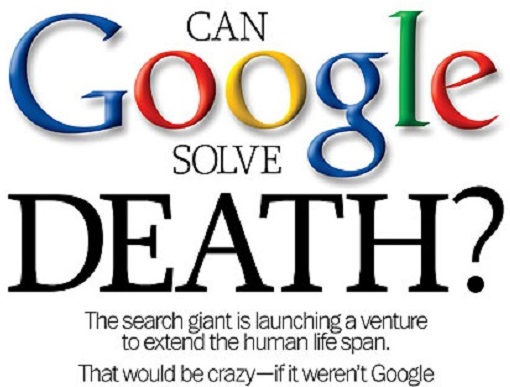
Google's working on life extension, too. I just hope
they plan to increase free storage on gmail.
The science of aging--more accurately, the science of arresting or even reversing the effects of aging--is progressing so rapidly that someone has coined the term
“longevity escape velocity”, the point where life expectancy increases by more than a year every year.
Researchers are pursuing multiple avenues--genome analysis, drugs, microbiology, diet, exercise, environment--that lead to life extension. When the maximum age, perhaps 120 years, of the human body is reached, then regenerative therapies such as stem-cell implantation or organ replacement by cloning may allow some to surpass this natural limit.

It's also both fun and alarming to speculate about the impact on society if large numbers of adults can live healthily past 100: [bold added]
People might go back to school in their 50s to learn how to do something completely different....The accountant might become a doctor. The lawyer, a charity worker. Perhaps some will take long breaks between careers and party wildly, in the knowledge that medicine can offer them running repairs.

How many will tie the knot in their 20s in the expectation of being with the same person 80 years later? The one-partner life, already on the decline, could become rare, replaced by a series of relationships, each as long as what many today would consider a decent marital stretch. As for reproduction, men’s testes would presumably work indefinitely and, though women’s ovaries are believed to be loaded with a finite number of eggs, technology would surely be able to create new ones. Those who wished to could thus continue to procreate for decades. That, and serial marriage, will make it difficult to keep track of who is related to whom. Families will start to look more like labyrinthine networks.
Perhaps we oldsters will still want to die "when it's our time," and I can't imagine myself living to 100. Nevertheless, I'm paying more attention to diet and exercise and seeing the doctor regularly. Admiring the Apollo astronauts as a kid, I dreamt of attaining escape velocity....

Sunday, June 26, 2016

Hope and Fear

A little over a year ago CRISPR ("clustered regularly interspaced short palindromic repeats") came to our attention. Now it merits the cover of Time:
Just four years old, this discovery is transforming research into how to treat disease, what we eat and how we’ll generate electricity, fuel our cars and even save endangered species. Experts believe that CRISPR can be used to reprogram the cells not just in humans but also in plants, insects–practically any piece of DNA on the planet. [snip]

Talk to any biologist, geneticist or botanist right now and you will hear a level of excitement that comes only from the emergence of something truly groundbreaking. If the evolution from giant mainframes to personal computers forever changed technology, CRISPR promises to do something similar for genetics–democratizing the power to improve on nature for scientists at nearly all levels of expertise in practically every field.
While human beings don't have the power to control the sun, moon, and stars, we now have at our fingertips the ability to redesign not only ourselves but every living thing. Enormous benefits are on the horizon (rejection-proof organ transplants, resurrection of extinct species, crops immune to disease), but there are also enormous risks:
CRISPR means that most microbes driving infectious diseases are just a few DNA edits away from becoming superstrains that could wipe out unprepared populations....With the tools easily bought online, it would be theoretically possible to engineer a killer mosquito that transmits a deadly disease, or a DNA-damaging virus, that could infect human cells and decimate the population.
As mankind races to acquire God's powers, pray that it falls no farther behind in acquiring His wisdom.

Monday, February 01, 2016

Designing is Better Than Destroying

We first came across the acronym, CRISPR, almost one year ago. The technology is too powerful and too easy to use that it couldn't stay bottled up, despite the ethical implications.

U.K. Approves First Studies of New Gene Editing Technique CRISPR on Human Embryos: [bold added]
It’s the first time the technology, which has taken the medical world by storm, has been sanctioned for use on human embryos. The team of scientists led by Kathy Niakan, a biologist at Francis Crick Institute, will attempt to edit out bits of DNA that prevent an embryo from developing properly—which may answer important questions about infertility. The embryo would not be allowed to survive beyond 14 days—meaning they wouldn’t be implanted into a woman’s womb and grown into live babies.

“I promise you she has no intention of the embryos ever being put back into a woman for development.”
It's highly unlikely that all scientists--or parents willing to pay big bucks--will be so scrupulous. The ethical issues have been known for some time.
CRISPR raises the notion of designer babies, made-to-order genetic traits and so forth. If CRISPR can successfully change the genome of an embryo, it could forever alter the human gene pool. [snip]

Niakan is using CRISPR to study genes responsible for infertility, but the technology could just as easily be used to dictate which genes an embryo should, or shouldn’t have. It’s relatively straightforward to decide that the gene that causes sickle cell anemia, for example, a devastating blood disorder that requires people to get regular transfusions of healthy blood cells, should be snipped out. But what about a gene involved in short stature? Or grey hair?
Millions of people use online dating sites to select prospects according to physical qualities (e.g., blonde, dancer, pianist), so such screening techniques are familiar. One can break up with a dating partner, however, but not a child.

Expect these designer-baby qualms to be dispensed with quickly; the wealthy and connected will do what they want and easily find justifications for their actions (an embryo is just a bunch of cells that's the woman's property, and besides, designing is better than destroying, right?).

Sunday, August 23, 2015

21st Century Begats

What was once a trickle of media mentions has become a cascade. The Economist devotes this week's cover to CRISPR (clustered regularly interspaced short palindromic repeats). The Economist even uses the "G" word.
There are those who will oppose CRISPR because it lets humans play God.
The gene-editing technology is remarkably easy to use, "like the find-and-replace function on a word processor."

CRISPR has one additional feature not present in old-fashioned gene-splicing: it can change not only the organism but also all of its descendants. [bold and italics added]
By changing a gene in an early-stage embryo, or in the cell that makes an egg, you could ensure that the change is found in every cell in the adult body—including its own eggs or sperm, which would pass it to the next generation and thus on down through the ages. No one is pursuing such avenues in the clinic as yet.
We can do more than Victor Frankenstein ever imagined: we can create the monster, who will beget another monster, who will beget...

Model of fruit fly DNA at San Francisco's Exploratorium: "Changing even one chemical 'letter' in an animal's
DNA can sometimes cause major changes to its body."

Thursday, August 13, 2015

Something Happening

Five months ago we wrote that CRISPR (Clustered Regularly Interspaced Short Palindromic Repeats) "may become one of the most significant acronyms of the 21st century."

More about CRISPR from Wired:
researchers have already reversed mutations that cause blindness, stopped cancer cells from multiplying, and made cells impervious to the virus that causes AIDS. Agronomists have rendered wheat invulnerable to killer fungi like powdery mildew, hinting at engineered staple crops that can feed a population of 9 billion on an ever-warmer planet. Bioengineers have used Crispr to alter the DNA of yeast so that it consumes plant matter and excretes ethanol, promising an end to reliance on petrochemicals. Startups devoted to Crispr have launched. [snip]

Crispr....could at last allow genetics researchers to conjure everything anyone has ever worried they would—designer babies, invasive mutants, species-specific bioweapons, and a dozen other apocalyptic sci-fi tropes. It brings with it all-new rules for the practice of research in the life sciences. But no one knows what the rules are—or who will be the first to break them.
One of the most exciting--and alarming--aspects of CRISPR is its low expense:
“Genome editing started with just a few big labs putting in lots of effort, trying something 1,000 times for one or two successes,” says Hank Greely, a bioethicist at Stanford. “Now it’s something that someone with a BS and a couple thousand dollars’ worth of equipment can do. What was impractical is now almost everyday. That’s a big deal.”
CRISPR joins other powerful, cheap technologies, e.g., drones, 3D printing, that have arisen suddenly and are spreading like wildfire. Society will be transformed dramatically, but in what directions we don't know.
There's something happening here
What it is ain't exactly clear
             ---Buffalo Springfield

Saturday, May 02, 2015

Two Miles Away

At the very top of the 2015 Barron's 500 is Foster City's Gilead Sciences.
Already a leader in HIV drugs, the company launched Sovaldi, a lifesaving treatment for hepatitis C, in late 2013. It quickly became one of the best-selling drugs in the world, producing $10.3 billion in 2014 revenue. Harvoni, a successor treatment approved in October, contributed another $2 billion in just a few months, helping to cement Gilead’s reputation for birthing biotech blockbusters.
$1,000 invested in Gilead in its 1992 IPO would have grown to over $600,000 today.

Your humble observer, unfortunately, was so enamored with the growth stories occurring elsewhere that he was blind to one that was occurring two miles away.

Before we can seize the opportunity we must first recognize it.

(The Barron's 500 is
is an exclusive ranking of the 500 largest [U.S. and Canada] public companies, measured by sales in the latest fiscal year...it compares companies on the basis of three equally weighted measures:

  • median three-year cash-flow-based return on investment;
  • the one-year change in that measure, relative to the three-year median;
  • and sales growth in the latest fiscal year.)
  • Gilead's sprawling campus has much larger buildings than its legal address,  333 Lakeside Drive.
    On Saturday morning the HQ parking lot is empty while construction crews work nearby.