Showing posts with label Risk. Show all posts

Thursday, February 01, 2024

The Lazy Explanation is Wrong

Same-sex couples are denied mortgages more frequently than different-sex couples, and, when they do get approved, are charged a higher rate. The lazy explanation is that discrimination must be the reason. This study looked deeper. [bold added]
We identify same-sex and different-sex couples according to the gender of the mortgage applicant and co-applicant. Then, controlling for a rich set of lender, borrower, and loan characteristics, some of which are important in mortgage decisions but were not available in previous research like credit scores, we find that same-sex couples are 8.8 percent more likely to be denied a home mortgage than similar opposite-sex couples and conditional on being approved, are quoted an interest rate that is 0.8 percent higher. We explore heterogeneity by regions, by acceptance of same-sex marriage, and pre- and post-COVID. Interestingly, we also find that same-sex couples default significantly more (53.9%) than similar different-sex couples, which suggests an unobserved characteristic that causes same-sex couples to default more, and could explain a part of observed disparities in mortgage approval, undermining results in previous research.
It's an undisputed principle of lending markets that higher-risk borrowers are charged higher rates and are turned down for loans more frequently. To this humble observer, the fact that same-sex couples are riskier is a more likely explanation for mortgage disparity than bias. (H/T Marginal Revolution)

Sunday, August 13, 2023

Leap of Faith

(Image from Christian Faith Guide)
This morning the lady minister spoke about Luke's Gospel lesson, the one where Jesus walks on water:
And early in the morning he came walking toward them on the sea. But when the disciples saw him walking on the sea, they were terrified, saying, “It is a ghost!” And they cried out in fear. But immediately Jesus spoke to them and said, “Take heart, it is I; do not be afraid.”

Peter answered him, “Lord, if it is you, command me to come to you on the water.” He said, “Come.” So Peter got out of the boat, started walking on the water, and came toward Jesus. But when he noticed the strong wind, he became frightened, and beginning to sink, he cried out, “Lord, save me!” Jesus immediately reached out his hand and caught him, saying to him, “You of little faith, why did you doubt?”
The lesson, the lady minister said, was that we should get out of the boat and take a chance.

During sermons I often daydream. I thought of the Lahaina woman who spent seven hours in the water to save herself. Boats were catching fire, and cars were exploding, so people saved themselves by exiting their vehicles, some jumping into the harbor.

I also thought of the 1972 disaster movie, the Poseidon Adventure, where one of the fateful decisions occurs near the beginning: do the passengers wait for help in the dining room or try to climb to the top of the now-upside down ship? The leader of the "climbers," an annoying preacher played by Gene Hackman, turns out to have made the correct decision.

Sometimes the leap of faith is the only one that will save your life.

Saturday, April 22, 2023

"Be the House"

(NY Post image)
One common characteristic of getting older is that people become more conservative--politically, culturally, and financially. As life's expiration date approaches, this perspective makes sense.

Older people, including your humble blogger, are less willing to take chances because they have more to protect. If a risky bet turns out wrong, recovery--physical and financial--is difficult and sometimes impossible.

That's why Elon Musk is unique. At 51, his enterprises and his wealth are an order of magnitude bigger than they were ten years ago, yet he's still willing to bet the farm to fulfill his vision(s):
In the span of 24 hours this past week, Elon Musk made three very big bets with three very different companies, together showing his penchant to plow ahead despite sizable risks.

Between Wednesday and Thursday evenings, he stripped celebrities, journalists and other high-profile users of their free, legacy verification on Twitter, risking a VIP revolt on the social-media platform. He promised that the electric-car maker Tesla Inc. increase; green up pointing triangle would chase sales volume at the expense of profitability. And he launched SpaceX’s first of its kind giant space rocket, which exploded on the way to the heavens.
Making big bets doesn't mean that Elon Musk isn't aware of the risks:
“If the odds are probably in your favor, you should make as many decisions as possible within the bounds of what is executable,” Mr. Musk said a few years ago. “This is like being the house in Vegas. Probability is the most powerful force in the universe, which is why the house always wins. Be the house.”
Although he's one of the richest people in the world, amassing wealth was not the goal, just a means to get to his destination. Elon Musk's aspirations are grand indeed: interplanetary space travel, efficient autonomous transportation, and a platform for the free-wheeling exchange of ideas.

Along the way Elon Musk doesn't care how foolish he looks to others. Blowing up a rocketship to find out whether it functions (without hurting anybody) is a necessary step on the way to Mars, and crashing cars is the price for making millions of authomobiles self-driving.

Wealth often induces billionaires to become philanthropists and lift individuals out of poverty. Elon Musk's way of using his wealth, IMHO, will enrich humanity's future.

Friday, March 10, 2023

Silicon Valley Bank Lent Long and Borrowed Short

Police at SVB HQ in Santa Clara (Mercury News)
The failure of Silicon Valley Bank today appears ("appears" because it's still early days) to be contained to the bank itself and does not foretell other failures in the banking sector.

However, the latter possibility affected the stock market, whose major indices were down between 1 and 2%. [bold added]
SVB Financial bought tens of billions of dollars of seemingly safe assets, primarily longer-term U.S. Treasurys and government-backed mortgage securities...These securities are at virtually no risk of defaulting. But they pay fixed interest rates for many years. That isn’t necessarily a problem, unless the bank suddenly needs to sell the securities. Because market interest rates have moved so much higher, those securities are suddenly worth less on the open market than they are valued at on the bank’s books. As a result, they could only be sold at a loss.

SVB’s unrealized losses on its securities portfolio at the end of 2022—or the gap between the cost of the investments and their fair value—jumped to more than $17 billion.

At the same time, SVB’s deposit inflows turned to outflows as its clients burned cash and stopped getting new funds from public offerings or fundraisings. Attracting new deposits also became far more expensive, with the rates demanded by savers increasing along with the Fed’s hikes. Deposits fell from nearly $200 billion at the end of March 2022 to $173 billion at year-end 2022.
The failure of SVB is symbolically meaningful because it puts an exclamation mark on the decline of the tech industry in California. SVB's customers are concentrated in tech, and the steep rise in interest rates over the past year has made risky investments in those customers much less attractive.

In California financial stress has been exacerbated by high taxes and regulations, which have caused high-profile companies like HP, Oracle, and Tesla to move out of State. It is easy to imagine that the run on California's premier tech bank is related to the exodus of businesses out of the State.

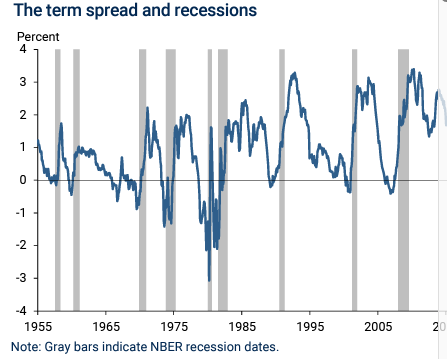
A negative number indicates the 1-year Treasury rate
is greater than the 10-year. (SF Federal Reserve)
The weekend hiatus provides time for cooler heads to prevail. According to the Journal article, SVB's problems seem to stem from lending long and borrowing short. That strategy produces regular profits, except for the infrequent occasions when the short rate exceeds the long. Duke University finance professor Campbell Harvey:
"If you lock your money up for a longer period of time, you almost always get a higher interest rate..."However, today, things are backwards - 10-year interest rates are far below short-term rates. This is known as an 'inverted yield curve.' In the past 50 years, we have seen seven inverted interest rate curves. Each one was followed by a recession."
Silicon Valley Bank bet that normal would continue. That bet proved disastrous when it kept having to refinance deposits and other short-term borrowings as rates climbed rapidly higher. Major banks are required to "stress test" for just such an eventuality; let's hope they didn't cut corners.

Saturday, May 07, 2022

Twitter: It's the Entertainment

So much for investing discipline.

After averring that I would stay away from trading stocks in general because of market volatility, or that buying Twitter specifically was too risky, I bought some TWTR on Thursday at $51. (It closed at $49.80 on Friday.)

In my defense, Elon Musk's takeover of Twitter looks very likely now that he's secured $7 billion from other equity investors. In fact $51 (actually $51.28) seems like a "fair" valuation based on a $54.50 acquisition price and a 90% probability of execution. The risk of loss is much lower than it was a month ago.

The second reason is that this was hardly an "investment." TWTR is less than 0.1% of the portfolio and the purchase was more to be kept apprised of shareholder communiqués than to make a killing. It's very rare that a small fry can be an arbitrageur.

Besides, I spend more on entertainment, and frankly after more than 40 years of being in the stock market I've never seen any story that's been more entertaining.

Thursday, January 06, 2022

The Other Dismal Science

(Image from the balance)
I never gave a thought to actuarial science until I went to business school. One of the smartest guys in the class had been an actuary, which I came to understand was too tough a career choice if I had to be as smart as he was and pass difficult, technical exams. (BTW, he's now CFO of a well-known company.)

Digression: so I became a CPA, which meant sitting for two days of exams and working for two years in the audit department of a CPA firm. The latter path was easier, and besides, I've never had to pay anybody to do my taxes.

Apparently, becoming an actuary is even tougher these days: [bold added]
Among people taking at least one exam from the Society of Actuaries—the field’s biggest U.S. credentialing body—15% eventually pass the multiple tests required to become an Associate, one of two designations allowing them to practice. Just 10% pass those and additional tests to become a Fellow, the group’s higher designation, which affords bigger responsibilities and salaries.

It’s such an arduous process that the number of test-takers has been declining in recent years, and the society is making changes to keep candidates from dropping out of the gantlet. It is also adding new “predictive analytics” tests to adjust to the massive amounts of data insurers now have...

There is no limit to how many times a candidate can take the tests. It took one man 50 years to become a Fellow, says Stuart Klugman, an official at the society. The society says a candidate typically takes seven to 10 years to become a Fellow. They must pass 10 exams plus other coursework and requirements.
Every profession is being inundated with oceans of data, and being familiar with data science has become essential to being an actuary. Knowing how to filter, analyze, and model the data is crucial to success. (We noted the importance of predictive analytics three years ago.)

If one is not thorough, knowledgeable about statistics, and honest, one can easily promulgate misinformation by biasing the data sets, selecting or not selecting variables to be analyzed, finding causation in correlation, and not "showing the work" so that results can be replicated.

Why must an actuary be honest? Because as the analyses become more complex, and as the demand for risk assessment (not only for insurance purposes) explodes, there are fewer people who are available to check the work; actuaries must be trusted not to force through results that please the powers that be.

I was glad that I didn't try to become an actuary.

Just for fun: the article presents a sample question involving rudimentary statistics and algebra. Without using a calculator, I could still solve it. (My high school self could have figured it out much more speedily but would also have snickered throughout at the phrase "blue balls.")
“An urn contains 10 balls: 4 red and 6 blue. A second urn contains 16 red balls and an unknown number of blue balls. A single ball is drawn from each urn. The probability that both balls are the same color is 0.44. Calculate the number of blue balls in the second urn.”


Monday, November 08, 2021

The Learning Trap

(Image from very well mind)
Berkeley psychologist Alison Gopnik showed experimentally that children were willing to take greater risks than adults for the sake of gathering information. [bold added]
We used what’s called a “learning trap.” When we grown-ups try something new, from oysters to opera, and get a bad result, we usually won’t try it again... If we quickly conclude that all oysters and operas are indigestible, and reject them ever after, we will never learn that the world is more complicated than that. A stale clam or lame Aida may keep us from ever discovering the delights of a sparkling Belon oyster or a scintillating Magic Flute.

When you give 4- and 5-year-olds exactly the same problem, they behave very differently. They are irresistibly drawn to see what the new blocks will do, even though they love the stars and know that they risk losing them.

But just as grown-up prudence may have drawbacks, childhood curiosity has advantages. Children gathered much more evidence than the adults and were much better at learning. Most of the children did figure out the right rule. However, they earned fewer stars than the grown-ups.
The grown-ups were less willing to experiment because they did not want to lose what they had, while the children were more willing to sacrifice their possessions for knowledge. (One can't over-generalize from this experiment, however, because anyone who has any experience with children knows that they often will fight very fiercely over toys and desired foodstuffs.)

Almost always dismissing ideas because of similarities to things that have failed in the past, I have to fight against the tendency to fall into the Learning Trap. At the same time there is much truth in the quote misattributed to Albert Einstein: “The definition of insanity is doing the same thing over and over again and expecting different results.” As winter approaches, I have less time to waste on repeating mistakes.

Wisdom is knowing when people, situations, objects, and ideas are fundamentally the same..or different.

Monday, June 21, 2021

Managing Risk When The Odds Are in Your Favor

Even he is not always right (Apple Insider photo)
In my novice investor days I would always bet too much on a story stock. Usually that stock would already have been bid up, and I was one of the last suckers buyers before the fall.

But even when I became a decent stock picker I still tended to put too much in one basket. Even the best investors in the world don't hit it out of the park 10 out of 10 times; experience has taught them how to manage portfolio risk even though they're right more often than not.

The WSJ has a simple baseball simulation game in which the player wins 57% of the time and gets paid 1 for 1; if it were a true game he would have to bet nearly $3 to win $2. He has a $100 stake, and there are 10 rounds of bets. What is the strategy? (Test yourself by clicking the link above.)