Showing posts with label Lahaina. Show all posts

Tuesday, October 24, 2023

We Know It When We See It

The sign on Thursday, October 19th
The owners of Hawaiian Rent-All continue to display their wit at the intersection of McCully and Beretania.

(They rose to attention for their chiding of President Biden's response to the Lahaina fires.)

From the looks of it, they should quit while they're ahead.

Political humor is challenging: one has to be funny without crossing the line into nastiness.

For example, their latest attempt is hardly funny and a little nasty:
We are born ignorant
But taught stupidity.
Explains why politicians
Are so educated.
This joke on the same subject matter, which I just made up, would have been a little funnier:
Those who can, do
Those who can't, teach
Those who can't teach
Go into politics.
Humor is subjective, and, like I said, challenging.

Saturday, August 26, 2023

Local Boys' 15 Minutes of Fame

I drive by the Hawaiian Rent-All sign nearly every day when I go back to the Islands. On the corner of Beretania and McCully, it's on the way to the H-1 on-ramp that's closest to my parents' house.

Long known for its silly puns (think Dad jokes), the sign recently has included political humor. The latest Hawaiian Rent-All sign went viral this week when it criticized President Biden for his Maui speech (representative tweet at bottom).

The store's owners, the Jung brothers, get a chuckle out of me when they're at their best. I suppose I'll now have to treat their humor with more respect.

Saturday, August 19, 2023

When You Want Everything, You End Up with Nothing

(Images of class action lawsuits against HE)
After its 2019 bankruptcy resulting from wildfire liabilities, PG&E enacted procedures to cut off electricity preemptively when fire danger is high.

Now similar class-action lawsuits have been filed against Hawaiian Electric for not shutting down Maui's power lines.

Utilities may not be as legally responsible in Hawaii as they are in California. [bold added]
The company noted that there is no precedent in Hawaii, as there is in California, for property owners to receive compensation for damages caused by a private party such as an investor-owned utility, or from a government entity.
Hawaiian Electric also cited the dangers of shutting down electricity in the midst of a fire:
“Preemptive, short-notice power shut-offs have to be coordinated with first responders, and in Lahaina, electricity powers some of the pumps that provide the water needed for firefighting,” the company wrote. “A power shut-off can jeopardize the health and safety of the elderly, the disabled and those most in need.”
Hawaiian Electric management no doubt bears some responsibility, but IMHO government is at least equally culpable. Government regulates utilities because utility monopolies are free to set prices without being restrained by competition. The WSJ says that Hawaiian Electric and PG&E are simply following their State governments' orders:
If Hawaiian Electric’s lines did ignite the fires, it would echo the problems of PG&E, the California utility that filed for Chapter 11 bankruptcy in 2019 after getting sued for tens of billions of dollars for damages from fires caused by its equipment. The 2018 Camp Fire killed 84 people and razed the town of Paradise.

What both utilities have in common is that they prioritized growing renewable power to meet government mandates over hardening their systems and reducing fire risk. In 2015 Hawaii lawmakers required that 100% of the state’s electricity come from renewable sources by 2045. California and some other states followed with similar mandates.
Hawaii and California share another characteristic: the Democratic Party has held all state-wide offices and controlled the state legislature for over a decade. This means that the priorities of regulated businesses are the priorities of the Party: eliminating fossil fuels, promoting DEI (diversification, equity, and inclusion) and corporate ESG (environment, social, and governance) all supersede such mundane activities as hardening infrastructure and operating profitably.

The voters of Hawaii and California are getting what they wanted, and the victims of Paradise, CA, and Lahaina, HI paid the tragic price.

Wednesday, August 16, 2023

Winning by Losing

After the acquisition fell apart in 2016, NEE and HE's stock prices diverged, even before the Lahaina fires.
(This post is related to yesterday's about the collapse of Hawaiian Electric Industries' stock price.)

Seven years ago Florida-based NextEra Energy (NEE) failed in its attempted acquisition of Hawaiian Electric for $2.63 billion. The deal was rejected by Hawaiian regulators.

The ostensible reason was that NextEra did not provide enough details about whether its green-energy plans were sufficiently compliant with Hawaii's own goals. In truth there was a local element that would have resisted any takeover of HE, a Hawaiian institution that was more than 120 years old.

NEE, with a current market cap of about $137 billion, must be thanking its lucky stars that the deal fell apart. With a wealthy Mainland parent company who would be convenient to blame, the Maui victims and lawyers would try to extract $billions in damages from HE's parent.

In NextEra's case the failure to make a deal was the best deal.

Tuesday, August 15, 2023

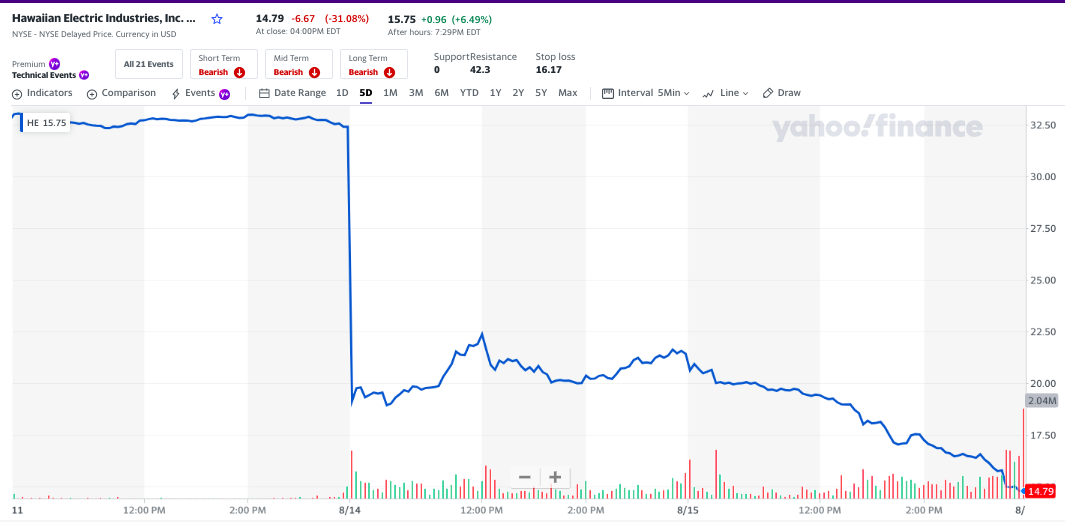
Hawaiian Electric on the Brink

The Lahaina fires began on Tuesday, Aug. 8.; HE stock took over a 50% hit this Monday and Tuesday.
Whether justified or not, Hawaiian Electric Industries is now accused of bearing major responsibility for the Lahaina fire:
The selloff continues in shares of troubled utility Hawaiian Electric Industries.

The stock fell another 24% on Tuesday after Monday’s plunge, on fears the utility could be held liable for the wildfires that have devastated Maui.

The stock recently traded around $16.

Wells Fargo analysts cut their price target to $25 per share on Monday. “While it remains unclear if any of HE’s equipment directly caused any of the wildfires, we believe it prudent to account for the risk,” they wrote.

All told, the stock has dropped about 50% so far this week, according to FactSet; that’s the stock's worst two-day selloff on record dating back to 1983, according to Dow Jones Market Data.
Honolulu: as power needs grow, the tangles get worse.
In 2017, as California wildfire liabilities drove PG&E into bankruptcy, I wrote:
Telephone poles and overhead power lines have been a ubiquitous part of the Honolulu landscape ever since I can remember. They're still in every neighborhood a half-century later despite the danger and poor esthetics. The cost of burying infrastructure (electricity, trains) is enormously expensive, so little has been done.

In Napa and Sonoma counties Pacific Gas and Electric faces similar costs to Hawaiian Electric and did not bury most of its power lines.
At today's close, HE had a $1.6 billion market cap, and there's not much flesh to scavenge from its bones. Any substantial recompense will have to come from Hawaii ratepayers.

Sunday, August 13, 2023

Leap of Faith

(Image from Christian Faith Guide)
This morning the lady minister spoke about Luke's Gospel lesson, the one where Jesus walks on water:
And early in the morning he came walking toward them on the sea. But when the disciples saw him walking on the sea, they were terrified, saying, “It is a ghost!” And they cried out in fear. But immediately Jesus spoke to them and said, “Take heart, it is I; do not be afraid.”

Peter answered him, “Lord, if it is you, command me to come to you on the water.” He said, “Come.” So Peter got out of the boat, started walking on the water, and came toward Jesus. But when he noticed the strong wind, he became frightened, and beginning to sink, he cried out, “Lord, save me!” Jesus immediately reached out his hand and caught him, saying to him, “You of little faith, why did you doubt?”
The lesson, the lady minister said, was that we should get out of the boat and take a chance.

During sermons I often daydream. I thought of the Lahaina woman who spent seven hours in the water to save herself. Boats were catching fire, and cars were exploding, so people saved themselves by exiting their vehicles, some jumping into the harbor.

I also thought of the 1972 disaster movie, the Poseidon Adventure, where one of the fateful decisions occurs near the beginning: do the passengers wait for help in the dining room or try to climb to the top of the now-upside down ship? The leader of the "climbers," an annoying preacher played by Gene Hackman, turns out to have made the correct decision.

Sometimes the leap of faith is the only one that will save your life.

Saturday, August 12, 2023

Everyone Was Affected

The Chronicle published before and after pictures of the fire.
It's not an exaggeration to say that everyone who's lived in Hawaii for at least a few years is affected by the destruction of old Lahaina. I've visited Maui often (though not this century) and know people who were born there and live there.

To them Lahaina is special, much like San Francisco is special to its region. Lahaina and San Francisco each have roughly 10% of the population of Maui and the Bay Area, respectively, but punch way above their weight in cultural and economic influence.

Sarah's diary, circa 1917
My maternal grandmother moved from Honolulu to Lahaina to stay with her older sister Ruth before Ruth went off to Boston to study nursing.

According to her diary Sarah, then an 8th grader, was "the pianist, the office helper, and the sewing assistan[t] to the pupils" at King Kamehameha III elementary school, which did not survive the fires this week.

Benjamin O. Wist (1889-1951), then principal of the school, helped my grandmother transfer to McKinley High in Honolulu. He later became the President of the University of Hawaii and wrote "A Century of Public Education in Hawaii, 1840-1940." Wist Hall on the UH campus is named after him.

Thursday, August 10, 2023

Lahaina No Ka Oi, Hopefully Again


As of this writing (4 p.m. HST) there are 53 confirmed dead in the Maui wildfires that started on Tuesday. 1,000 people are unaccounted for, historic Lahaina town is completely destroyed, and basic communications and infrastructure are heavily damaged. Flames are 80% contained.

The videos are similar to those that Californians saw during the 2018 Camp Fire that leveled the City of Paradise. In Maui too we watch residents given only seconds to flee, trees burning on both sides of the road, and winds spreading flames faster than people can run. In California people jumped into rivers and lakes, in Maui they leaped into Lahaina Harbor.

Before the Camp Fire Paradise was a city of 14,000 homes and 27,000 residents. 4½ years later Paradise is less than half what it once was: "more than 1,400 homes have been rebuilt and now nearly 10,000 people call Paradise home again."

Because of the importance of Lahaina to the State of Hawaii, your humble blogger hopes that Lahaina's restoration will be faster and more complete than California's rebuilding of Paradise. And, selfishly, it will raise the probability that I can visit Lahaina one more time before age and infirmity prevent me from doing so.