Showing posts with label Charity. Show all posts

Tuesday, September 02, 2025

The Club I Can Never Join

(WSJ graphic - darker blue circles are women)
Using data from Altrata, the WSJ profiles America's billionaires:
There were 1,135 billionaires in the U.S. as of 2024—up from 927 in 2020, according to data from Altrata, a wealth intelligence firm. The biggest concentration, 255 of them, is in California. But the super rich are also behind businesses in places such as Ridgeland, Miss., and Waunakee, Wisc.

Collectively, these people are worth about $5.7 trillion, according to Altrata’s estimates... The 100 richest billionaires account for nearly $3.86 trillion in wealth—more than half the total. Just three men—Elon Musk, [Jeff] Bezos and Mark Zuckerberg—account for almost $1 trillion of it.

Billionaires have publicly donated or pledged to give about $185 billion since 2015, according to Altrata. Mostly, they support causes such as education and medical research—they gave $90 billion to those two in the past 10 years. That has given them sway in ongoing campus debates over freedom of speech and antisemitism.

While some billionaires such as [Bill] Gates and Warren Buffett have openly pledged to give away much of their wealth, others have donated little so far. About a quarter of the billionaires in the list have known donations of less than $1 million in the past decade.
I'm wary of concluding that billionaires are selfish based on their lack of known donations. If I were a billionaire--of course, I'll never be part of that club--I would keep my donations quiet, both so I would not be inundated with other requests and because of the ethic against self-glorification.
I never knew a billionaire,
Such a life, I would not choose it
Too much time would be ensnared
Worrying about how I could lose it.
---inspired by the Purple Cow

Sunday, July 13, 2025

Walking the Walk

Guillaume Bodinier, The Good Samaritan,
1826 (Wikimedia Commons)
Today's Gospel lesson from Luke 10 was about the Good Samaritan:
But wanting to justify himself, [the lawyer] asked Jesus, "And who is my neighbor?" Jesus replied, "A man was going down from Jerusalem to Jericho, and fell into the hands of robbers, who stripped him, beat him, and went away, leaving him half dead.

Now by chance a priest was going down that road; and when he saw him, he passed by on the other side. So likewise a Levite, when he came to the place and saw him, passed by on the other side. But a Samaritan while traveling came near him; and when he saw him, he was moved with pity. He went to him and bandaged his wounds, having poured oil and wine on them. Then he put him on his own animal, brought him to an inn, and took care of him. The next day he took out two denarii, gave them to the innkeeper, and said, `Take care of him; and when I come back, I will repay you whatever more you spend.' Which of these three, do you think, was a neighbor to the man who fell into the hands of the robbers?" He said, "The one who showed him mercy." Jesus said to him, "Go and do likewise."
Comments:
1) In Sunday School we learned the simple version of the story, that Samaritans were not expected to behave honorably but in Jesus' parable the Samaritan was the only one who helped the wounded man. The Samaritan was the good guy.
2) The enmity between Jews and Samaritans dated back centuries, with the Samaritans ignoring Jewish laws, dietary customs, and social norms.
3) Jesus emphasized the principle that it is not social status or speech that matters but how one behaves.
4) Signalling real virtue comes at a cost in time and money, not on a bumper sticker or a social media post or sign posted on one's lawn (note: I haven't done the research about whether these examples existed in Jesus's time).

Friday, July 11, 2025

Sticky Ivy

Harvard and Yale: joining against a common enemy?
The Trump Administration claims that Harvard University has violated civil rights laws through Harvard's DEI programs and threatens to withhold $9 billion of funding and Harvard's accreditation.

Influential Ivy alumni seem to be supporting Harvard, at least for now.
“You know the world is going crazy when Yale alums are making donations to Harvard!” —Ross Eaton ’03 on the Yale Alumni Facebook group on April 16, shortly after the federal government began freezing grants to Harvard.

Monday, June 30, 2025

AI: Filling a Need for Seniors

(Pinterest image)
On Saturday we posted concerns about out-of-control artificial intelligence. Today we note how AI can make a big difference in the mental health of seniors: [bold added]
Research shows that phone calls with an empathetic listener can help reduce loneliness among older adults, leading to improved mental health. In-person interactions are even more effective. But nursing-home residents don’t always get many visits or calls.

The first Meela test phase, involving 23 RiverSpring Living residents, produced promising results, giving hope to the idea that AI can be used for a lot more than workplace efficiency and homework help.

Meela was founded by Josh Sach, a former tech product manager who was inspired to create a solution to the loneliness epidemic after seeing his late father-in-law experience isolation. The name of his companion bot comes from the Hebrew word “mila,” meaning “word.” He and his team listened to more than 2,000 voices before choosing a soothing-sounding, middle-aged voice actress.

Sach declined to say which tech company’s AI model powers Meela, but he said it already had strong safeguards and that his team added additional guardrails to ensure Meela doesn’t give medical, legal or financial advice. While it isn’t intended for clinical mental-health treatment, Meela is designed to deliver cognitive behavioral therapy—validating residents’ feelings and suggesting solutions to problems.

Meela remembers prior conversations with residents, who have to consent to their conversations being recorded and transcribed. Sach says the transcripts are retained for the duration of the account, unless someone requests their deletion. They aren’t available for users or their families. And where applicable, the recordings and transcripts are handled in accordance with HIPAA, a federal patient-protection law, and the care facility’s instructions.

In the first phase, participants’ depression and anxiety levels were measured before talking to Meela and 30 days after. Those with moderate to severe depression or anxiety were found to have demonstrated notable improvements after speaking with Meela at least once a week.

Participants spoke to Meela for an average of 10 minutes at a time, but some talked for more than an hour. Staffers also noticed that study participants were engaging in more social activities after talking to the bot, says Dr. Zachary Palace, medical director of RiverSpring Living’s nursing home.
Part of our church's ministry is to visit nursing homes and engage with residents. Many do not have any visitors and are happy to converse with complete strangers, even for just an hour. AI doesn't get tired, and it's clear that carefully tailored AI can provide regular mental health benefits to our senior citizens.

Monday, June 09, 2025

She Walks the Walk

Marlene Engelhorn (Le Monde)
Marlene Engelhorn, 32-year-old heiress, advocates taxing inherited wealth up to 90%. Because her native Austria imposes no inheritance taxes, she gave away "at least 90% of her total wealth."
Englelhorn received her millions after her grandmother’s death in 2022, but paid no inheritance tax on the money because Austria abolished such provisions in 2008. That reinforced Engelhorn's view that unearned wealth undermines democracy, a belief that had prompted her to co-found an initiative in 2021 called Tax Me Now, which pushes for tax reform.

Last year, Englelhorn went even further when she established the so-called “Good Council for Redistribution.” The initiative invited a 50-person representative sample of Austria’s population to decide on her behalf how to give away €25 million ($27 million), which represents the bulk of her inheritance and at least 90% of her total wealth. After consulting with experts, the citizen council agreed to allocate the money among 77 organizations, which tackle issues such as tax policy, climate protection, and human rights.

Engelhorn entrusted the group, she says, because "if you want democracy, you have to abolish monarchy and any structure that resembles it"—including inherited privilege.
Marlene Engelhorn advocates extreme wealth redistribution, and I've long held the view that giving away other people's money is not charity. However, I also give her a lot of credit for putting her money where her mouth is and giving away 90% or more of her wealth, which news reports say is under $30 million. While her remaining $3 million doesn't make her poor, she very likely has a long life ahead of her, and $3 million is no shield against many of life's storms.

Sunday, May 25, 2025

Diane Robertson

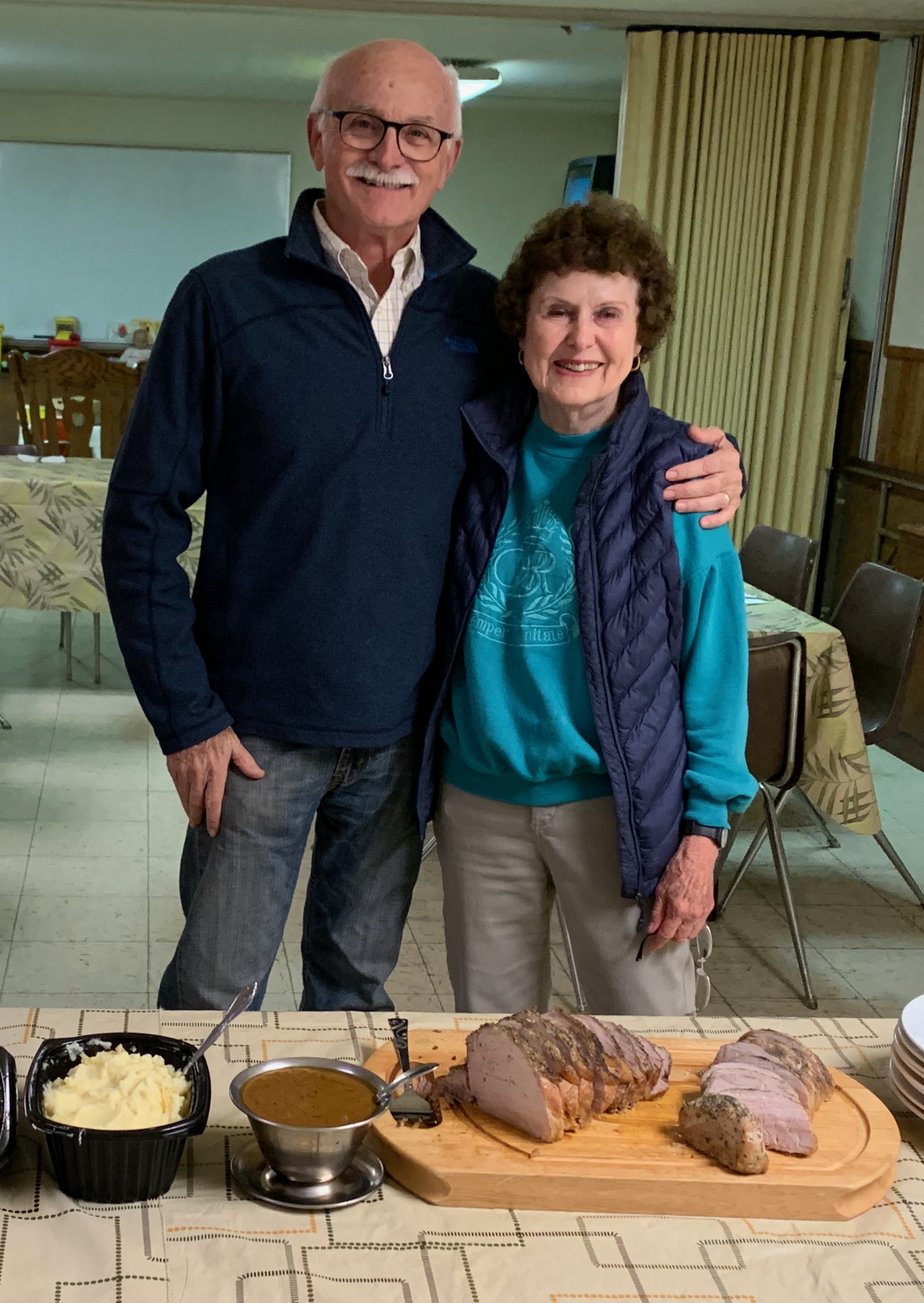
Diane Robertson and her signature roast pork,
with Jerry Brooks of Hope Lutheran, San Mateo
My friend Diane Robertson passed away on Thursday after a short illness.

I was the coordinator for the church outreach program, and for 20 years Diane cheerfully gave her money and time to the dozen or so activities we supported. She manned the church's booth for the Foster City summer fair, made sandwiches for Sandwiches on Sunday, and bought Christmas presents for immigrant families.

She was one of the stalwarts for Home and Hope, a consortium of Peninsula churches and synagogues that provided emergency housing at their facilities. Diane liked to roast a pork shoulder or ham for the Home and Hope families, and I always went back for seconds of her dish.

She was a retired stewardess (don't call me a flight attendant, she said) for United Airlines, and she was fond of recounting the glory of air travel as it used to be.

Though we grew up thousands of miles apart---me in Hawaii and she in Canada--we found common ground in our humble origins and marveled how good our lives had turned out to be. We also shared a deep gratitude that prompted us to give something back.

Goodbye, my friend, till we meet again.

Saturday, March 22, 2025

Greenpeace: the Sword Cuts both Ways

Greenpeace ships in 1976 (Wilson/SFGate)
As I entered the working world in the 1970's, the first non-religious, non-educational charity I donated to was Greenpeace. I agreed with its save-the-whales campaign and didn't see any compelling reason that whale-hunting benefited humanity, especially if it meant the extinction of a species.

A few years later I found that my donations had been redirected to Greenpeace's efforts to shut down nuclear power plants. I called, first to complain that their advertising was dishonest, then to ask that my donations be allocated solely to save-the-whales.

Instead of listening to my request, the Greenpeace person spoke about the dangers of nuclear power and why Greenpeace was right to prioritize stopping nuclear. I immediately ceased donations to Greenpeace. I had learned a valuable lesson about the fungibility of money and the trustworthiness of organizations, even those that are titularly non-profit.

Since then Greenpeace has expanded to embrace other leftist causes, most of which I do not support. Advocacy is one thing, but they've finally been spanked for crossing the line to property damage and blocking business operations. [bold added]
The environmental lobby Greenpeace is finally getting its just deserts after a North Dakota jury on Wednesday ordered it to pay $667 million in damages for its thuggish campaign last decade to block the Dakota Access Pipeline.

Pipeline company Energy Transfer LP provided compelling evidence during a three-week trial that Greenpeace defamed the company and abetted vandals. Its organizers trained protesters and even brought lockboxes they used to chain themselves to construction equipment. Protesters lobbed human feces and burning logs at security officers and vandalized construction equipment.

Greenpeace sought to get the pipeline’s financiers to pull out of the project by erroneously claiming the company’s “personnel deliberately desecrated documented burial grounds and other culturally important sites,” among other falsehoods. Energy Transfer said this malicious campaign delayed the pipeline’s construction and increased its costs by hundreds of millions of dollars.

Greenpeace’s defense? Not our fault since it didn’t expressly order the vandalism even if it did train protesters. But even Greenpeace USA’s then executive director boasted it had played a “massive role” in the protests. The jury agreed.
The judicial system is often used by leftists to halt activities that have been approved by the legislative and executive branches. The verdict against Greenpeace shows that the sword can cut both ways.

Wednesday, December 25, 2024

There's Gold in Them Thar Buckets

(AP 2008 photo)
A Christmas surprise in a Salvation Army bucket:
An anonymous donor dropped a rare gold coin into a red kettle operated by the Napa Salvation Army on Saturday.

Volunteers discovered the 1-ounce South African Krugerrand gold coin while counting donations after a day of bell ringing at Napa’s Bel Aire Plaza, Larry Carmichael, a corps officer of the Salvation Army of Napa, told the Chronicle on Sunday.

“This is not a coin you carry in your pocket to toss anywhere,” Carmichael said. “Whoever had it was intentional about where they were donating it.”

...The organization’s annual red kettle donation campaign, which started at the Oakland Ferry Landing in 1891, collects millions of dollars nationally to fund its holiday meals program. In Napa, donations also fund a culinary arts training program, music classes for children and housing grants for more than 100 local families.
What I like about this story is that the donor wanted anonymity (and didn't even want to document the donation for the IRS!). Yes, he or she could have private, practical reasons, but I like to think that this was the motivation:
“Be careful not to practice your righteousness in front of others to be seen by them. If you do, you will have no reward from your Father in heaven.

“So when you give to the needy, do not announce it with trumpets, as the hypocrites do in the synagogues and on the streets, to be honored by others. Truly I tell you, they have received their reward in full. But when you give to the needy, do not let your left hand know what your right hand is doing, so that your giving may be in secret. Then your Father, who sees what is done in secret, will reward you.----Matthew 6:1-4
The spot price of gold is about $2,630 per ounce, and the value of a 1-oz. Krugerrand tracks spot gold closely.

Merry Christmas!

Sunday, October 13, 2024

A Choice, But Not Really

The priest read from Mark 10:
Jesus, looking at him, loved him and said, “You lack one thing; go, sell what you own, and give the money to the poor, and you will have treasure in heaven; then come, follow me.” When he heard this, he was shocked and went away grieving, for he had many possessions.

Then Jesus looked around and said to his disciples, “How hard it will be for those who have wealth to enter the kingdom of God!”
It is true that most people---yours truly included---try to build up their wealth to a point where it provides protection against the exigencies of life. It's very difficult to "sell what you own, and give the money to the poor" and trust in God to take care of our future.

There are other examples in the Bible of how money is an obstacle to faith. Later in Mark, Jesus observes, "It is easier for a camel to go through the eye of a needle than for someone who is rich to enter the kingdom of God."

However, it would be a mistake to focus on wealth as the sole impediment to faith. I have encountered people who claim that money is not important to them. Putting aside whether I believe them or not, I have observed that certain activities (cooking and dining, sports, grandchildren) are their highest priority--and just ask some young people to turn off their phones for a day.

It's very difficult to leave everything behind, though the irony is that we eventually will have no choice in the matter.

Saturday, August 24, 2024

Books Discarded Wistfully

I'm going through some of the books in my not-completed pile and have had to face an uncomfortable truth: if I live to a hundred I'll never finish some of them because, frankly, I have other things I'd rather do.

Nevertheless, guilty feelings remained until book reviewer Maya Chung gave permission to (h/t Ann Althouse), Go Ahead, Put Down That Book [bold added]
This week, Sophie Vershbow asked English teachers, librarians, writers, and readers when it’s okay not to finish a book. My answer to that question is: almost always, unless you’re writing a review of it; in that case, please read it from cover to cover. You might think that, as a book-review editor, I’d have a completist attitude toward reading. In reality, I tend to drop books early and often...

I often find that I can prematurely part ways without angst even with a volume I’m thoroughly enjoying; I know that if I’m meant to finish it, I’ll find my way back eventually. Of course, if I want to recommend a book widely or rave about it on the internet, I need to complete it, in case the story takes an unexpected turn or something happens in the last few pages that changes my perspective. The same rule applies if I feel like hating. “Not finishing a story weakens your ability to properly assess it,” Vershbow advises. “It’s fine to abandon a title, but if you do, keep the strong opinions to a minimum.”

Not long ago, one of my colleagues told me about a rule her friend’s mother’s book club follows, and I’ve been sharing it with friends when they admit that they’re struggling through this or that beloved title: Subtract your age from 100, and you’ll end up with the number of pages you need to read before dropping a book. Only 20 years old? You’ll need to read 80 pages before you can move on. But if you’re 90, you need to read only 10. By that age, you’ve earned the right not to spend a second of your time on something that doesn’t bring you joy.
In a couple of weeks the church is having a parking-lot sale, and I'm donating some of my uncompleted books (pictured). I'll discard them wistfully, much as I gaze on foods that I no longer eat. I'll follow Ms. Chung's "100 minus" rule, however, and read at least 29 pages--I have already done so with many of them--before putting them in the box.

Wednesday, June 05, 2024

Stanford: A Reconsideration

Cleaning the mess at White Plaza (Chron photo)
Maybe, just maybe, Stanford University has had enough of the extremes of Progressivism, DEI (diversity,equity, and inclusion), and wokeness: [bold added]
Thirteen people were arrested at Stanford University in a protest led by pro-Palestinian students, university officials confirmed Wednesday.

"All arrested students will be immediately suspended and in case any of them are seniors, they will not be allowed to graduate," the university said in an emailed statement.

In the demonstration, students "unlawfully entered" Building 10 where offices for both the president and provost are located, according to the statement. Stanford officials said the offices were damaged and a public safety officer was injured "after being shoved by protesters who were interfering with a transport vehicle." The university did not elaborate on the severity of the injury.
Richard Saller, 71, the former Dean of the School of Humanities and Sciences and specialist in Roman history, is Stanford's interim president and was willing to tolerate the pro-Palestine protests up to a point. However, the arrests, suspensions, and refusal to confer degrees on arrested seniors showed where his red line was.

(After seven years as Stanford president, Marc Tessier-Lavigne resigned in 2023 after an investigation showed his research lab had produced reports that contained "falsified information." He had been cleared of personal misconduct.)

Jonathan Levin, the Dean of Stanford Business School for the past eight (8) years, will become Stanford's next president on August 1st.
Jonathan Levin, a renowned economist, comes to the top spot of one of the world’s most prestigious, and wealthiest, universities at a challenging time in higher education...

Levin, 51 years old, will begin his new job Aug. 1. A Stanford alum and son of former longtime Yale University president Rick Levin, he has been dean of the Stanford Graduate School of Business since 2016.
Jonathan Levin has a glittering pedigree, as well as an unsurpassed record of achievement. He was born in New Haven to Yale Assistant Professor Rick Levin, who rose through the ranks to become Yale's President from 1993 to 2013.

Earning degrees from Stanford, Oxford, and MIT, Jonathan Levin "received the John Bates Clark Medal as the outstanding American economist under the age of 40." As the Dean of the GSB, he kept Stanford atop the Business School rankings.

Successful business educators and leaders know that they must keep their organizations from taking political positions that will alienate customers, suppliers, and governments. Based on his record, Jonathan Levin will strike the balance between free speech, protest, and the rights of all Stanford students to receive a quality education.

I know that this has as much realistic impact as declaring which politician I will vote for, but I am reconsidering my decision to never make another donation to Stanford.

Sunday, January 28, 2024

Jason, We Hardly Knew Ye

October, 2022: the Bishop installs our new Minister
His ministry began with such promise in 2022. He was young, energetic, and empathetic, especially with Sunday School students. He introduced outreach efforts to the Bayview community and the Peninsula Spanish-speaking congregation, and the church members responded enthusiastically.

Alas, a health problem sidelined him for October. His absence stretched through Christmas. Then it was announced that his leave would extend through the end of February.

Blessing of the Animals, 10/1/23:
his last official act.
At today's annual meeting what we feared came to pass. The senior warden announced that our new rector would not be coming back but return to Minnesota to recuperate. After praying for his health, the congregation voiced concerns about the immediate future.

I looked around the room and saw at least a dozen stalwarts, all of whom led different ministries. They absorbed the news and--it could be my imagination--had a look of determination.

The Treasurer delivered some encouraging information about the 2024 budget. Even with conservative assumptions, the church is likely to run a surplus.

If the past two years has taught us anything, it's that we overreact to news. With a new leader we thought that we would be set for the next 5-10 years, but it was not to be. However, I think we're going to be all right.

Sunday, December 31, 2023

Sandwiches on 123123

Today, New Year's Eve, 123123, is an "angel number":
If you take a closer look at the date, written as 12/31/23 or even 123123, you might see an angel number, which are repeating number sequences, often used as a guide for deeper spiritual exploration. The numerical sequences can range anywhere from 000 to 999, with each number having a distinct meaning and energy, USA Today previously reported.

The once-in-a-century date, which won’t be seen again on our calendars until Dec. 31, 2123, marks a new beginning. One, that asks us to “transform and evolve with the times and in the right place to embrace what is coming to us,” according to the Old Farmer’s Almanac website.
Daniel, Solita, Janis, Valerie, David
Your humble blogger doesn't believe in numerology (although he has been known to mark particular numbers on a Lotto card), but having read Billy Graham's book long ago, I am inclined to believe in angels.

New Year's weekend was a time to spend a few moments being less hedonistic and more angelic. Six of us met at the church Saturday to make 80 brown-bag lunches for whoever showed up at the Fair Oaks Community Center on Sunday. With six experienced assemblers the work was done in a little over an hour.

The activity leaves a mark on the next generation,
or so they tell me years later.
After storing the lunches in refrigerators overnight, we took them to the community center at noon. Although the "crowd" was about half its normal size, all the bags were quickly snapped up by the patrons, some getting as many as three.

Within 20 minutes all the work was done. We wished everyone Happy New Year (Feliz Año Nuevo) and waltzed away on 1-2-3-1-2-3.

Speaking of waltzing...

Feliz Año Nuevo!

Friday, December 29, 2023

Sliver of Good News

My cart was filled like every other one.
On Friday the Costco parking lot was jammed with cars looking for a parking space. Usually I leave immediately and wait for a more opportune time, like one hour before closing. However these purchases had to be made today, as we were making brown-bag lunches on Saturday for Sunday's distribution in Redwood City.

It took 15 minutes to get a distant parking space, then another hour to buy all the ingredients on the list. It didn't help that there were shopping carts going in all directions, carts stopping at the sampler tables, and little kids running with abandon. It's a wonder that I've never seen someone hurt.

Hoping to impress the cashier, I estimated the total out loud would be $325. It turned out to be $308.

That's one sliver of good news, i.e., food prices have abated slightly. Happy New Year (almost)!

Monday, December 18, 2023

'Tis the Season of Sharing and Scamming

We will be making a donation to Al-Ahli hospital, which was
heavily damaged by explosions in Gaza (Guardian photo)
Boston University professor of humanities Joshua Pederson advises us not to contribute to organizations claiming to help victims of natural or human-caused disasters: [bold added]
I’ve become convinced that donations to disaster aid — whether in the immediate aftermath or as part of a nonprofit’s annual holiday drive — often provide only limited relief and sometimes none at all. There are a few main reasons why.

First, the field of pop-up disaster relief is rife with fraud as bad actors prey on the desire of well-intentioned people and bilk donors in the process. As the Los Angeles Times recently reported, many such scammers pose convincingly as employees of the Federal Emergency Management Agency or well-known charities, tricking even savvy givers. Donations to crowdfunding calls can be an even riskier venture. Notre Dame law professor Lloyd Hitoshi Mayer suggests that they are “particularly vulnerable to fraud” and urges caution when supporting them. One of the most egregious examples was Katelyn McClure, a New Jersey woman who used GoFundMe in 2017 to wheedle over $400,000 out of givers with a fake story of a homeless man who needed help.

...many would advise us to turn to locals. But even such on-the-ground efforts sometimes come up short. Take for example the Maui Community Power Recovery Fund, one of whose founders is former Hawaii House Rep. Kaniela Ing. It turns out that the fund is actually a political action committee, and while its website indicates that gifts will support “relief, recovery and rebuilding,” donors likely don’t know that donations could be used to fund political candidates.

...the American Red Cross. Its pleas for donations after major disasters are nearly ubiquitous. But as ProPublica revealed in a series of headline-grabbing investigations a few years back, the organization has significant problems with transparency, oversight and follow-through. And there are legitimate concerns about the way it tracks and spends the money it collects.
Immediately after a disaster, when the emotion to do something is at its highest, is the time to be especially cautious. I have made it a personal policy, as well as for charitable organizations over which I may have some infuence, not to rush to help. As you would with any major purchase or investment, do your research first.

Sunday, December 17, 2023

Christmas Shopping: A Benign Perspective

Gift-giving may be good, but I don't miss being
"Secret Santa" at the office Christmas party.
(hrleader)
Economics can explain much of human behavior, but UC-Berkeley psychology professor Alison Gopnik says it doesn't explain altruism. (There's a school of thought that posits altruistic behavior is built into our genes; in my view that "science" isn't useful because it's not predictive, but that's another discussion.) [bold added]
the foundational idea behind economic and political theory, and much moral psychology and philosophy too, is the social contract. On this view, I am an individual agent with goals I want to achieve and resources I can use to achieve them. So are you. By agreeing to swap some of our resources we can both do better than we would on our own. Markets and democracies, the great inventions of the Enlightenment, help to scale up those social contracts to include millions of people at once.

Caregiving, on the other hand, is at the heart of many different religious traditions. Agape and caritas, the Greek and Latin terms for unconditional love, are central to the Christian tradition, as chesed or loving-kindness is in Judaism...

Understanding caregiving better might help us to explain gift-giving; Christmas shopping might be a spiritual practice as much as an economic transaction. Caregiving doesn’t fit the social-contract picture. It’s profoundly and intrinsically altruistic. When I take care of my children or my aging parents I don’t expect anything in return. Even professional caregivers like child-care workers and home-health aides will tell you that they do the work despite being underpaid because it’s so satisfying to take care of people who need you.
I'm feeling less grinchy about gift-shopping and gift-giving now that Prof. Gopnik says that those activities spring from unconditional love(!). Just remember that the shopping mall still isn't a substitute for a temple of worship.

Sunday, December 10, 2023

Just Desserts

(Note: since this blog serves to instruct, it should be noted that the correct English phrase is just deserts.)

Today was the annual bake sale at the church. In recent years, with an eye toward elevated blood sugar readings, I had simply given a ten-spot to the ladies (no, the men never brought anything) and went home empty handed. Today I gave in to temptation and filled a small brown bag with sweetmeats.

I also had a piece of pie and coffee and sat down with the aforementioned ladies to discuss the goings-on at the parish. Decades ago I disdained people who went to church for the gossip and food during coffee hour. Lo and behold, I have become them.

This time I paid twenty bucks. It was worth every penny.

Sunday, October 29, 2023

Sandwiches on Sunday

Today is the quarterly Outreach activity where our church makes 80-90 brown-bag lunches for the community center.

Digression: it has recently come to my attention that the phrase "brown bag lunch" has racist origins in the minds of a few people. I'm sorry that some are offended, but we oldsters can't remember all the things that we're not supposed to say, especially since the list seems to change every week. Besides, we really do serve lunches in brown paper bags.

Speaking of lists, I blitzed (a German war maneuver, I'm sorry that some are offended etc) through Costco on Friday and bought the sandwich ingredients. The cart was less burdened than usual because I had bought two flats of water earlier.

On Saturday five people put together the lunches at the Parish Hall. The assembly took 2½ hours, an hour longer than usual, because two new volunteers insisted on preparing the sandwiches with loving care as opposed to slapping them together quickly, which is how I like to do things.

Warnings that they would be dismissed if they didn't speed up fell on deaf ears.

After we finished, everyone asked the date of the next Sandwiches on Sunday so they could help again. It must be my management style, because what else could explain their motivation?


Update - noon: The brown bags and bottles of water were all distributed in 15 minutes.

The three ladies in the picture said they all liked their sandwiches.

Saturday, October 28, 2023

Revival, But Not in the Way Imagined

(CBC news photo)
There are very few indoor, relatively safe, public gathering places--with restroom facilities--that remain open to all. That's why Libraries Are the New Front Line in America’s Mental-Health Crisis
Librarians are helping more patrons in crisis, and many cities are hiring social workers to help them. About two-thirds of nearly 600 library workers surveyed by Urban Librarians Unite in 2022 said they had experienced violent or aggressive behavior from patrons.

One of the few indoor public spaces open to all comers, libraries are now the scene for all that ails a public scarred by the pandemic and an opioid epidemic. For staff, that means reversing overdoses in bathrooms; confronting patrons watching pornography; or defending against people brandishing guns, or a snake in a jar. Some people come to the library to sleep, get warm or use the bathroom. Others are looking for jobs, housing or just somewhere safe to read.
Libraries have been transformed from mere repositories of books to ad hoc community centers. They provide free internet access and a growing array of services, e.g. job placement, mental-health treatment, and housing assistance.

If a person is idle, reading in a comfortable setting is an edifying and even useful way of passing the time.

When we contributed to the construction of the town library in the mid-1990's, we had hoped that it would become a valuable resource in the community.

Little did we imagine the form that it would take.

Sunday, October 22, 2023

Helping Without Taking a Side

The hospital's Cancer Diagnostic
Center before it was damaged.
Every year the now-retired rector of our church requested that we make a donation, always approved, to the Episcopal Diocese of Jerusalem. It was his way of acknowledging our debt to the fount of Christianity.

The Episcopal Diocese of Jerusalem runs the Al-Ahli Arab Hospital that was damaged in an explosion last week. Hamas and Israel are each claiming that the other was responsible.
Militant group Hamas immediately blamed Israeli airstrikes for the blast at the Al-Ahli Arab hospital and said 500 people had been killed. Israel, the U.S. and independent security experts on Wednesday cast doubt on Hamas’s claims, saying the preliminary evidence pointed to a Palestinian militant group. The amount of damage also appears inconsistent with the Hamas-controlled Gaza Health Ministry’s assertion on Wednesday that 471 people were killed, experts said. U.S. officials said that the death toll so far is likely between 100 and 300.

Images of the site suggest that a rocket, or fragment of a rocket, landed in the hospital’s parking lot, according to the Israeli assessment of the damage left by the explosion. Those killed by the explosion were likely many Gazans who had been camped out in the parking lot, Israeli military spokesman Daniel Hagari said.
Many people have been wrestling with how to help the suffering people of Israel and Gaza without "taking a side," or worse, having their donations go to combat forces and advocacy groups. 501(c)3 organizations that assure us that 100% of the donations will be directed to humanitarian aid in the region are Episcopal Relief and Development and American Friends of the Episcopal Diocese of Jerusalem.

As individuals and as churches we will be making such donations in November.