Showing posts with label Construction. Show all posts

Monday, June 17, 2024

Gains and Losses

The view of the Hayward-San Mateo Bridge from the Foster City levee.

I went for a walk along the new $90 million Foster City levee. The path is wider and better engineered than the narrow strip it replaced. There are separate marked lanes for pedestrians and bikers, reducing the chances of injury.

The big change was the height of the levee. It was built to protect Foster City from floods, which means that one can no longer see the Bay from ground level. Walking along the top is nice enough, but one can no longer go up to the Bay and touch the water. No big deal you say? It's the difference between a cliff and a beach. Both have good views of the ocean, but the latter is more popular.

Below is how the Bay and the San Mateo Bridge appeared along the old path in 2018. I used to sit on a bench a few feet from the water and ruminate on various and sundry. Then there was a little sand, now there are only rocks.

Friday, January 05, 2024

Containers: No Longer Just for Transportation

Shipping containers form a makeshift wall around
People's Park in Berkeley (Mercury photo)
My former employer leased large transportation equipment (airplanes, locomotives, barges) to industrial customers. Shipping containers were an adjunct to the main business.

Basic used containers then cost in the $5,000 range, and that market was highly competitive. To be successful, lessors had to be good at moving thousands of units. Specialized containers--for example those that are refrigerated and insulated--could be expensive, but the bulk of the business was commodity-like, not high-tech, and not subject to obsolescence.

Durable, heavy, relatively cheap and portable containers have been produced for decades, and estimates are that there are hundreds of millions of them in existence. It's not surprising that they are being put to uses that were not originally envisioned. In an ongoing, publicized example shipping containers are being used to keep out activists from People's Park in Berkeley:
After the overnight raid of the park to remove protesters of the development, as well as longtime unhoused residents, the block of open space was largely closed off by the 160 big metal boxes. Most were dirty yellow with a few orange and blue scattered in, with all wording and numbers haphazardly covered by blue or white paint.

The hulking boxes each weighed at least 5,000 pounds...

“We learned in August of 2022 that even a really sturdy fence, and an expensive one at that, that we put up, was not sufficient to withstand attacks on it by people who were ready and willing to engage in vandalism, and who would resort to just about anything to tear the fence down,” said Dan Mogulof, university spokesperson, adding that alternatives would probably be expensive and unsuccessful as well. The shipping containers “seemed to offer the best solution given that our primary objective was to close what is a construction site.”
An example of "cargotecture"
As for the other uses,
Shipping containers have had something of a rebirth in recent years, their typical job of transporting goods shifting to a variety of uses, including border security.

Arizona officials double-stacked 1,700 containers along its southern border with a plan for such a barrier to block 10 miles, but caved to protesters and threats of federal litigation, trucking the big metal boxes away for auction early last year. They are now being made into tiny homes.

But shipping containers have also been chic darlings of industrial design, becoming homes, restaurants, bunkers, pop-up shops and playgrounds, among a wide range of uses.

The famed Starburst House in Joshua Tree, which looks like a bunch of rectangular boxes sticking out at odd angles, is 2,000 square feet of living space made entirely of shipping containers.

Los Angeles has an apartment complex made from containers, designed for homeless people.

And then there was the 2022 FIFA World Cup stadium in Qatar built from 974 shipping containers.

The concept has become so trendy in recent years that it has its own moniker: cargotecture.
Accountants may have to adjust upward the 25-40 years they've been using for the useful life of containers.

Friday, December 15, 2023

Hopeful and Disappointing at the Same Time

We first observed the "tiny home" phenomenon eight years ago. Although the original rationale was to live more simply while helping the environment, tiny homes were quickly seen as one of the solutions to homelessness.

Dignity Moves' 70 tiny homes on Gough St. (Chron)
The San Francisco non-profit Dignity Moves successfully completed 70 tiny homes last year at an out-of-pocket cost of $34,000 each, which doesn't include donated labor and materials. Hoping to replicate Dignity Moves' example, the City of San Francisco has been trying to get a similarly sized project started at a cost of $113,000 per home.
It’s been a year since 33 Gough St. opened, and San Francisco has still not been able to replicate its success.

City officials have spent years talking about opening a similar tiny home village in the Mission on a vacant lot near 16th and Mission streets. But that project is not expected to open until 2024. The per-cabin cost is about $104,000, but when you factor in amenities such as offices and a community room at the project, it rises to a whopping $113,000 per cabin.
The City's reasons for the cost differential are that the rules must be followed: [bold added]
Supervisor Hillary Ronen told the Chronicle that while costs are high, city rules ensure that workers are paid a fair wage and that the work is done according to its regulations. She also criticized Dignity Moves for its framing of the situation.

“I’m frustrated with their position because here you’ve got a losing bidder who did not come with the best bid now complaining about it and criticizing the rules we have in place to protect workers as the reason for that,” Ronen said. “It doesn’t give them much credibility.”

Ronen added that these rules “are in place for a reason,” and that making exceptions during a crisis — such as during the pandemic — is worthwhile, but “when we have the time to follow all of the rules, I think that we should.”

Ronen also said Dignity Moves is using “union-busting rhetoric” by suggesting the city use union labor along with volunteer labor.
The 33 Gough Street project gives hope because it shows what can be possible, but the Mission-Street project throws cold water on those hopes as the City bureaucracy reasserts its power.

Monday, November 06, 2023

Too Late for a Party

The apartment building that my father built is 63 years old. I lived in one of the units for ten years, and the property is still owned by my mother.

Through all that time I've never been to the roof. One of the reasons is moderate acrophobia. Dad used to balance a ladder precariously on a ledge in the back, then climb to the top. He never asked me to join him, and I certainly didn't offer.

Last month my brother hired a construction company to make sure the roof was sealed before the rainy season started. It looks sturdy now, and the view is nice.

If there was a safe way to climb to the top, we could add guard rails and have a party up there.

Monday, September 18, 2023

No Good Deed

First Church of Christ Scientist in June (Merc photo)
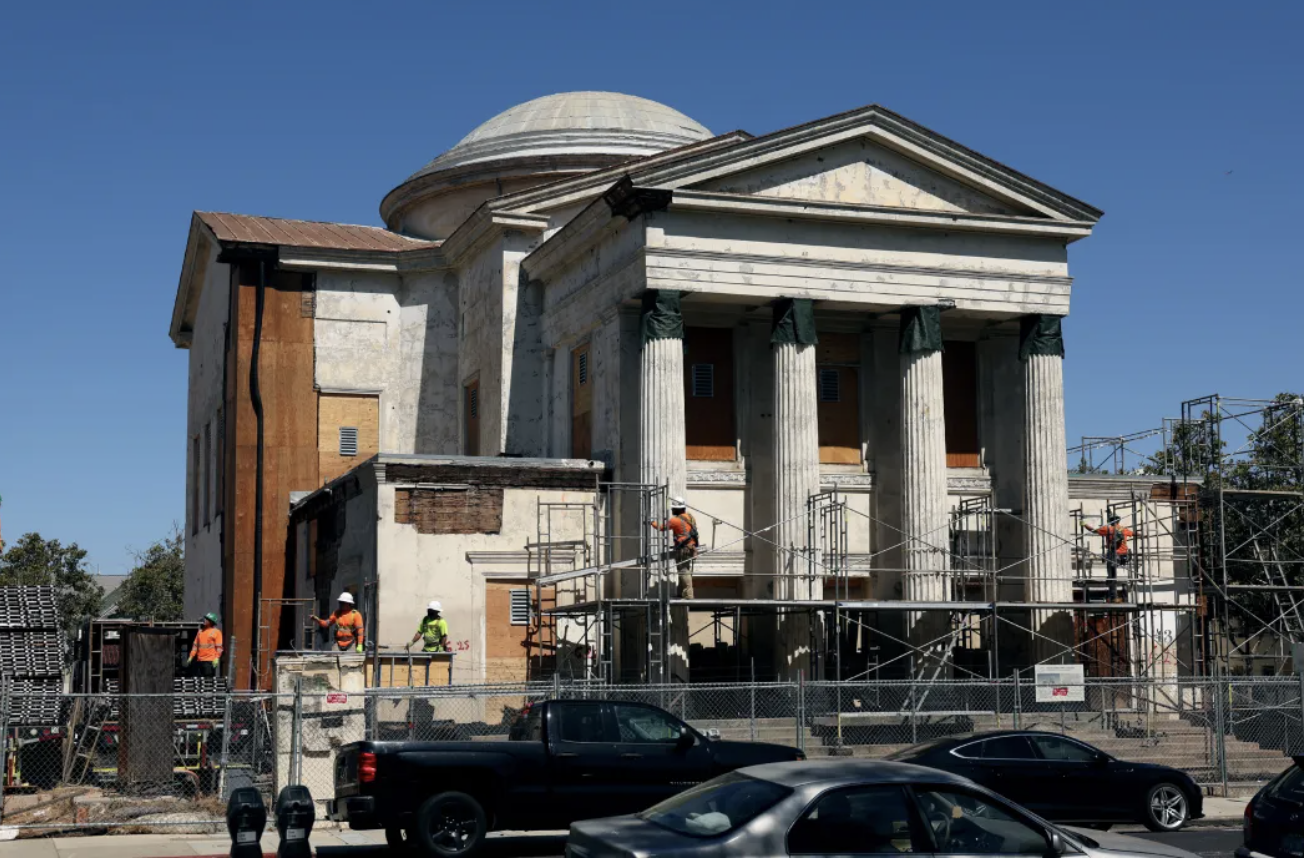
No longer used as a house of worship in San Jose, the 1905 Christian Science church was sold to China-based developer Z&L Properties in 2014. Z&L proposed to restore the structure and build adjacent high-rise housing. The project stalled, and the landmark was covered with tarpaulin.

Nine years later, the tarp was in tatters, and exposure was ruining the building, which has been called "the worst blight in the city."

Attempts to force a sale or even to have San Jose seize the property will take many months, if not years; Zhang Li, the head of Z&L, is under house arrest in London and has been accused of bribery and fraud on another project in San Francisco.

Patching the church after the tarp was removed
Jim Salata, whose construction company had worked on the property years earlier, had seen enough. He had his company remove the tarp, repair the roof, and board up the windows.
So Salata, who had done some work with Z&L inside the church and knew the combination for the gate lock, orchestrated the removal in late August of the tarp, scaffolding, debris, plastic contamination, cooking equipment and a generator. He and his crews cleared away fire hazards such as dry vegetation, made repairs to the roof and boarded up broken windows.

“Somebody had to do something about this,” Salata said. “The city of San Jose has allowed Z&L to let this property become blighted for years. Nobody from the city has called. Nobody from code enforcement has called. Nobody from the city is asking for advice about the next steps.”
Jim Salata and his company likely won't receive a nickel for their work. However, city officials are thinking about compensation. [bold added]
Officials may impose a fine on a construction executive whose crews removed an unsightly, tattered tarp that had covered a historic downtown San Jose church that’s fallen into disrepair...

“I know Jim Salata means well, but a crime is a crime,” said San Jose City Councilmember Omar Torres, whose district covers most of downtown San Jose. “We were told by city staff that Salata trespassed.”
Thus it was and ever shall be: no good deed goes unpunished.

Friday, July 14, 2023

Fits and Starts

July, 2023: lots of progress (viewed from Kuhio Ave.)
The fits and starts of construction since 2020 have been mirrored in this Waikiki property that I walk by on my semi-annual trips.

In 2020 tourism slowed to a trickle, unemployment in Hawaii reached 15%, and construction halted not only for economic reasons but also because it was a non-essential business during the pandemic.

In 2021 tourism picked up slowly, some Mainlanders exploited the working-from-home craze to move to Hawaii, and construction resumed.

Nov., 2022: Building on Kalakaua & Kalaimoku
In 2022 rising inflation caused the Federal Reserve to take the punch bowl away by dramatically increasing interest rates. Speculative projects were postponed, if not killed.

The opposite effect occurred on construction-in-progress. Delays were costlier, and it was urgent to finish them to make them revenue-producing. The property I've been watching is on pace to be completed by year-end.

That's good timing. Tourism is almost fully recovered, and this is the only sizable building coming on line in Waikiki.

Thursday, May 04, 2023

Snowpack Feast or Famine


The satellite images show what a difference a year makes. In 2022 (left) the snowpack was under 60% of average for the third straight winter. On May 1, 2023 (right) it was 254% of average.
Twelve months ago, California was entering year three of an extended drought. On the heels of the driest January-April period in 128 years, the state’s two largest reservoirs were down to critically low levels, and a skimpy snowpack meant little additional water was on the way...

This year has been a complete turnaround.

Storms drenched California for months and piled on epic amounts of snow in the Sierra Nevada. The state’s May 1 snowpack clocked in at 254% of average for the date.

California regularly sees variability in Sierra snow from season to season, or a “snowpack whiplash.”
Dry winters have been the norm over the last two decades, but snowpacks above 150% have appeared four times, including this year (graph).

There appears to be little that California can do to reduce the variability of winter storms, but it's obvious that investing in water storage, including underground aquifers, can mitigate the worst effects of drought years. $7.5 billion was approved by the voters in 2014, but nothing has been built, truly an outstanding example of incompetence and unseriousness.

Thursday, April 20, 2023

The Men's Shed

Dale Nugent and Jim Tuten at the Ruston, LA Shed
Three decades ago John Gray wrote Men Are from Mars, Women Are from Venus. It described the different methods by which men and women communicate, their different perspectives of the world, and, importantly, how men and women could communicate more effectively with each other. It sold 15 million copies.

The book has been criticized as making over-broad generalizations, but it still resonates with the millions of Americans who subscribe to traditional views of the sexes.

The Men's Shed movement, while open to women, has filled a need for men who like to work in groups to construct something tangible.
The Hopkins [Minnesota] shed is one of 27 Men’s Sheds in the U.S., where men, and sometimes women, gather to build park benches, desks, and bird feeders, or learn to cook and sew. At David’s Memorial Men’s Shed in Girard, Pa., a 5,000-square-foot pole barn, members work on cars or learn to weld. Shedders, as they are called in Ruston, La., construct bunk beds for shelters in a former warehouse. Elsewhere, shedders repair bikes for police youth leagues and clean parks....

The Men’s Shed movement started in Australia in the 1990s, to combat loneliness among retired men, and has grown to more than 2,500 sheds in a dozen countries, each with projects based on local interests. Estonia has two sheds, whose members help each other with chores, such as stacking logs and transporting stones.
A mere half-century ago every community had non-sectarian organizations where men could gather together outside of work and home, for example, the Freemasons and Elks and Rotary Clubs. (All now are open to women, or have affiliated groups for women, but they're still predominantly male.) These groups have a general philanthropic bent, but they have not been able to arrest the decline in membership.

Men's Sheds seem to have struck the right chord with guys who want to work with their hands, strive toward a concrete, limited goal, and be around other guys doing the same. More like this, please.

Thursday, March 02, 2023

Cocks of the Lots

On the same block as million-dollar houses and condos roam wild chickens. (We've noted them before.)

This empty lot in Waikiki is ripe for building, or perhaps it's owned by a developer who is biding his time, hoping to buy adjacent properties to build something tall.

Construction projects that had been active when I was here in November are being completed; those loans don't extend indefinitely.

Friends and relatives on the Mainland have been shocked at the price of Hawaiian rentals. Tourism is almost back to pre-pandemic levels.

Given construction lead times, owners of empty lots such as this one should be laying the groundwork(!) for a speculative build, but it's not my money and advice is cheap.

Then the chickens will have to find another place to strut.

Saturday, June 19, 2021

This Project is Not Underwater

Foster City levee construction (SF Chronicle image)
Whether or not we agreed with the premise that global warming will endanger coastal cities, we didn't really have a choice in voting for a $90 million levee to be built.

In 2014 FEMA warned that Foster City would be in a flood zone if it didn't build a new levee that would protect it from a 100-year flood. Prior to this Foster City was classified as not being in a flood zone.

Property owners faced a decision in 2017: vote for the levee and pay an additional $279 per year in property tax, or pay flood insurance premiums of at least $2,000 per year.

(Those who didn't have a mortgage would not have been forced to purchase coverage, but these owners were relatively few.)

Your humble blogger resented the obvious nudge--let's call it a shove--but voted for Measure P anyway.

So far the project criteria are being met:
The steel is thick enough to resist not only earthquakes and strong storms — and the pressure of the 100,000 cubic yards of new soil that will be packed in behind the interlocked plates — but to support an addition when and if there’s a need to go higher.
It's been decided, so we may as well look on the bright side: property values may be boosted because buyers will believe that living in Foster City is marginally safer than elsewhere along the Bay; also, construction projects like these never get cheaper; and if sea levels do rise (I give it no more than a 10% chance in my lifetime) then it will have been worth the expense.

Saturday, February 27, 2021

The Machinery is Working

The big trucks have been in our six-house courtyard all week. The men have been jackhammering, digging, and sucking up mud, sand, and gravel.

On Wednesday I went over to the supervisor to ask about the project. The storm drain at the end of the cul-de-sac wasn't draining, and water was accumulating.

The problem wasn't the usual clogging of debris; it was poor design of the grade, which erosion had made worse.

The rains of early February prompted the City, finally, to rectify the problem. The crew laid pipe at a sufficient angle to ensure draining, then connected it to a line to the Bay that they knew was working properly.

They sealed the opening and coned off the area to let the asphalt cure.

Yesterday, county vector control inspected the exterior of all our houses to make sure that there was no standing water where mosquitoes could breed.

Governments at all levels have been under a lot of criticism, but our little community of Foster City seems to be working just fine.

Thursday, February 06, 2020

Could Be Worse

Walking around the Ala Wai Canal on February 5.
After three months the heavy equipment is still there, much longer than the 65 days promised in the project description.

But hey, I'm from California, where the project overruns are measured in years and billions of dollars. It's a good thing that California and Hawaii are as close to Socialism as any state in the Union, because if the profits of contractors were not controlled, think how much more expensive things might be.

Thursday, October 04, 2018

Peak Real Estate?

San Francisco Real Estate Item 1:
Booming SF hits new high for office rent, beating dot-com record
Rents for new offices in the city’s central business district reached $81.25 per square foot in the third quarter, according to brokerage Cushman & Wakefield. The previous record of $80.16 per square foot was recorded in the fourth quarter of 2000, as the previous tech boom was ending.
After the 2000 dot-com crash resulted in unplanned vacancies, and with a raft of new construction coming online, prime ("Class A") SF office space in 2001 could be had for about half today's rate.

San Francisco Real Estate Item 2:
New report finds overlooked earthquake vulnerabilities in some SF high-rises
Between 50 and 65 San Francisco high-rises used specific types of steel welds that were later found to fracture during the 1994 Northridge earthquake in Los Angeles.
I'm always in favor of more knowledge, but in this case I'm grateful that I didn't know that for 20 years I was working in a highrise that was in any danger--it survived the 1989 Loma Prieta quake just fine.

With office rents at all-time highs, with pending fixes that are going to cost beaucoup bucks, and with the Bay Area experiencing a mass exodus, it sure feels like we've reached peak real estate in this cycle.

Tuesday, October 02, 2018

So Bad in Their Execution

Ribbon cutters included SF supervisor Jane Kim, Nancy
Pelosi, and Mayor London Breed (3rd from right).
Success has a thousand fathers and mothers. August 10:
Thousands jam new Transbay Transit Center for its open house
Thousands of visitors jammed the new Transbay Transit Center for its grand opening party Saturday...Lines stretched the length of the Grand Hall as people tried to get into the $2.2 billion multistory transportation hub.
But that was then.

This is now. September 28:
Salesforce Transit Center to remain closed after crack in second beam discovered
The $2.2 billion Salesforce Transit Center is expected to remain closed at least through the end of next week after inspectors found a second cracked steel beam beneath the center’s rooftop park, officials said Wednesday.
Flashback to 2015, after spending $6 billion:
Plague of problems puts Bay Bridge seismic safety in question

Flashback to 2009: SF Officials Knew About Sinking Millennium Tower

For a City that likes to lecture the rest of us against pushing Nature too far, it's astonishing that it: 1) proceeds with multi-billion-dollar construction projects on top of landfill next to major earthquake faults, and 2) is so bad in their execution.

Thursday, September 15, 2016

Answer: Probably Not Enough for a Skyscraper

Bloomberg: "An architectural rendering of a 1,000-foot-tall wood skyscraper proposed for London."
Question: How much wood would a woodchuck chuck, if a woodchuck could chuck wood?

The titular answer to the playful question is not so silly as it used to be.

The Economist: The case for wooden skyscrapers is not barking. Wood is lightweight:
There would also be less construction traffic. [Cambridge professor Martin] Ramage calculates that for every lorry delivering timber for a wooden building, five lorries would be needed to deliver concrete and steel.
Objection #1: Is wood strong enough?
there have been big advances in “engineered” wood, such as cross-laminated timber (CLT) made from layers of timber sections glued together with their grains at right angles to one another.
Objection #2: what about fire?
The concrete covering the floor was mainly for sound insulation, but it helps to deal with the second worry: fire. The concrete adds a layer of fire protection between floors....But with other fire-resistant layers and modern sprinkler systems, tall wooden buildings can exceed existing fire standards, reckons Benton Johnson, a project leader with Skidmore, Owings & Merrill.
Wood, with a little help from concrete, is strong, light, and fire-resistant.

It all looks good on paper, but the big bad wolf has yet to be heard from.