Showing posts with label Amazon. Show all posts

Friday, September 12, 2025

"A Toaster on Wheels"

Seven years after relocating to Foster City and five years after Amazon acquired it, autonomous-driving company Zoox is introducing its robotaxis in Las Vegas.
Zoox’s first public launch kicks off Wednesday on the Las Vegas strip. The company is offering free rides from a few select locations, with plans to expand more broadly across the city in the coming months. Riders will eventually have to pay, but Zoox said it’s waiting on regulatory approval to take that step.

Amazon is jumping into a market that’s all about the future, but one where Waymo has a major head start, having offered commercial driverless rides since 2020. Earlier this year, Waymo said it surpassed 10 million paid rides, and the company now operates in five cities, with Dallas, Denver, Miami, Seattle and Washington, D.C., coming next year.

Tesla, meanwhile, began testing a limited robotaxi service in Austin, Texas, in June, though with human supervisors on board.

But unlike Waymo and Tesla, Zoox’s electric robotaxi doesn’t resemble a car. There’s no steering wheel or pedals, and the rectangular shape has led many in the industry to describe it as a toaster on wheels. Zoox co-founder and technology chief Jesse Levinson says, “We use robotaxi or vehicle or Zoox.”
Our driving skills have been eroding, and in 3 to 5 years we foresee being in the market for a self driving vehicle. Waymo and Tesla would've been at the top of our shopping list, but we'll take a look at Zoox. I wonder if they'll give a hometown discount to local customers?
2018: Zoox prototype (Bloomberg photo)

Monday, November 14, 2022

Blandishments of the Bear

The four most valuable companies on the U.S. exchanges--Apple, Microsoft, Alphabet (Google), and Amazon--all enjoyed at least a 6% bump in price last Thursday, when a 7.7% increase in the Consumer Price Index showed that inflation was abating, perhaps moderating future Federal Reserve rate increases.

What gave investors hope was that stock prices continued their rise on Friday, a sign that the bounce may have legs. But your humble blogger has seen--and fallen victim to--"bear traps" before.
A number of investors say they question how long the comeback can last. In previous years, like after the dot-com bubble burst in March 2000, selloffs took many painful months to play out, and the downturn was marked by big swings up and down. That is a cautionary tale for investors hoping that the worst has passed after last week’s stock rally.

“This is typical of a big bear market rally,” said Julien Stouff, founder of hedge-fund firm Stouff Capital. “It is not over.”
My stock portfolio is looking better after one week, but it's still down for the year. I'm not selling, but I'm going to resist the blandishments of the bear by not buying either.

Well, it could have been worse. In my younger, risk-taking days I would have put a sizeable chunk into cryptocurrency. Last week's bankruptcy and hack of a crypto exchange cast such a pall over the industry that it will take a long time to recover, if at all. Over the long haul one can become a successful investor just by preventing disastrous mistakes (mistakes are a given).

Added: The Crypto-Ignorant Person’s Guide To What’s Going On With FTX And Founder Sam Bankman-Fried

Wednesday, April 20, 2022

Netflix: That Sinking Feeling

Netflix (NFLX) fell 35% today and is down 62% since January 1st
Competitive stresses had been building for Netflix, which once had the market for streaming video all to itself. The dam broke last night, when Netflix announced that it had lost subscribers, and the stock fell precipitously:
The shares shed more than a third of their value, finishing down $122.42 to $226.19. The stock was the S&P 500’s worst performer of the day. Investors had expected that the company would add new users in the quarter. Instead, Netflix said it ended the first three months of the year with 200,000 fewer subscribers than it had in the fourth quarter and said it expected to lose two million global subscribers in the current quarter...

The fall in Netflix’s shares represented its biggest single-day percentage drop since Oct. 15, 2004, when it fell 41% after saying it would cut subscription fees and postpone planned international expansion. It slashed $54.3 billion from the company’s market capitalization, its largest one-day market cap loss on record...

“Nobody was expecting Netflix to announce they lost subscribers. They were expecting a slowdown in subscriptions, but seeing Netflix losing subscribers is a big deal,” said Ipek Ozkardeskaya, senior analyst at Swissquote Bank, an online broker.
Your humble investor/blogger turned a modest profit on Netflix eleven years ago. At the time I was spooked by Amazon's entry into streaming video and thought that the much-larger company would eat Netflix' lunch.

Though I sold Netflix ten years too soon, there are only small regrets. I would probably have held on too long and watched a large Netflix holding fall by 35% in one day. Irrational, to be sure, but that's why you shouldn't listen to a blogger who gives free advice.

Monday, March 07, 2022

Different, and Not in a Good Way

2020: Acer Chromebook
Two years ago we bought an Acer Chromebook 14 to web-surf and email in public places. For $175 it appeared to be a good deal.

I didn't know that it had less than a 3-year effective life span. Chromebook software expires:
Once a Chrome OS device expires, the device might continue to function as expected, a Google spokesman said, but over time “there could be incompatibilities with some websites, applications or management policies with no ability to fix them.”

Earlier devices receive updates from Google for five years. Devices released in 2020 and later will be supported for up to 8½ years, depending on the model.
Why did I get only 2½ years of software updates? Because when I bought it from Amazon in 2020 it had been sitting in inventory since 2018, according to the sticker on the back.
The problem is that many Chromebooks stay on the market for years, so the lifespan can be much shorter when the buyer takes off the plastic wrap.
Rueful comments: 1) there was a reason the Chromebook was cheap; 2) having gotten used to Apple's free updates for the 8-year-old MacBook Air, and Microsoft's support of Windows XP for 12 years, I thought long-term support for tech products was a given.

This is another example of how Google is different, and not in a good way.

Friday, December 31, 2021

The Big Got Bigger

Except for Amazon, the "tera" cap stocks beat the indices
It was a very good year for stock market investors: [bold added]
the rollout of Covid-19 vaccines and low interest rates...helped the S&P 500 to close at a record 70 times this year, more than one-quarter of all trading days, according to Dow Jones Market Data, and pushed the index up 27% in 2021. The Dow and Nasdaq did well over the past 12 months too, rising 19% and 21%, respectively, handing all three benchmarks their best three-year performance since 1999.

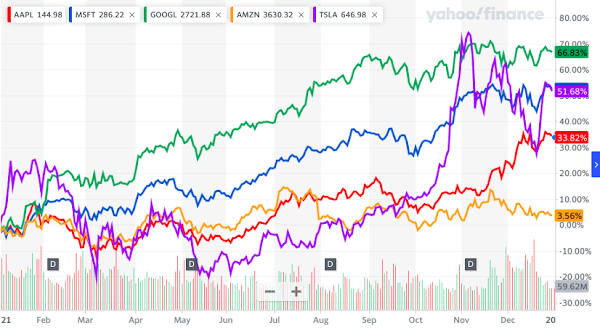
Much of the broader market rally was also driven by a small group of massive stocks, such as Apple, Tesla and Microsoft. Microsoft and Tesla shares have each risen around 50% this year, while Apple has gained more than 30%.
Our stock holdings are weighted toward the so-called "megacap" tech stocks, so the portfolio has done well for the past decade. The 2021 performance of about 30% was way above expectations, since we did not expect the biggest of the big to go up that much. If we're up 10% in 2022, we'll be happy.

If you keep your expectations low, you aren't likely to be disappointed.

Thursday, February 25, 2021

This Retailer Was Something Special

Palo Alto Fry's, 2003: when you couldn't find parking
My first visit to Fry's Supermarkets was in Fremont in 1976, when we bought our first home in the then-sleepy East Bay town at the BART terminus. Fry's had an aisle devoted to electronics parts, an unusual feature in an era when grocery stores only offered food and household items.

Over the next few years Fry's found its niche in the tech-happy Bay Area and switched out of the cutthroat supermarket business.

Fry's Electronics became a fixture in Silicon Valley. There are hundreds of stories about engineers running down to the local store to pick up a crucial part for research that couldn't wait.
Fry’s Electronics was a mainstay for electronics experimenters from the 1980s through at least 2018 and one of the “must see” locations during visits to the Bay Area of California. They supplied many of the electronic parts, computers, tools, test equipment and accessories needed by Silicon Valley startups and other geeks living in the area.
Even your humble blogger, no tech whiz, kept his old equipment alive by going to Fry's for an old part; sometimes I would find something on a nearby shelf that might work better. I kept my 2009 MacBook alive by swapping out the hard drive in 2012 and again in 2014.

But Fry's, like many retailers, couldn't survive the trend towards online sales. Today the company announced the closure of all its stores.
After nearly 36 years in business as the one-stop-shop and online resource for high-tech professionals across nine states and 31 stores, Fry’s Electronics, Inc. (“Fry’s” or “Company”), has made the difficult decision to shut down its operations and close its business permanently as a result of changes in the retail industry and the challenges posed by the Covid-19 pandemic. The Company will implement the shut down through an orderly wind down process that it believes will be in the best interests of the Company, its creditors, and other stakeholders.

The Company ceased regular operations and began the wind-down process on February 24, 2021.
Fry's fell victim not only to Amazon but also to the shrinking of its customer base. There are fewer people who have the knowledge, motivation, and courage to work on hardware---either as fixers or inventors--with only speciailzed tools, a soldering iron, and an oscilloscope. A bygone store for a bygone era.

Wednesday, February 03, 2021

Support Your Local Merchant

Though continuing to shop at Amazon and Costco, I have diverted more spending dollars toward supermarkets, drug stores, and other physical retail outlets. Sure, the latter is more expensive, but while saving money is the most important thing, it's not the only thing.

The stores provide local employment, immediate availability of goods, and a larger selection than Costco. I want to keep them in business; the negative externality of a half-empty mall detracts from our happiness and well-being.

And so it was that I found myself picking up a package of Hello Kitty toilet paper at the local 99 Ranch. Neither the brand nor the store has a national presence.

30 rolls for $20 wasn't an outrageous price. In fact the same quantity of Charmin costs $20 at the local Costco ($27.99 at Costco online).

I still give the nod to Charmin for the combination of strength, softness, and absorbency, but Hello Kitty TP was perfectly adequate.

And that's the bottom line.

Monday, December 28, 2020

Time Spent

The 30-year-old magazine rack had fallen apart. Its plastic screws and inserts (bottom of first photo) had loosened and cracked, leaving the hardwood pieces in a disconnected jumble.

We looked online for a new one. New racks don't cost much--$20 to $50--and are made of steel wire or plastic. But there were no hardwood racks for $100 or less. (Why not spend more? Who reads magazines?)

A trip to the Home Depot fastener section didn't turn up parts that fit, so I ordered inserts, washers, and bolts (second photo) that cost a total of $31 from Amazon.

My woodworking acquaintances will sneer at the trouble in putting the pieces together.

The metal inserts wouldn't stay in the holes where the old plastic inserts were seated.

First I tried merely pushing them, but they moved with the slightest turn of the screw. Next I set the inserts with Elmer's Glue, basically the same product we used in shop class nearly (cough) 60 years ago; no luck, they still wouldn't hold after two days of drying.

Finally, I drilled the holes a quarter-inch deeper, and after some hard pushing and turning achieved success (bottom photo).

Why am I recounting this tale of a trifling repair?

A rational person might argue that there is no justification for spending $31 in materials and laboring six hours over four days to produce a used item whose market value was, say, $25.

On the other hand, monetary cost-benefit analysis is the wrong perspective from which to view activities that give one pleasure. For example some people happily garden or look after their children while others are only too glad to pay someone else to assume these "burdens."

I am at an age where I should more carefully evaluate how I spend my time.

Fixing broken magazine racks wasn't on the list, yet the task did give me some pleasure after all, and I'm glad that I did it.

Do you ever wonder whether Warren Buffett does the dishes or whether Bill Gates changes a light bulb? It wouldn't surprise me if they did.

Thursday, October 01, 2020

Biting the Hand That Supports Them Dept.

(Image from Adweek)
This is an unexpected move by Democrats with only a month to go before the November elections:

House Democrats to Call for Big Tech Breakups [bold added]
Democratic lawmakers are expected to call on Congress to blunt the power of big technology companies, possibly through forced separation of online platforms, as a House panel concludes its Big Tech probe.

The House Antitrust Subcommittee is nearing completion of a report wrapping up its 15-month investigation of Alphabet Inc.’s Google, Apple Inc., Amazon.com Inc., and Facebook Inc. The report follows the committee’s collection of more than one million documents from the companies and competitors, as well as a July hearing with CEOs of the four tech giants.

Rep. David Cicilline (D., R.I.), who chairs the subcommittee, has indicated the panel is poised to recommend significant measures targeting Big Tech’s power, including requiring owners of huge technology platforms to separate those platforms from other businesses.
The largest tech companies (Amazon, Facebook, Google, Microsoft) distribute their funds to Democrats and Republicans fairly evenly (Apple doesn't have a PAC). However, their employees contribute heavily--over 90%--to Democrats.

(BTW, you can bet your bottom dollar that, because donor data is public information, there's some workplace coercion--"Hey, Joe, how come you didn't donate to Biden? Are you a racist?" If you don't toe the line in Silicon Valley, you could be blacklisted for wrongthink like James Damore or Brendan Eich.)

There is a bona fide discussion to be held over the power Big Tech holds over our lives, but it's not at all clear that consumers are worse off, say, because Amazon gives us more selection and lower prices than brick-and-mortar stores, or that Facebook shows us ads that are likely to interest us as opposed to burying us in dreck like traditional TV.

IMHO, the Democrats have judged that Big Tech will support them no matter what and are throwing a bone to Progressives that believe: 1) Tech has made too many people extraordinarily wealthy--exacerbating inequality is bad, despite making every individual better off; and 2) concentrations of power other than government cannot be allowed.

“Everything within the state, nothing outside the state, nothing against the state.” - Anne Applebaum, on totalitarianism in 20th century Eastern Europe.

Saturday, July 25, 2020

The Golden Apple is Out of Reach

EU antitrust enforcer Margrethe Vestager (Forbes)
The large-cap tech companies (Apple, Amazon, Google, Microsoft, and Facebook) all have attracted fierce scrutiny, but nowhere more so than in Europe. [Disclosure: a good chunk of my retirement portfolio is invested in these companies both directly and indirectly through funds and ETFs.] The authorities object to these companies creating legal structures that minimize taxes.

It has long become clear to this writer that the European Union tries to extract huge tax awards by getting courts to apply tax "principles" retroactively to these successful companies, despite their following the letter of the law. That is why it was gratifying to see Apple win a $14.8 billion tax case last week in European court: [bold added]
The case stems from a 2016 decision by the European Commission, the bloc’s top antitrust enforcer, which said that Ireland must recoup €13 billion in allegedly unpaid taxes between 2003 and 2014, money the commission said constituted an illegal subsidy under the bloc’s strict state-aid rules.

The General Court swept aside that reasoning, saying it annulled the decision because the commission had failed to meet the legal standards in showing that Apple was illegally given special treatment.

The 2016 decision against Apple was one of Ms. Vestager’s first big broadsides against tech companies in her role running the EU’s competition enforcement, earning her the nickname “tax lady” from President Trump. She later issued Google three fines totaling $9.4 billion, and launched formal antitrust probes into Amazon and Apple. She is now also responsible for tech regulation and is considering imposing a digital tax on tech giants...

A central issue in the Apple case was whether two Irish tax rulings granted to Apple in 1991 and 2007 gave a form of special treatment to the company, or whether they just reiterated an interpretation of Irish tax law as it was applied more generally.

Those rulings allowed two Irish-registered Apple units to attribute only a small sliver of some $130 billion in profit to Ireland in an 11-year period. The commission said all that revenue should be attributed to Ireland, but the Irish government and Apple say they split the profit reasonably, given that almost all of Apple’s intellectual property is developed in the U.S., not Ireland.

In Wednesday’s ruling, the General Court said that, despite the gaps in the contested tax rulings, the commission hadn’t proven the Irish government granted a special advantage to Apple that was unavailable to other companies in Ireland.
The European Union will now have to do the hard work of crafting new laws that will achieve their goals and not trying to re-interpret the past to try to solve present needs.

Saturday, July 04, 2020

Too Useful to Get Rid Of

My Amazon shopping cart normally has 1-5 items.
Abandoned shopping carts are a burden to supermarkets that have to retrieve them. Abandoned carts are also a nuisance in the on-line world because they distort merchants' data on what products attract customers.

They also cause an administrative burden by triggering e-mail reminders to "customers"; if the messages bounce back, eventually the merchant has to intervene and delete the cart.

Which brings us to the mysterious shopper John Smith who has been abandoning carts across the Internet.
John Smith started shopping early on a recent Wednesday and didn’t stop for days.

(Image from iaffiliatemanagement)
He visited an auto-supply site where he loaded his cart with a replacement turn-signal lever, emergency strobe light and two dozen other items. He hopped over to a home-goods merchant for another 10 items including wood picture frames, address plaques, a towel rack and mailbox. He ordered one of every kind of baby bundle, ranging from about $80 to nearly $500, from a site that sells infant sleeping boxes popular in places such as Finland.

When the roughly 48-hour spree was over, John Smith did what he always does. He walked away without buying anything.

For more than a year, online merchants selling items ranging from kayaks to keychains have puzzled over the mystery shopper with the generic name behind thousands of abandoned carts.
In a triumph of investigative journalism the Wall Street Journal tracked down the serial looker. Merchants noted that John Smith always had a gmail address. Repeated telephone calls to Google unearthed the truth:
The mystery shopper is a bot of its own creation. The purpose: making sure the all-in price for the product, including tax and shipping, matches the listing on its Google Shopping platform or in advertisements. It wasn’t to cause angst to merchants due to thousands of abandoned carts.
Internet platforms and news sites have been flooded by bots that dispense fake news, sell products, and degrade debates. So why aren't they eliminated completely? Because the platforms find them useful, too.

Monday, April 20, 2020

Take My Oil, Please

Oil storage tank (it's a model) for sale on Amazon.
Another effect of coronavirus economics that even experts have a tough time explaining:

CNBC: An oil futures contract expiring Tuesday went negative in bizarre move showing a demand collapse
West Texas Intermediate crude for May delivery fell more than 100% to settle at negative $37.63 per barrel, meaning producers would pay traders to take the oil off their hands.
Your humble blogger has never traded commodities and remembers vaguely from long-ago finance classes that future oil prices are dependent on today's ("spot") price, interest rates, and storage costs.

But the biggest factor can be buyers and sellers' estimate of future supply and demand . A producer can sell oil today, for example, at around $20 per barrel but might be willing to commit to deliver oil at a $15 price in July if the producer thinks demand will be soft.

Oil markets have been pessimistic before, but the futures price has never been negative. The closing price in the headline means that the seller will pay a "buyer" $37.63 to take a barrel of oil on May 1st. I was tempted to place an order to take delivery of oil and get paid for doing so, but I don't have a place to put 1,000 barrels, the minimum size of a futures contract.

The anomalous situation will undoubtedly right itself tomorrow, but there have been too many glitches in the Matrix recently:

  • Governments voluntarily killed their economies for a month or longer, akin to doctors stopping the patient's heart to perform an operation.
  • A roaring economy and stock market have collapsed into a deep recession and bear market, respectively, in a matter of weeks.
  • After a primary season with more than two dozen contenders, the Democrats have picked the worst candidate possible. Anybody in the Boston phonebook will perform better in a debate with Donald Trump.
  • Celebrities voluntarily broadcast their images without make-up, and many just look like ordinary people.
  • Thursday, February 27, 2020

    Preventive Purchase

    2009: Lenovo IdeaPad
    I bought a "Netbook" computer 11 years ago. The operating system was Windows, it had no hard disk and hence no file storage (at the time few consumers used the cloud). I used it primarily for web-surfing at public WiFi locations.

    The Lenovo IdeaPad S10 Netbook cost $350. It was a pleasure to use--netbooks were much lighter compared to laptops with hard drives--but not durable. It broke after two years.

    2020: Acer Chromebook
    After an 11-year hiatus I bought my second websurfing-only computer, an Acer Chromebook 14. It's superior to the old IdeaPad--for example as the name implies, it has a 14" HD display--,but the functionality is basically the same. The operating system is Google's Chrome, not Microsoft's Windows. The price was right--$175 before tax--demonstrating the workings of Moore's Law.

    I have other devices that can be used to websurf, but the main reason for the purchase was indeed different from 2009: there's been a rash of thefts of laptops while people are using them. I can't afford to lose one with (backed-up) sensitive information, but if thieves need a Chromebook that badly they can have it with no resistance.

    In most ways the world is better, but in a few it's become worse.

    Saturday, September 14, 2019

    Slicing It Thin

    Urology patient's nightmare
    Amazon sells a ceremonial ribbon-cutting scissors for $99, but a co-worker needed one the next day.

    Fortunately a party supply store in San Francisco had one that we could rent for three (3) days at $45.

    So off to SF on Thursday, the Friday event came off without a stitch hitch, then back to SF on Saturday to return the item.

    That was cutting it close.

    Saturday, August 24, 2019

    Making It So Easy

    Never much of a line at the Treasure Truck. I don't
    see how it can be a money-maker for Amazon.
    Three times a week around 10 a.m. Amazon texts me about an item on the Treasure Truck.

    Though I've considered daily specials such as an Acer Chromebook ($199), Air Plant Terrarium Kit ($19.99), a Chemical Guys car wash kit ($26.99), a bidet sprayer ($19.99--ok, kidding about considering a purchase), diamond necklace ($849.99), or electric skateboard ($799), I've never pulled the trigger....until last week.

    Amazingly compact!
    The Klymit Static V Sleeping Pad, according to the ad, is lightweight, compact, durable, and easily inflatable. Today it was marked down from $49.99 to $29.99. At 40% off it was a deal that I couldn't pass up.

    It was a simple matter to prepay the sleeping pad on my Amazon account and select one of the three options for the pickup, in this case the Stonestown Galleria between 3:30 and 5:30. Life has never been sweeter than in 2019---finding out about all the stuff you never thought you needed and making it so easy to buy them.

    The sleeping pad rolls out to seven feet. Bonus: it's green, the color of the virtuous.

    Tuesday, July 30, 2019

    Not So Diaphanous

    Apple's 500,000-sq-ft data center in North Carolina.
    One of the big advantages to cloud computing is that the customer can cut back on hardware maintenance, utilities, and upgrades, not to mention its footprint.

    However, while society's overall hardware burden is reduced, it doesn't go away.
    Investment in cloud infrastructure has surged since 2015, and the market for data-center equipment is expected to grow at an average annualized rate of roughly 16% this year and next, according to Citigroup Inc.

    Cloud servers, though, typically have a lifespan of only about three years, according to experts, meaning that some of the earliest equipment already has passed its use-by date.
    The dollar value of new infrastructure equipment was $142 billion in 2017.

    Amazon disclosed in its 10-K that Amazon World Services added $9.2 billion in Property, Plant, and Equipment in 2017. If the largest company in cloud storage comprises only 6-7% of world capacity, and if capacity is growing at 16%, then the opportunity for suppliers is immense (Amazon and Microsoft aren't the only players) in a business where the equipment must be replaced every three years.

    And that goes for the disposers and recyclers, too. You can't bring in the shiny new equipment if the old stuff is still there.

    Wednesday, August 29, 2018

    Amazon's Whole Foods App: Check Your Receipts

    The app page on the WF site.
    The member of our household who shops at Whole Foods eagerly downloaded the new Whole Foods app onto her iPhone. She would be eligible for special deals and 10% off yellow-tagged items.

    Sure enough, the Whole Foods meat counter, whose prices are typically 20%-50% higher than Safeway, Lucky, or Costco, had a promotion on beef kabobs. The $10.99/pound would be reduced to $7.99/pound when she used the app at the register.

    Below are the costs before the discount:


    But here's what happened at the register:

    The total cost of the two items ($17.47 and $18.13) was left the same, the price per pound was reduced to $7.99, and additional weight of about half a pound each was added to make the multiplication work out.

    Fortunately, our household shopper checked the ticket and spoke to the manager (your humble blogger often does not audit because he trusts computers and is lazy). The manager apologized and reversed the erroneous charges completely; so we got the kabobs for free (aside--note the peculiarity of American English: "the kabobs for free" sounds a little better though "the kabobs free" means the same thing and is a more efficient wording). The corrected price would have been $25.89.

    We were happy with the result, but think of all the (thousands?) of Whole Foods app users who don't catch these mistakes.

    It pays to check your receipts.

    Thursday, July 26, 2018

    We've Heard This Before

    American capitalism is going through one if its periodic episodes of gargantuan infatuation. The analysis is familiar: "XYZ Corp is so big and so dominant that no one can possibly compete with it for the foreseeable future. It has the most money, it attracts the brightest people and ploughs $billions into R&D. Legions of lawyers and lobbyists protect its interests. Customers flock to it for its reputation of being the biggest and best, etc. etc."

    (Graphic From Management Study Guide)
    In the mid-1970's your humble blogger was introduced to the Boston Consulting Group matrix.

    According to BCG businesses can be classified according to four types: stars, cash cows, question marks, and dogs.
    Stars- Stars represent business units having large market share in a fast growing industry. They may generate cash but because of fast growing market, stars require huge investments to maintain their lead. Net cash flow is usually modest. SBU’s [Strategic Business Units] located in this cell are attractive as they are located in a robust industry and these business units are highly competitive in the industry. If successful, a star will become a cash cow when the industry matures.

    Cash Cows- Cash Cows represents business units having a large market share in a mature, slow growing industry. Cash cows require little investment and generate cash that can be utilized for investment in other business units. These SBU’s are the corporation’s key source of cash, and are specifically the core business. They are the base of an organization. These businesses usually follow stability strategies. When cash cows loose their appeal and move towards deterioration, then a retrenchment policy may be pursued.

    Question Marks- Question marks represent business units having low relative market share and located in a high growth industry. They require huge amount of cash to maintain or gain market share. They require attention to determine if the venture can be viable. Question marks are generally new goods and services which have a good commercial prospective. There is no specific strategy which can be adopted. If the firm thinks it has dominant market share, then it can adopt expansion strategy, else retrenchment strategy can be adopted. Most businesses start as question marks as the company tries to enter a high growth market in which there is already a market-share. If ignored, then question marks may become dogs, while if huge investment is made, then they have potential of becoming stars.

    Dogs- Dogs represent businesses having weak market shares in low-growth markets. They neither generate cash nor require huge amount of cash. Due to low market share, these business units face cost disadvantages. Generally retrenchment strategies are adopted because these firms can gain market share only at the expense of competitor’s/rival firms. These business firms have weak market share because of high costs, poor quality, ineffective marketing, etc. Unless a dog has some other strategic aim, it should be liquidated if there is fewer prospects for it to gain market share. Number of dogs should be avoided and minimized in an organization.
    High-market-share companies, whether they are cash cows or stars, are very difficult to dislodge because, in general, their costs are lower than smaller competitors' and they have more reinvestable cash flow to maintain their dominance.

    Today the evidence seems to suggest that the biggest companies are pulling away from, not regressing back to, the field: [bold added]
    The biggest companies in every field are pulling away from their peers faster than ever, sucking up the lion’s share of revenue, profits and productivity gains...But new data suggests that the secret of the success of the Amazons, Googles and Facebook s of the world—not to mention the Walmart s, CVSes and UPSes before them—is how much they invest in their own technology.

    IT spending that goes into hiring developers and creating software owned and used exclusively by a firm is the key competitive advantage. It’s different from our standard understanding of R&D in that this software is used solely by the company, and isn’t part of products developed for its customers.
    Just like the "old" IBM, AT&T, Microsoft, GM and GE, the tech giants Amazon, Google, and Facebook appear to have unassailable positions in their respective sectors. Everyone else is at best a "question mark" and has to invest $billions just to be an also-ran. Everyone else may as well give up.

    Thursday, January 25, 2018

    FANG*-ian Bargain

    (Economist cover illustration)
    *Jim Cramer's acronym for Facebook, Amazon, Netflix, and Google (Alphabet).

    Facebook and Google have borne rising criticism for the "fake news" that users are referred to on their platforms. From the left they are charged with Russian disinformation that swung the election to Donald Trump. From the right they, along with Twitter, are blamed for censorship of conservative views.

    IMHO, fake news is a far less important problem (alleviated by providing as much information as possible and letting consumers decide for themselves) than their accumulation of data on billions of human beings.

    Including Netflix, Amazon, and Apple, tech giants know what we buy, where we are, our health, our viewing and reading habits, who we know, much about our wealth, where we live, and are privy to much of our private communications.
    Many of their services appear to be free, but users “pay” for them by giving away their data.....The platforms have become so dominant because they benefit from “network effects”. Size begets size: the more sellers Amazon, say, can attract, the more buyers will shop there, which attracts more sellers, and so on. By some estimates, Amazon captures over 40% of online shopping in America. With more than 2bn monthly users, Facebook holds sway over the media industry. Firms cannot do without Google, which in some countries processes more than 90% of web searches. Facebook and Google control two-thirds of America’s online ad revenues....

    Facebook not only owns the world’s largest pool of personal data, but also its biggest “social graph”—the list of its members and how they are connected. Amazon has more pricing information than any other firm.
    Old-fashioned antitrust law provides poor protection against the power that springs from data analyzed by powerful computers.
    The traditional tools of utilities regulation, such as price controls and profit caps, are hard to apply, since most products are free and would come at a high price in forgone investment and innovation.
    One solution: [bold added]
    personal data are the currency in which customers actually buy services. Through that prism, the tech titans receive valuable information—on their users’ behaviour, friends and purchasing habits—in return for their products. Just as America drew up sophisticated rules about intellectual property in the 19th century, so it needs a new set of laws to govern the ownership and exchange of data, with the aim of giving solid rights to individuals.

    In essence this means giving people more control over their information.
    "Control" to the Economist doesn't mean that Facebook or Google doesn't have the information, just that they aren't as free to keep it out of competitors' hands. In any event privacy will be as dead as the dodo.

    Whether the subject is nuclear weaponry or space exploration or personal data, the hoary cliché still holds: law and ethics cannot keep up with technology.

    Thursday, October 19, 2017

    An Honest Day's Walk

    The Apple Watch reminds wearers to stand up every hour because sitting on one's keister for long stretches is harmful to one's health. Even better than standing is walking, which for even short intervals confers significant health benefits:
    Research showed that walking for less than two hours a week was linked to a lower mortality rate for all causes compared to being completely sedentary. Walking two and a half to five hours a week showed a 20 percent lower mortality risk.

    Walking was also linked to specific types of lower mortality risks, for example, walking more than six hours a week was linked to a 35 percent lower mortality risk from respiratory disease.
    If one finds an $11.50-per-hour wage acceptable, the perfect job from a moderate-physical-activity point of view is to be part of Amazon's army of seasonal workers. One blogger describes the experience: [bold added]
    There were 4 jobs available: stowing, picking, packing, quality assurance (QA). Each job has it’s own pros and cons and physical challenges. I was a Stower. My job was to place items onto the shelves so they could later be picked after being ordered, and then packaged and shipped out. I averaged 5 miles of walking a day, plus a lot of lifting and repetitive motion with my arms. I didn’t do these other jobs, but from what I gather from coworkers; Pickers walk more than 13 miles a day, Packers stand in 1 spot all day, and QA has to kneel and sit a lot. Each job has a quota to fulfill.
    At the cafeteria in Campbellsville, KY (daveandkathy2011)
    A significant subset of Amazon's seasonal labor is known as CamperForce, workers who live in recreational vehicles (RVs):
    Many of the workers who joined Camper­Force were around traditional retirement age, in their sixties or even seventies. They were glad to have a job, even if it involved walking as many as 15 miles a day on the concrete floor of a warehouse. From a hiring perspective, the RVers were a dream labor force. They showed up on demand and dispersed just before Christmas in what the company cheerfully called a “taillight parade.” They asked for little in the way of benefits or protections. And though warehouse jobs were physically taxing—not an obvious fit for older bodies—recruiters came to see Camper­Force workers’ maturity as an asset. These were diligent, responsible employees. Their attendance rates were excellent.
    Bankrupt in 2008, they live in an RV  (Wired)
    Seniors who are part of CamperForce likely have had some bad breaks; living in an RV and having to take seasonal work to supplement Social Security and Medicare could not have been the "golden years" they envisioned.
    Many had seen their retirement savings vanish in the stock market or had lost homes to foreclosure. Others had watched businesses go under or grappled with unemployment and ageism. A larger number had become full-time RVers or vandwellers because they could no longer afford traditional housing—what they called “sticks and bricks.” They talked about how Social Security wasn’t enough to cover the basic necessities and about the yoke of debt from every imaginable source: medical bills, maxed-out credit cards, even student loans.
    Nevertheless, the fact that they persist in trying to make a go of it is inspirational to this observer.

    Apple Watch would approve, but I'm sure they don't care.